
This is the thirty-first part in a multipart series on the Book of Genesis. You can find the others here:
What Is The Imago Dei? What is the Sin of Ham? (Genesis 9:1-29)
Who Is "I Will Bless Those Who Bless You and Curse Those Who Curse You" Actually About? (Genesis 12:1-20)
No, Abraham Did Not Lie Because He Was Scared (Genesis 20:1-18)
Why Is There So Much Bronze Age Real Estate Law In The Old Testament? (Genesis 22:20-23:20)
Isaac and Rebekah as a Type of Christ and the Church (Genesis 24:1-67)
Esau Was ALWAYS The Bad Guy And Jacob Was ALWAYS The Good Guy (Genesis 25:1-24)
Isaac Did Nothing Wrong Deceiving Abimelech (Genesis 26:1-33)
Jacob Did Nothing Wrong In Deceiving Isaac (Genesis 26:34-28:5)
Jacob's Ladder Is Not What You Think It Is (Genesis 28:6-22)
No, Jacob Did Not "Deserve" What Laban Did To Him (Genesis 29:1-30)
Introduction
The story of Jacob in Padan Aram is the opening melody in the grand symphony that is the Exodus. Like a great symphony, the first few notes often start out as quiet, small, and simple; there is very little fanfare, and only a few instruments can be heard. But the theme of those opening notes later crescendos into glorious harmonies. That is what is taking place in this passage here. This great symphony is beginning to be played. But like the aficionado of classical music, where only the well-trained ear can notice such subtleties, we must have the same kind of well-trained ears to hear the melody of Exodus in Jacob’s slavery and liberation from “Pharaoh” Laban.
The Woodchipper is a reader-supported publication. To receive new posts and support my work, consider becoming a free or paid subscriber.
The Tyranny of Laban
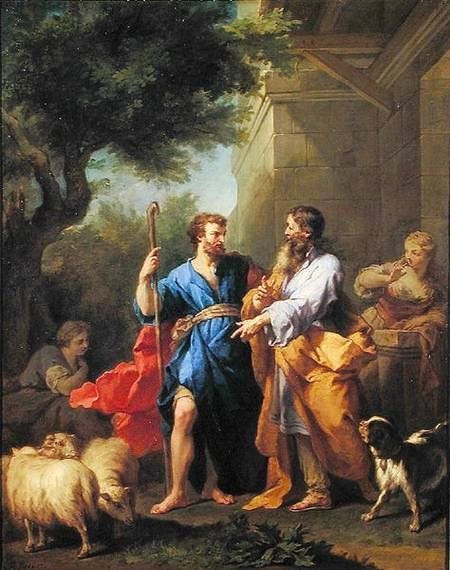
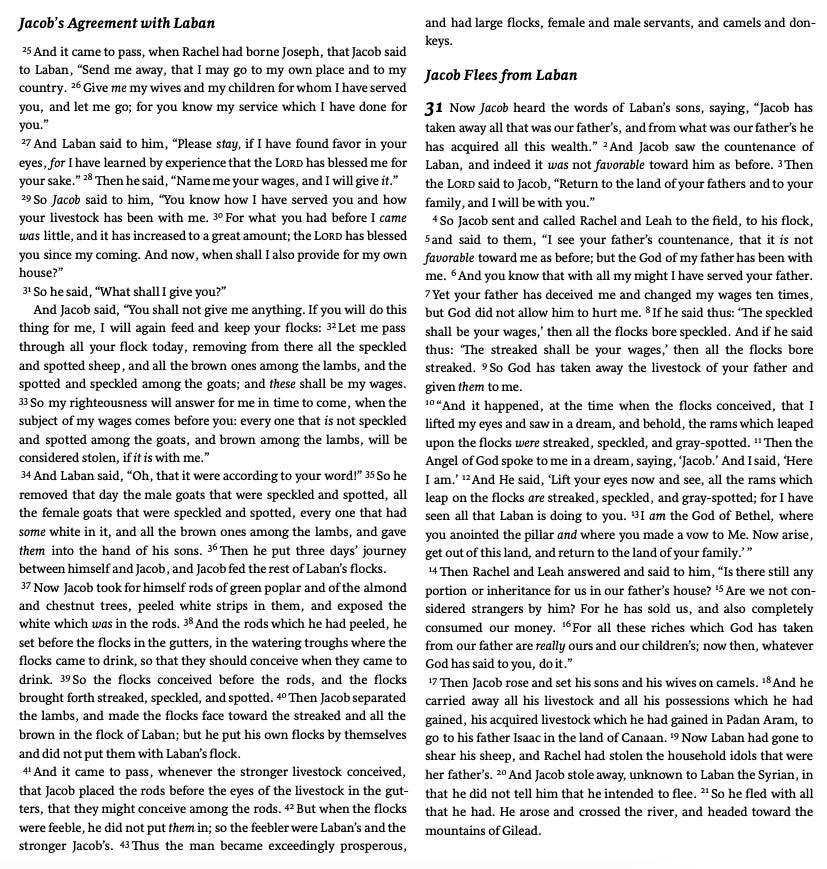
After Jacob’s service to Laban for his wives has come to an end, he announces to Laban his intention to return to his home. He has a duty as the Seed to return to the Land. He has served his time for his wives and their progeny; now he wants to leave. Laban instead makes an offer. On face value, it seems to be an innocent offer from Laban. “The Lord has blessed me because of you, so please stay. Name your wages and I will give them to you.” It is subtle and easy to miss, but Laban is again putting Jacob in the position of slavery. Jacob refuses to be given a gift. This might seem odd, especially if we are viewing this in the context of Laban lording over Jacob, reducing him from a son to a slave. Why would he refuse a gift? Abraham refused a gift from the king of Sodom. Abraham refused a gift from the Hittites. The gifts must come from God, not from the Canaanites, and not from a stand-in for the Canaanites like Laban. To accept the gift is to accept submission to the gift-giver. The only gift-giver that the Seed can submit to is God Himself. So Jacob must accept this term of slavery. He must receive his wealth from God’s hand alone.
So Jacob proposes that he receive the minority of Laban’s flocks. Most of the sheep and goats are white, so Jacob takes the ones that are not. And in this way, the deal is unambiguous; the sheep that are white are his, the ones that are not are Jacob’s. Laban agrees to this. But what does Laban do? He removes all the ones that would have been Jacob’s and gives them to his sons! And he puts three days of distance between the two of them. Once again, “three days” comes into focus here; three days being frequently the time of judgment in the Bible.
Jacob uses a folk method as the sheep are drinking from the troughs. Rods of green poplar, almond, and chestnut trees, with peeled strips of white. And notice the theme of “the well as the place of courtship and fertility” appears once again here. The flocks drink at the wells and mate, and the sheep they conceive all come out streaked, speckled, and spotted.
Then Jacob applies this method to the stronger of the flock and does not apply it to the more feeble sheep and goats. This result is that the stronger are all his and the weaker are all Laban’s. Bear in mind, he doesn’t do this until after Laban had cheated him in the initial deal. What is Jacob doing in the context of the Exodus? He is plundering the Egyptians, so to speak. He is building up his house with the wealth of his adversary and is doing so totally within the bounds of the deal. In doing so, Jacob becomes exceedingly prosperous with large flocks, male and female slaves, and camels and donkeys.
Jacob hears Laban’s sons complaining about him, that he has taken away all that belonged to Laban. They accuse him of stealing their father’s wealth and their own inheritance. What is the problem here? Before Jacob came, Laban was not wealthy with large herds, but since Jacob’s coming, Laban had grown very rich. There is a reason Laban had connived to keep Jacob around. The Lord was blessing Laban through Jacob. The wicked are accusing the righteous of theft when the righteous were the entire reason for them having any wealth in the first place. Laban, too, now no longer had the same disposition toward Jacob as he had before. It is at this point that the Lord spoke to Jacob and commanded him to return to the land of his fathers and that, again, like He had said at Bethel, “He would be with him.”
So Jacob called his wives to him, explained that their father’s countenance toward him had changed from friend to enemy. But, he tells them, “the God of my father has been with me.” He tells them that he has served their father with all his might, yet their father has deceived him and changed his wages ten times. As a result of Laban’s treachery, God has blessed Jacob and given him the wealth of Laban. Just as in the Exodus, God judges Egypt by destroying that nation and their wealth, and the wealth of Egypt is given to the Israelites.
Jacob then recounted a dream that he had as the flocks conceived, where rams leaped upon the flocks that were his, and the Angel of the Lord spoke to him, calling him by name. The angel told him that He had seen all that Laban was doing to him. He announced to him that He was the God that he had met at Bethel, and again He commanded Jacob to gather his household and return to the Land.
Rachel and Leah replied to Jacob, saying, “There is nothing left for them in their father’s house.” Their father had consumed their dowry, their mohar. He has, in effect, sold them as slave women to be concubines. The riches that Jacob had gained during this time, God had given them to be theirs and their children’s inheritance. Both Rachel and Leah understood what God had done for them during this time. They understood their father’s tyranny and God’s deliverance of them from it. They understood that it was time for Laban to “let God’s people go.”
So they gathered everything and everyone and left in haste. At this point, Rachel had stolen her father’s teraphim, the household idols. What this means we will get to in the next passage, if the Lord wills. But here Jacob is fleeing without telling Laban. He crossed the river Euphrates with his household and journeyed to the edge of the Land, in the mountains of Gilead.
Conclusion
Jacob and his house had been tyrannized by Laban, and God had vindicated them. Laban had made Jacob into a slave and his daughters into slave women. He had attempted to cheat Jacob out of any wealth that he owed him for his service. Laban had consumed the dowry of his daughters, leaving them destitute. What Laban had done was attack the Seed and the Bride, like Pharaoh. And God was delivering them from him and from that place, returning them back to the Land.
What we see in this passage is the wicked having great power and using that power against the righteous. We see the righteous accused by the wicked of doing the very things that the wicked are doing! And we see God prospering the righteous even in such conditions and ultimately delivering them from this terrible estate.
It is not difficult to see ourselves in this story. To see ourselves both as individuals and collectively as a people here. We seek to be faithful to God, while the wicked have all the power and all the wealth, while the wicked dominate everything. Yet, day after day, we pursue what the Lord has called us to; we pursue faithfulness in our daily lives, and God is with us. He prospers the things we do, He blesses the work of our hands, even as we toil under the tyranny of the wicked over us. What will the end result be? Well, we cannot say for certain in each of our own circumstances. We each have successes and failures, even as we pursue faithfulness and righteousness in obedience to Him. But the Lord has promised to be with us, just as He promised to be with Jacob. Just like Jacob, all that we have, all the successes we have, are all from His hand. And the end result, collectively, is that the wicked do not ultimately prosper in their tyranny. Proverbs 13:22 might be the most neglected and most important proverb of our age:
A good man leaves an inheritance to his children's children,
But the wealth of the sinner is stored up for the righteous.
Laban was wicked and consumed his children’s inheritance. He was not a good man. And the end result is that his wealth, which had been given to him by the Lord, was ultimately stored up for the righteous to have.
It is easy to be dismayed when you see the great wealth and power that the wicked have today and how it is used to do great evil. It is easy to feel weak and powerless. But you should not be discouraged. You should not be dismayed by this. What is the Lord doing? He is storing all of that up for His people. If we continue in the faith, if we pass this faith on to our children and to those whom the Lord has called, if we devote ourselves to Christ’s kingdom, all that is wielded against His kingdom will one day belong to Him and to His people. Trust in the Lord, trust that the things that He has shown in His word again and again, He will actually do once more. His kingdom will not fail. He loves His people and is with us. All that you strive for, all that you do with all your might in His name, will never be in vain. He will vindicate His people now, just as He vindicated Jacob in Padan Aram and Jacob’s children in Egypt. Trust in the Lord with all your heart, because He will do this. In the Name of the Father, the Son, and the Holy Spirit. Amen!
The Woodchipper is a reader-supported publication. To receive new posts and support my work, consider becoming a free or paid subscriber.
Comments
Nothing yet. Say the first thing.
Sign in to join the conversation.