
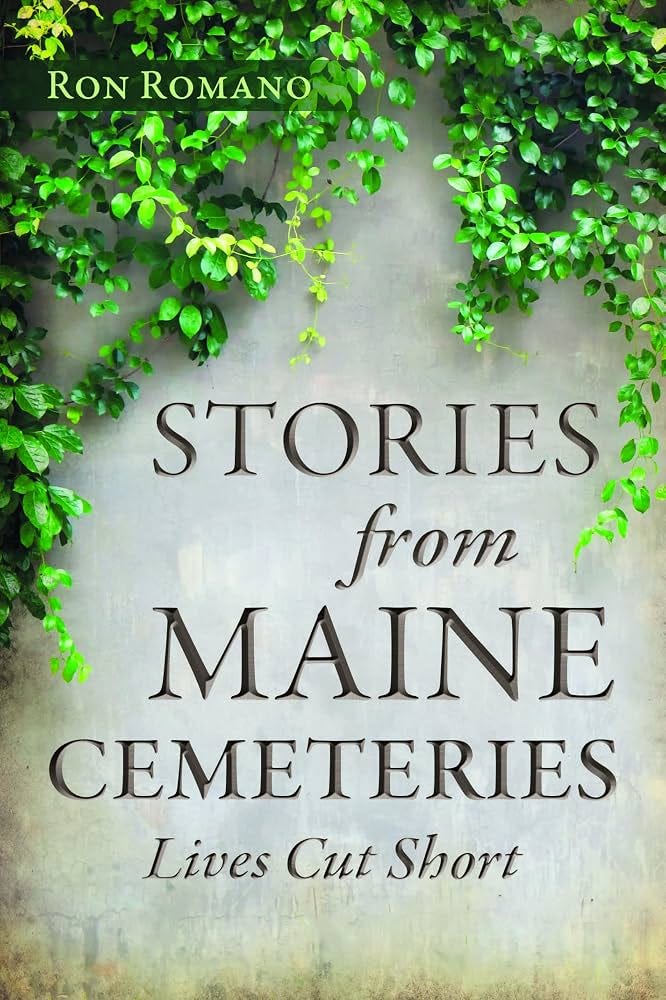
Stories from Maine Cemeteries: Lives Cut Short
Ron Romano
The History Press
Ron Romano grew up in Portland and had a successful career in Boston as an insurance executive and, subsequently, a college professor teaching courses about the industry. In 2008, a family genealogy project got him looking into old gravestones, and in 2011 he moved back to Portland and set foot for the first time inside Eastern Cemetery, the city’s first burying ground. “My first visit — at age fifty-five — sealed my fate as a gravestone enthusiast,” he writes with a corny historian’s good humor in the introduction to his latest book, Stories from Maine Cemeteries: Lives Cut Short.
Maine has no shortage of graveyard geeks who’ll devour this book like candy. Witness the popularity of the Eastern Cemetery tours run by Spirits Alive, the nonprofit boneyard conservation organization Romano works with, and the cemetery tours he and others lead all over the state — Romano has developed walking tours of 20 historic burial grounds.
Those, like me, whose interest in the subject is mild to moderate, will be educated and entertained by Romano’s writing. Although the subject is grim, and the stories often deeply tragic, he maintains a light yet respectful tone throughout this short book packed with black-and-white photos by the author.
Romano is also sensitive to the political and socioeconomic forces that determined where and how people were interred during the 19th and early 20th centuries. For example, Eastern Cemetery was segregated, he notes, with Section H, in its original center, full of bones previously covered in white skin, and Section L, in “the far back corner … in an area out of view from … outside the cemetery’s fence,” was “reserved for people of color and other minorities, such as Catholics, criminals, and paupers.” Due to its population and location, Section L was marred by vandalism for many years, Romano reports.
The book is a mix of scholarship and history, with some chapters devoted to specific motifs found on gravestones — in particular, the stones of people who died young — and others detailing sensational stories of people buried in Maine.

If you enjoy strolling through sprawling graveyards like Portland’s Evergreen Cemetery or South Portland’s Mount Pleasant, you’ll be pleased to have Romano’s insights into what certain common symbols mean, like acorn caps missing their nut (an allusion to early death), columns sculpted so as to appear intentionally broken off at the top (ditto), and tree trunks made of limestone (denoting dead loggers).
Among the stories Romano relates is the 1878 murder of Rose Vincent in Biddeford. The killer, a man aptly named Fred Savage, was soon apprehended and initially denied he’d done the deed. “Fred asked if the penalty for murder in Maine was hanging,” Romano writes. “When told it was life imprisonment, not hanging, he admitted his crime. When asked why he killed Rose, he replied, ‘Oh, I loved her too much.’” That line made the story go viral, 19th-century style, with articles about the killing and subsequent court actions printed in newspapers worldwide.
At the end of the book, Romano delves into a subject with strong relevance today: the way the town of Scarborough struggled to care for indigent and mentally disabled or ill residents in the late 1800s. It’s an interesting, inspiring and, ultimately, horrifying story that begins with an account of how much public money was spent to reimburse residents who housed and cared for the needy (called “letting out” — i.e., renting to — “the poor”) or to support them directly (e.g., “$1.42 for a pair of shoes for James Libby … $3 for a pig for Emma Moody and her sister”). Expenses after death were likewise tallied: $1.50 for an indigent woman’s “grave clothes,” $2 for “digging grave,” 75 cents for “shoveling a path to the burying ground.”
In the 1850s and 1860s, those sums were equal to or exceeded the funding annually dedicated to building and maintaining schools, roads and bridges. To save money, the town bought a farm in 1867 and housed penniless and mentally troubled residents there. Conditions at the “Poor Farm,” “Poor House” or “Alms House,” as the property was variously called in town documents, were better than those in Portland’s “almshouse,” which Romano notes housed “well over one hundred people at a time, many of whom were non-English[-]speaking immigrants,” in crowded conditions that fostered the spread of diseases.
The Poor Farm initially looked like a progressive program far ahead of its time. Town officials furnished it, stocked it with food and farm animals, and hired an overseer to manage operations at an annual salary of $300. Residents lived and worked on the farm, and proceeds from the sale of its produce and livestock helped offset its expense. “While never quite self-sustaining, the farm was proving itself to be of great value to the town,” Romano wrote.
Then the dying began.
It seems there were never more than about half a dozen residents (called, disturbingly, “inmates” in town records) living at the farm in any given year during its first decades, but turnover among overseers was high, as was the body count. The first fatality was of a woman named Deborah Dyer, in the farm’s first year, and two more people died there before that year was over. Two years later, in 1869, two more residents died, and four expired on the property in 1870.
The Poor Farm had its own graveyard, where plots were either unmarked or given a wooden marker that deteriorated quickly. “In just over twenty years, the farm cemetery had received the remains of at least seventeen people,” Romano wrote, soon followed by an eighteenth, around 1890. He makes no mention of suspicious circumstances — and surely would have if such speculation were in the records or the newspapers at the time — or unhealthy conditions at the Poor Farm, but the mortality rate indicates something was not right.
In the early 1890s, remains at the Poor Farm’s graveyard were disinterred and transferred to the town graveyard, Dunstan Cemetery, and the farm’s residency program ended in the mid-1920s (the 125-acre property was sold in 1953 and was redeveloped earlier this century into a subdivision of about 50 homes). Dozens of unidentified bodies of disabled and destitute Scarborough residents, including those from the Poor Farm, lay beneath the “paupers’ field” in Dunstan Cemetery. Romano led an effort to place a memorial marker with an inscription he wrote on this section of the graveyard. It was unveiled during a ceremony earlier this year.
Ron Romano discusses Stories From Maine Cemeteries tonight at Longfellow Books (1 Monument Way, Portland) at 6 p.m. Free.
No posts
Comments
Nothing yet. Say the first thing.
Sign in to join the conversation.