
Words: Ella Sweeney
When it comes to tracing the history of floristry and those who pioneered the craft, very little exists.1 The material history of flower arranging is knotty and hard to untangle; it has been flattened by simplified and reductive narratives about the art and practice of floristry as a feminine leisure pursuit, apparently unworthy of more serious analysis or attention. Yet floral decoration has been practised since the dawn of human civilisation (approx. 12,000 years ago, give or take), and most likely in some form before that. The ancient Egyptians are known to have decorated spaces using cut flowers and crafted vases, and in medieval Europe the devotional Book of Hours was adorned with floral designs in the margins.
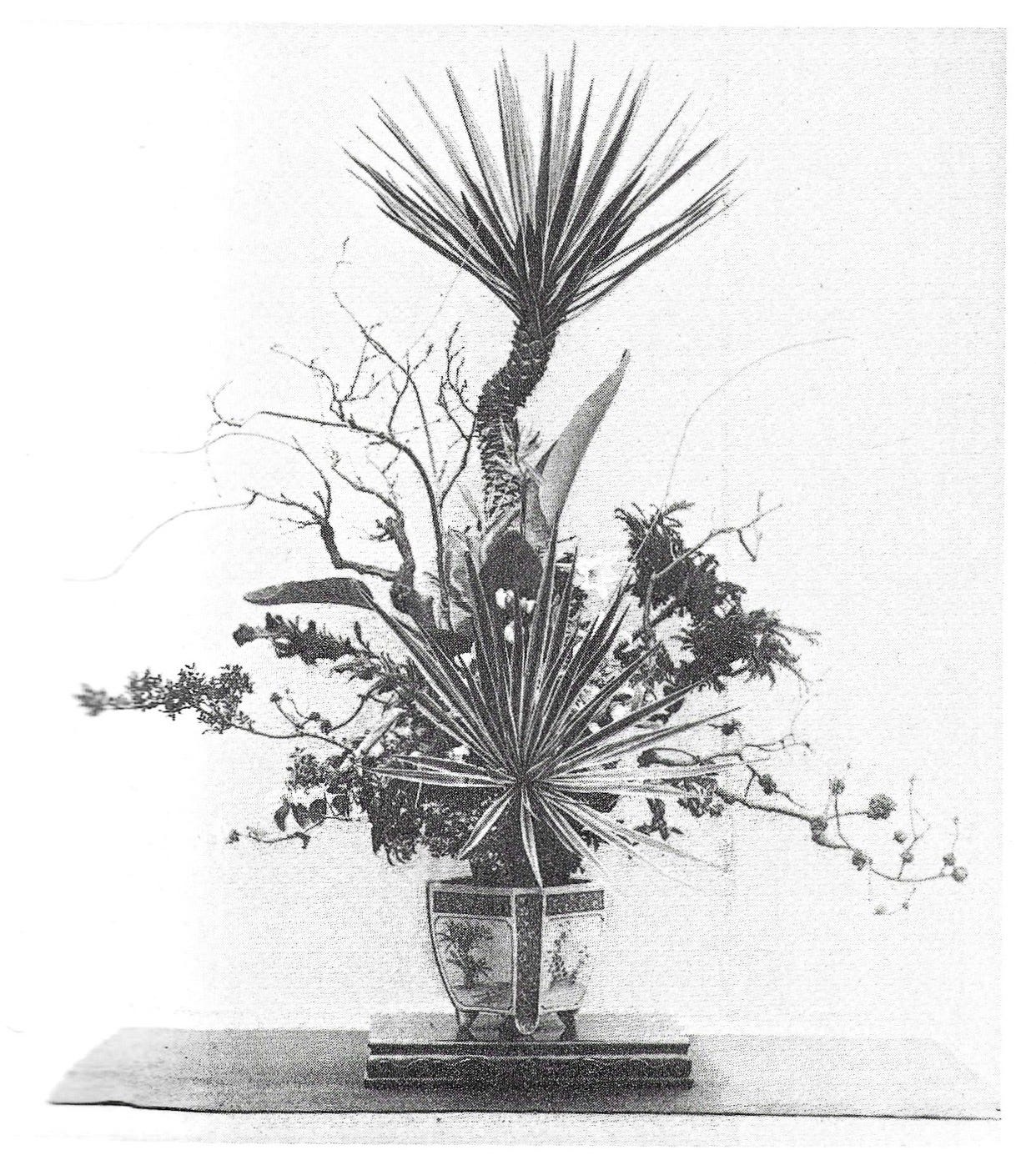
Originally published in 1953, Julia S. Berrall’s A History of Flower Arrangement is one of the only comprehensive guides that explores the broader social and cultural contexts in which floristry has developed since AD 1. She begins in China, one of the earliest cultures to formalise floral design, drawing upon Confucian teachings on contemplation, preservation, and symbolism to develop a highly formalised and codified practice of floral design. Then to Japan, where for centuries the practice of Ikebana has been a significant part of culture and custom, and a type of flower arranging that has been studied and documented more seriously than any other. Then to the seclusion of medieval monasteries in Europe, and through the courts of 18th-century France and the Victorian estates of England.
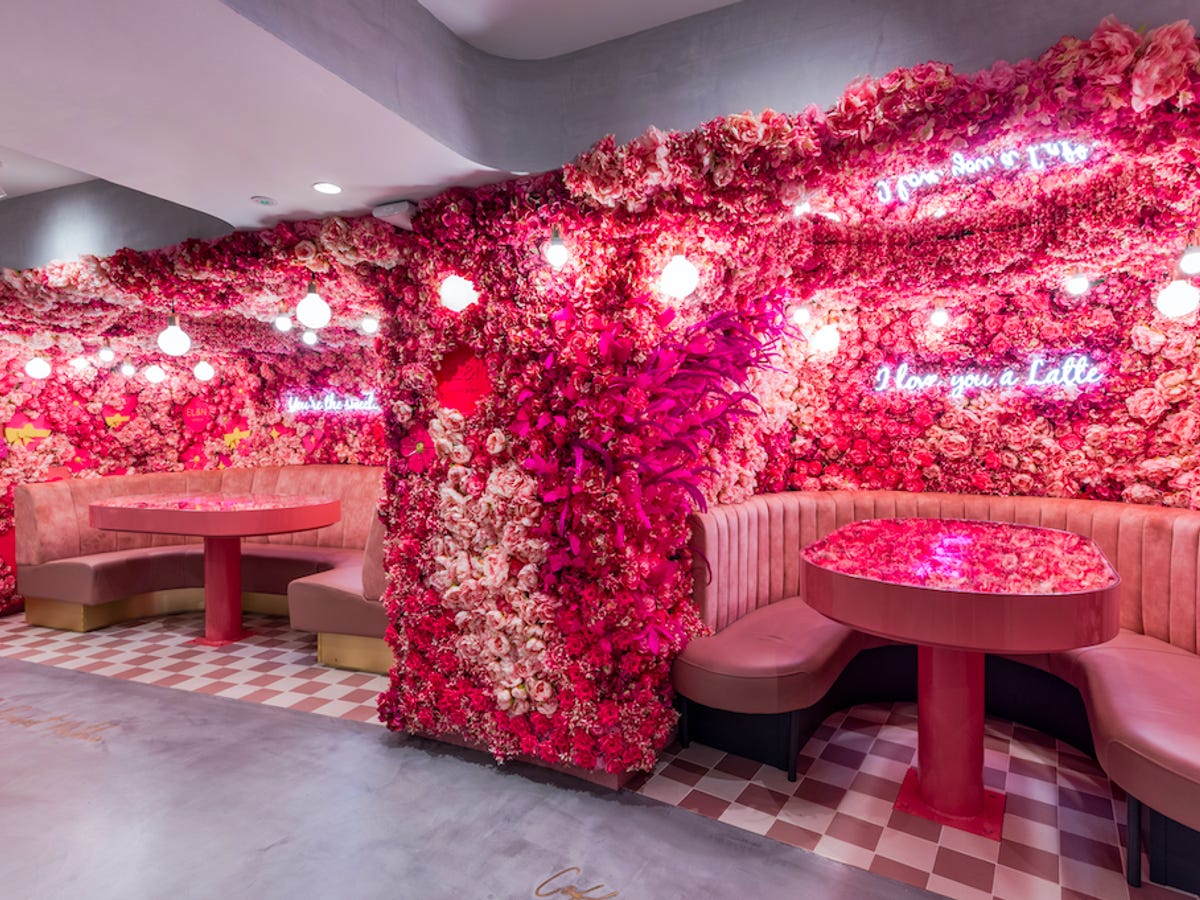
How a culture relates to its flowers can tell us something about the people of said culture. What might the exuberant and electric arrangements of 1980s LA restaurant Spago, hang out of rich kids, poseurs and the young Bret Easton Ellis, tell us about the hedonist and hypercapitalist culture of Reagan’s America? And what could the high street florist, a somewhat dying breed, often managed by working-class men and women, tell us about the history of our high streets, local economies, and wider communities? More recently, why are ever-increasing numbers of shops and cafes, predominantly in West and central London, inflicted by what I call the “modern flower virus”. A floral aesthetic that emphasises sheer spectacle and scale for the sake of social media metric value, led by the likes of Chelsea in Bloom.
Floristry can reveal much about culture and a society’s mode of living. Berrall argues that floral design is intimately connected to the social and material conditions of the period in which it appears. When we practice floristry, “themes are taken from our direct experience of the world around [us] and translated into interpretive arrangements,” writes Berrall.2 She links the “tension, brutality and speed” of ‘modern’ 1950s arrangements common during the period she is writing to the lasting artistic influence of the abstract expressionists, a movement itself influenced by and responding to the existential anxiety of the Cold War and the proliferation of American capitalism and individualism.3
A History of Flower Arrangement is indispensable; yet I can’t help feeling there’s something missing from Berrall’s survey. Floral histories tend to focus on the styles, lives, and practices of the aristocratic and upper classes, leaving the distinct but misleading impression that it was these groups alone that possessed the access and desire to pursue and practice floral design. For example, in the chapter on Victorian floral design, Berrall rarely says much about a middle- or working-class experience of floral design. Nor does she acknowledge those who made the arrangements that adorned Victorian parlour rooms, let alone those who grew and tended to the flowers used – a job almost always relegated to servants and staff.
It is within the history of gardening that we find something more closely resembling a working-class history of floral design. In The Gardens of The British Working Class, Margaret Willes describes the concept of “weavers’ floristry”. This was practised in pockets across the country in the 18th and 19th centuries, notably in Lancashire, England, the place where I grew up. At this time, Lancashire had devoted a great deal of its energy (and population) to spinning and weaving cotton and silk. In what was a primarily poor agrarian society, home to rows of brick houses called “weavers cottages” that handloom weavers and their families lived and worked.
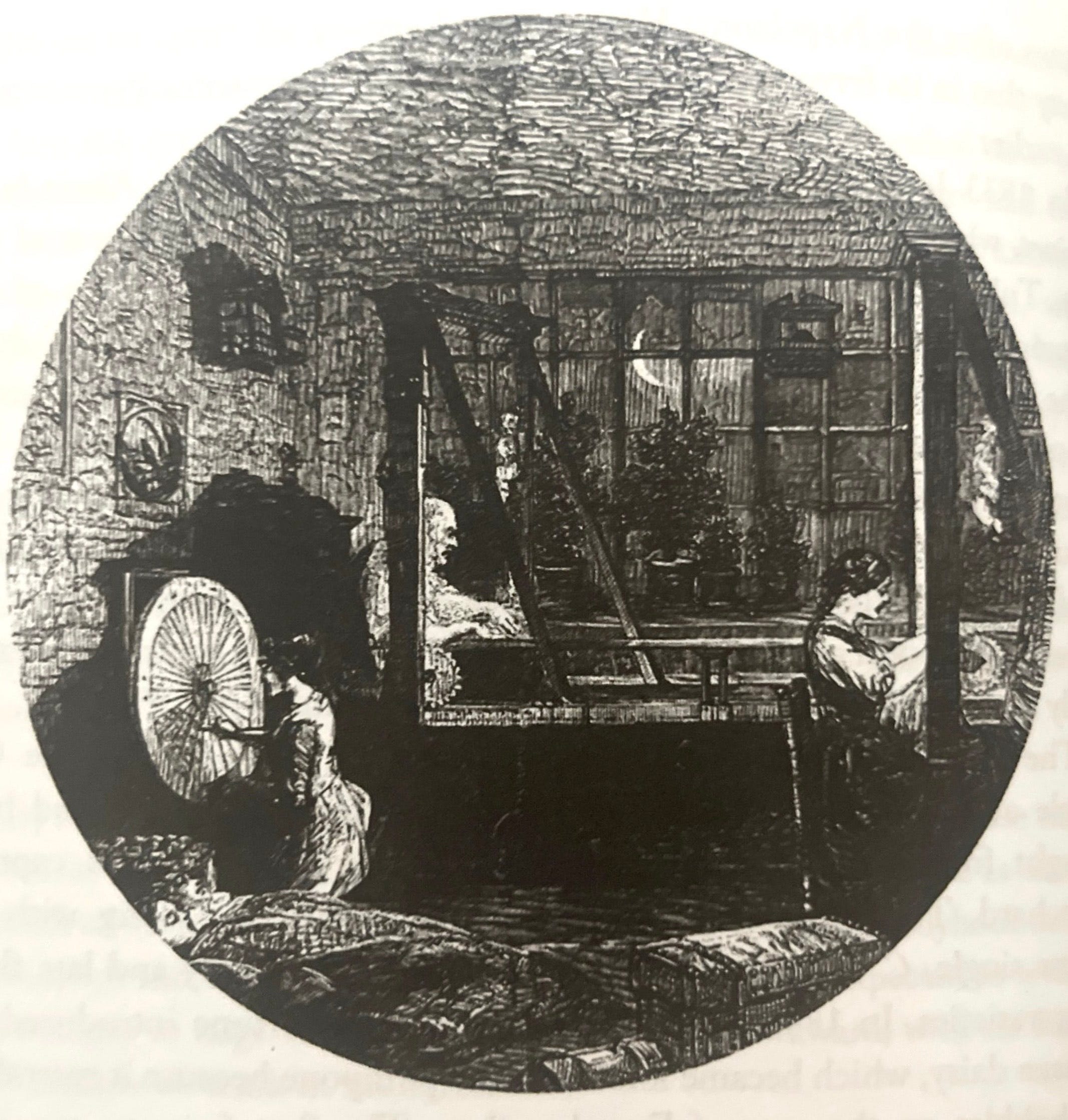
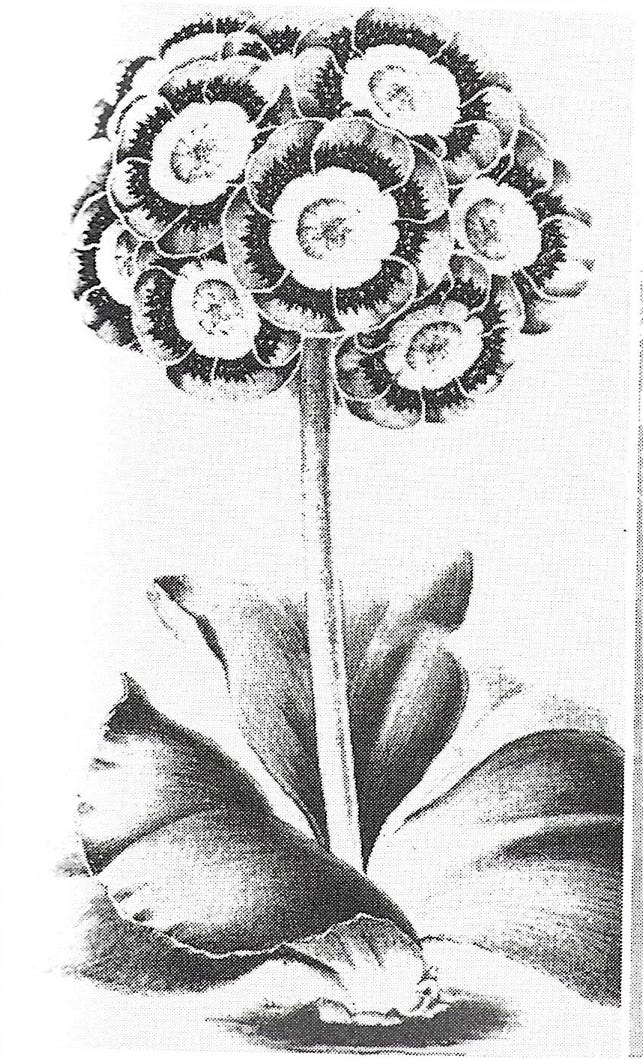
Here they practiced weavers’ floristry, the practice of both growing and arranging flowers. In the 18th century, men were the dominant gender within the weaving and spinning workforce and many of them were also florists, which, in the 1700s, meant not just an arranger of stems, but a person who grew, cultivated, and arranged specific plants for appreciation of their decorative flowers.4 At each window a “weaver worked behind his loom, able to watch the flowers as carefully as his work, his labour and his pleasure intermingled, interwoven, as intimately as his silken threads.”5 Often these were displayed on “theatres”, dramatic tiered displays placed outside of the weaver’s window, and shown at local exhibitions and competitions where fantastical floral creations were:
Made up of two or more individual flowers “dressed” with all the artistic skill of an accomplished milliner [...] Hyacinths shown for competition with small pins sticking the flowers close to the stems, and the drooping flowers of a loose tuss brought to look you in the face by the flower stalk being tied to the stem by an almost invisible ligature of fine green silk.6
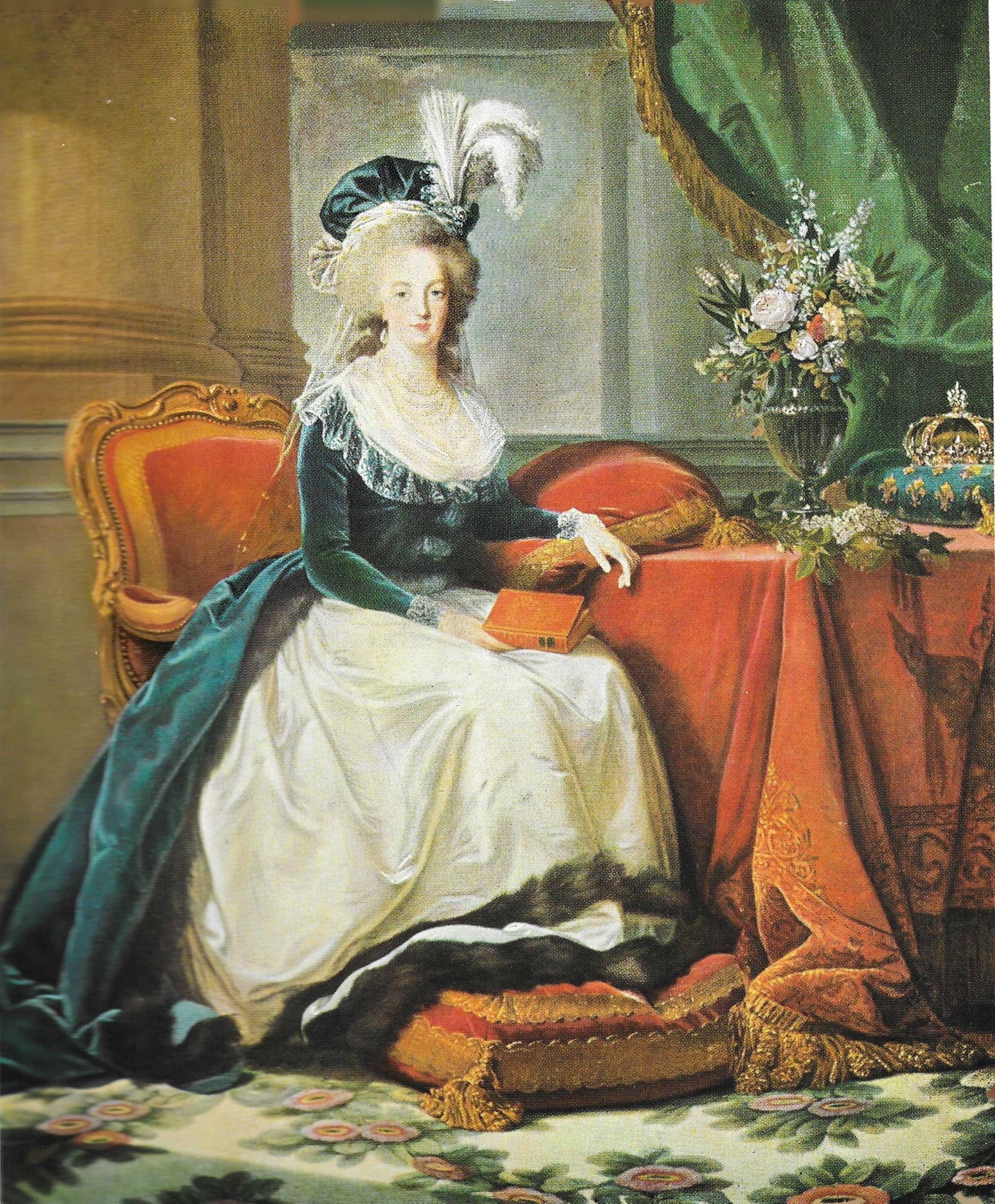
Weavers’ floristry was a practice that required skill, manual dexterity, attentiveness, and patience, much like the practice of weaving itself. It has even been argued that their appreciation of floral artistry influenced their weaving. As Willes writes, “the rearing of flowers, by a reaction, must tend to improve the genius for invention in elegant muslins.”7 It seems like no coincidence that the tulip, iris, ranunculus, hyacinth, auricula, and anemone – all mainstay florals tended by the weavers – were also the most popular fabric motifs of the 18th and 19th centuries. In fact, the cottons and silks used for the robe à l’anglaise, a style of dress worn by fashionable aristocratic women in the mid-18th century, were adorned with such floral motifs. The act of floristry for pleasure and leisure, then, was not isolated from the weavers’ work but articulated in relation to it.
The Lancashire weavers led a rich cultural life. As well as tending to their flowers, many were highly literate poets and musicians. Poetry and lyricism would become a medium for protest throughout the turbulent industrial revolution and cotton famine of 1861-1865. The below lyrics, composed by John Grimshaw and recorded in John Harland’s 1865 book Songs of Lancashire, capture the importance floristry to the cotton weavers:
So come all you cotton weavers, you must rise up very soon,
For your must work in factories from morning until noon:
You mustn’t walk in your gardens for two or three hours a-day.
For you must stand at their command, and keep your shuttles in play.8
By the early 19th century, with the industrial revolution in full swing, working conditions for handloom weavers were subject to drastic upheaval and change. As work moved into the factories from 1760 to 1860, traditional handloom weavers suffered mass unemployment and eventual obsolescence. Yet, even amidst this drastic upheaval weavers resisted the transition to the factory, preferring to remain in their homes and determine their own hours for as long as possible.9
“The act of floristry for pleasure and leisure was not isolated from the weavers work, but articulated in relation to it.”
In 1826, the Lancashire Weavers’ Riots (also known as the Weavers’ Uprising) took place. Driven to the edge by unemployment, poverty, and starvation, thousands of weavers protested for four days, from 24-27 April, breaking into factories and destroying over 1,100 power looms. They did so during a period in which machine breaking had become a relatively widespread form of protest. The Luddites, the 19th century movement of textile workers who opposed the new factory system and its wider social impact, had pioneered this kind of protest just over a decade prior, during the years 1811-1816.
Not only did the machines create a factory system that removed textile workers from their gardens, but their furnaces polluted the very ground in which they grew their flowers. Waste was dumped unchecked in waterways and a dense fog of pollution restricted access to sunlight, creating a hostile environment for cultivating almost anything. As a result, by 1855 there had been a huge decline in weavers’ floristry. In Spitalfields, London, another place where the practice had taken root, it is noted that weavers stopped growing flowers some time in the 1840s.10
This is not to suggest, however, that we fall into the trap of rural romanticism. The lives of the handloom weavers in Lancashire were tough; the work was tedious and ceaseless, while poverty and cramped living conditions were common. The weavers, however, led a life that was informed by the cultivation and display of flowers, emblematic of an independent lifestyle eventually destroyed by industrial capitalism. Even in the midst of significant social and political upheaval, floristry provided a botanical nomenclature that helped to reproduce the values of traditional artisan ‘work’ culture. It provided a “property of skill” to hand-loom weavers who became “deskilled” by the power loom and factory system.11
Weavers’ floristry presents a history of flower arranging outside of the already-existing discourse. It demonstrates that working-class people did not simply use floral design for ornament, but practiced it in a way that remained intricately connected to, and informed by, their daily lives and the land on which they lived. The process of cultivation was as important as the aesthetic results produced, and weavers’ flowers were more than just a vase on a table.
Berrall closes A History of Flower Arrangement with the message that modern floral arranging is “losing touch with one of the most gratifying experiences that is to be had in the handling of flowers – their cultivation.”12 Since writing in 1953, this division has widened. Most flowers we put in vases at home are grown and arranged in a modern factory system, and the floral industry is one that utilises mass production, exploitation, and causes extreme environmental damage. It’s an industry that is consistently pulling in opposing directions between luxury and adornment at one end, and the earth and soil on the other. Considering the more multifarious material and cultural histories of floral design might help create room for further, less exploitative explorations of the craft.
I grew up in Lancashire, playing around (and occasionally breaking into) the abandoned factories and cotton mills built in the 18th and 19th centuries. The industry was dead by the time I was born (it had practically vanished as mass employer in the area by the 1980s) but the mill system was around long enough for my grandmother to have worked in one, powering six looms at once and learning to “lip read”, as she puts it, so she could still gossip with the other women over the sound of the machines.
I also walked the same moors, coppices and quarries that the weavers did, inspired by the landscape, flora, and fauna, always wanting to bring some of it back home with me. It doesn’t seem a surprise then, that when I think about growing and arranging flowers, I always seem to picture the process of stitching and weaving, of starting with a single thread and creating something new. In the act of growing flowers, the single thread is a seed or bulb that with time and patience will blossom. Within floral design, it’s a single stem, curved in a certain way, marking the moment a new arrangement begins.
Increasingly, florists like myself are working hard to relearn and understand their medium, making an effort to understand the importance of growing flowers, as well as what they are and what they might represent. Working with and cultivating flowers in a way that is led by the plant rather than our own aesthetic desires not only allows for the appreciation of natural variation and rhythm but it also helps florists develop a style rather than imitating others. No stem of a flower grown and cut by hand ever mirrors another – the same should go for an arrangement.
Weavers’ floristry shows us that the arrangement and cultivation of flowers throughout history was not just the pursuit of the upper classes. The history of weavers’ floristry is enmeshed with artistry, community building, knowledge sharing, and protest. Like fabric and flowers, this practice is always in process, never quite finished, and, today, ripe for recontextualisation.
Ciao for now!
There are a few obscure websites that recount significant milestones in the development of modern floristry, such as this and this, but they are rather short on details.
Julia S. Berrall, A History of Flower Arrangement, (London: Thames and Hudson, 1978), p.148.
It was only towards the late 19th century that the word ‘florist’ came to represent a person arranging and selling cut flowers.
Margaret Willes, The Gardens of the British Working Class ,(London and Yale: Yale University Press), p.111.
Willes, The Gardens of the British Working Class, p.118.
Lyrics from John Grimshaw, ‘Hand-loom versus power-loom’ in John Harland, Songs of Lancashire. (London: 1865), p.189.
Robin Veder, ‘Flowers in the Slums: Weavers’ Floristry in the Age of Spitalfields’ Decline’, Journal of Victorian Culture, Volume 14, Issue 2, January 2009, pp.261-281.
Roy Genders, Flowers and Herbs of Love, (London: Darton, Longman & Todd, 1957).
Veder, ‘Flowers in the Slums: Weavers’ Floristry in the Age of Spitalfields’ Decline’.
Berrall, A History of Flower Arrangement, p.150.
Comments
Nothing yet. Say the first thing.
Sign in to join the conversation.