
Words: Róisín Hurley Hirschkop
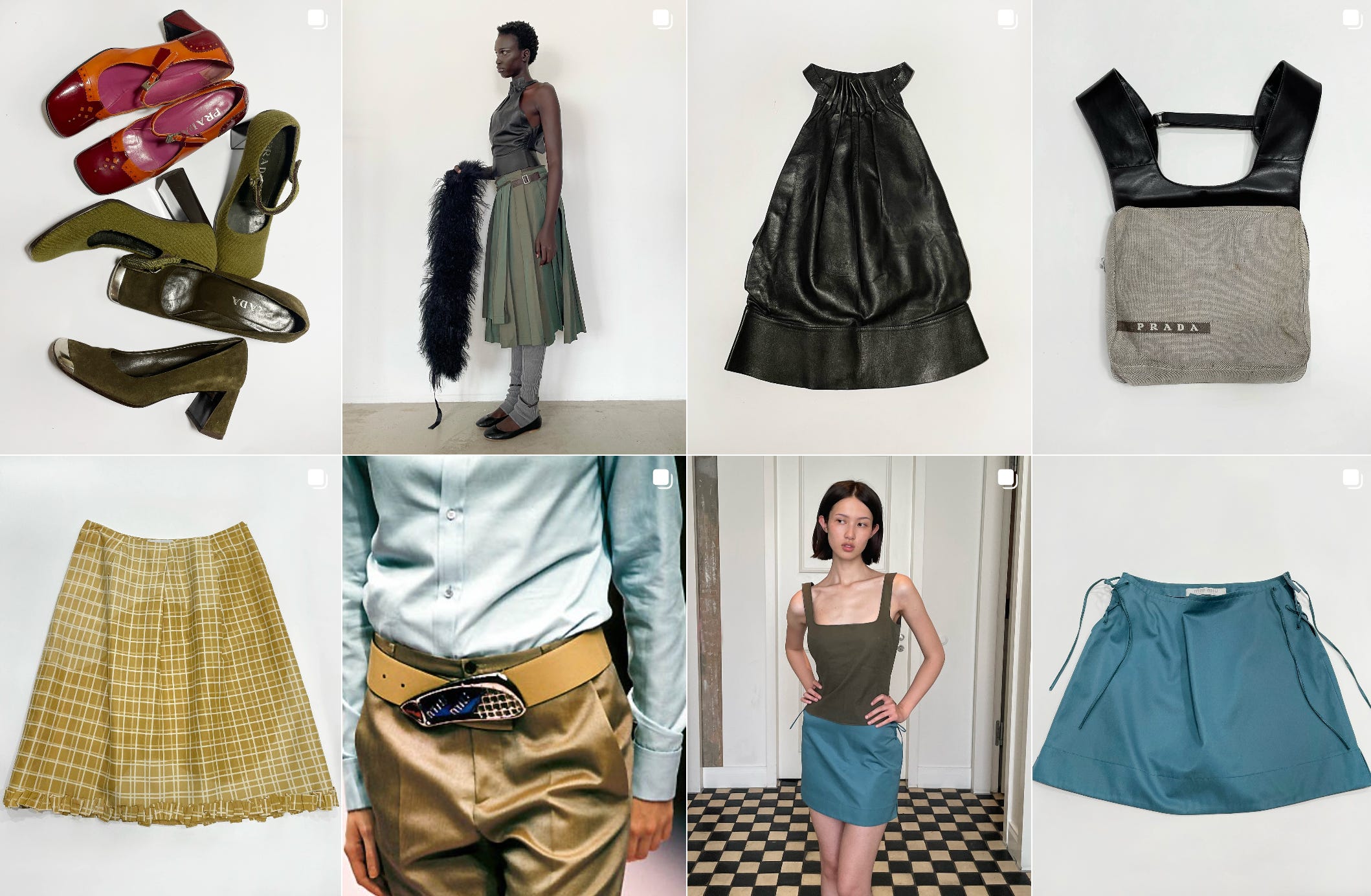
@secondskinarchive joined Instagram in April of 2020 and their page contains a total of 297 posts at the time of writing. Their first post is made up of three photos, dated the 5th of June 2020. It depicts a flat lay photograph of a brown skirt on a white background, with the second photo showing the back of the garment, and the third the interior tag. The caption reads ‘Junya Watanabe x Comme des Garçons 2005 windstopper gortex structured skirt with toggle back. Size M. [NFS]’.1
Although the account now posts predominantly 1990s and 2000s runway scans and photographs of models’ bodies with their faces cropped out, many of the photos from around the time of the account’s founding are made up of ‘flat lays’ of clothing produced by designers now commonly associated with what is colloquially known as ‘archive’ fashion: Prada, Miu Miu, Rick Owens, Comme des Garçons and Junya Watanabe, alongside occasional ‘cult’ or lesser-known labels such as Gomme, Nozomi Ishiguro, Three as Four and A.F. Vandevorst. According to information provided by Instagram, this is the only username the account has used, making it one of the earlier accounts to use the term ‘archive’ in its title.
This use of the flat lay photograph extends to many other accounts selling secondhand clothing with and without the word ‘archive’ in their name. Its visual rhetoric – objects arranged neatly onto a neutral background and shot from above in indirect light – is an inescapable presence on social media if one’s algorithm is trained on a diet of secondhand clothing accounts. Many of these, and where the trend seems to originate from, are secondhand clothing sellers whose focus is on flogging ‘archival’ designerwear.
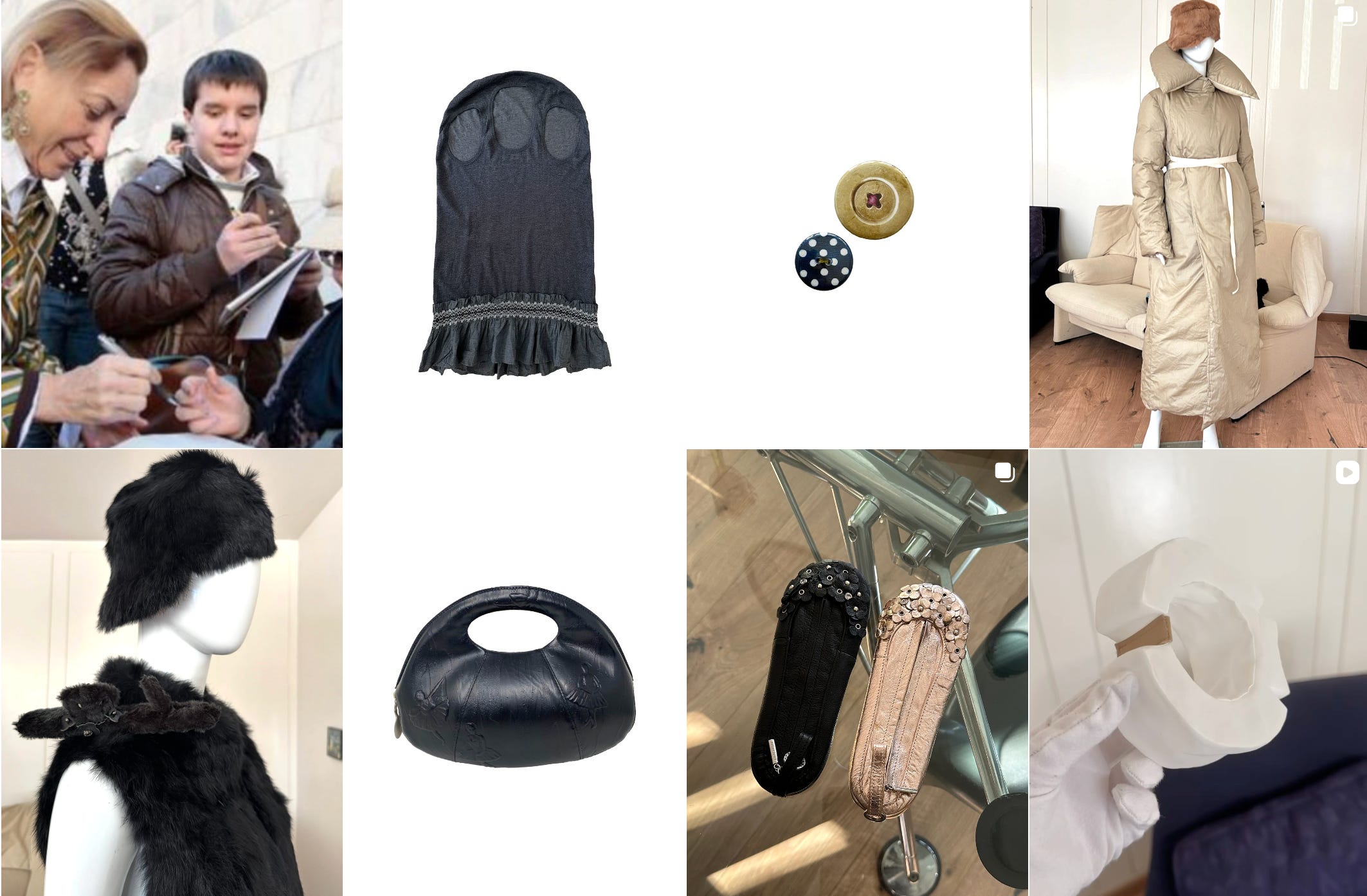
See @velvetknife.archive, for example, as well as @archive.club, which intersperses flat lays with mannequin shots and runway content. On the other end of the spectrum, vintage menswear sellers such as @sumshitifound or @anataresarchives have adopted this technique to display their ‘thrashed’ wares, foregrounding patina and trace – the softened cotton, the frayed cuff; evidence of previous lives – offering a more somatic encounter with the clothing they sell.
This type of photography, though, didn’t emerge on Instagram. Some believe the precise sterility of the flat lay can be dated back to 1987, when a janitor at Frank Gehry’s furniture fabrication shop called Andrew Kromelow noticed how satisfying it looked to arrange all his tools at right angles (a practice later dubbed ‘knolling’, so-named after the clean lines of the modernist Knoll furniture Gehry was working on).2 The American artist and sculptor Tom Sachs, who also spent time in Gehry’s studio, adopted Kromelow’s practice and formalised it into an aesthetic, complete with informal guidelines, bolstered by the mantra ‘Always Be Knolling’. Later, this kind of photography was (and still is) used for fashion e-commerce. Diffused lighting and infinity curves have become the defining features of product photography: objects displayed so that they can be viewed, assessed and consumed.
Our understanding of the flat lay photograph has, however, been transformed by its use on Instagram. Lev Manovich, an academic whose research mostly centres around how Instagram has changed photography practices, argues that since its inception, Instagram has been able to produce an aesthetic culture and digital subcultures in its own right. He argues that Instagram “establishes small and subtle distinctions from this imagery in terms of what is shown, how it is shown, and for what purpose.”3 Thus, on Instagram, this style of photography has been used to intellectualise and ‘museumise’ the selling of garments and the process of collecting.
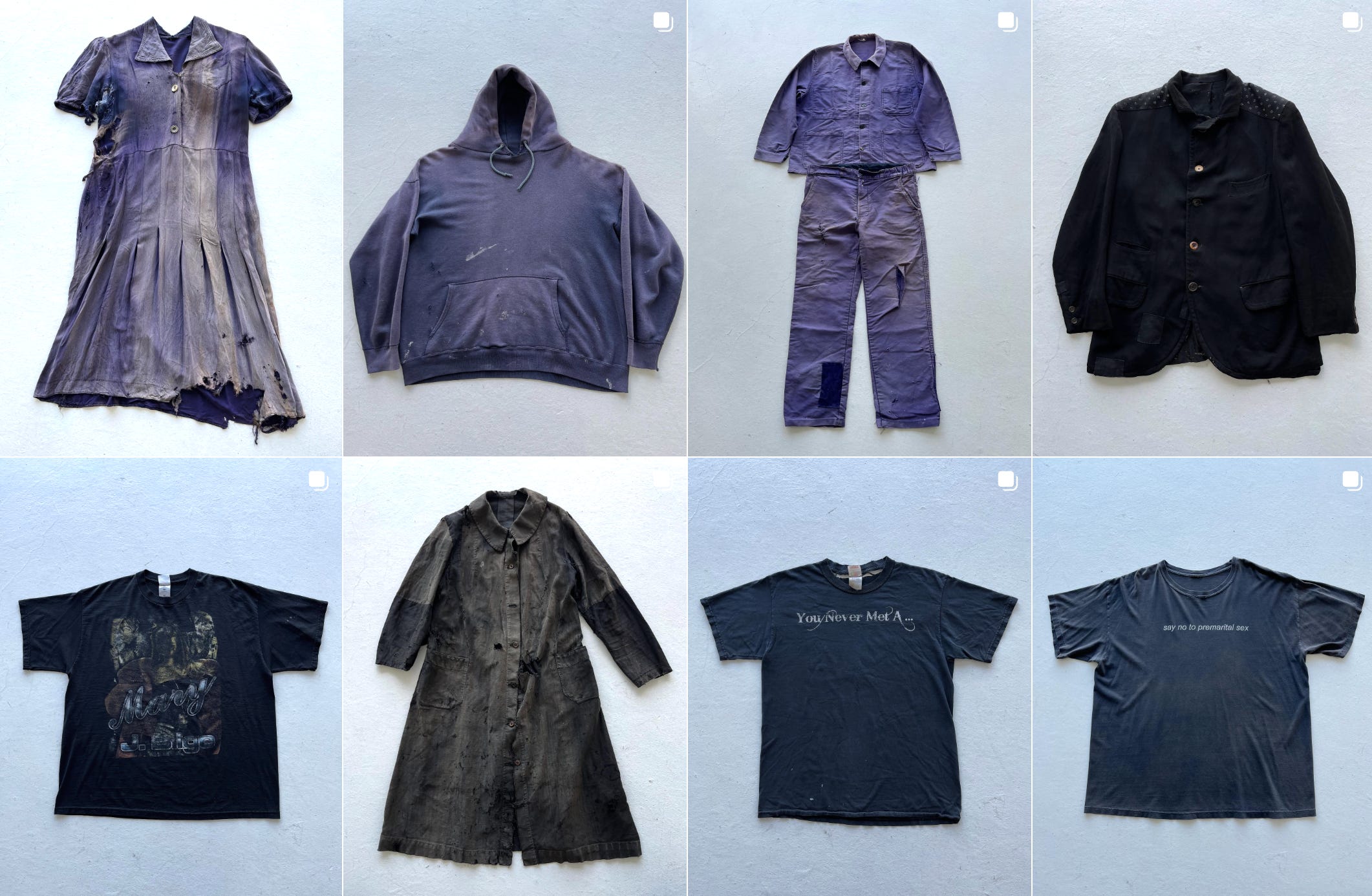
Often when archives are discussed, we have an archaic and outdated association with objectivity: there is an assumption that what is contained and organised within the archive fulfils a system with little arbitrary acquisition. Thus, using the term ‘archive’ in the name of a shop introduces an elevated, authoritative approach. The overhead shot of the garment reduces it from a three-dimensional object into an artwork or a specimen. Similarly to how one looks at clothing in a museum vitrine, the screen (and digital platform) might act as a display case; a figurative glass wall. Flat lay photography can be understood as both a defining feature of the ‘archive’ account and a visual mechanism through which their ‘archival’ claims are sustained.
It might be more accurate to call these ‘archive’ accounts, ‘amateur archivists’, defined by academic and photographer, Kyler Zeleny as those who “collect out of interest [and] scour for hidden gems,” operating outside formal institutions yet actively organising and circulating material online.4 This is a term not intended to be reductive, but to differentiate what an Instagram ‘archive’ account does, and what the job of an archivist is within an institution. Given that to become an archivist, one usually needs to meet a set of strict criteria, such as an academic qualification or considerable experience handling and preserving archives not to sell but for the purposes of future research, in order to understand the ‘archive’ account, it’s important to distinguish between these two roles. Yet, the ‘archive’ fashion account plays into the slipperiness of their title.
“The overhead shot of the garment reduces it from a three-dimensional object into an artwork or a specimen”
The attempt to draw parallels between fashion and the ‘artwork’ or museum-worthy object has not gone unnoticed by scholars of fashion. The perceived ‘artification’ of fashion objects – often achieved through the adoption of modernist aesthetics – has frequently been understood as part of a broader effort to intellectualise fashion. This process first became visible in physical retail spaces. Diana Crane, fashion theorist and sociologist, has argued that the ways in which conceptual or ‘avant-garde’ designers chose to display and curate their stores were themselves indicative of this intellectual ambition. Through careful visual organisation and associations with museums and galleries, fashion objects could be framed as cultural artefacts, edging closer to the status of art and, by extension, legitimacy. As Crane observes:
Many luxury fashion designers have attempted to frame their collections in such a way as to minimise the commercial context. They have created stores that appropriate the appearance of art galleries, with white walls and floors and a minimum of garments on display, but the fashion objects on display do not acquire the same aura as art objects, in part because they are not unique objects.5
Accounts such as @archive.club or @sumshitifound demonstrate how these display strategies can be mimicked digitally by those operating outside formal cultural institutions. A few years ago I interviewed Etienne Bolduc, who founded @myclothingarchive and who, when I interviewed him in 2024, was posting photographs of flat lay garments on his Instagram page. He told me that these photographs were used as research documents, and that he would only sell these garments as a means to sustain his research practice. Now he has transitioned his account into one that primarily shares fashion history infographics, but the commercial aspect of his venture is still to be found online, and represented through the flat lay image.
When we spoke in 2024, he noted that although his actual page did involve the sale of clothing, he was careful not to make this fact its dominant visual cue. Instead, he wanted to code the space as non-commercial, drawing explicitly on the sterility and restraint associated with museum environments:
….but the thing is, if I want to have something that’s more museum-like I need to have it flat and remove the background and all. So, it depends. If I had to change it, let’s say, if I have more time, and if I had to document it in a different context, I think I would probably hang it on a wall, and try to make it as nice and as sterile as possible.
Bolduc’s reflections echo the intent to render fashion objects as intellectual art objects, suggesting a contemporary iteration of this strategy in digital form. By presenting garments as museum-worthy objects – flattened, isolated and carefully staged – the commercial dimension of these amateur fashion archives is obfuscated, even as it remains structurally present. The flat lay imagery that appears on these ‘archive’ accounts can be understood as a visual representation of this effort to turn commodities into artefacts through replicating a museum-like display.
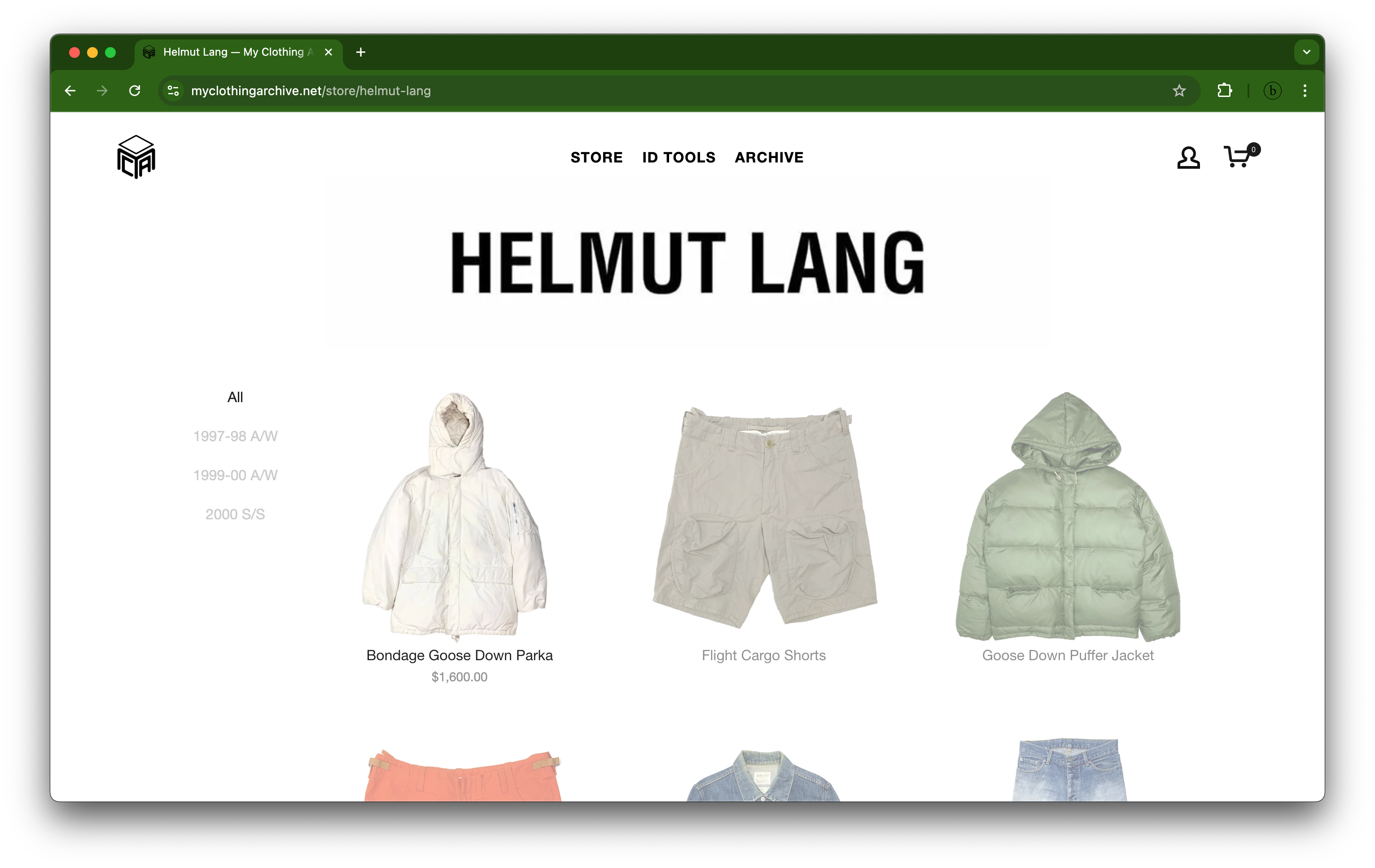
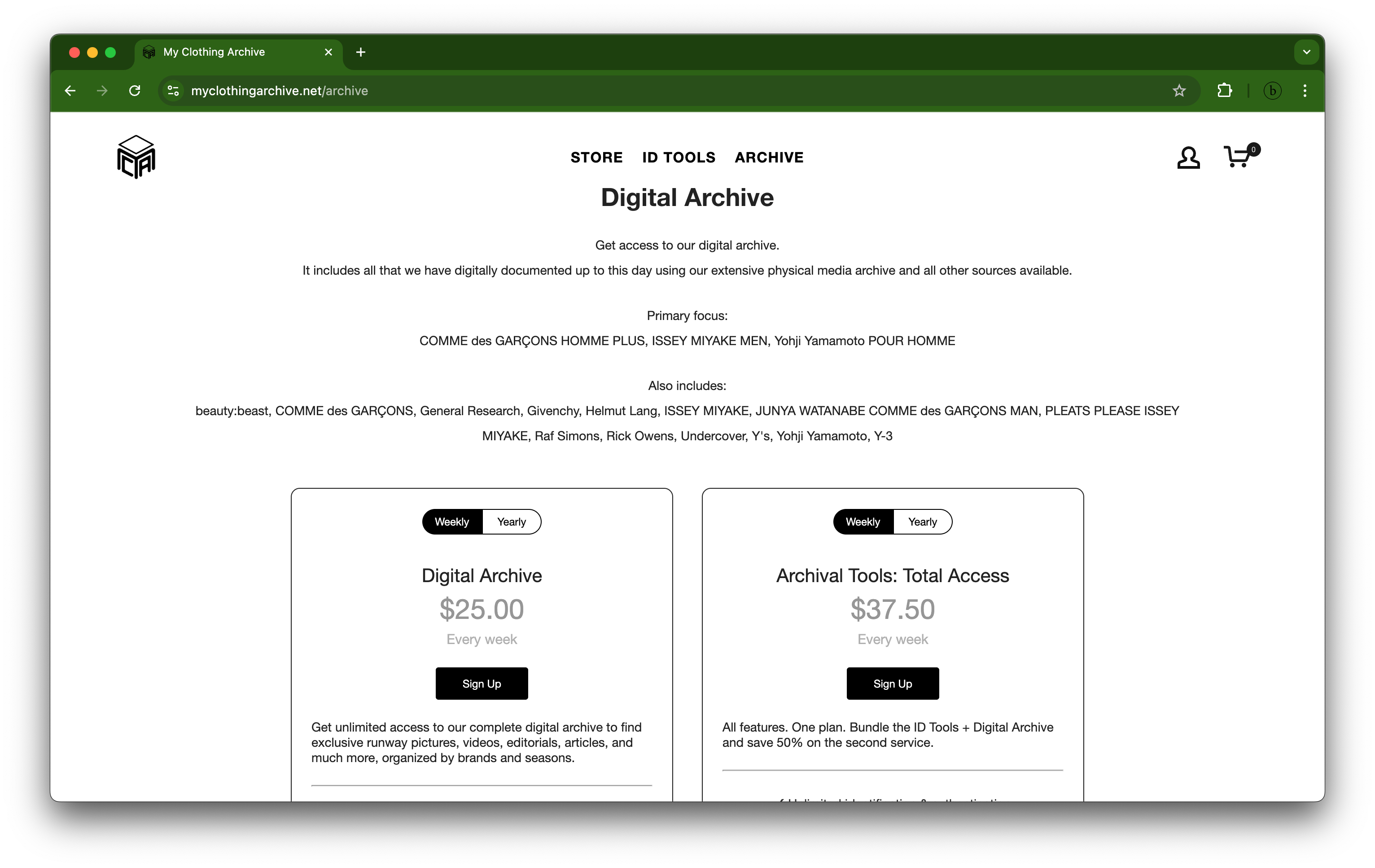
This is only reinforced by these sellers’ use of language. Accounts such as @secondskinarchive, and @velvetknife.archive use their Instagram pages primarily to contextualise and identify garments fashion provenance, noting their collection, designer, date, condition and, occasionally, whether or not they are for sale. In some cases, bios and captions even hint towards future research use, suggesting that these accounts position themselves not just as marketplaces but as sites of documentation and knowledge production, providing context for the flat lay photographs rather than simply promoting the storefront. This is how @myclothingarchive now positions itself: as a pay to play resource, with a shop attached.
The way the clothes are represented through scans and flat lays combined with the caption’s copy seem to mimic what one might imagine a more formal fashion archive or library might look like. In fact, this type of photo has been adopted by museums and archives for cataloguing purposes for many years. A photograph from the Instagram account of the Metropolitan Museum of Art’s Antonio Ratti’s Textile Centre is flat-laid and contextualised by an in-depth caption addressing both the history of the garment and its construction, as well as its date, place of manufacture and textile makeup. A similar style is used by the Fashion Museum Bath, as well as the Shetland Museum and the Westminster Menswear Archive. The structure of ‘archival’ flat-laid photography is pervasive throughout museums and archives that house fashion and textile collections, and reflects how some garments are stored and displayed. A video posted by Palais Galleria Musée de la Mode shows a curator fetching a garment from their vast archive which is already being stored perfectly flat-lay flat.
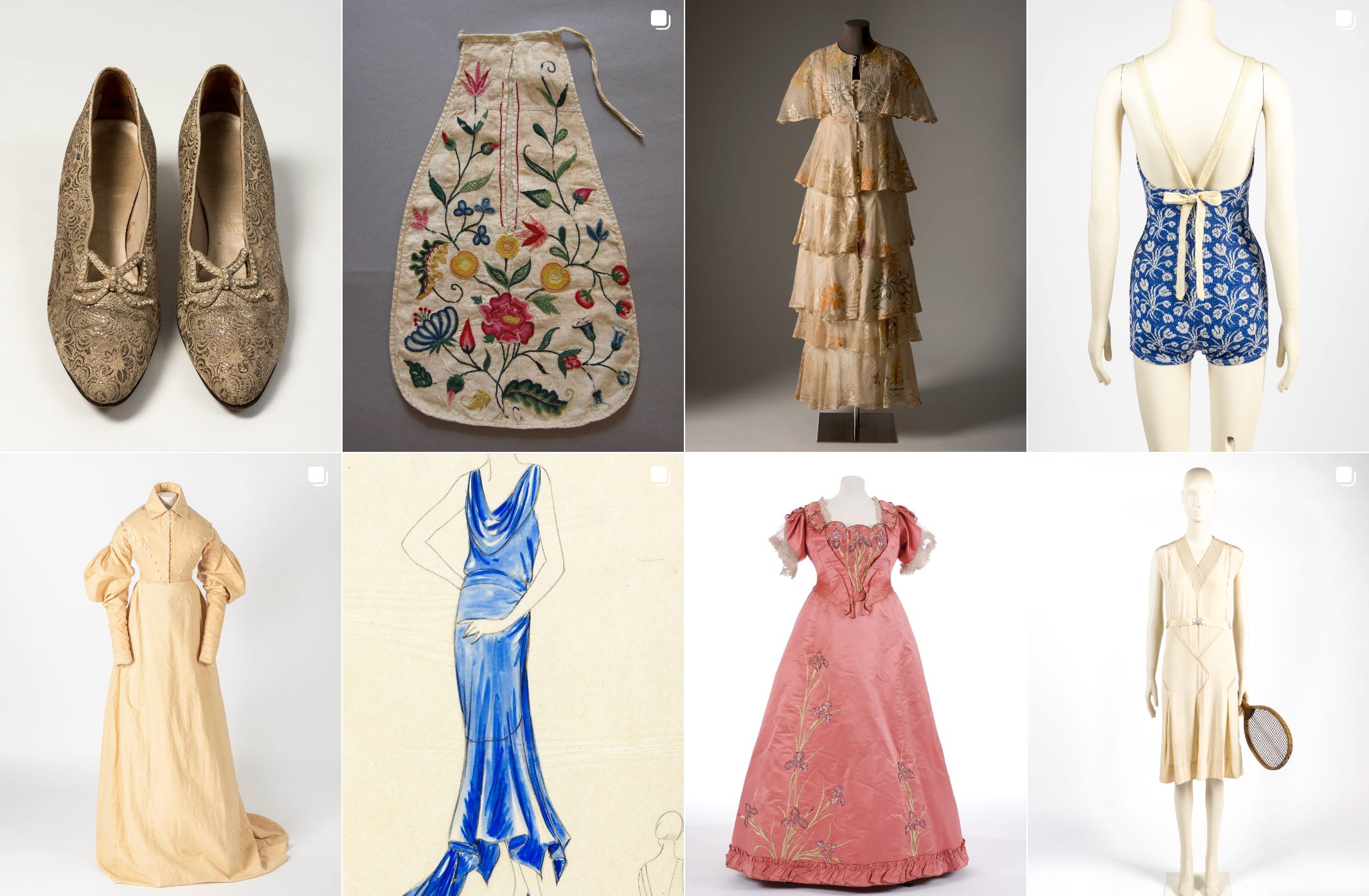
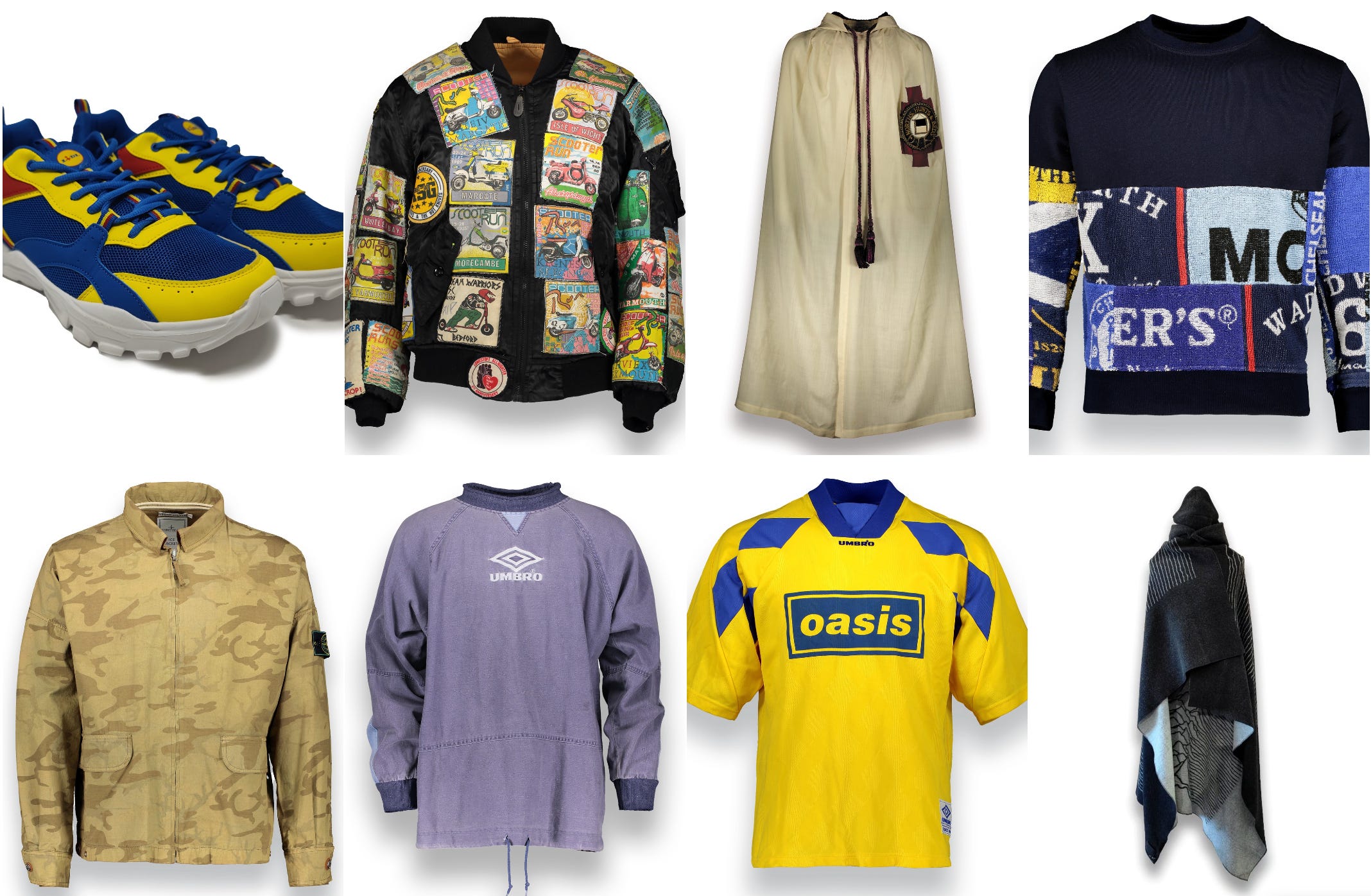
Using this genre of photography in a commercial context infers that these ‘archival’ Instagram accounts emulate the care demonstrated by textile conservators and curators, contextualising and highlighting the history and specific design of each item. By locating these fashion objects within the context of an ‘archive’ and establishing them as collection items, it allows them to acquire what Walter Benjamin termed ‘aura’. Benjamin used the term ‘aura’ to describe the unique presence of an object, a quality that cannot be reproduced mechanically. This presence arises from the specific time, place and cultural context in which the object was created. By subjecting mass-produced items to this archival framework, these accounts bypass the garment’s lack of original ‘aura,’ using the curation of digital space to manufacture a new sense of historical singularity and presence.
What becomes apparent when we interrogate the flat lay photography used in these archive accounts is that it functions as more than a neutral method of documentation or as a simple e-commerce tool. While ‘archive’ accounts do sometimes depict models wearing the garments, they are often cropped to remove faces or identifying features, rendering their bodies mannequin-like. Sometimes mannequins are used in lieu of bodies altogether, adding to this museological effect. The wearer disappears, replaced by the garment as object. This absence reinforces the archival logic: the clothing is not styled but catalogued, not lived in but preserved.
Through its repeated use, the flat lay begins to operate as a structuring principle, shaping how garments are viewed and valued. Clothing is not simply recorded, but rendered legible as something to be preserved, compared and historically situated. In this sense, the archive does not exist prior to the image; rather, it is brought into being through the conditions of its display. The flat lay, with its emphasis on order and detachment, its rendering of a garment flattened, isolated, and intellectually framed, is intended to quietly produce an archival logic of its own.
Ciao for now!
‘Second Skin Archive (@secondskinarchive) • Instagram Photos and Videos’ <https://www.instagram.com/secondskinarchive/> [accessed 8 May 2024].
Lauren Fritts, ‘Knolling: The art of material culture’ Art Education 72, no.1 (2019) pp.50-58.
Lev Manovich, Instagram and Contemporary Image (The book is released on the web under Creative Commons License, 2017), p. 48 <http://manovich.net/index.php/projects/instagram-and-contemporary-image>.
Kyler Clarke Zeleny, ‘Amateur Archives: The Uses of Public and Private Archives in a Digital World’, The International Journal of the Image, 7.3 (2016), pp. 33-44.
Diana Crane, ‘Boundaries’, in Fashion and Art, ed. by Adam Geczy and Vicki Karaminas (Bloomsbury Academic, an imprint of Bloomsbury Publishing Plc, 2013), p.103.
Comments
Nothing yet. Say the first thing.
Sign in to join the conversation.