

Imagine being a mom to a 13-year-old girl, lying in a hospital bed.
You knew something was very wrong for a while now, but until this moment, the doctors had told you she was “fine” and to “just make her eat.”
The night before, you had been trying to do exactly that — but your daughter’s emotional dysregulation became so extreme you had no choice but to call the ambulance. Overnight monitoring revealed how low her heart rate was dropping while she slept.
“Oh! She has an eating disorder!” the hospital attending tells you.
Yes. Finally. I told you so!
Getting the right help had felt impossible up to this point.
As you begin the early stages of navigating your daughter’s treatment for Anorexia Nervosa, you think about all the “eating disorder prevention” content you’ve consumed and followed on Instagram:
Don’t talk critically about bodies. Normalize all foods. Neutralize Fat. Let all feelings belong. You did it all. So how could this have happened? The mom guilt creeps in.
Through treatment, you learn that despite everything you did to protect her, your daughter was born preloaded with neurobiological risk: she was a preemie, she is neurodivergent, and eating disorders run in the family.
The genetic cards were stacked against her — part of what she inherited from you, but not anything you did “wrong”.

The above story is inspired by the real experience of A., a licensed mental health counselor — and a mom — who sent me a DM on Instagram last year.
She kindly told me she loves my content, but that she sometimes struggles with it too. As a mom who genuinely does all of the things I preach, she wished I talked more about what happens when “body-positive nurturing” still isn’t enough. About the reality that you cannot necessarily outsmart neurobiology.
I told A. how much her honesty meant to me — and that it was a useful reminder to center more experiences like hers in this space. I also told her about one of the core beliefs I teach: Know How to Notice, which reframes early detection of eating disorders as an essential form of prevention. The more fluent we are in the signs, the sooner you can get your child the support they need.
Though A. initially struggled to find the right providers, catching the problem early, acting quickly, and years of intentional parenting may have significantly changed her daughter’s trajectory. Her daughter is doing better now, though the eating disorder struggles persist. Still, these early actions likely increased the chances of eventual remission and reduced the risk of the illness becoming severe and enduring.
For many parents, early detection of an actual eating disorder is the best possible prevention there is.
Not the absolute prevention you hoped for, but rather prevention from the most severe, enduring, and possibly deadly expression of the illness that was never totally preventable in the first place.
So in honor of A. and her daughter, let’s get into what some of those risks she’s navigating actually are.

Genetics & Family History
Eating disorders are among the most heritable psychiatric conditions we know of. Twin and family studies consistently show that genetic factors account for a significant portion of ED risk — research suggests genetic factors account for roughly 33–84% of the risk for anorexia nervosa, 28–83% for bulimia nervosa, and 41–57% for binge eating disorder.1 A large population study drawing on data from over 17 million people in Denmark and Sweden found that individuals with a first-degree relative diagnosed with an eating disorder face, on average, a threefold higher risk compared to the general population.2
This is important to sit with, because our culture loves a narrative of individual choice and parental influence. And honestly — my entire Instagram page is built around exactly that. Reels of me demonstrating what to say, what to do, how to build a body-positive home to optimize protections against eating disorder risk. Environment matters. Parental influence matters. I believe that deeply. But it does not operate in a vacuum. For children with a strong genetic loading, the question was never really "if" certain vulnerabilities existed — it was whether and how they'd be expressed.
If eating disorders run in your family, this isn’t a reason to panic — but it is a reason to be informed and take seriously the responsibility of knowing how to notice when something is off.
Neurobiological Risk Factors: Prematurity & Neurodivergence
A. mentioned two specific risk factors that don’t get nearly enough airtime: her daughter was born premature, and she is neurodivergent.
On prematurity: a large Danish population study found that prematurity was associated with increased eating disorder risk, particularly for anorexia nervosa.3 Preterm birth is also associated with differences in how the nervous system develops, including interoception — the ability to sense and interpret internal body signals like hunger and fullness. When interoception is disrupted, it can make it harder to read and respond to the body’s cues.
On neurodivergence: autistic people and those with ADHD are at high risk of developing an eating disorder, with research also suggesting associations between other forms of neurodivergence — including OCD (which A. told me she herself has) and Tourette’s syndrome — and disordered eating.4 Some estimates hold that as many as 23% of people with eating disorders are also autistic.5
Importantly, the presentation often looks different from the “classic” image most people picture — rigidity, sensory aversions, difficulty with interoception, and rule-based thinking can all intersect with ED behaviors in ways that are easy to miss or misread.
When multiple neurobiological risk factors are present, the risk compounds. A’s child wasn’t simply “at risk.” She had a constellation of factors that made her highly vulnerable — regardless of what her home environment looked like.
Parents Don’t Cause Eating Disorders
I want to say this as clearly as I possibly can: parents do not cause eating disorders.
This is not just reassurance. It is what the research actually shows. The biopsychosocial model — the most widely accepted framework in the field — recognizes that eating disorders arise from a combination of genetic predisposition, neurobiological factors, temperament, and environmental triggers. No single factor, including parenting, singlehandedly causes them.
Every time I say this, I receive angry messages.
And I understand why. Because there are people reading this who can point directly to a parent as the reason they learned to hate their body, went on their first diet at age seven, or spent years unraveling the damage done at the dinner table. I believe them. Their experience is real. Had things been different at home, things may well have been different for them.
This is a rather painful dialectic: parents do not singlehandedly cause eating disorders and they can absolutely increase risk. A home environment saturated in diet culture, weight stigma, or body shame (all independent environmental risk factors in their own right) does not always create a child with an eating disorder. At the same time, striving to eliminate environmental risk never hurts and can only help.
Early Detection & Intervention: Why It Changes Everything
The part of A’s experience I want us all to hold onto is this: she caught it early. She knew how to notice.
Early intervention in eating disorders (one of my clinical specialties) accelerates recovery, improves outcomes, reduces costs, and saves lives. Longer duration of an untreated eating disorder is a significant predictor of poorer outcomes, lower rates of recovery, and longer hospitalization.6 Research consistently points to the first three years of illness as a critical window.7
Early detection doesn’t mean surveilling your child or catastrophizing every skipped meal or complaint of “feeling fat”. It means being informed enough to recognize when something may be wrong, and empowered enough to act on it.
This is an important skill set…one I’ll be teaching in my upcoming workshop!
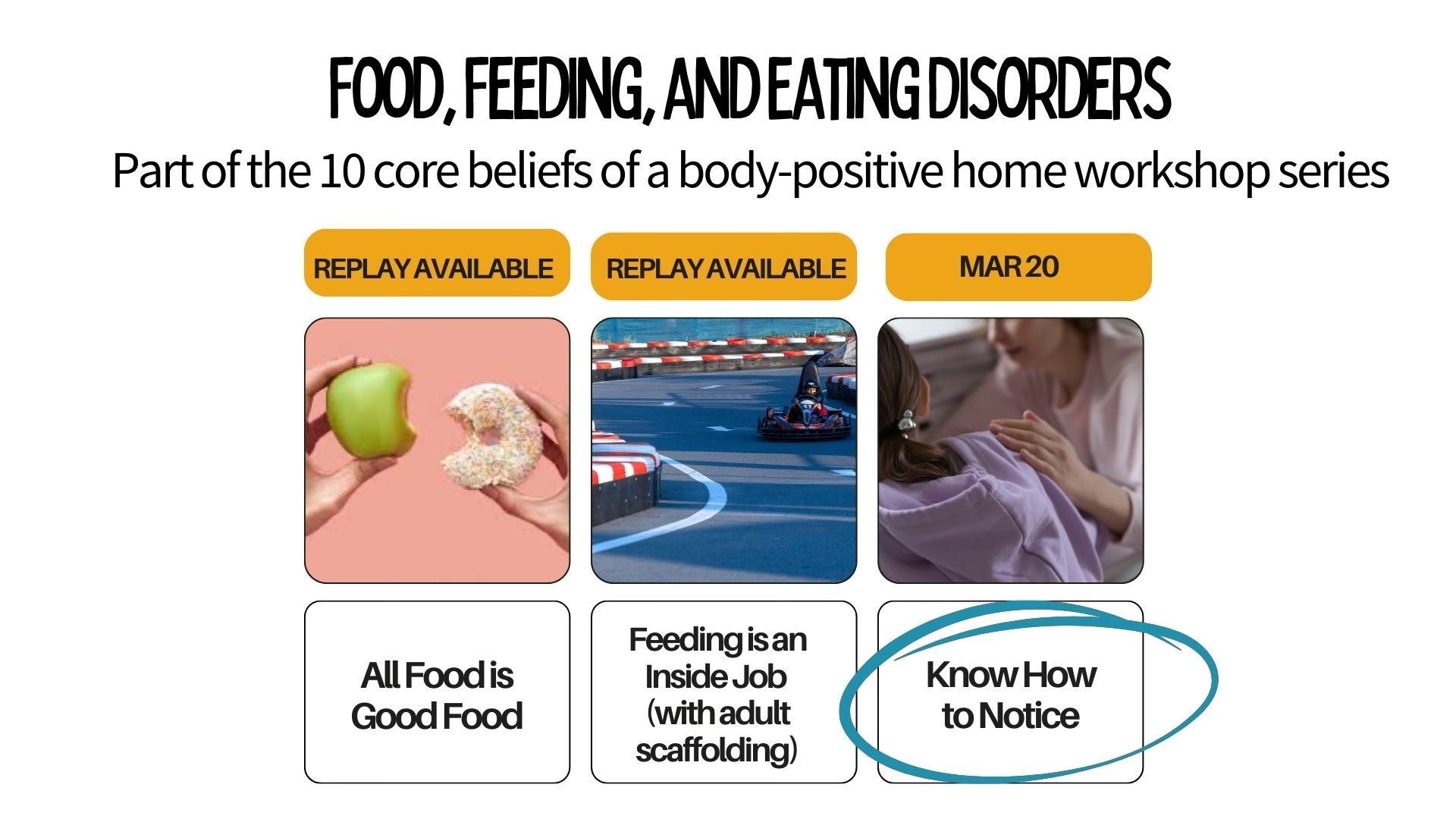
We’ll talk a bit more about the neurobiological risk factors every parent should be aware of, what early warning signs of struggle can look like across various presentations, how to trust your instincts and take action, and why a body-positive home still matters — even when it isn’t enough on its own.
I want to thank A. again for granting permission to share her story. And I hope you'll let it inspire some urgency — because the most powerful thing you can do for your child isn't just building a protective home. It's knowing what to look for if/when that might not be enough.
All content shared here is protected under applicable copyright, trademark, and other proprietary rights. It is intended for informational and educational purposes only and should not be considered a substitute for professional, medical, or psychological advice, diagnosis, or treatment. Engaging with this content does not establish a professional or therapeutic relationship. If you have concerns about your or your child’s health, mental health, or safety, please consult a qualified medical or mental health professional.
Motif et al. (2022). Gene variants in eating disorders. PMC.
Sävendahl et al. (2025). Shared genetic architecture between eating disorders, mental health conditions, and cardiometabolic diseases. Nature Communications.
Larsen et al. (2021). Prenatal and perinatal factors and risk of eating disorders. PubMed.
Karamacoska et al. (2024). Neurodivergence, intersectionality, and eating disorders. Journal of Eating Disorders.
National Eating Disorders Association. Eating Disorders and Neurodiversity.
Beat Eating Disorders. (2022). Best Practice in Ensuring Early Intervention for Eating Disorders.
Miskovic-Wheatley et al. (2023). Prevention and early intervention in eating disorders. Journal of Eating Disorders.
No posts
Comments
Nothing yet. Say the first thing.
Sign in to join the conversation.