

Hi everyone,
If you’ve been attending or following the 10 Core Beliefs of a Body-Positive Home workshop series, you know we’ve spent the past several months focused on what we can do to protect our kids—how to create a home environment that supports a healthy, flexible relationship with food and body.
This work will always matter deeply, and I stand by my belief that it is never too late to begin.
But sometimes… it’s not enough to keep our kids, tweens, and teens safe.
For a whole host of reasons—many of which have nothing to do with anything we “did wrong”—kids, tweens, and teens genuinely struggle. They may struggle with eating, with their bodies, and with managing the enormous feelings alive inside them.
I don’t want you to experience your child’s struggle as a failure of your prevention efforts. I want you to understand that recognizing and responding to that struggle is an essential part of that prevention.
And I want to help you build ED-professional-level early detection skills that allow you to respond clearly and effectively when something feels off.
Given how deadly eating disorders can be, believe me when I say these skills can be both life-saving and quality-of-life preserving.
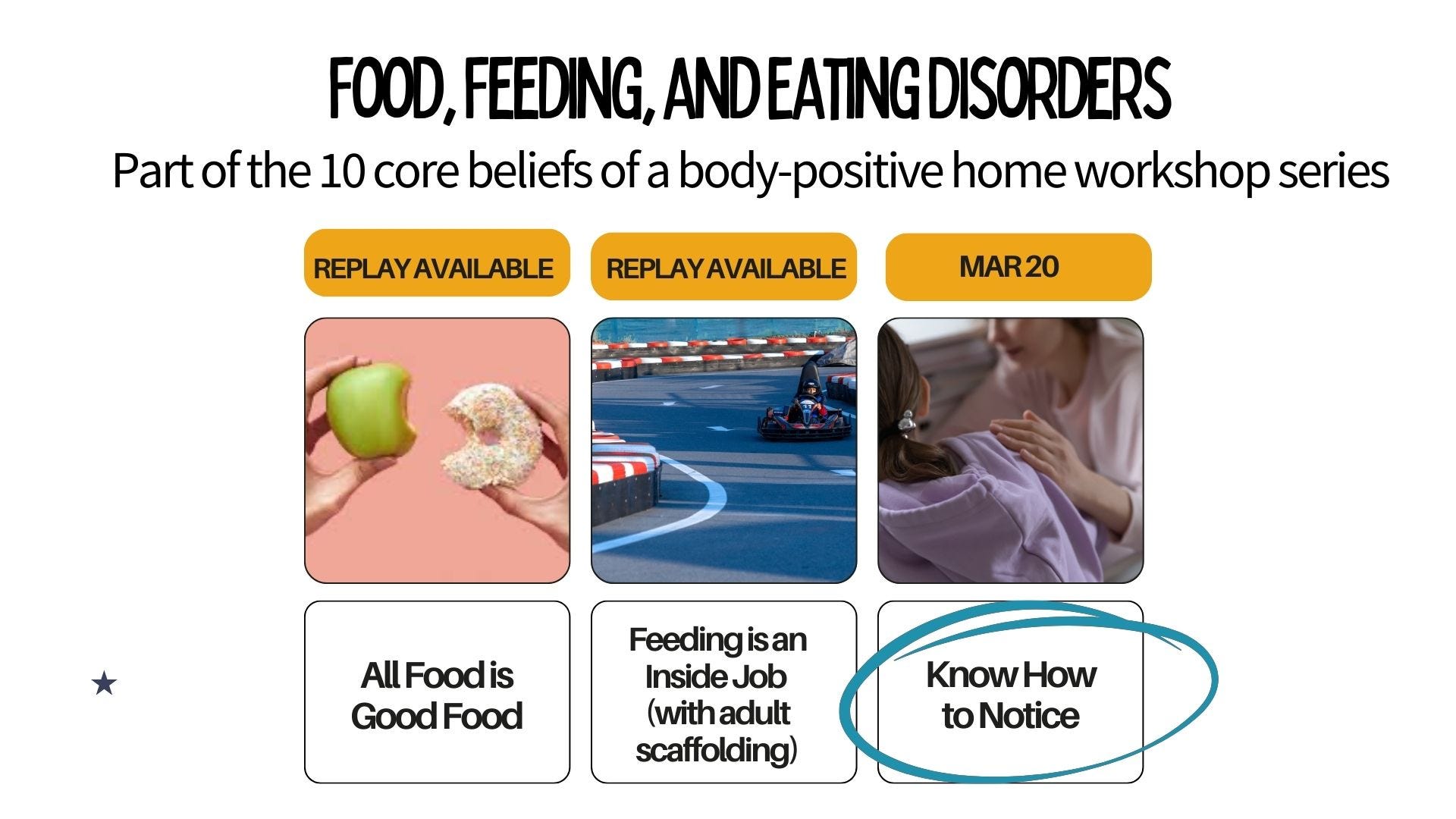
So tomorrow, Friday, March 20th at 2pm EST, I’ll be hosting a workshop focused on one of the most underappreciated—and most critical—skill sets for parents: the early detection and early intervention of child and adolescent eating disorders.
In this session, we’ll discuss:
The different ways eating disorders can show up in children and teens (including the ones that don’t raise immediate alarm)
Why early detection matters more than most parents realize—and what’s at stake when concerns are missed
How to make sense of risk factors without spiraling or second-guessing yourself
The early signs of struggle that are easy to overlook
What to say (and what not to say) when something feels off
How to determine when a concern warrants professional evaluation—and what kind of support to seek
How to make sure the professionals you consult truly understand eating disorders—and won’t miss or minimize what you’re seeing (sadly this happens a lot!)
If you are already a paid subscriber, you will find the Zoom link for tomorrow’s session at the bottom of this email. If not, please consider upgrading so you don’t miss this series.
On April 10th, we’re going to talk about why “BODY AUTONOMY MUST BE BALANCED WITH ENVIRONMENTAL SAFETY”—because yes, you get one life, one body, and you absolutely get to make your own choices about it. And yet, those choices inevitably shape the environment where your kids’ relationship with food and body is developing. Conflicts of interest are unavoidable, but with skills you can navigate them with care.
On May 8th, we’re going to talk about INCONVENIENT ACTIVISM — because there’s an aggravating amount of advocacy required just to protect kids (and ourselves) from body shame. You need skills to set boundaries, negotiate new norms within the family, and stand up for body respect—in school, at the doctor’s office, and beyond.
Oh, and in case you missed the last six sessions in this series, replays are available here:
Comments
Nothing yet. Say the first thing.
Sign in to join the conversation.