
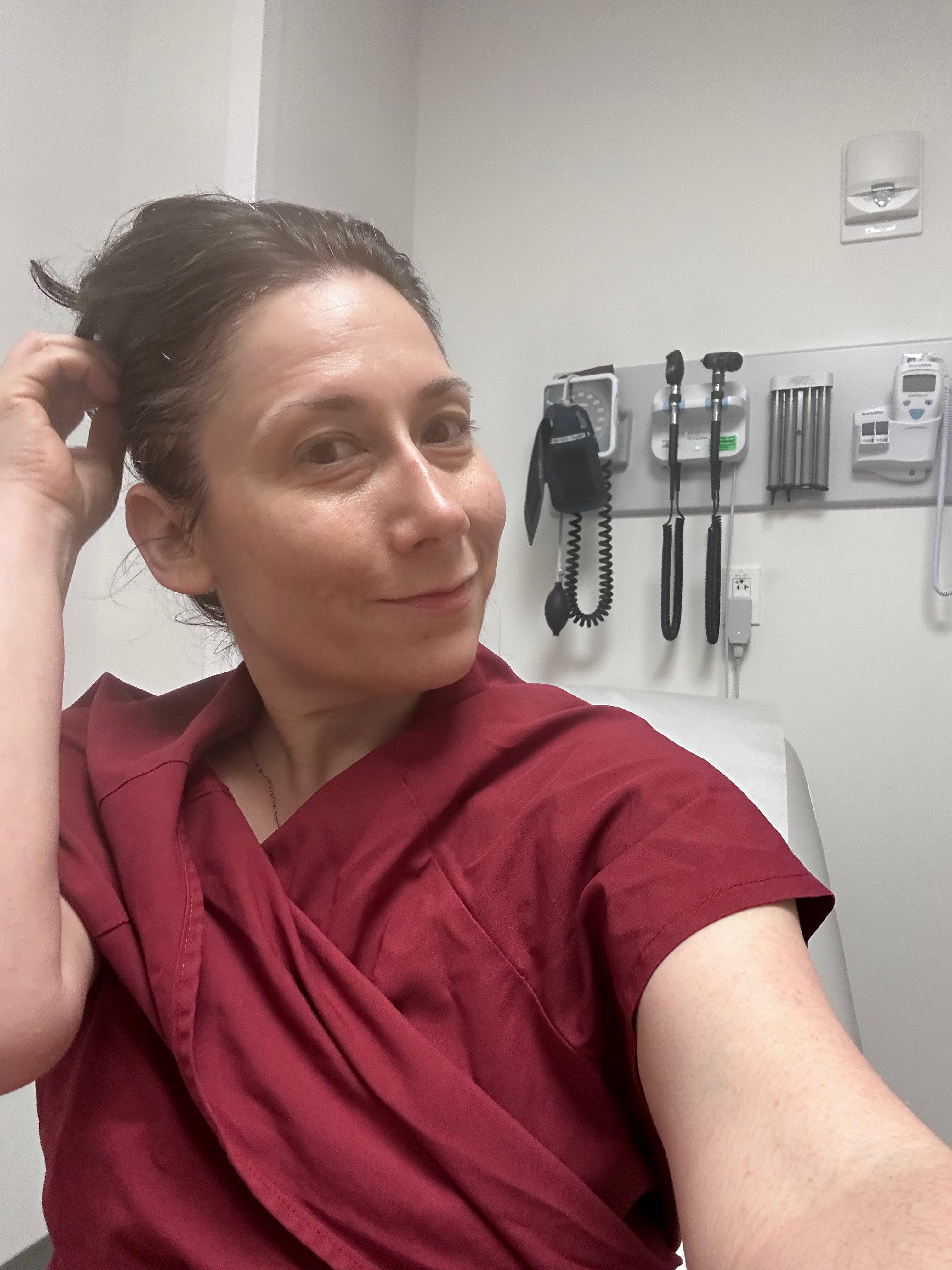
Today I went to my annual GYN appointment. I really hate the invasiveness of pelvic exams, but I genuinely love the perinatal nostalgia of seeing my OBGYN, Dr. B. She was my doctor for two of my three pregnancies, so sitting in her office still brings me back to that oxytocin den era of my life. She knew how badly I wanted a VBAC when I first met her in 2015 and how upset I was when a brutal stomach bug sent me into labor at 35 weeks, with symptoms of what turned out to be a placental abruption. I’ll always be grateful that she helped guide my baby boy safely into the world and helped guide me toward a repeat C-section that ultimately became a deeply healing and redemptive birth experience. (Stories about natural childbirth mythology, birth trauma, and complicated feelings about C-section scars — physical and emotional — another time.)
Over the past decade+ in her care, both as an OB and GYN patient, I’ve come to know Dr. B as efficient, deeply competent, and calming in a crisis. And notably, even during my third pregnancy, at the literal peak of the pandemic in NYC, with my blood pressure soaring, significant weight gain, and unexpected signs of late-term gestational diabetes, she never once made me feel like my body had become a behavioral problem to solve.
To be clear, I understand my relative body privilege here. Even at my highest lifetime weight, when from a clinical perspective I technically met criteria for “Class I Obesity,” I have never entered her exam room in a body likely to experience the worst version of medical weight stigma. (I have a theory this is partly because I’m very short (barely 5 feet) with defined cheekbones — a combination that has always allowed me to pass as “small” even when my BMI1 has told a different story.)
While Dr. B has always struck me as innately respectful toward women’s bodies, she also doesn’t seem especially size inclusive in an ideological sense. I doubt she’s spending her free time reading about Fat liberation or Health at Every Size, between marathon training and delivering 350 babies a year. So I can’t say I was shocked when she told me today that over the next four years she plans to phase out OB work and focus on her emerging specialties: Menopause Care and “Obesity” Medicine.
Now, I have complicated thoughts and feelings about the field of “Obesity” Medicine. I have engaged with “Obesity” Medicine specialists who are deeply compassionate and genuinely knowledgeable about the interconnectedness of metabolism, trauma, stress, genetics, environment, mental health, medications, access, and behavior. And I know there are patients who feel profoundly validated by being diagnosed with and treated for “the chronic condition of obesity.” Patients who report finally feel cared for instead of blamed for the weight, whose health markers, mobility, and quality of life improve.
And I also know there are many patients who experience the entire framework as fundamentally stigmatizing and harmful. Patients who do not experience the word “obesity” as neutral, clarifying, or helpful to their health goals, but rather as violent and pathologizing from the start; a primary barrier to accessing equitable healthcare.
Personally, I do worry about the inherent stigma embedded in treating body size itself as pathology. But I don’t see my role as a therapist with an educational platform to flatten this conversation into “good” or “bad.” I’m not interested in becoming some vigilante screaming about how objectively horrible anyone who uses the term “obesity” is. I am interested in helping people understand that there are real lived experiences on both sides of this conversation.
So as Dr. B talked excitedly about this next chapter of her career and the promise of GLP-1 medications, I found myself wondering whether she had ever considered things from a different perspective. Did she even know that some people actually experience the word “obese” as a slur?
I noticed the clock. My 8:30 appointment, always miraculously on time, was clearly heading toward a precise 9:00 ending. But I felt compelled to say something before I left.
So, with two minutes left, I said: “I know these medications and this field are helping a lot of people, but I often think about Fat activists who feel the entire premise is deeply loaded with weight stigma. How do you reconcile that?”
Her answer wasn’t especially satisfying. She circled more around themes of body autonomy — “if someone feels better in their body after losing 20 pounds, they should be able to pursue that.”
We didn’t have time to get into eating disorder risk. Or unconscious anti-fat bias. Or the complicated body politics of it all. And maybe she won’t give my question any more thought. But maybe she will. Maybe the next time she sits with a patient in a larger body Fat activism will cross her mind…and my micro-version of what I call inconvenient activism will have meant something.
I know this may not look like activism in the traditional sense. It is not a march or a protest or a public call-out. It is just one quasi-uncomfortable question asked in an exam room at 8:58am. But sometimes that is what inconvenient activism looks like: finding a tiny opening to voice our values out loud on the chance that the question lingers after the conversation ends.
Of course, there are many other forms inconvenient activism can take — perhaps most relevant to many of us, learning how to speak up with the people closest to our children: the grandparents who keep commenting on their body, the teacher policing lunchbox choices, the pediatrician cautioning about high BMIs and juice.
We’re going to talk more about all of this in tomorrow’s workshop. The link to attend is behind the paywall below. As always, the replay will be available afterward, and you’ll also get access to the full 10 Core Beliefs of a Body-Positive Home series and the growing workshop library.
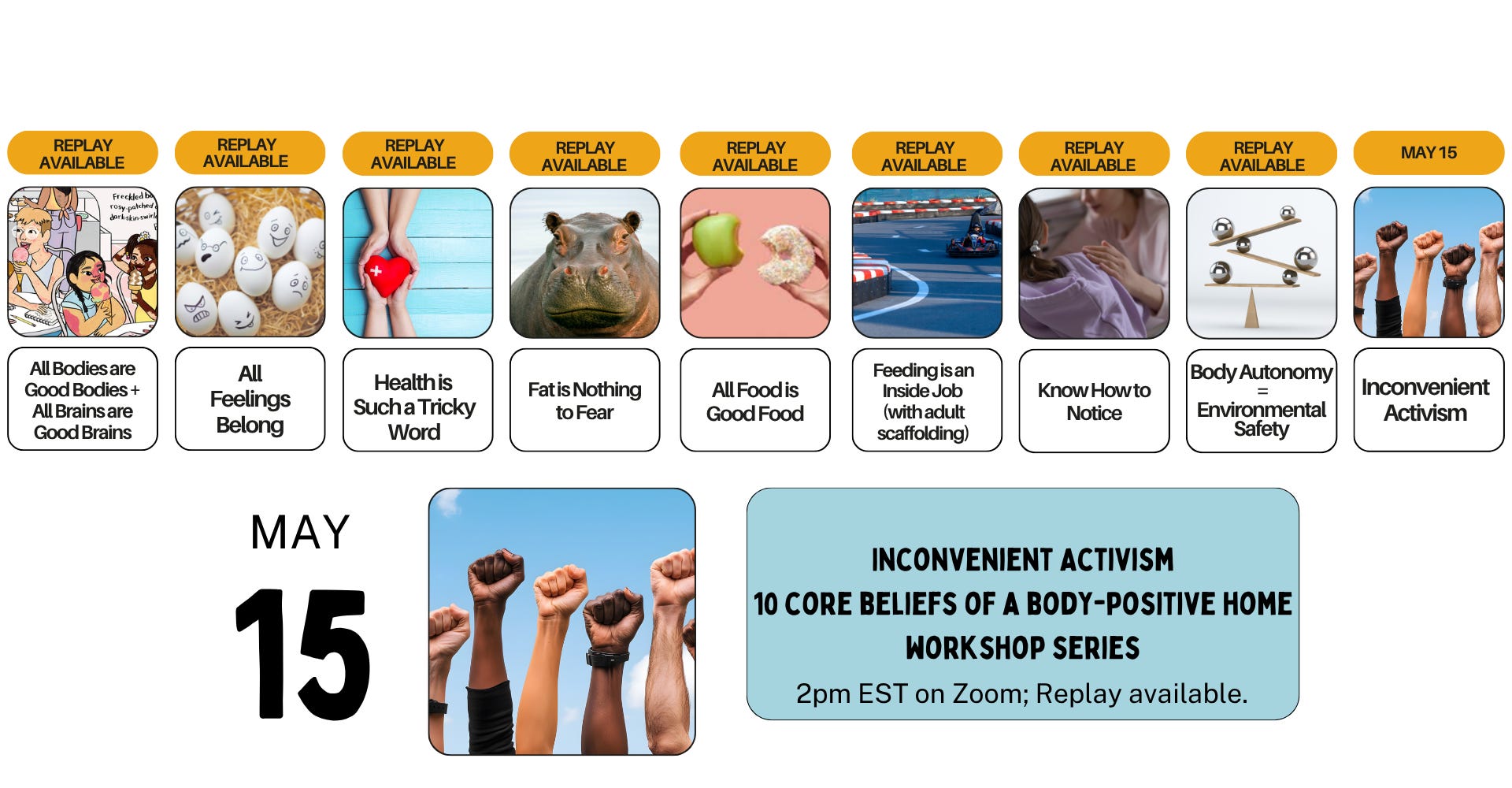
Become a paid subscriber to get behind the paywall for the link to the workshop and the replay!
Comments
Nothing yet. Say the first thing.
Sign in to join the conversation.