
A 95-year-old Portland resident wrote a letter to her government.
The president of the Portland City Council told her to “mind your own business.”
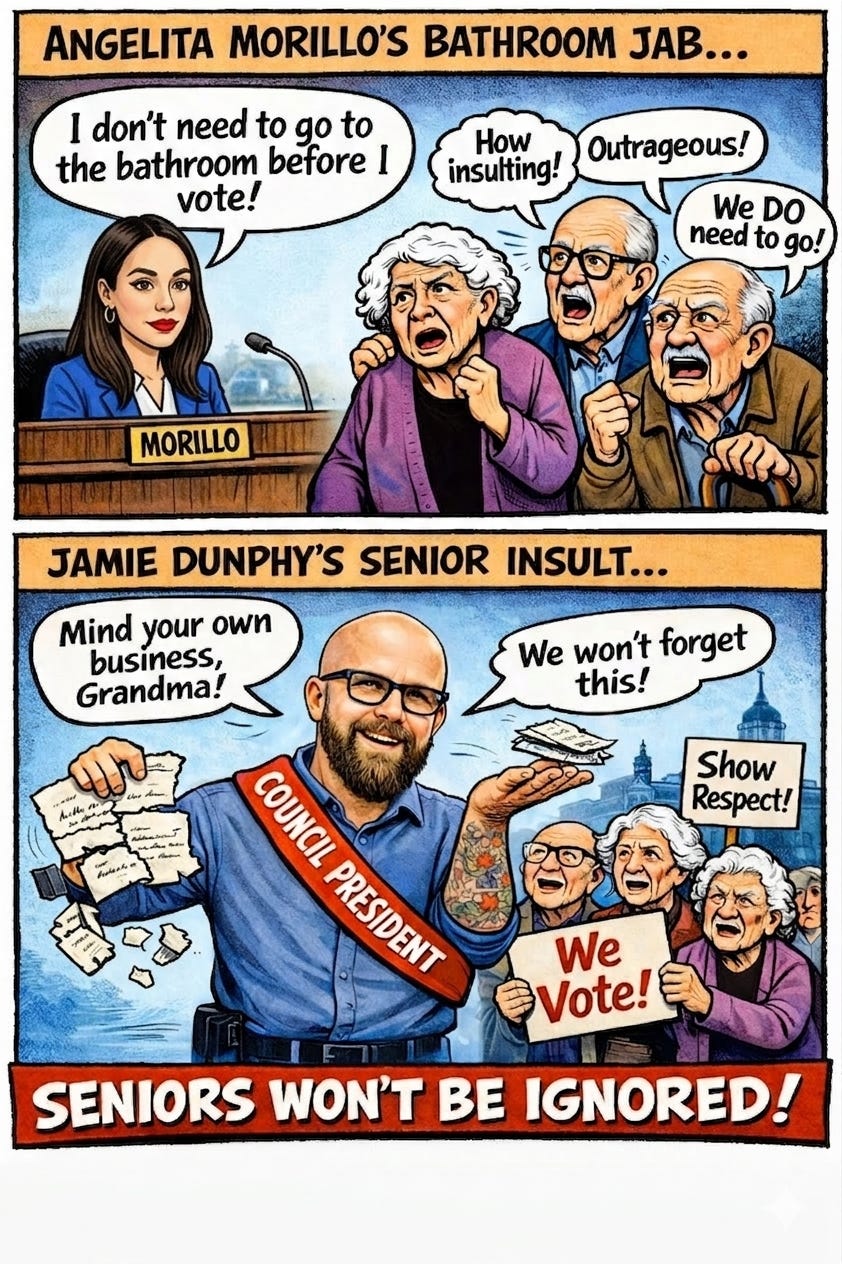
And earlier this year, during a council stalemate, another council member mocked older colleagues with a dig about bathroom breaks.
Individually, each of these moments might be dismissed as a lapse in judgment.
Taken together, they raise a larger and more uncomfortable question:
When did basic respect for citizens become optional at Portland City Hall?
The first episode came during the chaotic leadership stalemate on the City Council earlier this year. The council spent hours deadlocked while trying to elect its own president, unable to move forward while the city faced mounting challenges.
During that debate, Councilor Morillo delivered a line that quickly made the rounds in Portland political circles. As the council remained stuck, she took a swipe at her older colleagues:
“Because I am not as old as you, I will sit here and I won’t have to go to the bathroom for the vote. I will wait as long as it takes, and I will wait for Councilor Kanal. So, whenever you are ready to show some level of maturity, I am ready to take a vote.”
The remark circulated widely after it appeared in reporting by The Oregonian on the council’s leadership stalemate.
The irony in the closing line—calling for someone else to “show some level of maturity”—was hard to miss.
And it set the tone for what came next.
The second episode unfolded very differently.
According to reporting by The Oregonian, Council President Jamie Dunphy recently received a handwritten letter from a 95-year-old Portland resident.
Her concern was straightforward: she questioned whether Dunphy’s visible tattoos reflected the professional image she expected from someone holding his office.
Reasonable people can disagree with that view. Cultural norms around tattoos have clearly evolved.
But the real issue is not the letter or whether the woman was right.
The issue is how an elected official responds when a citizen—especially one who has lived nearly a century—takes the time to write to her government.
In a world of healthy civic discourse, a leader might disagree politely or simply file the letter away. Instead, Dunphy chose the path of public shaming, telling the elderly woman to “mind your own business” and labeling her concerns “small-minded.” He later shared the exchange publicly.
Think about that for a moment.
A 95-year-old citizen took the time to write to her government. The response was not respectful disagreement, or even quiet disregard. It was a public ridicule.
Healthy civic engagement depends on a basic expectation: citizens should be able to communicate with their government without being mocked or publicly shamed.
That principle applies even when those citizens are wrong.
It applies when their views are outdated.
And it certainly applies when those citizens are seniors who have spent decades contributing to the community.
When elected officials publicly “clap back” at constituents—especially elderly ones—the message is unmistakable: If you don’t share my cultural sensibilities, your voice no longer counts.
That message discourages civic participation. And it erodes public trust.
These incidents also land in a city where many residents already feel the relationship between City Hall and the public has deteriorated.
Across Portland—whether the issue is homelessness policy, taxes, public safety, or basic city services—residents frequently say they feel dismissed when they raise concerns.
Rightly or wrongly, the perception has taken root that City Hall views criticism not as input from citizens—but as something to brush aside.
Moments like these reinforce that perception.
A tense council meeting turns into a snipe about age, A 95-year-old who writes a letter is publicly scolded. Together, these incidents send a message about the culture taking shape in local government.
And that message carries consequences.
Public office comes with a simple expectation: leaders should show more restraint than the average social media user.
Holding office means hearing criticism. Sometimes it will be thoughtful. Sometimes it will be unfair. Sometimes it will come in shaky handwriting from someone who has lived nearly a century.
Leadership requires something social media rarely rewards: restraint.
It means responding with perspective and humility, even when criticism feels irritating or outdated.
That standard matters even more today.
Portland faces real challenges. Persistent homelessness. Struggling small businesses. Public safety concerns. These are not small problems, and they demand leaders capable of rising above petty point-scoring..
What residents want from their leaders is seriousness and competence.
Too often lately, what they are seeing instead is performance politics.
Bathroom gibes in council debates.
Public clapbacks at elderly women who write letters.
Portland’s seniors helped build this city. They paid the taxes that funded its schools, parks, and infrastructure. They raised families, started businesses, and helped create the community that younger generations now inherit.
Many remain active citizens. They attend meetings. They write letters. And they vote in every election.
They deserve something simple from those who hold public office today:
Respect.
And if City Hall forgets that, Portland’s voters—many of them seniors—are more than capable of reminding them.
After all, the "small-minded" grandmother with the pen is still a powerful force in the voting booth.
No posts
Comments
Nothing yet. Say the first thing.
Sign in to join the conversation.