
Portlanders voted for a police accountability system built on independence, transparency, and public trust. We were promised a watchdog—not a body operating under City Hall’s thumb.
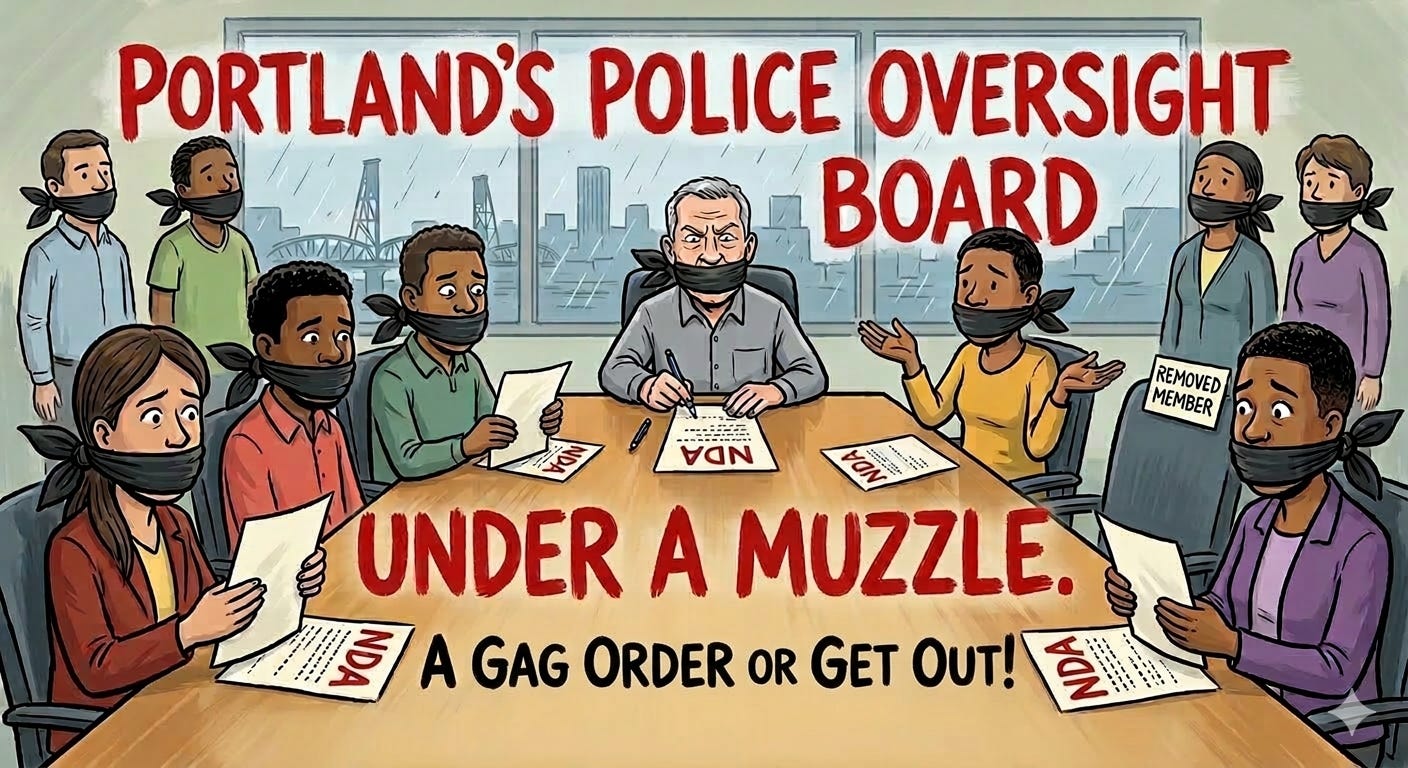
Instead, City Hall demanded that every Community Board for Police Accountability (CBPA) member, including me, to sign a sweeping nondisclosure agreement (NDA) that would silence even basic public discussion of the board’s work. When I refused, the City Council removed me in a narrow 7–5 vote.
Now I’m suing the City of Portland. The case asks a simple question: Can the City hide public information behind a blanket of secrecy that the Oregon Constitution does not allow?
A Gag Order Disguised as Paperwork
The message from City Hall was clear: sign the gag order or you can’t serve.
That demand contradicts what Portland voters created. The Charter requires an independent CBPA to operate openly, hold public meetings, and keep the community informed.
The City’s NDA does the opposite. It declares that “all information shared with [a CBPA member] shall be treated as confidential” and may not be disclosed “in any format, including verbally.” It never defines what “confidential,” “privileged,” or “strategic” means—effectively treating everything is secret unless City Hall decides otherwise.
During Council testimony, a City representative acknowledged that even a flowchart explaining how officer misconduct move through the system would be off limits for CBPA members to discuss. Yet the City would release that same document under a public records request—if someone knew it existed and asked for it.
Think about that: the people appointed to ensure police accountability could not talk about what the public could freely request. That is the definition of a gag order—and precisely what Article I, section 8 of the Oregon Constitution forbids: laws “restraining the free expression of opinion, or restricting the right to speak, write, or print freely on any subject whatever.”
Oregon has rejected government secrecy since 1862. The Oregon Supreme Court has affirmed that the “people have the right to know. Freedom of information about public records and proceedings is their just heritage.” The Council majority seem to have forgotten that heritage.
I Offered to Sign a Lawful NDA
Throughout my career—as a school superintendent, a mayor, chair of a state commission that investigated teacher misconduct, and a U.S. Senate staffer, I routinely handled sensitive information, including confidential personnel records, investigative materials, and privileged legal advice.
Those materials absolutely should be protected. I offered to sign an agreement covering them.
That is how responsible public bodies normally operate—protecting what is truly confidential information while respecting the public’s right to understand how their institutions function.
The City refused, insisting on an agreement restricting speech about virtually everything connected to the board’s work.
Staff recommended my removal. On February 11, 2026, the Council voted 7–5 to oust me—not for misconduct but for refusing to give up my right to speak. I thank Councilors Clark, Zimmerman, Smith, Ryan, and Kanal for their support of me and free speech.
This is not a dispute about paperwork. It’s about whether Portland’s government can silence the very people appointed to hold it accountable.
A Larger Transparency Problem
This NDA reflects a broader problem: a City Hall increasingly comfortable with secrecy and willing to use procedural tools to silence dissent. The CBPA was supposed to counter that culture. Instead, the City is trying to turn it into another closed‑door institution.
Transparency is not a slogan. It is a constitutional obligation—and the foundation of public trust.
If the City can require a police oversight board to operate under a gag order, it can impose the same secrecy on any board, commission, or volunteer body. It can muzzle budget committees, neighborhood associations, advisory groups—anyone who might speak publicly about what they see inside City Hall.
The precedent is dangerous: speak freely and you can be removed.
Why This Lawsuit Matters
I filed this case because Portlanders deserve a government that honors the Charter they voted for, respects the Constitution that protects them, and trusts them with the truth. .
The real question is not whether I remain on a board. The question is whether citizens must surrender their voice in order to serve their community.
A government that demands silence from its watchdogs is not strengthening accountability. It is weakening it.
This case is not about my voice. It is about whether the City can take yours.
Bob Weinstein is a Portland resident and former mayor of Ketchikan, Alaska. He is represented by attorney Edward A. Piper of Glenmorrie Law LLC.
No posts
Comments
Nothing yet. Say the first thing.
Sign in to join the conversation.