
The conventional meets the experimental with a mix of new releases including three new ones from Ivo Perelman and some archive UK jazz from a band that never got around to releasing an album in their lifetime. A spicy mix of straight ahead jazz together with the best in current improvisation.
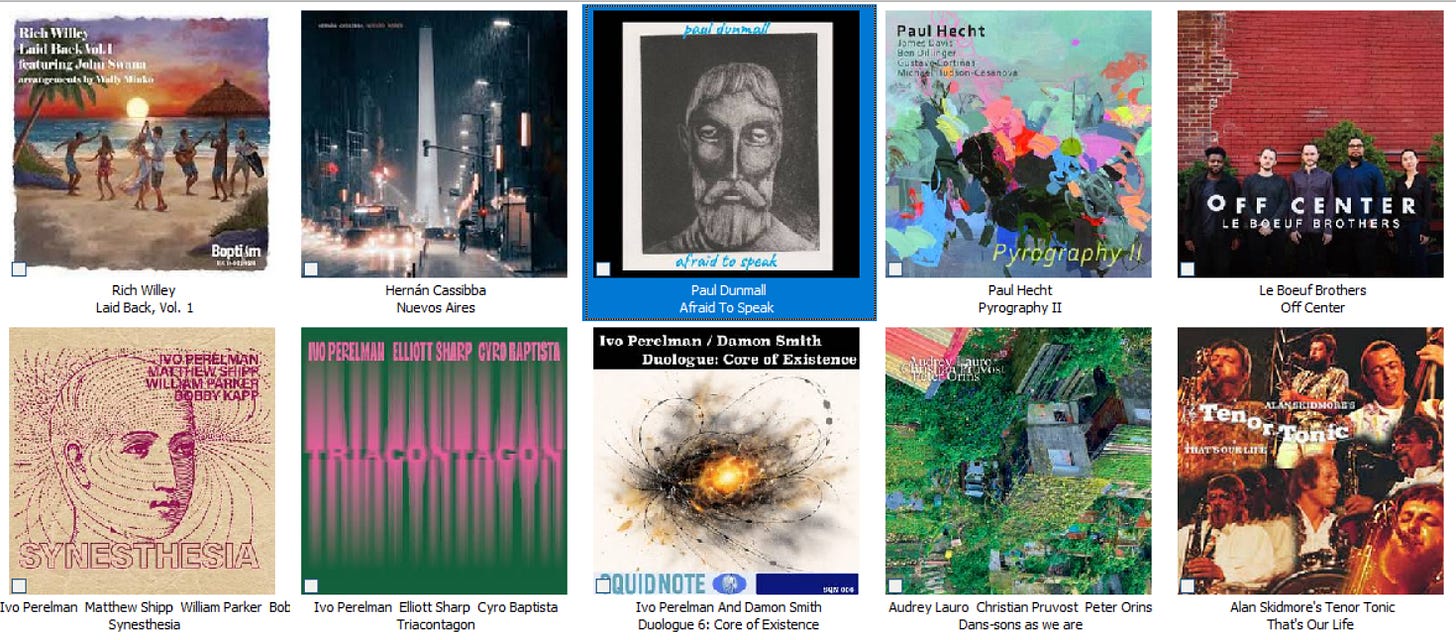
In recording Laid Back Vol. 1, Rich Willey had several specific goals. He wanted to showcase the playing of the great trumpeter John Swana exclusively on the EVI (electronic valve instrument), making the case for the instrument’s great potential and for Swana’s artistry. Although he is a skilled arranger and contributed all seven compositions on this set, he wanted to utilize the talents of arranger Wally Minko. And, most of all, Willey wanted to create a jazz album that, in addition to being inventive, was joyful and fun; modern good-time music that a large audience would enjoy. Utilizing top-notch musicians from Chicago assembled by producer Carey Deadman, Rich Willey succeeded at all of his goals.
The groove-oriented music on this release is danceable and filled with happy spirits but never predictable. There are superior solos by Swana, trumpeter Willey, Paul Mutzabaugh on organ and electric piano, trombonist Steve Duncan, and Jim Gailloreto on soprano, spirited arranged ensembles from Minko, and consistently infectious rhythms by the five-piece rhythm section. The result is a memorable and easily enjoyable set.
Pyrography II builds upon the foundation of Hecht’s debut by expanding the ensemble into quartet and quintet settings, further exploring the intersection of rigorous composition and spontaneous improvisation. The album features a core rhythm section of bassist Ben Dillinger and drummer Gustavo Cortiñas, alongside the melodic voice of trumpeter James Davis, with the addition of alto saxophonist Michael Hudson-Casanova on select tracks. This ensemble navigates a diverse programme that ranges from abstract original compositions to imaginative reinterpretations of jazz standards. Throughout the record, the group demonstrates a high level of telepathic interplay, balancing Hecht’s academic background and structural complexity with a soulful, outward-facing approach that makes the music as accessible as it is intellectually engaging.
The Le Boeuf Brothers new album represents a pivotal moment in the duo’s discography, showcasing their ability to synthesize intricate compositions with a world-class ensemble. Building upon the artistic trajectory established in previous projects, this release features a powerhouse band led by pianist Pascal and saxophonist Remy, who are joined by the formidable core rhythm section of tenor saxophonist Dayna Stephens, bassist Linda May Han Oh, and drummer Christian Euman. The album is characterised by its sophisticated arrangements that challenge traditional structural boundaries, expertly balancing rigorous through-composed passages with expansive, high-velocity improvisation. By fostering a deep, telepathic interplay among these top-tier musicians, the record captures a vibrant, forward-looking aesthetic that highlights the brothers' refined compositional voices and their commitment to pushing the expressive limits of modern jazz.
The first of three new releases from Ivo Perelman on the show. This one is an album of improvised music featuring Elliott Sharp, and Cyro Baptista. The record consists of six tracks, all of which are spontaneous, unscripted performances without pre-composed melodies or fixed rhythmic structures. The musicians utilise extended techniques on their respective instruments—tenor saxophone, 8-string electric guitar, and various percussion—to create a series of abstract, textural improvisations. Unusually for an Ivo album the tracks have names rather than just being numbers.
An album of free improvisation featuring alto saxophonist Lauro, trumpeter Pruvost, and drummer Orins. The trio focuses on texture and timbre, utilising extended techniques such as breath variations, harmonics, and resonant drum mechanics to create a soundscape that moves between quiet, restrained tension and dense, shifting sonic layers. The record, recorded following the group's initial meetings in 2023, is defined by a collective approach to sound-making that emphasizes mutual listening and physical, gesture-based interaction over traditional melodic or rhythmic structures.
The second album from Ivo is the sixth release in his ongoing Duologue series and features ten freely improvised tracks. They were captured in a single session, focusing on the spontaneous interplay between tenor saxophone and double bass. The performances utilise extended techniques, including bowing, percussive string attacks, and multiphonics, to explore textures and tonal dynamics without the use of pre-composed melodies or fixed rhythmic structures.
Composed and led by bassist Cassibba. The core ensemble features Lucas Goicoechea on alto saxophone, Gonzalo Rodriguez Vicente on tenor saxophone, Nahuel Bracchitta on guitar, Leo Duck on piano, Matias Crouzeilles on drums, and Cassibba on bass. On tracks 4 and 8, the group is joined by a guest ensemble consisting of vocalist Juana Sallies, pianist Leandro Garcia de la Maza, conductor Julian Solarz, bass player Cristian Basto, and a string section featuring violinists Guillermo Rubino and Gustavo Mulé, violist Carla Regio, and cellist Clement Silly. The album features everything from spikey piano-bass tutti lines to soaring melodies over rhythmic nonsensical bopping, to fluid and flowing purely chamber interjections featuring the string quintet, voice, and piano.
The third offering from Ivo sees his him time up with long time associates for another album of improvised pieces. Following the acclaimed Ineffable Joy and Heptagon, the group continues to explore spontaneous composition, open form, and strong collective interplay. This time, the music leans further into a modern jazz language, with sharper focus, clearer shapes, and a refined sense of flow.
A fantastic group that never released an album during their short lifetime. It’s a piano-less quartet of Alan Skidmore , Paul Dunmall, Paul Rogers and Tony Levin, formed in February 1985. The band toured throughout 1985 and 1986 and Jazz In Britain has compiled an album of live and studio recordings from 1985, some of which it is believe were intended for an album release which reached fruition. The interplay between Skidmore and Dunmall is wonderful. A mix of riff lead interplay and more ambient excursions. More great work by the excellent Jazz in Britain.
Talking of Dunmall - forty one years later he is still going strong. Departing from a run of releases for Discus Music featuring mainly large group composition, this stripped down, free-blowing session features a group of great players on top form, delivering music which is in turns heavily incisive and delicately traced. Dunmall himself has never sounded better than he does here. With Paul Dunmall who plays tenor and C soprano saxophones, and Bb clarinet, are Corey Mwamba - vibraphone, Steven Saunders - electric guitar, Dave Kane - double bass and Miles Levin - drums who completes the circle back to the previous album featuring his father.
Thanks for reading Different Noises! This post is public so feel free to share it.
Comments
Nothing yet. Say the first thing.
Sign in to join the conversation.