
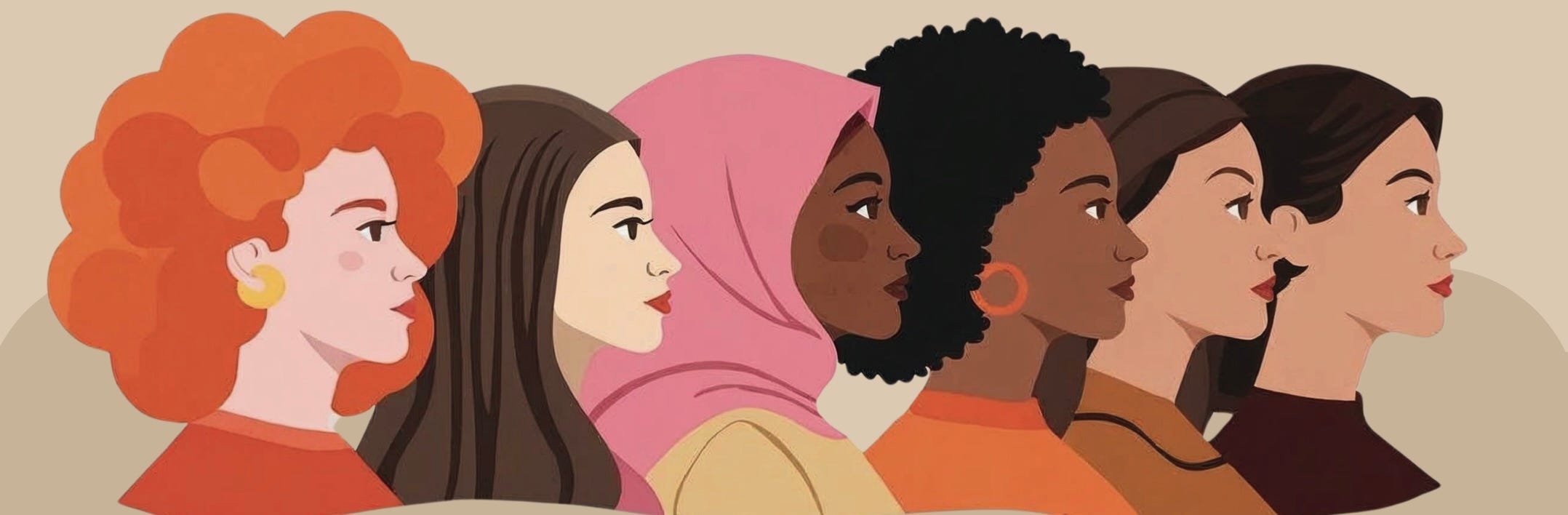
The cruel, savage Trump deportation campaign is spreading pain throughout this nation, to innocent men, women, and children. Two people my wife Judy and I know, who have suffered and have to worry about future suffering, are women. So I was naturally drawn to an event called The Journeys of Immigrant Women.
The Long Island Immigrant Justice Alliance presented the event at the Congregational Church of Patchogue this past Sunday, March 15. The facilitator of the event, Cheryl Keshner of the Empire Justice Center, serves on the steering committee of the alliance, and she described the organization in an interview afterward. “It’s a cross-section of folks from different nonprofits, as well as some concerned individuals who have joined, and some people from legal organizations,” Keshner said. “It’s a nice mix of folks who are concerned about justice for immigrants and who want to take action.”
The alliance tries to do some sort of program once a month. Last November, I attended one of them in Huntington Station, a vigil for los desaparecidos, immigrants who have been taken from their families and “disappeared.” For February, a focus on women seemed a natural.
“It’s Women’s History Month, and it was a week after International Women’s Day,” Keshner said. “We were just thinking about doing something for a monthly event, and felt that that would be appropriate, just because so many women are being adversely impacted by the immigration enforcement on many levels. We do see a lot of women in our community who are struggling. Oftentimes their partners are being taken by ICE, and they’re kind of left without that additional emotional and financial support. They’re trying to raise their kids. They’re just trying to get through. And then, of course, there are women being taken as well.”
Despite the natural appeal of an event focused on women in Women’s History Month, the turnout was much smaller than the Congregational Church has had for past events. Patchogue has a large Latino population, and federal deportation efforts are a familiar story there. “ICE in the community is not new, in that we had had ICE as an issue in this community 19 years ago, when I first came here,” said the church’s pastor, the Rev. Dwight Lee Wolter. “It might be new in the awareness of people who don’t normally think about it, like white, middle-class people with documentation.” Recently, Wolter said, a dishwasher at a Main Street restaurant has been deported, and ICE is targeting a laundromat in town.
One of the organizers of the event, Dick Koubek of Long Island Jobs with Justice, explained the dilemma that the Long Island Immigrant Justice Alliance faced, in deciding how to publicize the event. “We didn’t put out a press release, because the speakers were undocumented,” Koubek said. “But we did circulate to thousands of people the flyer.” The alliance’s events held in places in the center of the island have been good—in the range of 150 to 200 people. “Then we had one in Freeport, because we said, we can’t keep having it in the same places,” Koubek said. “We started to look at the more outlier spots that are under assault by ICE. So we went to Freeport on February 18, and the turnout was about 70, which is way down from where we were.” The threat to people who might attend the alliance’s events is a strategic consideration for the group. “We have to decide, do we go for numbers, or do we go to the places that are being affected, even though we don’t get as many people turning out?”
The widely circulated flyer that Koubek mentioned described Sunday’s event this way: “Across borders, through fear, and against all odds, immigrant women have carried their stories in silence for too long. Join faith leaders, advocates, and community members for an afternoon of personal testimony, poetry, reflection, and action to honor the courage of immigrant women in the spirit of Purim, Lent, and Ramadan. Their voices deserve to be heard.”
Two of those voices were those of Patricia and Claudia. They were among 10 women who wrote for an Immigrant Writers Workshop sponsored by the New York Immigration Coalition, the Long Beach Latino Civic Association, CARECEN (Central American Refugee Center), and Herstory Writers Workshop. “The idea was to get people to write about their experiences, with the theme of looking for a home,” said Helen Dorado-Alessi, executive director of the Long Beach Latino Civic Association. “They were looking for a home and thought they had found it here on Long Island.” Of course, mass deportation has made that home feel much less secure.
“This is a land where one does not come to fulfill just one dream. One comes to discover that it is possible to have many,” said Patricia. She spoke in Spanish, and the organizers provided audience members with a printed English translation. “And just now, when I finally feel that I am home, a deep fear appears. A different kind of fear, a larger one, because it no longer comes from my mind or from my insecurities. It is a fear I cannot control, a quiet presence that reminds me how fragile the things we love can feel. It is the fear of losing everything.”
That fear, Patricia said, is not hers alone. “I see it in the eyes of so many people who, like me, love this land and have built a life here, a family, a story. My soul aches when I see the pain of those who live with the constant fear of being separated from the place they now call home. Because it is not only about returning to a place they once chose to leave. The real fear is losing the home they found afterward, the place where they began again and found happiness.”
Many women have undergone the hardship of leaving behind the land where they were born and grew up, because the terror of gangs or the struggles of their native country’s economy prompted them to undertake the perilous journey north.
The other writer was Claudia, writing far from the home she left behind. “Written from a place where I decided to migrate with my son, although I still do not know with certainty if the decision was the right one,” Claudia said. “But anyway, here we are in New York. A city where I deconstruct and reconstruct myself differently each day. Where today the absence of my culture and my peers weighs more than ever. Where I constantly seek to belong and fit in. Today I write from a place where my physical features, my language, and my skin color are at risk.”
One of the speakers representing a faith tradition was the Rev. Marie Tatro, vicar for community justice ministry of the Episcopal Diocese of Long Island. She offered a Lenten link to the dangerous journeys that so many women have taken.
“In the Christian tradition, the season of Lent tracks the story of Jesus going out into the wilderness for 40 days—to pray, to fast and stare down the forces of evil—before returning to face his execution at the hands of the Roman Empire,” Tatro said. “A true wilderness journey is not a relaxing stroll through the woods. You don’t always have a clear path, or a safe one….Immigrant women bear heavy physical burdens in the migration process, often with their babies literally on their backs, and whatever other necessary belongings they can carry. But they also face extreme emotional and structural challenges. They are frequently targets of traffickers and gender-based violence, including within detention systems themselves.”
Tatro said that her great-grandmother and her two sisters were teenagers when they made the journey in the steerage of a ship, from the Galicia region of Poland, now part of Ukraine, to this country. “We stand on the shoulders of these, our foremothers,” Tatro said. “All of us, whether you are Jewish, Muslim, Christian, Buddhist, Hindu or any other faith community that exists in this world, there is a woman, or several in your lineage that carried you to where you are now. For those of you here who observe the Holy Season of Lent, as you imagine Jesus—a brown-skinned, Middle Eastern Jew—on his journey through the wilderness, I want you to imagine those women, both in our pasts and in our present day, walking alongside him on that journey.”
Of course, male immigrants are suffering, too. Rev. Wolter reminded the audience of the 2008 murder, a few blocks away in Patchogue, of an immigrant from Ecuador named Marcelo Lucero. A group of high school students, looking to harass someone who looked Latino, accosted Lucero in the street. “It was lethal for him, because he fought back,” Wolter said. “He fought back. ‘How dare you fight back?’ ” Lucero was buried from Wolter’s church. His brother, Joselo, became a friend of mine when we worked at the Hagedorn Foundation, which enabled Joselo to give a series of talks to students, urging tolerance for immigrants.
The speakers at the event also included Judith May, retired from the Schechter School of Long Island, reflecting on the Jewish feast of Purim and women’s courage; Ala Amoachi, an immigration attorney; Monica Díaz, an organizer for SEIU 32BJ (Service Employees International Union) and a board member of Long Island Jobs with Justice; Katherine Veloz of SEPA Mujer, an advocacy organization for Latina immigrants; and Sumera Danisman, who moved to this increasingly autocratic nation to get away from authoritarian rule in her native Turkey. Danisman talked about immigrant women in the context of the closing days of the Muslim month of fasting, Ramadan.
Closing out the talks, Mary Beth Guyther, a member of the faith committee of the Long Island Immigrant Justice Alliance, offered ideas for action. That included New York for All, state legislation that would prohibit state and local resources from being diverted to the federal mass deportation agenda. If you feel the need to do something to ease the pain of the women—and men and children—who are being targeted by ICE, asking your legislators to support that bill in the Senate and Assembly (S. 2235B, A. 3506B) is one way you can help. Gov. Kathy Hochul’s proposal to help immigrants does not go as far as New York for All. So it really needs a boost. The voices of immigrant women like Patricia and Claudia should motivate you to help.
No posts
Comments
Nothing yet. Say the first thing.
Sign in to join the conversation.