
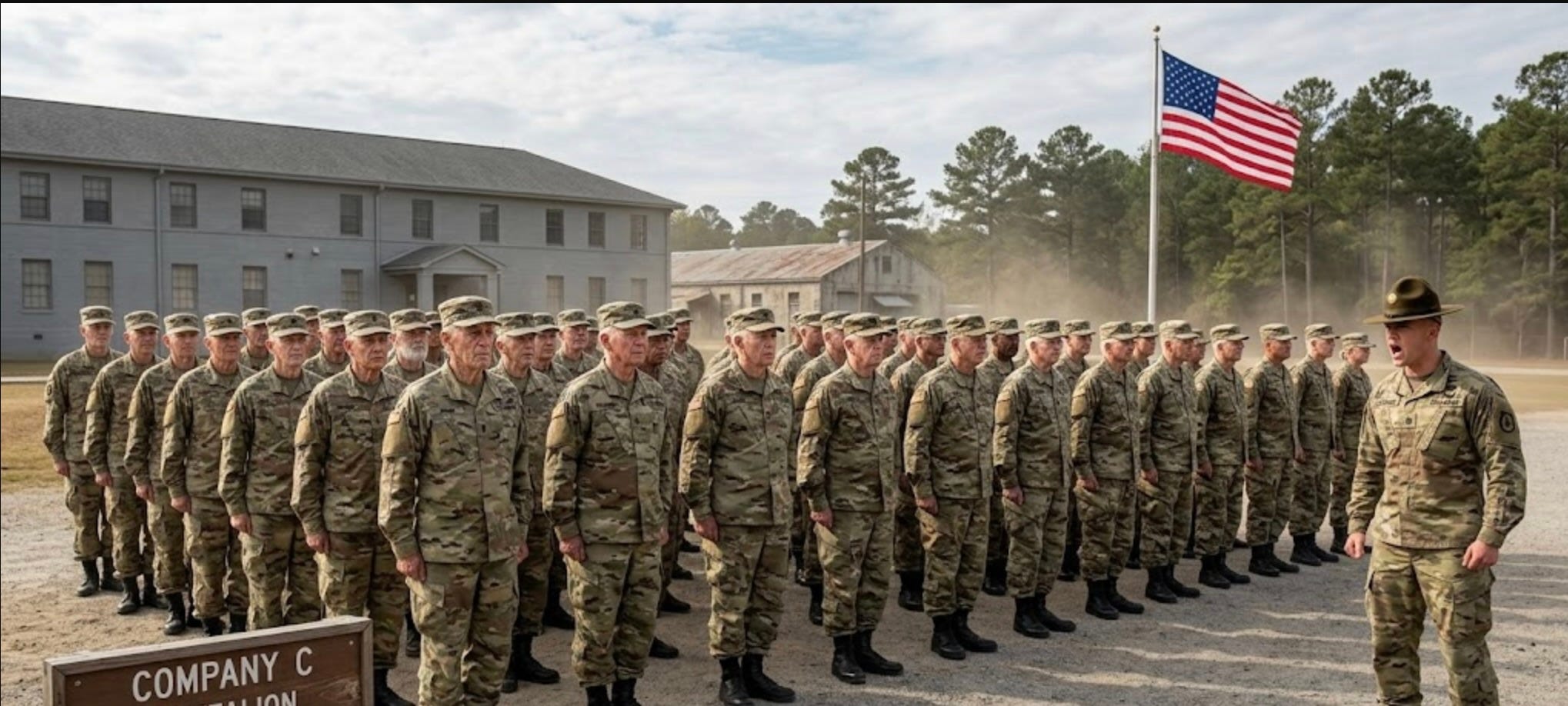
If this country still had an active draft, there would be a simple cure for warmongering by old men who send young Americans off to war: Change the draft age to 55.
Well, the draft ended in 1973. And the mandatory requirement that all men—yes, unconstitutionally, only men—register for the draft at age 18 is basically a joke. As I’ve said before, a lot of young men ignore it entirely, even though failure to register is a federal crime. The Department of Justice doesn’t prosecute offenders, because there are too many. Some men do register at 18, but fail to notify the government when they change addresses. As a result, the list that the draft registration system produces is essentially useless.
So my whimsical cure for warmongering is no longer possible, even as a joke: no draft, no draft age. But something is happening that sounds almost like an echo of my older-draftees idea: The army has just raised the age when people can enlist to 42. It has also eliminated the need for a recruit to obtain a waiver “for a single conviction of possession of marijuana or a single conviction of possession of drug paraphernalia,” the army explains.
What do these changes mean? Will they lead us to an army of aging potheads, too stoned to shoot straight? Probably not. But the changes do mean this: Recruiters are having a tough time getting people to sign on the dotted line of the enlistment contract. Sorry, but I can’t summon up any empathy for recruiters, because bad news for recruiters is good news for the rest of us. This moment is a particularly bad time for anyone to enlist. Signing on the dotted line could put you in danger of being dispatched to an American city to suppress an imaginary insurrection—or off to the Middle East to serve as fodder in this nation’s latest unnecessary, indefensible war.
President Bone Spurs once thought war was a bad idea, when he would have been exposed to its dangers, if he hadn’t so resolutely avoided the draft. Now he thinks war is not such a bad idea after all, even though he vacillates between calling the hostilities with Iran a war or an “excursion” or something else. Why not call it a war? “This is for legal reasons,” Trump acknowledged recently. “Because as a military operation, I don’t need any approvals. As a war, you’re supposed to get approval from Congress, something like that.”
No matter what he calls it, Trump says the United States has won whatever this is, but if Iran doesn’t knuckle under, he threatens further bombing. This is what he posted on social media:
Great progress has been made but, if for any reason a deal is not shortly reached, which it probably will be, and if the Hormuz Strait is not immediately “Open for Business,” we will conclude our lovely “stay” in Iran by blowing up and completely obliterating all of their Electric Generating Plants, Oil Wells and Kharg Island (and possibly all desalinization plants!), which we have purposefully not yet “touched.”
Such an attack on the drinking water of civilians would incontrovertibly constitute a war crime. It would be further evidence that whatever this is is—war, excursion, or lovely stay—it is decidedly not a “just war,” to use a frequently misused oxymoron. It’s just a war. But Secretary of Defense Pete Hegseth sees it not only as just, but as divinely inspired. Last week, at a Pentagon prayer service—another loathsome oxymoron—Hegseth said:
Let every round find its mark against the enemies of righteousness and our great nation. Give them wisdom in every decision, endurance for the trial ahead, unbreakable unity, and overwhelming violence of action against those who deserve no mercy.
In the closing weeks of Lent, the season leading up to the liturgies marking the passion, death, and resurrection of Jesus, the defense secretary did not hesitate to invoke that sacred name as part of his pep talk: “We ask these things with bold confidence in the mighty and powerful name of Jesus Christ, King over all kings and amen.”
A few days later, addressing a large Palm Sunday crowd in Rome, Pope Leo XIV begged to differ, though he did not mention either Hegseth of Trump by name.
This is our God: Jesus, King of Peace, who rejects war, whom no one can use to justify war. He does not listen to the prayers of those who wage war, but rejects them, saying: “Even though you make many prayers, I will not listen: your hands are full of blood.”
The pope has been saying a lot about war and peace, starting right after his election last year. On May 11, in his first Sunday address as pope, he made his core attitude abundantly clear: “Mai più la guerra!” Never again war! In January, he told members of the diplomatic corps accredited to the Vatican: “War is back in vogue and a zeal for war is spreading. The principle established after the Second World War, which prohibited nations from using force to violate the borders of others, has been completely undermined.” And he has continued to speak out in the weeks since the United States and Israel launched the war with Iran.
Nor has Pope Leo been alone among Catholic leaders critiquing this war. Cardinal Robert McElroy, the archbishop of Washington, called the war “not morally legitimate.” He pointed out that one of Leo’s predecessors, Pope Benedict XVI, rejected the idea of a preventative war: one that is justified on the basis of possible future events. McElroy added, “Our current war effort does not meet Catholic just war teaching because it is far from clear that the benefits of this war will outweigh the harm which will be done.”
The leader of another major Catholic archdiocese, Cardinal Blase Cupich of Chicago, reacted strongly against the White House release of a video that mixed actual footage of war damage in Iran with fictional images from action movies. “A real war with real death and real suffering being treated like it’s a video game—it’s sickening,” Cupich wrote.
Vatican Secretary of State Cardinal Pietro Parolin recently cited McElroy and said the Washington cardinal had “explained this point very well” in declaring that this war does not meet the “just war” requirement that the benefits outweigh the harm. “Easter is the feast of peace, the peace of the risen Lord, and therefore, it is a special occasion to renew this invitation and put an end to this foolishness that is war,” Parolin said.
Still, the National Catholic Reporter recently ran a column by Michael Sean Winters, one of NCR’s regular contributors, under the headline: “Just war theory is back.” Here’s the nub of his argument:
Many people have reduced just war theory to a single criterion, just cause, and failed to note the other criteria: War must be a last resort, and a war must be winnable to be just, and the warmakers must have a right intention. Modern abuses of just war theory, as well as its critics, miss the fact that the theory as a whole is intended to make it more difficult to go to war, that just war theory is itself a practical tool for avoiding violence and for restraining it once begun.
Why, then, is just war theory back? Why has a commitment to nonviolence not supplanted it? In a word: Ukraine.
But the “just war” oxymoron has two parts: ius ad bellum, which deals with the criteria for judging whether a nation can justly enter a war, and ius in bello, which lays out the criteria for how a nation should behave once it is in a war. Though Ukraine is defending itself, it has caused civilian casualties in Russia, violating the ius in bello rules.
Despite his citation of Ukraine as evidence of the value of “just war,” Winters links to a 2020 NCR article that cited Cardinal Michael Czerny, undersecretary for the Vatican’s Migrants and Refugees Section. In that article Czerny referred to Fratelli Tutti, on Fraternity and Social Friendship, an encyclical by Pope Francis. The encyclical is correct in cautioning against reliance on the “just war” theory because it often “is just misunderstood and misused as a justification and it is invoked as a shield, as a disguise for motives which are far from just and far from justifiable,” Czerny said.
To me, Czerny’s analysis sounds a lot like what I have often asked about “just war” theory: Try to name a circumstance in which some nation contemplated entering a war, but studied the ius ad bellum criteria and essentially decided: “Nah! That war is not just. Count us out.” As the United States thought about dropping atomic bombs on civilian populations in Hiroshima and Nagasaki, it’s unlikely that President Harry S Truman studied the ius in bello rules. In any case, he not only decided that America should drop those bombs, but rejoiced about it. Still, unleashing those devastating new weapons on two cities filled with civilians clearly violated the ius in bello rules. In other words, “just war” is used as a “justification” and a “shield,” as Czerny said. It’s a seal of approval, to make a war seem OK, despite the reality. It doesn’t stop wars from happening or make the warriors refrain from war crimes.
In the current situation, Pope Leo continues to urge dialogue, not destruction. Here’s what he said in a CNN interview:
I was told that President Trump had recently stated that he would like to end the war. Hopefully, he’s looking for an off-ramp. Hopefully, he’s looking for a way to decrease the amount of violence, of bombing, which would be a significant contribution to removing the hatred that’s being created and is increasing constantly in the Middle East and elsewhere.
Speaking of hope, my friends in Pax Christi Long Island fervently hope that Pope Leo goes one step further. We hope that he writes an encyclical stating definitively that the church rejects the “just war” oxymoron. He’s the right person for that important job. One of the major proponents of “just war” thinking was Augustine of Hippo. Pope Leo belongs to the Order of St. Augustine and served for years as its prior general. Who could possibly be better suited than an antiwar Augustinian priest to the task of burying the “just war” oxymoron propounded by Augustine? The pope wouldn’t have to criticize Augustine. He’d just have to explain the historical setting that persuaded Augustine to lend his persuasive skills to the “just war” idea—and then write that there’s no such thing as a “just war.”
This one is certainly not a “just war.” Nor is it, as Pete Hegseth would have us believe, a divinely inspired one. The attempt by the secretary of war crimes to bless his war by using the name of Jesus was blasphemous. I’ll let Bishop William J. Barber II, president of Repairers of the Breach, have the final word:
This is Trump’s greatest unholiness and failure. He is at war with divinity. He is driven by the need to be all in all. So were the ancient Caesars. It’s what drove them insane and caused them to make insane decisions to destroy life. Could it be this is the real reason why we have a 25th amendment? When an elected leader is at war with divinity, trying to prove his own god status and demonstrate his desire for everyone to bow to him—even if it means using the resources of this nation to obliterate and kill civilians—he is, in the truest sense, “unable to discharge the powers and duties of his office.”
No posts
Comments
Nothing yet. Say the first thing.
Sign in to join the conversation.