
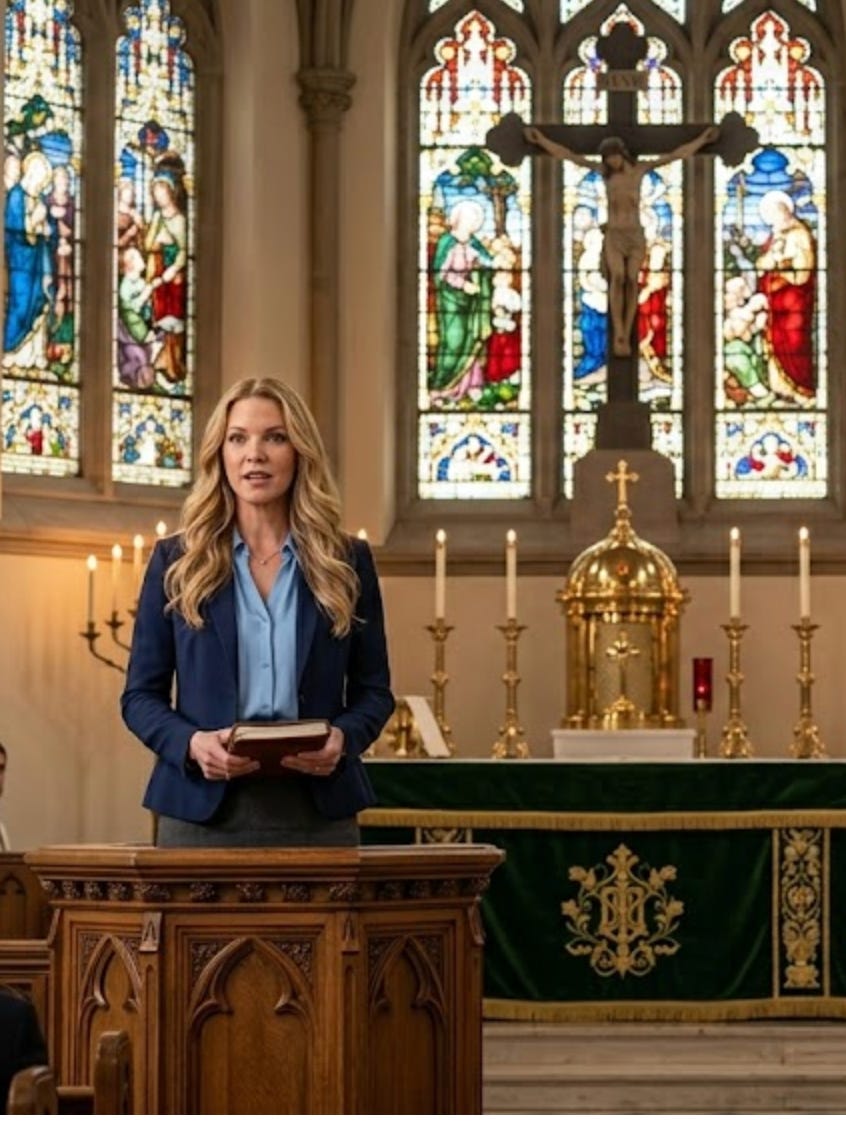
Pope Leo XIV has been a good pope for me and a lot of people, Catholics and otherwise. What’s not to like? He’s a Chicago baseball fan who has suffered with a losing team for many years, like me, and his name used to be Bob, like me, until he adopted the name of an earlier pope and of my grandson, Leo. He worked with the poor in Peru and fully grasps the crushing reality of poverty. Most important of all, he has spoken often and powerfully against war, and he hasn’t backed down under whacko criticism from the “peace president” who started the current losing war.
But yesterday, Pope Leo’s Vatican took another swipe at women. In my years at Newsday, and in retirement, I killed a lot of trees writing columns urging the church to allow women to preach the homily at Mass. In the Code of Canon Law, Canon 767 makes clear that only ordained people—priests and deacons, all of whom just happen to be male—can preach at that pivotal moment in the liturgy. Yesterday, the Vatican office governing worship repeated that prohibition in a short, flatly worded press release.
“The current discipline cannot be dispensed from,” said the press release, in response to a request by German bishops that women or other non-ordained people be allowed to preach the homily at Mass. In his report for Reuters, Joshua McElwee wrote: “The German request echoed sentiments from many bishops in the U.S. and other European countries, who say many laypeople are as capable of preaching as priests. They often cite a desire to hear sermons from women, who cannot be ordained in the Catholic Church.” But the Vatican bureaucrats were not impressed. “The reservation of the homily to a priest or deacons is not a merely disciplinary norm but derives from the very nature of the liturgy,” the release said.
It’s not possible to know how much influence Pope Leo had on that pronouncement, but this is the Vatican, where he lives. Like any pope, he has to spend time working to fix whatever is wrong with the Curia, the collection of Vatican agencies that does the day-to-day work of setting policy for the whole church. It’s not really clear how much attention he has paid to the Vatican’s Dicastery for Divine Worship and the Discipline of the Sacraments, which issued the press release. (It’s also not clear to me why organizations in the Curia that used to be called congregations, a word familiar to many, are now called dicasteries, a word unfamiliar to most people who don’t write about or work in the Vatican. It’s so unfamiliar to the dictionary I use on my computer that I just had to add it. But I digress.)
The press release merely summarized a letter to the German bishops from the DDWDS. (I don’t know if they actually use that acronym, but it’s shorter than spelling out the whole thing or using the word dicastery.) EWTN News, a conservative online publication, reported some of the actual content of the letter, which included language about the homily such as “intrinsically linked to the proclamation of the Gospel,” and “represents an exercise of the munus docendi [the office of teaching] entrusted to ordained ministers through the sacrament of holy orders.” Holy orders, of course, is ordination. And the church does not permit women to be ordained as either priests or deacons. Ah, but the letter did offer a tiny bit of consolation to the half of the species Homo sapiens not endowed with testicles—or burdened with them, if you consider the testicular contribution to such realities as war. The letter said: “There are numerous forms of proclamation of the Word and preaching that can be entrusted to the lay faithful outside the homily and outside the celebration of the Eucharist.”
The celebration of the Eucharist, of course, is the primary place where most Catholics receive preaching. That preaching is tied to the lectionary, the three-year cycle of Scripture readings. And the lectionary doesn’t always provide the best possible point of departure for preaching about current-day issues of burning importance, such as the mass deportation of immigrants—the vast majority of them everyday working people who pay taxes, including to the Social Security system, from which most of them are currently unable to collect. Only a small fraction of those being deported are the “worst of the worst,” the description used by the Felon-in-Chief, who should have a more rounded attitude toward immigration, given the immigrant origins of his own family and 66 2/3 percent of his wives.
A group of lay Catholics in the Diocese of Rockville Centre, Catholic Welcome Immigrants (disclosure: it includes me) are working to get parish priests to preach about how our national government is not even coming close to obeying the command of Jesus in Matthew 25 to welcome the stranger. That’s an uphill battle, because most priests are reluctant to depart from the readings in the lectionary to preach about something political that’s happening in the world—unless, of course, the subject happens to be abortion. Polls show that the attitude of Catholics to abortion is much the same as the general population’s. Apparently, that parish-level preaching and the consistent lobbying by the bishops are not making a lot of headway.
As a Catholic all my life, I’ve heard a lot of preaching at Mass, some excellent, but too often suboptimal. We once had a priest I dubbed “Father So,” because every homily he preached started with “So,” and what followed was clearly ill prepared. Other priests do a lot of preparation, but fail to deliver a homily that leaves one coherent, memorable message from that day’s lectionary-assigned Scripture reading. Too often, even well prepared homilies come out sounding like “holy word, holy word, semicolon; holy word,” and you leave Mass without even remembering the core point of the homily.
So, why not open the preaching at Mass to women—not just any women, but women with excellent theological training. I know plenty of those. Or open the homily at Mass to men who are not ordained but do have solid theological credentials?
Will Pope Leo get there someday? It’s not a heavy lift. All he has to do is delete or vastly edit Canon 767, so that theologically qualified people who are not ordained can preach the homily. Pope Leo did recently appoint a woman, Maria Montserrat Alvarado, as the prefect of the Dicastery for Communication. She’s the president of EWTN News. When she takes over the communication job on November 1, she’ll be the first woman who is not a member of a religious order to lead a Vatican agency. (She’d better be prepared for some firestorms. She’ll take office just before the American midterm elections, and the Felon-in-Chief could renew his nasty comments on the pope, if the election doesn’t go his way.) But letting a woman run a Vatican agency is a long way from letting women preach.
It’s an even longer way from letting women be ordained as deacons. The bishops are studying that as part of the ongoing synod process that supposedly involves listening to the voices of laypeople. Phyllis Zagano, an expert on that subject, has just written an article for Religion News Service. The headline: “A Catholic schism over women deacons? Many opponents have already left.” Zagano is a senior research associate-in-residence and adjunct professor of religion at Long Island’s Hofstra University and the author of a new book, The Vatican and Women Deacons. In the RNS article, she discusses past schisms—major splits within the church, and concludes with this:
The latest argument against restoring the abandoned practice of ordaining women as deacons is that it would cause a schism. But Pope Leo can reinstate the practice. The people who reject papal authority are already out the door. The women who have given up hoping for change are on the way out, too.
There is no Catholic doctrine banning women as deacons. Ancient Conciliar canons, medieval papal letters and even modern canon law of the Maronite Catholic Church allow for the ordination of women as deacons.
But in the view of the patriarchy dominant in the church, ordaining women as deacons would be an ominous breach in the wall of maleness, inevitably leading to a push for the ordination of women as priests. Letting women preach at Mass without allowing them to be ordained should be an easier change for the patriarchy to accept, but it probably won’t be. Pope Leo could open the door to women without ordaining them. Whether he will or not remains to be seen. Meanwhile, we’ll continue to hear homilies at Mass from only half of our species. The late Rev. Andrew Greeley, a sociologist, said that survey data showed that laypeople gave low marks to priests for their preaching. And all of those priests were men.
No posts
Comments
Nothing yet. Say the first thing.
Sign in to join the conversation.