
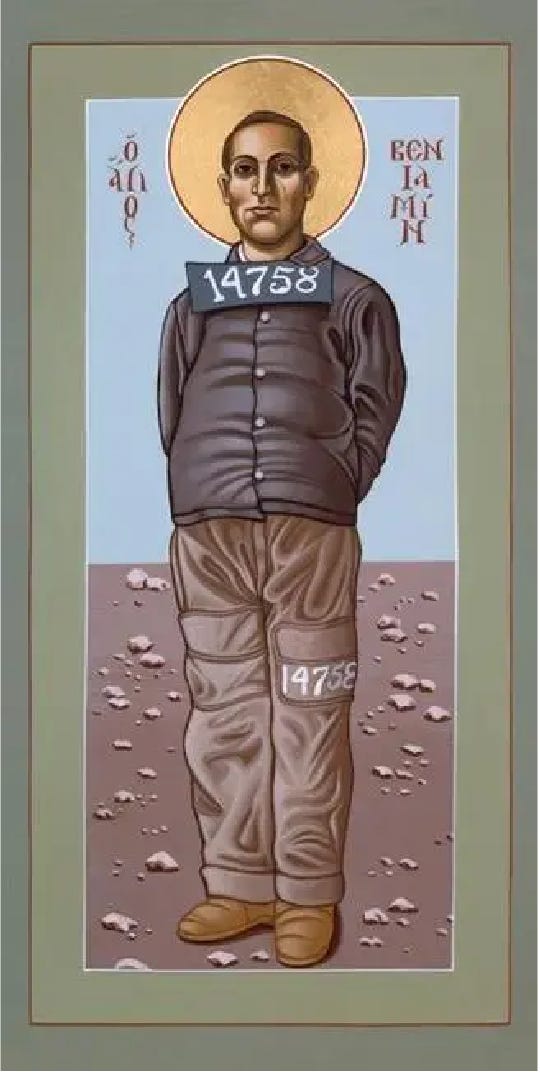
Flag Day in wartime seems like a suitable time to contemplate the wars that have been fought and continue to be fought under that flag.
Two opinion pieces in recent days have aided that contemplation: one reflected briefly on a courageous, long-ago conscientious objector and one reminded us again of the many wars this nation has fought—and not won—since the end of World War II.
Let’s start with a typically tough piece by Tom Engelhardt in Counterpunch, under the headline “War, What Is It Good For?” Of course, that question reverberates on a Flag Day that is also the 80th birthday of a president who promised many times during his campaigns to keep America out of wars—and happily accepted a newly invented peace prize from a soccer organization. Now, more than three months after he inexplicably started a war against Iran, every day brings a new comment from him that the war is over, or the Iranians are not agreeing to a peace plan, and he’ll bomb them again, or the peace plan is a few days or two weeks away. Many pundits are saying there’s no way the “peace president” can win this war that he started. Now, here’s Engelhardt on this nation’s recent experiences in warfare:
Historically speaking, consider it strange beyond compare. There may, in fact, be nothing like it in the imperial history of this planet. The United States, the greatest power on Earth from the moment it defeated Nazi Germany and imperial Japan in World War II, has never again actually won a war of any significance (or even come close). And that’s true despite the fact that it’s distinctly been the numero uno power on this planet for the last century-plus, with by far the most powerful and wildly over-funded military that has fought any number of wars during these decades, always against seemingly far less powerful adversaries….
From the Korean War in the early 1950s (at best a draw) to Vietnam (Cambodia and Laos) in the 1960s and 1970s, a distinct loss (despite the slaughter of literally millions of Vietnamese, Cambodians, and Laotians, and 58,000 Americans); from the invasion of Afghanistan in October 2001 in the wake of the 9/11 attacks on New York City and Washington D.C., to the invasion of Iraq in 2003, both of which ended in dismal defeat (Afghanistan after 20 years of combat!), as did the full-scale Global War on Terror launched by President George W. Bush; and, in the era of Donald Trump, from the Caribbean Sea and eastern Pacific Ocean (where more than 60 random boats have been blasted out of the water) to the bombing of Somalia and Nigeria, and now the devastating air and naval war on Iran, the United States, despite its weaponry, has proven incapable of actually impressing its will on lesser powers in what might by now be considered an all-American militaristic tradition….
So, don’t think there’s anything new or particularly striking about Donald Trump’s visibly failing war against Iran. In fact, the present situation there couldn’t have been more predictable (not that anyone bothered to tell that to the president).
Though I agreed with Engelhardt’s analysis, it left me feeling a tad depressed. When will we ever learn? How many losses or ties in war will it take before we stop playing that deadly game? Happily, I had a much better reaction to the other piece, a first-person essay in Newsday by Pete White, a retired social studies teacher at Northport High School, who has spent many years helping the poor in Nicaragua—and bringing Long Island students along with him. The core of his piece was an account of his regular drives to upstate Ossining, to visit his long-time friend, Sister Liz Salmon, at the headquarters of Maryknoll, formally known as the Catholic Foreign Mission Society of America. More about Sister Liz in a bit. First, Pete White’s background.
White spent his childhood in Levittown, without a father. “I grew up very poor,” he told me. “We were on welfare the whole Fifties. My mother raised four kids by herself, with nothing but a little $150 a month from welfare. We had no car. I thought we were poor, because we didn’t have what other kids had.” As an adult, he encountered a deeper level of poverty. That came about through Dick Streb, who was the chairman of the social studies department at Northport High School when White started teaching there in the mid-Seventies. “I never had a father,” White recalled. “He was like a father figure to me.”
Streb, a Latin American expert, retired in 1981, but remained active in Nicaragua. “He would take groups all through the Eighties, during the Contra war,” White recalled. Then, in 1990, Streb invited White to visit Nicaragua. At the time, White had a busy life: four kids, a job, summer school, and a part-time gig at his brother’s bar. But Streb persisted. “He took me down there in ’90, and it changed my life,” White said. “I went to Nicaragua, and I just realized people who don’t eat, people who don’t have shoes, people who don’t have doctors, people who have just dirt floors and rats and everything. I just looked around and saw my experiences were very kind of trivial, compared to two-thirds of the world that I never knew about, and I felt embarrassed to be a social studies teacher for at that point 20 years, and I didn’t know how two-thirds of the world’s people lived. So that one-week trip changed me.”
That 1990 trip also brought White into contact with a Maryknoll nun who spent almost two decades in Nicaragua and has served as White’s liaison on about 50 field trips there. Her name is Sister Liz Salmon, now 101, the only surviving child of conscientious objector Benjamin Joseph Salmon, who spent more than two years in federal prison, including solitary confinement, for refusing to join the military during World War I, laughingly known as “the war to end all wars.” The treaty of Versailles that ended it, of course, led to economic and political instability in Germany, angering many Germans, including a soldier named Adolf Hitler, paved the way for German re-armament, and helped lead to World War II—The War to End All Wars, Part 2.
It was Ben Salmon’s name in White’s Newsday essay that caught my attention. Last June, after the “peace president” bombed Iran, a lot of people started worrying about a draft. So I wrote a piece on the draft, including a reference to a new initiative by Pax Christi USA called the Ben Salmon No Just War Registry for Conscientious Objectors. The idea came from Pax Christi New York State. One of the prime movers was someone I know, Mark Scibilia-Carver, and others in Friends of Ben Salmon. The purpose of the registry is to provide draft-age people with a way to show that they are conscientious objectors, if this country ever revives the draft.
The registry found a home at Pax Christi USA, which announced it in June 2025. “They were supportive almost from the moment they heard of it,” Scibilia-Carver said. So far, though, the registry has not exactly taken off. “Just a handful of people have signed,” he said.
A member of the Pax Christi USA National Council and Pax Christi’s young adult caucus, Rozella Apel-Hernández, confirmed that the number of signers is fairly low. I asked her if the problem might be the overwhelmingly gray membership of Pax Christi. “I think it’s that, and I think that it’s not an insignificant amount of work to get registered,” she said. “We tried to streamline it as much as possible. But for someone to take the time to go and have a conversation with their parish priest and get the parish priest to sign it, and go out and get postage, and read through a couple pages, it would take a half day to do, and I wonder if that’s another constraint.”
The low numbers of registrations have disappointed some who worked on the project—but not Apel-Hernández. “I don’t find it remotely discouraging that we have low numbers,” she said. “I think that the establishment of the registry was a major, major win….We’ve been doing outreach and outreach and outreach, so that it’s sitting in the back of people’s minds. They know it exists. Hopefully, should it become necessary, it will be easily accessible for people when it’s needed.”
Part of the problem is that, for young people, the lessons of Vietnam—the last war to use a draft—have faded into the distant past. “I don’t think that it actually sits in my generation’s consciousness in a real way,” Apel-Hernández said. “I think that my generation is so overloaded with the amount of threats out there that a draft that may or may not happen falls to a much lower priority in just the general consciousness.” Today’s youth have problems that seem more immediate. “So I feel sympathy for my fellow twenty-thirty-year-olds who are kind of trying to make a living, trying to find housing, trying to navigate this new AI world, whatever it is, and who just don’t have the mental energy to devote to things like drafts or nuclear issues, even if they should be—and clearly they should be.”
While Pax Christi people are thinking about ways to help people avoid the draft, someone who successfully avoided the Vietnam-era draft by claiming bone spurs is now urging young people to enlist. In a typically bizarre social media post two days before Flag Day, Trump announced that, during the warlike UFC fight on the White House grounds, the “Department of War” would debut a TV ad. He included a video of the bellicose ad. In his typical uppercase way, he boasted, “The Warrior Ethos is BACK at the War Department, and we call on our greatest young Americans to join our Great Fighting (when necessary!) Machine.”
Well, President Bone Spurs, I beg to differ. Now, more than ever, with a malignantly narcissistic, cognitively impaired, warmongering “peace president” at the helm of the “Great Fighting Machine,” young Americans should reject Trump’s call for enlistment. Instead, they should follow the words and the example of Ben Salmon and not join the killing machine.
In 1917, Salmon wrote to President Woodrow Wilson, whose 1916 campaign boasted of keeping the country out of war, but later led America into World War I. “The commandment ‘Thou shalt not kill’ is unconditional and inexorable,” Salmon wrote. “Conscience, my infallible guide, impels me to tell you that prison, death, or both, are infinitely preferable to joining any branch of the Army.”
During his imprisonment for refusing to fight, Salmon was sent to St. Elizabeth’s Hospital for the Insane in Washington. While he was there, he wrote a surpassingly sane treatise of more than 200 pages. “I believe Ben Salmon was the first Catholic to write a complete refutation of CJWT,” Scibilia-Carver said in an email, referring to Catholic just war theory. Salmon wrote that many Catholics were perplexed that the pope had not spoken ex cathedra, in a formal teaching, to forbid war. But Salmon added, “I have a faith that some day the Pope will officially declare that the command to not kill means to not kill.” Admirers of Salmon’s stand against war have launched a drive to have him canonized as a saint.
Salmon’s daughter, Sister Liz, was only seven years old when her father died in 1932. What she remembers of him is his personality. “He was a gentle man, and he laughed a lot,” she recalled. “He was always joking and laughing.” She doesn’t recall having conversations with him about war and peace, but she’s pretty sure what he’d be saying about the current situation, if he were still alive. “I think he’d say it was terrible stuff.”
No posts
Comments
Nothing yet. Say the first thing.
Sign in to join the conversation.