
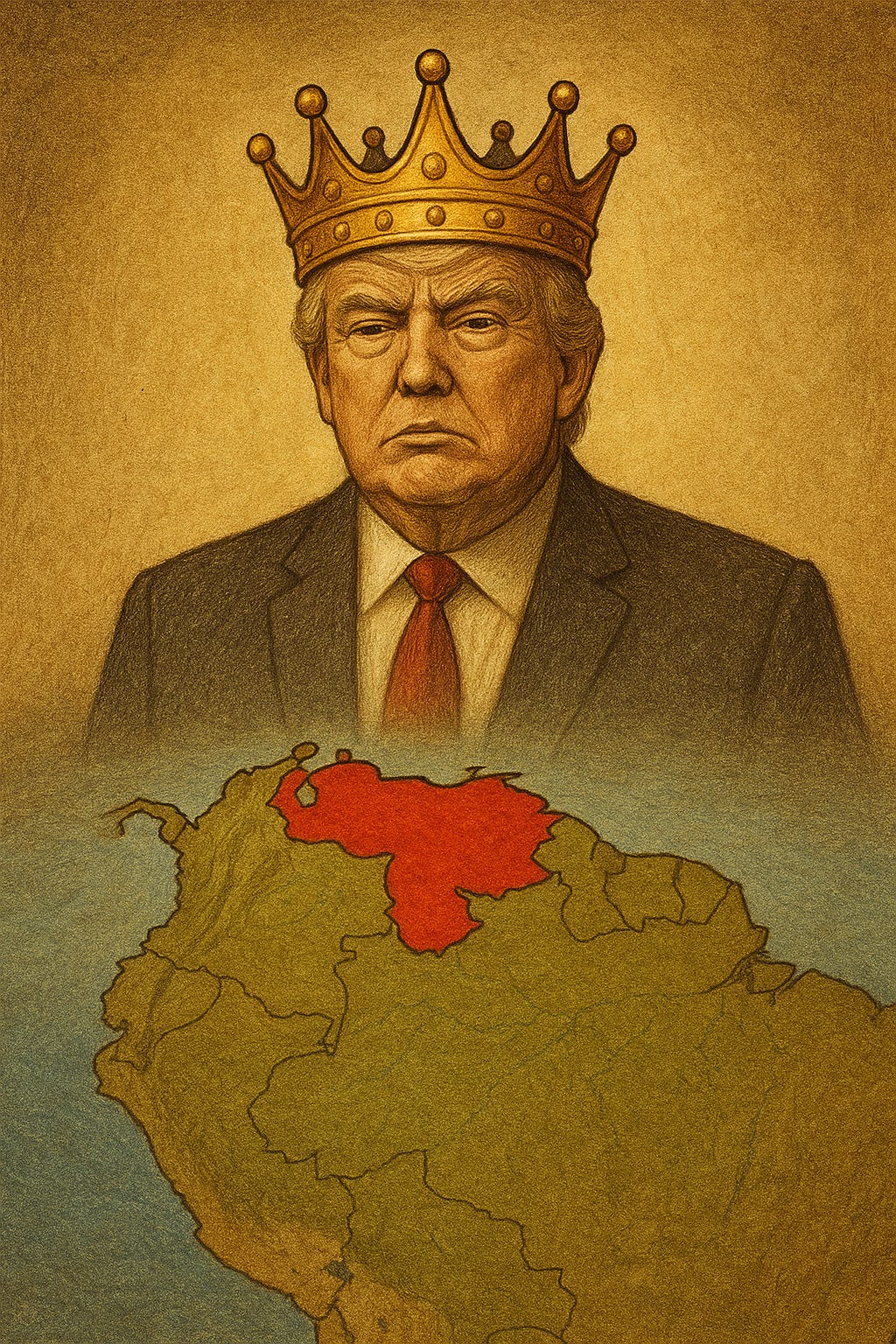
If only Donald Trump could read.
I know, I know. Imagining Trump doing serious reading is about as tough a challenge for the human brain as summoning up a mental image of Trump feeding the hungry, welcoming the stranger, helping the poor, or expressing contrition. But I seriously wish he had the attention span to read something longer than a social media post on his ever-present cell phone. The extended piece of writing that I would most want him to read and study at this perilous moment of escalating action against Venezuela is a book by Stephen Kinzer, Overthrow: America’s Century of Regime Change from Hawaii to Iraq.
Why should Trump read a book about regime change? Well, his actions and words directed at Venezuela certainly sound like a prelude to regime change for that South American nation. First, Trump ordered the bombing of boats off the coast of Venezuela, on the pretext that they were somehow dangerous drug dealers, even terrorists. Trump acknowledged that he had authorized covert Central Intelligence Agency action in Venezuela. And Secretary of Defense Pete Hegseth ordered the world’s largest aircraft carrier, the USS Gerald R. Ford, and its strike group to move from the Mediterranean to the Caribbean, near Venezuela. “Once the Ford arrives, the U.S. will have roughly as many ships in the Caribbean as it used to defend Israel from Iranian missile strikes this summer,” an analysis in The Atlantic reported. Trump has hinted that the battle against drug cartels at sea may expand to operations on land, within Venezuela, but he also seems to be saying he’s not interested in overthrowing the regime of President Nicolás Maduro. Right.
This is how Nahal Toosi, senior foreign affairs correspondent for Politico, described Trump’s approach to Maduro, in her reported column, Compass:
The first time President Donald Trump tried to push Nicolás Maduro out of power, he wasn’t coy about it. He accused the Venezuelan dictator of stealing an election, stripped U.S. recognition from Maduro’s government, imposed sanctions on Caracas and rallied other countries to pressure Maduro to quit.
It didn’t work.
In his second term, Trump is targeting Maduro differently, and his message is, uncharacteristically for Trump, less direct. Even though Trump continues to say Maduro is an illegitimate leader, he has said “we’re not talking about” regime change in Caracas. Instead, he’s emphasizing the long-standing accusations that the strongman is a drug lord and a dangerous criminal. The plan, people familiar with the situation tell me, is to force Maduro out as part of Trump’s ongoing fight against drug cartels.
The effort has included labeling such groups as terrorist organizations, carrying out military strikes against alleged drug-carrying boats from Venezuela, raising the U.S. bounty on Maduro’s head to $50 million, and cutting off diplomatic talks with Caracas. The campaign may not formally be about regime change, but if the pressure from the anti-cartel moves happens to topple Maduro, well, the president and his team will be delighted.
While Trump admires many of the world’s autocrats, he has long appeared to genuinely dislike Maduro. The South American has socialist roots, not far-right tendencies the way Trump favorites such as Hungary’s Viktor Orbán and Russia’s Vladimir Putin do. And—I’ve heard this from multiple U.S. officials over the years—Trump is truly aghast at how Maduro savaged the economy of a once-vibrant Venezuela.
Then, of course, there’s the oil. Venezuela’s petroleum reserves are actually larger than those of Saudi Arabia. So it’s hard to believe that oil is not a factor in the decision-making of our drill-baby-drill president. Right now, all the signs point to increasing pressure on Maduro. Will that mean American boots on the ground? We should all pray that it doesn’t happen. It would be a tragic irony if an order to engage in ground combat came from someone who calls himself the peace president; someone who went to a military high school because his tyrannical father wanted his out-of-control son to learn discipline, but never spent a single day in the actual military, thanks to a “bone spurs” diagnosis during the Vietnam War by a doctor who rented space from Trump’s father; someone who declared in an interview that his battle against sexually transmitted disease was “my personal Vietnam,” adding: “I feel like a great and very brave soldier.”
Before Trump goes any further on the Venezuela front, boots on the ground or not, and before he considers any kind of action against Colombia, whose president he has labeled an “illegal drug dealer” who is “poisoning Americans,” Trump should read Kinzer’s book. He wrote Overthrow in the period after the Anglo-American invasion of Iraq in 2003, which was advertised as being about weapons of mass destruction, but really was about regime change: getting rid of Saddam Hussein. Trump wouldn’t have to read the whole book. Perhaps this section from the book’s introduction will suffice to make him think twice—an unaccustomed exercise for a person who finds thinking even once a challenge:
Why does a strong nation strike against a weaker one? Usually because it seeks to impose its ideology, increase its power, or gain control of valuable resources. Shifting combinations of these three factors motivated the United States as it extended its global reach over the past century and more. This book examines the most direct form of American intervention, the overthrow of foreign governments.
The invasion of Iraq in 2003 was not an isolated episode. It was the culmination of a 110-year period during which Americans overthrew fourteen governments that displeased them for various ideological, political, and economic reasons. Like each of these operations, the “regime change” in Iraq seemed for a time—a very short time—to have worked. It is now clear, however, that this operation has had terrible unintended consequences. So have most of the other coups, revolutions, and invasions that the United States has mounted to depose governments it feared or mistrusted.
The United States uses a variety of means to persuade other countries to do its bidding. In many cases it relies on time-honored tactics of diplomacy, offering rewards to governments that support American interests and threatening retaliation against those that refuse. Sometimes it defends friendly regimes against popular anger or uprisings. In more than a few places, it has quietly supported coups or revolutions organized by others. Twice, in the context of world wars, it helped to wipe away old ruling orders and impose new ones.
This book is not about any of those ways Americans have shaped the modern world. It focuses only on the most extreme set of cases: those in which the United States arranged to depose foreign leaders. No nation in modern history has done this so often, in so many places so far from its own shores.
The italics in that final sentence are my own, because it makes a powerful point. Does our bone spurs commander-in-chief want to continue that abysmal record by pushing for the ouster of Maduro? Over the years, after I left the army in 1969, I have become increasingly concerned about our nation’s propensity for unnecessary, unwinnable wars—starting with the one in Vietnam.
My skepticism moved me to argue vociferously, in the deliberations of the Newsday editorial board, against approving of the 2003 Anglo-American invasion of Iraq, over the issue of weapons of mass destruction supposedly in the hands of Saddam Hussein. On the wall of my office, I had photo of Donald Rumsfeld, the special envoy of President Ronald Reagan, shaking hands amicably with Saddam in 1983. That was in the middle of the eight-year war between Iran and Iraq, in which America was supposedly neutral, but was supporting Iraq with intelligence, dollars, and technology.
American support for Saddam turned to military action against him when his forces invaded and annexed Kuwait in 1990. “By invading Kuwait, evidently under the mistaken impression that the United States would approve, Saddam turned himself into a pariah in the eyes of Washington,” Kinzer wrote. President George H. W. Bush then launched the 1991 military campaign that pushed Iraq out of Kuwait but did not unseat Saddam. That job later fell to his son, President George W. Bush.
In the aftermath of the 9/11 attacks on the World Trade Center and the Pentagon in 2001, George W. Bush, nudged by Vice President Dick Cheney and others, was determined to do what his father had not done: go all the way to Baghdad. Well, we know how that turned out: no weapons of mass destruction, the end of Saddam Hussein’s regime, massive destruction in Iraq, and years of deadly encounters between American troops and their allies against armed resistance by Iraqi insurgents. That was when we all learned the dreadful meaning of IED: improvised explosive devices, which killed and maimed so many Americans.
Iraq was one failed regime change. Another that is still haunting us was the one against Iran, years before the Iran-Iraq War. On August 19, 1953, a coup arranged by the United States Central Intelligence Agency and the British government removed the democratically elected prime minister of Iran, Mohammad Mosaddegh. That gave vastly more power to the monarch, Shah Mohammad Reza Pahlavi. The basic details of that event are clear. In fact, the United States government acknowledged in 2013 the CIA’s role.
The overthrow of Mosaddegh in Iran, which Kinzer covers in his book, is the coup that reverberates most strongly to this day. Many Americans call our nation a global supporter of democracy. But in Iran and elsewhere, the United States has too often rejected the democratically expressed will of the people of other nations, to install leaders who are more autocratic and better aligned with America’s perceived interests.
A former Newsday colleague of mine expressed pithily what the reign of the CIA-aided shah meant: “He gave us 25 good years.” Those years might have been useful to American foreign policy, but they were hardly good years for Iranians. The shah’s secret police, SAVAK, terrorized his people. And an American, Major General Norman Schwarzkopf Sr. (father of the general of the same name who led the Gulf War against Iraq), helped train SAVAK.
The modern history of Iran is complicated, but the roots of the coup called Operation Ajax can be summed up in two words: oil and communism. The British enjoyed an immensely favorable concession for extracting Iran’s oil, approved over the years by the Iranian monarchy. So Mosaddegh’s move to nationalize the oil industry and give Iran a fairer share of the proceeds was a major problem for London. For the CIA, in a postwar era when the agency imagined communists everywhere, Mosaddegh’s embrace of democracy looked like the forerunner of a communist Iran.
So Mosaddegh had to go. The CIA’s Kermit Roosevelt Jr., grandson of Theodore, made sure he went. In the aftermath, American companies got to share in the profits from Iranian oil, the shah was reliably pro-American, and the SAVAK suppressed any anti-shah activity. That ended abruptly with the Iranian revolution in 1979, the taking of American hostages that heavily influenced the 1980 presidential election in Ronald Reagan’s favor, and many future consequences.
“Iran’s revolutionary leaders became heroes to fanatics in many countries,” Kinzer wrote in another book, All the Shah’s Men: An American Coup and the Roots of Middle East Terror. “Among those who were inspired by their example were Afghans who founded the Taliban, led it to power in Kabul, and gave Osama bin Laden the base from which he launched devastating terror attacks. It is not far-fetched to draw a line from Operation Ajax through the Shah’s repressive regime and the Islamic Revolution to the fireballs that engulfed the World Trade Center in New York.”
We can describe those unintended consequences with one word, blowback. In Blowback: The Costs and Consequences of American Empire, Chalmers Johnson wrote: “The term ‘blowback’ first appeared in a classified government document in the CIA’s post-action report on the secret overthrow of the Iranian government in 1953.”
In the post-shah era, the United States sees Iran as a dangerous enemy, a nation that supports terrorists around the world. Trump was only a few months into his second presidency when he ordered the bombing of Iranian facilities with the capacity to produce nuclear weapons. Characteristically, Trump called that bombing a “complete and total success.” Well, that remains to be seen. No one can predict how Iran will react in the long term.
What also remains to be seen is how dangerously Trump will pursue regime change in Venezuela. One certainty is that he probably won’t be reading either of Kinzer’s books, Overthrow and All the Shah’s Men. You can bet that he will also not be reading Blowback. And if he really does pursue regime change in Venezuela—and perhaps later in Colombia—it almost certainly won’t work out well for our nation in the long run, just as the overthrow of Mosaddegh gave us an implacable enemy instead of the peaceful and democratic Iran that Mosaddegh could have led.
If Trump is interested in a regime change that would certainly benefit the United States, he can do something that doesn’t involve aircraft carriers, bombed ships, or boots on the ground: He should forget his unconstitutional dream of a third term, allow the 2028 presidential election to proceed without his name on the ballot, and exit the White House on schedule on January 20, 2029, thus offering the American people a peaceful and joyous regime change.
No posts
Comments
Nothing yet. Say the first thing.
Sign in to join the conversation.