
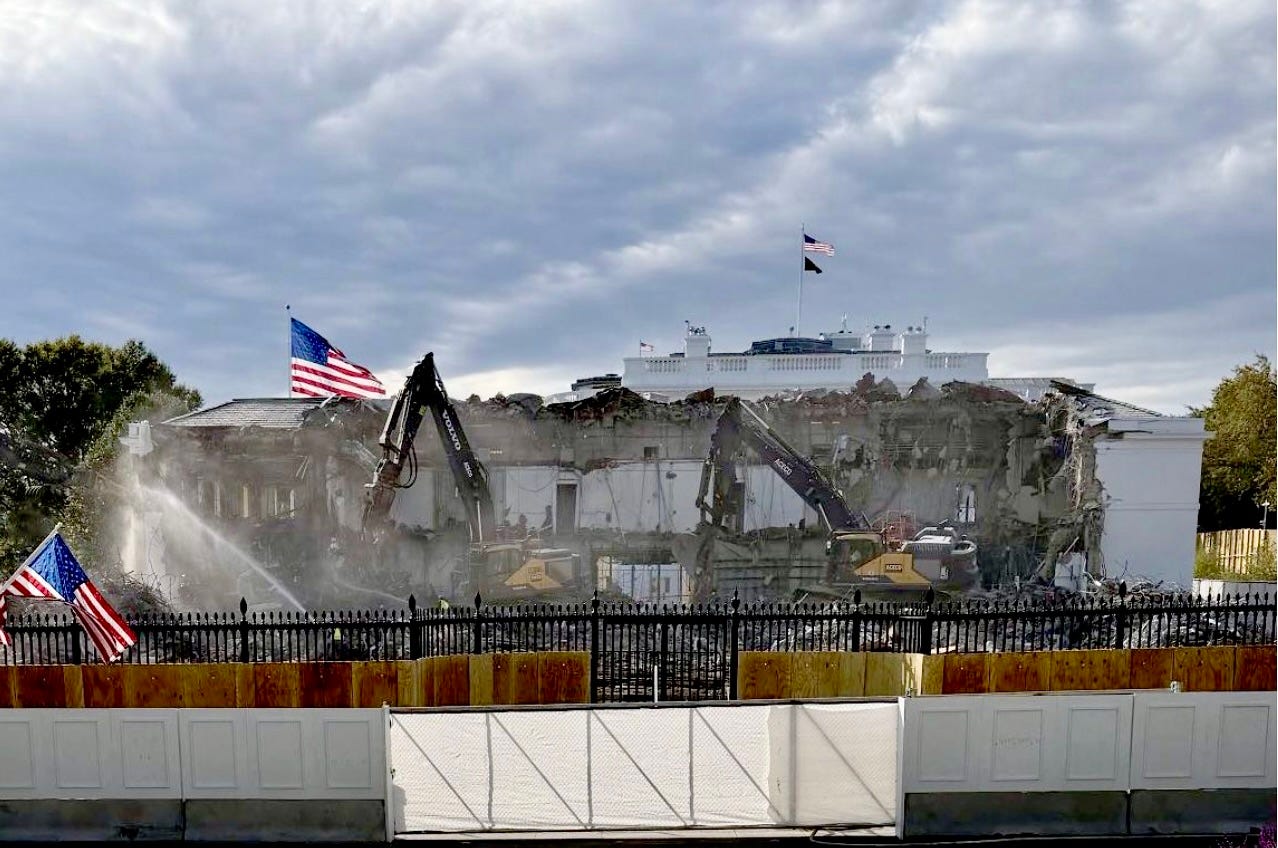
The widespread outrage over the demolition of the White House East Wing has focused on the complete lack of due process. Did Trump consult with the National Capital Planning Commission? Does the commission supervise demolition, or only the construction that happens when the demolition is done? Oddly, no one seemed to be inquiring whether he sought the permission of First Lady Melania Trump, whose offices were in the East Wing. (Or did he knock it down as some sort of not-so-subtle message to her?)
In answer to all the questions, a White House statement asked, in effect, why all the fuss? Doesn’t anyone remember construction projects by previous presidents, such as Richard Nixon’s conversion of a swimming pool into a press briefing room, or Barack Obama’s decision to adapt a tennis court so that the existing small basketball court could become a full-size court for his favorite sport? None of those alterations, of course, comes close to the size of the 90,000-square-foot golden-ballroom-from-hell that Trump is erecting—pun intended—next to the original White House.
Beyond the details argued in the political sphere, it took a late-night comedian, Seth Meyers, to put the East Wing demolition into terrifying perspective: “I don’t think he’s planning on leaving in three years,” Meyers said on Tuesday night. “If I had three years left on a lease, I wouldn’t even put up a shelf.”
In a way, this demolition resembles the lack of due process afforded undocumented immigrants in the United States and the passengers and crew of boats off Venezuela and in the Pacific Ocean. But the erasure of the East Wing has not killed anyone or sent anyone into detention in another country. Mona Charen puts it into perspective in her Substack column on The Bulwark:
It’s obscene.
No, destroying the physical structure of the White House is not as bad, on a moral scale, as blowing up boats carrying possibly innocent people to kingdom come. It’s not as bad, as a political science matter, as corrupting the Justice Department to criminally prosecute Trump’s critics. It’s not as menacing as sending troops into American cities. And yet, this hurt is particularly sharp.
Any American who has ever been stirred by patriotic feeling has at some time or other considered the White House his or her own possession. Ten thousand people a week tour the mansion that is sometimes called the “People’s House.” They aren’t there just to see the Blue Room or the Green Room. They are relishing a piece of their patrimony. The building was basically a character in the hit show The West Wing, and you cannot count the number of movies—thrillers, histories, love stories—that have been located there. The building itself has semi-sacred status because of its history and because it represents something inestimably precious: this democratic republic.
A footnote to that “semi-sacred status” that Charen mentions. Some of those who built the original White House were enslaved people. The White House Historical Association, a nonprofit founded by First Lady Jacqueline Kennedy, put it this way: “Enslaved laborers participated in every stage of building construction, from the quarrying and transportation of stone to the construction of the Executive Mansion. They worked alongside European craftsmen, white wage laborers, and other free African-American wage laborers.”
In her column, Charen concurred with another writer’s suggestion that whoever runs as the Democratic presidential nominee in 2028 should make “erasing this monstrosity” a key campaign promise. Of course, that assumes that there will actually be a presidential election in 2028. But, as Meyers suggested in his monologue, Trump doesn’t seem to be planning to leave office on January 20, 2029. That possibility is the scariest implication of the East Wing demolition.
Indeed, why would Trump be rounding up $250 million to $300 million in private donations from morbidly wealthy people and corporations to build a huge, gold-encrusted, Mar-a-Lago-like ballroom, nearly twice the size of the White House itself, if he is not going to be around to preside over many gatherings there and enjoy the adulation that he so desperately needs? And why would his critics see this ballroom as an unnecessary obscenity, when Trump’s White House put out a statement calling the ballroom “a bold, necessary addition that echoes the storied history of improvements and renovations from commanders-in-chief to keep the executive residence as a beacon of American excellence”?
Still, I can’t help but compare Trump’s willingness to knock down a whole building, without even a hint of official approval from the relevant agencies, to the bureaucratic processes that my family had to navigate to get a certificate of occupancy from our town for a tiny front porch.
Watching this demolition, it seems, the appropriate reaction is more than simply disgust. It is fear. If Trump doesn’t hesitate to do this, you have to think that he won’t hesitate to launch far worse, far more lethal projects without review or permission from the appropriate authorities, such as Congress. If he can knock down the East Wing without consultation, what’s to prevent him, for example, from sending the American military to invade Venezuela or Panama or any geographic region that he craves?
To put Trump’s latest obscenity in proper perspective, I’ll leave the closing words to Nobel Prize-winning economist Paul Krugman. His latest Substack column, under the subhead, “Tackiness and tyranny go hand in hand,” put it this way:
Yes, Trump has terrible taste and probably would even if he didn’t have power and, thanks to that power, wealth. But the grotesqueness of his White House renovations is structural as well as personal. For the excess and ugliness serve a political purpose: to humiliate and intimidate. The tawdry grandiosity serves not only to glorify Trump’s fragile ego, but also to send the message that resistance is futile….
So the ballroom is a sign, not just of Trump’s personal vulgarity, but of the collapse of small-r republican norms. Trump is turning the people’s house into a palace fit for a despot partly because that’s his taste, but also to show everyone that he can. L’etat, c’est moi….
This isn’t a remodeling or building an addition, it’s a teardown. It may seem like a trivial story, but it’s a highly visual metaphor for the way MAGA is tearing down almost everything good about our country. And that ballroom’s hideousness is an equally good metaphor for all the political ugliness that lies in our future.
Comments
Nothing yet. Say the first thing.
Sign in to join the conversation.