
Shift4’s Q4 earnings were a mixed bag, to be generous. In reality, there were several red flags that warrant greater scrutiny. Yes, shares are cheap at around 7.5x normalized 2026 EBITDA, which excludes stock-based compensation, but if anything is certain in payments it’s that valuation alone is not a reason for a stock to move higher. My goal for this update is to dig deeper into the red flags I’ve identified, show my math, and discuss my level of concern. I’m still holding my shares of Shift4 because I believe there are too many good parts of the business underappreciated by the market. That being said, the company has its work cut out to restore credibility and push back on bear cases that are gaining traction.
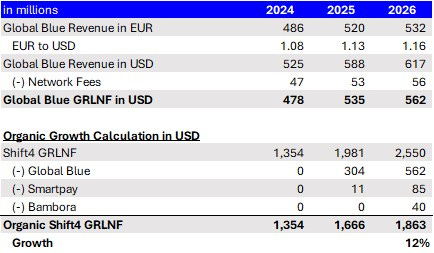
Appreciable slowing of organic revenue growth. After increasing 26% in 2024, Shift4’s organic revenue (GRLNF) growth slowed to the mid-teens during H2 2025, with about 12% growth exiting the year, although that was admittedly up against a difficult compare. For the upcoming year, 2026, Shift4’s guidance implies organic revenue growth of 12%, by my estimate:
Key Assumptions
Global Blue and Smartpay GRLNF contribution of $315MM in 2025, implying 23% growth for Shift4 excluding these businesses
Pro-forma Global Blue GRLNF of $535MM in 2025, up 12%, including $304MM contribution in H2 since Shift4 owned ($156MM in Q3, $148MM in Q4)
$562MM of Global Blue GRLNF in 2026, up 5% pro-forma
Smartpay GRLNF contribution of $11MM in Q4, representing 1.5 months (deal close mid-November)
Smartpay GRLNF of $85MM in 2026, up 8% pro-forma
Shift4 paid 1.5x revenue for Bambora, implying around $50MM of GRLNF in 2026 with about $40MM GRLNF contribution for 10 months (deal close March 2)
If I were to add Global Blue to Shift4’s base (assume Shift4 owned Global Blue since the start of 2025), it would imply pro-forma 2026 organic revenue growth of 10%:
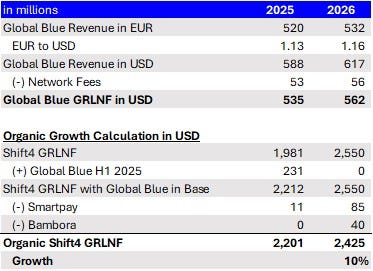
While low double-digit organic revenue growth is good, especially for a company trading at Shift4’s valuation, the trend is not our friend. More importantly, the slowdown adds validity to a key bear argument for Shift4 that acquisitions fuel an unsustainable burst of ‘organic’ growth (i.e., using carrots and sticks to convert captive volume to E2E processing within the first few years following an acquisition), requiring continual M&A to sustain attractive ‘organic’ growth.
Consider this: in 2023 and 2024, Shift4 made seven acquisitions for about $1 billion. Since that time, outside of Global Blue, which had no immediate revenue synergy expectations, Shift4’s only acquisitions were Smartpay (November 2025 close) and Bambora (early March close). A skeptic would say that as these seven deals from 2023 and 2024 enter Shift4’s base, age and are not backfilled, it is not a surprise to see an appreciable slowdown in ‘organic’ growth even as the macro holds in there pretty well.
Verdict: This is the most serious concern for me. The math does not paint a pretty picture either. It also does not help that Shift4 introduced the organic revenue growth disclosure during Q3 only to back away from it in Q4 when it seemingly worsened. The key question is what is the path of travel? Are we moving from 26% organic revenue growth to mid-teens to low double-digits to high single-digits to mid-single-digits over a compressed time period, or is the business going to stabilize at a low double-digit organic growth rate over the medium-term? The good news, I suppose, is that the market has already priced in a move down to the mid-single digits very soon, in my opinion, offering meaningful upside if Shift4 can stabilize organic growth at 10% or more. I, for one, believe organic growth will be closer to double-digits than mid-single-digits, but certainly my confidence is lower than it has been in the past.
2026 guidance does not appear conservative, calling into question a return to beat-and-raise cadence. While not perfectly clear, it appears Shift4 is assuming a continuation of recent same store sales (SSS) trends throughout 2026, which creates a more challenging comparison in H1 2026 before lapping the mid-year 2025 slowdown, setting up an improvement in organic growth during H2 2026. Here’s how Shift4 discussed it on the earnings call:
“In the first half of the year, we’re anticipating that there’s a continuation of the kind of exit rate trends that we were seeing within the Triple S. And that seems to be holding up, because even though we had what looks like a little bit of a continuation of softer trends in January, February was looking strong, but you have to offset some of that with weather events.
But I think in total, you end up with a place that says, that’s the first half of the year, assume similar trends to what you were seeing coming out of the end of the year. And then in the back half, an assumption that there will be an anniversary over some softer comps, and you see some positive rebound. Overall, though, I think the outlook for the year is a fairly neutral view, which is admittedly a couple of points lower, like low single-digit points lower than what might have existed in years past as we were laying out kind of Triple S impact within an overall outlook for the year.”
Christopher Cruz, CFO of Shift4 Payments
Certainly, if the Iran conflict continues for an extended period, causing gas prices to remain elevated, eating into discretionary spending, and global travel is subdued into certain corridors (Shift4 called out the Middle East and Saudi Arabia as increasingly important strategic markets), there are significant risks to Shift4’s outlook, in my opinion.
Verdict: While not a fundamental issue, per se, properly managing expectations and setting the stage for beat-and-raise quarters is table stakes for most successful stocks, and was a hallmark for Shift4 prior to 2025. Even before the Iran development, it did not appear, to me, that Shift4 was baking enough conservatism into its 2026 guidance to assure a return to a beat-and-raise cadence.
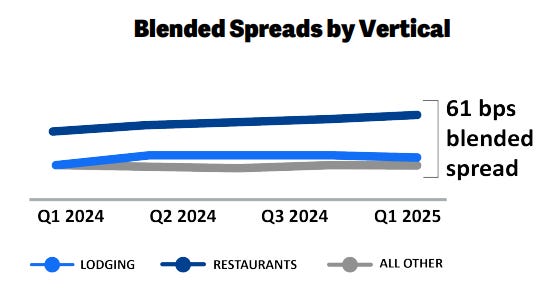
Falling blended spreads in Q4. On a year-over-year basis, Shift4’s blended spread (i.e., net take rate) fell by about 3-bps in Q4—from 60-bps in the prior year, to 57-bps in the current year. While Shift4 explained away the decline by a mix shift toward enterprise clients with higher seasonal volume during Q4, under the surface, I believe the decline was a bit more pronounced after considering the contribution from higher yielding Global Blue acquiring and dynamic currency conversion (DCC) volume. Based on my knowledge of Global Blue, which comes from the company’s past filings and Shift4’s disclosures since owning the company, I believe Global Blue’s fully loaded take rate on acquiring and DCC volume is approximately 80-bps. In Q4, I estimate Global Blue’s acquiring and DCC volume contributed roughly $2 billion to Shift4’s $58.9 billion of total E2E processing volume, generating $17 million of net payments revenue. Excluding the contribution from Global Blue, Shift4’s blended spread would have been about 0.8-bps lower than the reported 57-bps, making the year-over-year decline a bit larger:
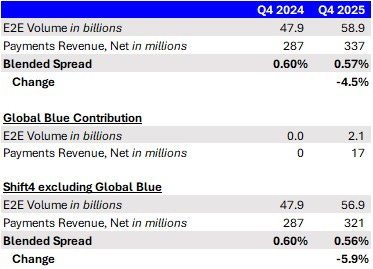
Verdict: Outside of Q4 2025, the trend in Shift4’s blended spreads have been favorable over the past several quarters. While I’m willing to give Shift4 the benefit of the doubt, if it was indeed a mix issue, it implies meaningful slowing in Shift4’s SMB volume, calling into question the quality of the merchant base and how it would hold up in a more significant economic downturn.
The lack of a clear handle on how FX and geopolitics will impact Global Blue. I’ve written in the past about why I believe the Global Blue acquisition was a mistake for Shift4 (too large, too much debt, precludes Shift4 from smaller lower risk deals without stretching leverage, makes it more unlikely Shift4 will be acquired itself, payments cross-sell conviction is low). While I still believe the strategic merits of the deal are weak, another issue that’s emerged is Shift4’s seeming surprise about how, or the level to which, FX and geopolitics are impacting Global Blue’s business. Recent movements in the U.S. dollar (USD) is an example. With a meaningful amount of Global Blue revenue denominated in euros (EUR), the weakening in the USD relative to the EUR has created a favorable translation impact for Shift4’s financials, which are reported in USDs. However, the weakening USD has impacted certain travel corridors (Americans traveling to Europe), reducing luxury shopping demand by more than the translation benefit. Further, on the Q4 earnings call, Shift4 raised tension between China and Japan as a tourism-related headwind for Global Blue, noting passenger airline seats between China and Japan are currently down 30%.
Verdict: While I don’t blame Shift4 for things that are clearly outside of their control (FX movements and geopolitical tension), I do believe Shift4 was overly optimistic about the underlying growth potential of Global Blue. As I noted back in October, Global Blue’s revenue grew only at a 4% compound annual rate from 2019 to 2025 (fiscal year ending March), falling to about 2% after excluding acquisitions that created the Post-Purchase Solutions segment in 2020 and 2021:
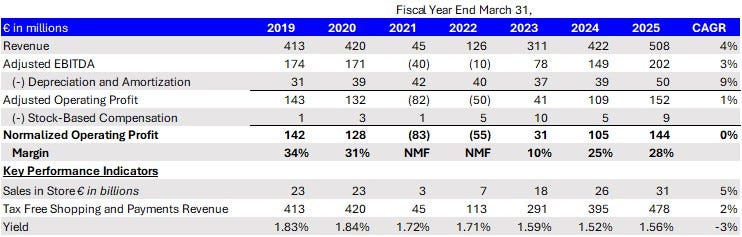
The bottom line is that Shift4 expects Global Blue to grow organically by mid-single digits in 2026, below the low double-digit rate achieved in 2025, and the high single-digit rate over the long-term Shift4 had assumed when they decided to make the acquisition.
Shrinking backlog. At the end of 2025, Shift4’s volume backlog was $32 billion, representing only 15% of 2025’s E2E volume. It was also down from more than $35 billion at the end of Q1, Q2 and Q3. Prior to, and immediately following, the acquisition of Global Blue, Shift4 spoke frequently about its cross-sell funnel, which stood at $1.4 trillion post the Global Blue acquisition:
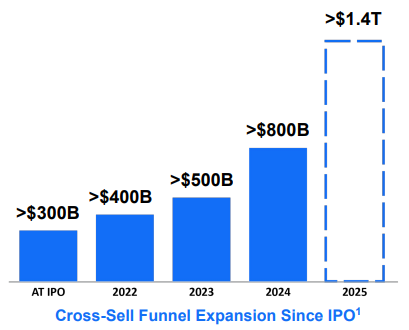
Verdict: While I’m in no way dismissing the opportunity from the cross-sell funnel, recent backlog performance suggests this volume may be more adjacent than captive, requiring more effort by Shift4 to convert it to actual end-to-end volume. In reality, the backlog issue dovetails with my concerns over Shift4’s slowing organic revenue growth.
Adjusted free cash flow flat in 2026. Shift4 is guiding for adjusted free cash flow (AFCF) of $500 million, at the midpoint, in 2026, flat to 2025:
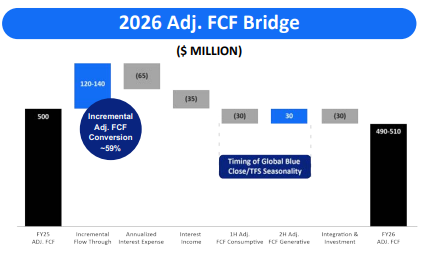
Further, the company backed away from its prior goal of $1 billion in annualized AFCF exiting 2027, instead preferring to look at the metric on a per-share basis to account for the company’s capital allocation priorities, which have focused on buying back stock ($500 million repurchased, of its $1 billion authorization, during Q4 and Q1, through its reporting date of February 26) at the expense of paying down debt.
One of the primary drivers behind the flat AFCF from 2025 to 2026 is the seasonality of Global Blue, which generates significant AFCF in the second half of the calendar year but may have little, to negative, AFCF in the first half. To put it another way, Shift4 received an outsized benefit from owning Global Blue in the second half of calendar 2025 and not the first half. Shift4 also included a $30 million headwind in 2026 from ‘integration and investment’ which the company framed as the expense required to stand up a sales force to sell its new all-in-one terminal (payments, DCC and tax-free shopping) across 15 European markets. Interestingly, Shift4 added back $92 million of ‘acquisition, restructuring and integration costs’ to arrive at its $500 million of AFCF in 2025. It’s not clear if the $30 million headwind in 2026 is in addition other ‘integration’ costs, but it would certainly be a step in the right direction if Shift4 began excluding these costs from its AFCF, narrowing the gap between GAAP and adjusted FCF.
Verdict: Although the discussion around the puts and takes of the 2026 AFCF bridge makes sense, the bigger issue for me is the seemingly large shortfall to the $1 billion 2027 target. Even if I assume AFCF grows by one-third in 2027, which may be aggressive, $665 million is a far cry from a $1 billion annualized exit rate. Shift4 now prefers to look at this metric on a per-share basis given its preference for buybacks over debt paydown. Fair, but if I assume Shift4 buys back the entire $1 billion authorization, the forfeited interest expense savings would only be about $50 million ($1 billion at 7% and a 25% tax rate), making the $720 million pro-forma AFCF number still notably shy of the $1 billion target, suggesting shortfalls in other parts of Shift4’s business, including Global Blue. Just last quarter, Shift4 said it was on pace to exceed the $1 billion 2027 target. What’s changed?

Changing and inconsistent disclosure. Underpinning most of my concerns and the red flags I’ve outlined above is Shift4’s changing and inconsistent disclosure. While publishing a quarterly shareholder letter is an excellent communication tool, providing a blank canvas for a company to tell its story, it also creates opportunities for criticism when key metrics, tables and charts are not consistently disclosed, or selectively disclosed to serve a company’s preferred narrative (Block is another company that struggles with this). Here are a few examples:
Introducing an organic revenue growth disclosure during Q3 (+18%) only to not disclose in Q4 when it seemingly worsened (+12%). I would prefer to see this metric disclosed every quarter with historical context provided.
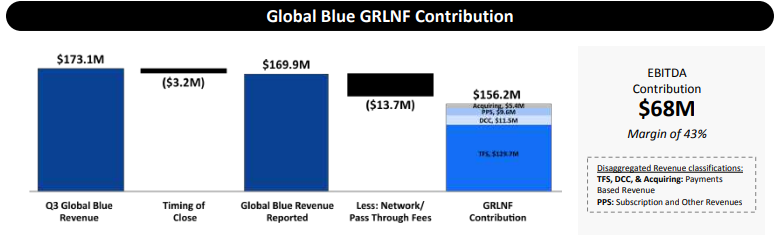
Providing granular revenue and EBITDA contribution from Global Blue in Q3 but not Q4. Given concerns over the acquisition, I would prefer to see as much detail as possible, for as long as possible.
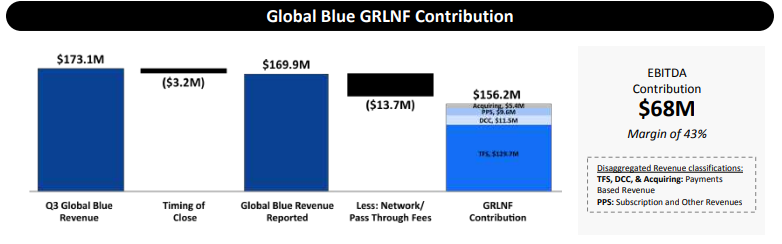
Shift4’s Q3 2025 Shareholder Letter Failure to provide consistent disclosure of blended spreads by vertical. The below graphic makes its way in and out of shareholder letters, and is particularly helpful when mix shifts impact overall blended spreads despite stable underlying spreads by vertical, as was presumably the case in Q4. The graphic was not provided for Q4 2025.
Failure to provide updates on Investor Day scenarios. After providing updates on its three scenarios outlined at Investor Day (sit on our hands, with Global Blue, and additional M&A, the most likely case) in both Q2 and Q3 earnings, and at various conferences in between, Shift4 failed to do so on its Q4 earnings call and in the shareholder letter. Good, bad, or indifferent, Shift4 should provide updates on medium-term guidance provided just one year ago.
Verdict: Changing and inconsistent disclosure strikes at the heart of management’s credibility, a precious resource for companies. Everything mentioned here is controllable by Shift4. Failing to do so only hurts them and provides opportunities to write articles like the one I’ve just written.
As always, thank you for reading, and if you’ve enjoyed this, please consider sharing, liking, commenting or subscribing!
Disclosure: As of March 11, 2026, I am long Shift4 Payments. This report is for informational purposes only and is not a recommendation to buy or sell any stock. Finally, while I rely on the information in this report to guide my investment decisions, you should not, because I cannot guarantee its accuracy.
No posts
Comments
Nothing yet. Say the first thing.
Sign in to join the conversation.