
At the beginning of the year, I laid out what I believed would be both bullish and bearish developments for the companies I follow most closely across payments and fintech (Payments and FinTech in 2026). The purpose of this article is to assess performance relative to those expectations, lay out company-specific objectives for the second half, and name my top picks as of today.
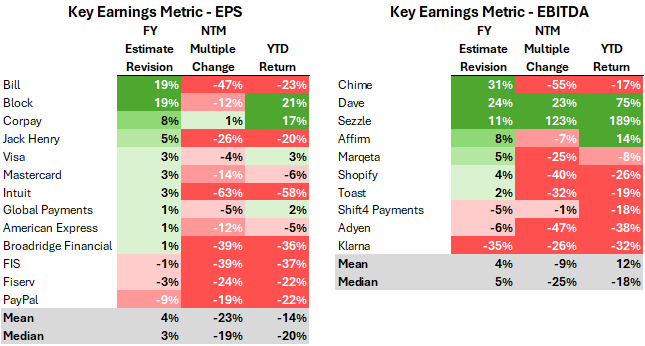
Even though many companies performed well, meeting or exceeding my bullish benchmarks, sentiment remains challenging with the market severely punishing any misstep. Outside of Sezzle and Dave—the top performers during H1 2026—the median return across the remaining 21 payments and fintech companies listed below was -19% with the multiple compressing 25% despite earnings estimates, whether that be EPS or EBITDA, rising 3%:
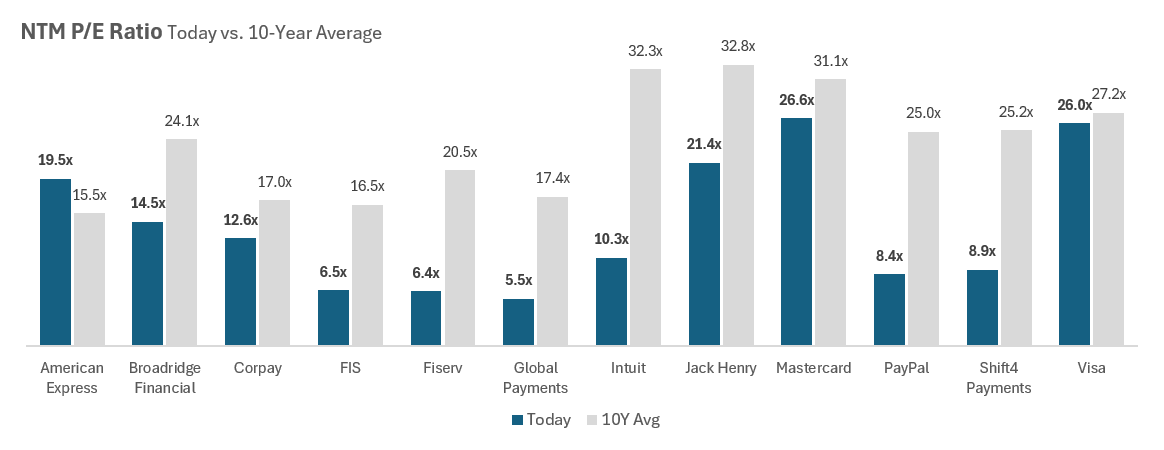
With the exception of the networks, most mature payments and fintech companies trade at significant discounts to long-term averages:
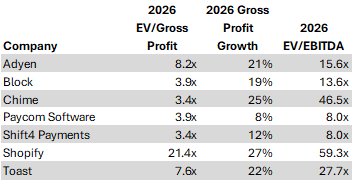
Among faster growing companies, there remains significant variation in multiples despite similar top-line growth. As an example, even though Adyen, Block and Toast are expected to grow top-line 19-22%, Toast (28x) trades at a significant premium to Adyen (16x) and Block (14x) on an EV-to-EBITDA basis:
The order of the article is as follows: the company, my first half grade, bullish and bearish developments as written January 1, 2026, an explanation of performance relative to expectations, and second half objectives. At the end of the article, I share my top picks.
January 1, 2026
Bullish Developments: Further improvement in the U.S. SMB market (U.S. SME billed business for American Express was up 4% in the last quarter), where American Express has a significant presence, U.S. billed business growth above the U.S. credit card market, and stable credit loss rates (the company’s net write-off rate has consistently been best-in-class and the spread between it and the average charge-off rate for its issuing peers has been higher than pre-pandemic).
Bearish Developments: U.S. billed business growth below the U.S. credit card market, discount revenue growth at 6% or below, an increase in the net write-off rate or a narrowing of the gap with the average charge-off rate for its issuing peers, and larger-than-expected increases in rewards costs as a percentage of billed business.
American Express’ credit performance remains best-in-class, a bullish development. However, U.S. SMB billed business growth remains ‘stuck’ in the 3-4% range and total U.S. billed business growth of 7.2% during Q1 trailed industry-wide growth by 120-bps, the largest spread since…Q1 2021, both bearish developments. Bottom line, I don’t believe American Express has lived up to what its re-rated valuation demands.
Second Half Objectives: I’m sticking to my guns. American Express must close the gap in U.S. credit for the stock to move appreciably higher.
January 1, 2026
Bullish Developments: Constant-currency net revenue growth at-or-above 22% in 2026, expanding take rates for Platforms, suggesting Adyen is winning more attractive smaller vertical software customers and relying less on eBay, and slowing headcount growth, indicating the potential for more significant margin expansion over the near-term.
Bearish Developments: Constant-currency net revenue growth below 20%, more robust headcount growth that limits margin expansion over the near-term, and slowing growth in Platforms and Unified Commerce, which are viewed as the company’s primary growth drivers over the near-to-medium-term.
While several companies announced significant reductions in force, Adyen is accelerating headcount growth, weighing on 2026 margins, a bearish development. Add in net revenue guidance that failed to excite, the CFO’s departure, and a shift in strategy to incorporate (some) M&A, and you have a recipe for an unsteady—but by no means bad—H1.
Second Half Objectives: Hit net revenue guidance, preferably at midpoint (21%) or above, reiterate long-term margin guidance (55% EBITDA margin by 2028), and talk credibly about how recent acquisitions will strengthen or fortify Adyen’s competitive position and are consistent with Adyen’s ‘single tech stack’ ethos.
January 1, 2026
Bullish Developments: Absent a sale, stronger volume growth from an improving small business environment and traction with its embedded partnership strategy, improving monetization through the adoption of BILL’s ad valorem products (only about 15% penetrated currently), core revenue growth, which excludes interest on client funds, at-or-above the high-end of its 12-15% guidance range for fiscal 2026 (+14% in fiscal Q1), and a more rapid decline in stock-based compensation as a percentage of revenue (BILL is approximately 5 points above its peers on a TTM basis).
Bearish Developments: Core revenue growth at the low-end of its 12-15% guidance range for fiscal 2026, failure of new embedded partnerships to create volume momentum, persistent GAAP operating losses, and inability to materially increase adoption of its ad valorem products.
BILL is set to grow core revenue 15-16% in fiscal 2026, similar to fiscal 2025, and above the high-end of its original guide of 12-15%, with volume growth remaining in the low double-digits, bullish developments. Further, the company’s recent 30% reduction-in-force (RIF) is likely to result in a step-up in fiscal 2027 profitability, accelerating the decline in stock-based compensation as a percentage of revenue, which was already trending down.
Second Half Objectives: I think another year of the same—mid-teens core revenue growth—would go a long way for BILL. The company’s RIF put AI front and center so it’s important BILL shows traction with its AI-powered tools for SMBs.
January 1, 2026
Bullish Developments: Accelerating Square volume growth and further narrowing of the gap in food and beverage volume growth with Toast, stable loss rates on Block’s lending products (Square Capital loans, BNPL, and Cash App Borrow), and sustained attractive Cash App commerce volume growth (+17% during Q3).
Bearish Developments: Square’s gross profit growth trailing volume growth materially, increasing loss rates on lending products, and stalled Cash App monthly actives.
While the 40% workforce reduction, Block’s AI ambitions, and significant lending expansion make headlines and drive short-term financial performance, underlying momentum continues to improve, although only modestly, in my opinion. After a softer Q4, Square’s GPV growth accelerated during Q1 with growth in food and beverage volume drawing nearly equal to Toast’s, bullish developments. However, the spread between Square gross profit and volume growth (4-points in Q1) remains too wide for comfort. Outside of lending, Cash App’s performance remains positive, but not necessarily accelerating: commerce volume and primary banking actives (PBAs) growth remains in the high-teens.
Second Half Objectives: With a nice 21% gain during H1, I think the stakes get a little bit higher for Block in H2: Square’s gross profit growth needs converge with volume growth, Cash App would ideally sustain commerce volume and PBAs growth in the high-teens, and it would be a big plus for Block if it can demonstrate AI features are facilitating customer success across Cash App and Square.
Broadridge’s governance and communications businesses continue to perform well, sustained by increased financial market participation. Although I don’t believe tokenized securities pose a risk to Broadridge’s franchise, the onus on them is to win that argument, which may prove difficult over the near-term. Capital markets and wealth management are more SaaS(y), exposing them to AI fears, which has not been helped by declining closed sales during fiscal 2026.
Second Half Objectives: I think it’s imperative Broadridge close some of the larger, complex deals they cited as taking longer last quarter, and provide an outlook for positive closed sales growth in fiscal 2027. Outside of that, providing fiscal 2027 guidance that falls within its long-term algorithm of 5-8% organic recurring revenue growth and 8-12% EPS is mandatory, in my opinion.
Chime’s done a lot right since its IPO, but has not been rewarded. I think that’s largely a function of starting valuation and an overshoot to the downside. I believe it’s up to Chime how fast they want to step on the accelerator in terms of lending expansion and monetization. With lend-centric peers being rewarded, it may be tempting for Chime to be more aggressive, but I don’t think that’s the right long-term strategy for Chime and don’t think they will do that.
Second Half Objectives: First and foremost, stabilize spending-based volume (card and outside instant transfers) growth, optimize transaction profit growth for lending products (modestly higher loss rates balanced by lending expansion), and execute on its product roadmap (investments, joint accounts, Jade, its AI-powered advisor, and signs of enterprise traction).
January 1, 2026
Bullish Developments: New management regains trust by meeting near-term commitments (low single-digit organic revenue growth and a modest decline in EPS during 2026), Clover volume growth improves, and Banking returns to positive organic revenue growth in Financial Solutions.
Bearish Developments: A further reset of the financial baseline (at or below my $8 estimate), slowing Clover volume growth, and ongoing organic revenue declines for Banking in Financial Solutions.
While things were basically ‘going as planned’ for Fiserv in 2026—maintained guidance, albeit trending toward the lower end, in my opinion, and positive Investor Day presentations—that all got thrown out the window when Mike Lyons abruptly left the company, eroding trust, and clearly a bearish development for sentiment. Putting that aside, Clover’s underlying volume growth accelerated 3-points to 12% during Q1, demonstrating a still a vibrant platform and any pricing/service missteps have not impaired the franchise, a bullish development. I think the verdict is still out for banking, where service/tech problems may run deeper and industry growth is not as attractive as payments.
Second Half Objectives: The exit of Lyons resets the clock. The new CEO must demonstrate competence when speaking to the investment community, which he is likely to do. Accelerating growth in H2 to achieve 1-3% full year revenue growth is important. The market is expecting the lower-end, so anything above that would, I think, would be clearly positive. Most important data points are Clover volume growth and banking organic revenue growth.
January 1, 2026
Bullish Developments: Modest improvement in Global Payments’ organic revenue growth rate, which is expected to be approximately 6% during H2 2025, greater detail around Worldpay’s revenue mix and its ability to sustain ‘solidly’ mid-single-digit organic revenue growth, and a firm commitment to pay down debt, balanced with share repurchases.
Bearish Developments: A decline in Global Payments’ organic revenue growth rate, slower growth in the integrated and embedded channel, suggesting pressure from software companies reaching further into payments, and failing to meet cost saving and margin targets for the Worldpay acquisition.
Global Payments failed to live up to any of my bullish developments, with organic revenue growth of approximately 5% expected for 2026 (down from 6% to exit 2025), a lack of detail and performance reporting on the combined businesses, and a clear preference for share buyback over more aggressive debt paydown. Still, shares rose slightly in the first half (up 2%), suggesting expectations were sufficiently low to provide upside even with lackluster performance. Unfortunately, for other legacy payments companies, that low water mark for valuation, as set by Global Payments, is approximately 4.5x EPS.
Second Half Objectives: Q2 is expected to be softer due to the travel impact from the Middle East conflict and lower income tax payments, combining for a 1-point headwind to revenue growth. I believe 3.5% organic revenue growth is a good benchmark for Q2—above that would be positive, below that negative. Regardless of what happens in Q2, it’s imperative Global accelerates organic revenue growth to slightly more than 5% during H2, as promised, which is based on signed business to be onboarded. Beyond that, gaining a clearer picture of underlying business mix and performance is very important and something Global promised to provide with Q2 earnings last quarter.
Software disruption concerns from AI and a hiccup at TurboTax were good enough for a whopping 63% decline in Intuit’s NTM P/E ratio since the beginning of the year. Taking a step back, Intuit’s fiscal 2026 EPS estimate rose 3% since the start of the year and Intuit remains committed to mid-teens EPS growth moving forward, even though it has signaled slower top-line growth during fiscal 2027 as it resets pricing at the lower-end of its DIY offering.
Second Half Objectives: All eyes will be on Intuit’s TurboTax fiscal 2027 guidance, which will be delivered with fiscal Q4 results announced mid-to-late August. The bad news for Intuit is that a better-than-expected guide won’t be trusted—needing to be confirmed next tax season, which is still a long way off—and a worse-than-expected guide will be punished immediately. Nevertheless, it’s important to remember DIY tax represents a low double-digit percentage of Intuit’s overall business with the low-end making an even smaller contribution. Over the past decade, Intuit’s organic revenue growth averaged 13%. For fiscal 2026, it’s expected to be 13-14%. Reading the tea leaves, I think a fair expectation for the initial fiscal 2027 guide is 10-11% with an emphasis that Intuit’s big bets—the mid-market, its money offering, and assisted tax—are still performing well.
January 1, 2026
Bullish Developments: Organic revenue growth for fiscal 2026 at the high-end or above its 6-7% range (fiscal Q1 was 8.7%), an acceleration in core customer wins, both in count and total assets (Jack Henry had 47 core wins totaling $19 billion in assets in fiscal 2023, 54 wins totaling $39 billion in fiscal 2024 and 51 wins totaling $53 billion in fiscal 2025), and strong free cash flow conversion (above the midpoint of its 85-100% range).
Bearish Developments: Organic revenue growth for fiscal 2026 at the midpoint or lower of its 6-7% range, no indication the Fiserv disruption is resulting in an acceleration in core customer wins, and lagging margin expansion, excluding termination fees.
Jack Henry achieved most of my bullish benchmarks—the current midpoint of organic revenue guidance implies 6.8% growth, at the high-end of original guidance, the number, size and scope of new wins are up significantly versus prior year, and FCF conversion is expected at the high-end of 95-100%. Yet, the stock is still down 20% YTD as Jack Henry’s multiple compressed 26% but still remains uncharacteristically high, for this group, in the low-20s.
Second Half Objectives: I think the market would like to see some acceleration in organic revenue growth for Jack Henry in fiscal 2027 based on the strength of new business signed and its pipeline. From fiscal 2019 to 2024, Jack Henry’s organic revenue growth averaged 7.4%. In the last two fiscal years (including 2026), it’s been 60-90 bps below that. A return to the mid-7% range would be helpful along with sustained margin improvement, which Jack Henry has signaled as likely in fiscal 2027.
January 1, 2026
Bullish Developments: Organic net revenue growth at-or-above 13% for Mastercard, value-added services revenue growth in the high-teens or better, and an indication that stablecoin payments are failing to gain widespread appeal among consumers or Visa and Mastercard are successfully capturing value by facilitating them. Also, agentic commerce creates more online commerce with a lower average transaction value (as the agent shops around to find the best deals on multiple items from multiple retailers).
Bearish Developments: Organic net revenue growth below 10%, a major acquisition that dilutes EPS and margins, news flow around legislation, regulation or litigation that is viewed as adverse to Visa and Mastercard, and an indication that stablecoins or real-time payment networks are gaining increased traction.
Since the beginning of 2025, Mastercard’s return has trailed rival Visa’s by more than 12%, resulting in Mastercard’s historical premium—on a NTM P/E basis—falling from about 4-points historically to less than 1-point currently. Mastercard is on track to grow organic net revenue around 12% during 2026, neither bullish nor bearish, with high-teens value-added services growth, a bullish development. While there has been lots of press and jockeying around stablecoins during the first half, I’m no closer to believing they will significantly alter the way consumers and businesses pay one another.
Second Half Objectives: Based on underlying strength in consumer spending and the cessation of open hostilities in the Middle East—which to be fair was already included in Mastercard’s outlook—a guidance increase post-Q2 seems like a 50-50 proposition.
Although Paycom continues to deliver innovative products that are well liked by customers, recurring revenue growth continues to slow, despite hints to the contrary ever since Paycom reset its growth rate following the cannibalizing effects of significant Beti adoption in 2023.
Second Half Objectives: The market is keying on improved client employee growth and retention as signs that Paycom’s ‘full solution automation’ platform is winning not only hearts and minds, but also the wallets, of clients. Since these statistics are given only once at the end of each year, investors are relegated to reading the tea leaves from quarter-to-quarter, which can be difficult and have turned out to be more optimistic than reality during recent years. The objective for the remainder of the year is to deliver healthier upside to its 7-8% recurring revenue guidance than the last couple years, when it only has been about 1-point vs. the original guide.
January 1, 2026
Bullish Developments: Underlying TM$ growth of more than 4% in 2026, branded online checkout TPV growth of 5% or more in 2026, and only a modest decline in debit card and Pay with Venmo TPV growth and sustained BNPL TPV growth of 20% or more. Finally, an indication that investments are driving increased adoption of key products, like core checkout, BNPL and debit cards.
Bearish Developments: Underlying TM$ and branded online checkout TPV growth of 3% or less in 2026, a more meaningful decline in BNPL, Pay with Venmo and debit card TPV growth, and the failure of investments to drive increased adoption of key products.
Guidance for branded online checkout growth of ‘slightly positive to low-single-digits’ for 2026 fell well short of expectations, a bearish development and underscoring the fragility of PayPal’s most important volume stream. Alex Chriss’ departure was sudden, but several months on, and it’s still not clear what the plan is for PayPal under new CEO Enrique Lores. While rumors of a sale or breakup floated in the spring, they have gone silent of late, and disclosure around the parts of PayPal that may be on the block—including Venmo—don’t appear to be forthcoming anytime soon.
Second Half Objectives: Delivering upside to guidance aside, the most important objective for PayPal is providing a credible plan to stabilize its core checkout business, which may be impossible for anyone to deliver. Although PayPal indicated financial details around its new segments will not be coming until next year, doing so beforehand would be a good step in restoring some level of confidence and credibility.
January 1, 2026
Bullish Developments: Organic revenue growth at-or-above the mid-teens in 2026, an indication Shift4 is successfully cross-selling Global Blue’s dynamic currency conversion solution to its merchant base and/or Shift4 is signing Global Blue merchants for end-to-end processing, and a firm commitment to pay down debt, balanced with share repurchases.
Bearish Developments: Organic revenue growth falling below the mid-teens in 2026, continued M&A activity that keeps leverage uncomfortably high or significant share buyback at the expense of debt paydown, and little-to-no revenue synergies from the Global Blue acquisition.
Organic revenue growth fell to the low double-digits during the past couple quarters, a bearish development for Shift4. Potential revenue synergies aside, Global Blue’s growth was expected to slow during 2026 before any impact from the Middle East conflict, which is weighing on near-term performance. Shift4 repurchased a significant amount of stock in Q4/Q1 (about $600 million), keeping leverage high.
Second Half Objectives: Given where Shift4’s stock price is, the primary objective for the remainder of the year is to deliver on guidance, low-end included, which implies low double-digit organic revenue growth, and maintain or increase transparency around the business. I believe there is no expectation for any Global Blue revenue synergies over the near-term, so any evidence of them would be a positive development.
January 1, 2026
Bullish Developments: Sustained GMV growth in the high-20% range, more significant expansion in profitability, and an indication of a volume uplift from its partnership with OpenAI, which could create excitement for the stock and attract more small businesses to its platform.
Bearish Developments: GMV growth slowing to the mid-20% range or below and limited margin expansion due to stepped-up investments to chase the agentic commerce opportunity.
GMV growth remains robust (30% in Q1) and operating profit expanded significantly last quarter, both bullish developments. Despite this, Shopify is guiding for a slowdown in Q2. Also, while Shopify believes it will benefit from AI and agentic commerce, the market is likely more skeptical. In a group where no high multiple is safe, Shopify has the highest by far, putting it at risk.
Second Half Objectives: Deliver meaningful upside to guidance as it has in the past, maintain GMV growth in the high-20% range, and demonstrate it is an AI beneficiary not casualty—which is hard to do either way at this point.
January 1, 2026
Bullish Developments: Volume growth remaining above 20%, continued success penetrating international markets, food and beverage retail and enterprise restaurants ($100 million of annual recurring revenue expected collectively for 2025), and more robust margin expansion in 2026 than the ‘flat to slightly up’ guidance implies.
Bearish Developments: Volume growth below 20%, SaaS ARPU growth falling to the low single-digits (from mid-single digits currently), and increased spending to enter new markets that weigh on profitability.
GPV growth remains in the low-20% range, including a 22% increase in both Q1 and Q4. While positive, Toast was one of only a handful of companies that did not see volume growth accelerate from Q4 to Q1. Consistent with its earlier messaging, Toast does expect 2026 margin expansion to be more modest than recent years due to accelerating investment in its growth markets—international, enterprise and food and beverage retail.
Second Half Objectives: Exceed guidance, as usual, provide evidence of accelerating momentum in growth markets, justifying investments, and build confidence in potential upside to the long-term EBITDA margin target of 40%, which the core business has already reached.
January 1, 2026
Bullish Developments: Organic net revenue growth at-or-above 12%, value-added services revenue growth in the high-teens or better, and an indication that stablecoin payments are failing to gain widespread appeal among consumers or Visa and Mastercard are successfully capturing value by facilitating them. Also, agentic commerce creates more online commerce with a lower average transaction value (as the agent shops around to find the best deals on multiple items from multiple retailers).
Bearish Developments: Organic net revenue growth below 10%, a major acquisition that dilutes EPS and margins, news flow around legislation, regulation or litigation that is viewed as adverse to Visa and Mastercard, and an indication that stablecoins or real-time payment networks are gaining increased traction.
Visa is tracking to low-teens net revenue growth during fiscal 2026 on the back of continued strength in value-added services with mid-to-high 20% growth, both bullish developments. It was not too long ago the market was questioning Visa’s ability to grow double-digits, so 12-13% growth is a significant achievement relative to expectations.
Second Half Objectives: Deliver on guidance and continue to position the business for the possibility stablecoins and agentic commerce may become mainstream transaction and payment methods.
My top picks to start the year—Block and Global Payments—delivered decent results during the first half, especially relative to the rest of the group. While I continue to like and hold positions in both stocks, price movement has created more attractive opportunities elsewhere. My top picks as of today, in no particular order, are Adyen, Broadridge Financial and Intuit.
Adyen is not fighting for a small opportunity against companies like Stripe, Checkout.com, and Braintree, it’s pursuing a very large pie that currently sits on disadvantaged legacy platforms. While there have been slight missteps, volume and net revenue are still growing at attractive rates—mid-20% and low-20%, respectively—hardly slowing from recent years. Trading at approximately 15.5x on an EV-to-2026 EBITDA basis, Adyen is attractively valued.
Adyen: Much ado about nothing…or something
Broadridge’s proxy distribution and processing business is a virtual monopoly that enjoys secular tailwinds from increased participation in financial markets. By no means eye popping, but you can take 6% organic revenue growth to the bank for Broadridge every year, providing the foundation for 10% EPS growth. The market use to pay a pretty penny for that. No more. At 14.5x NTM EPS, Broadridge is a steal—in my opinion.
While the market focuses its attention on the blip at TurboTax, it’s overlooking Intuit’s best business, an increasingly all-in-one platform for SMBs with the dominant QuickBooks accounting suite at its center, something no other software, payroll, HCM or payments company can stake a claim to. I think Intuit’s ability to penetrate services—payroll, HCM, lending, marketing and payments—within the QuickBooks base is a huge and underappreciated opportunity that sets the stage for growth to remain attractive for a long time. 13x fiscal 2027 normalized EPS (GAAP plus the amortization of acquired intangibles) makes no sense to me. I think the stock should be much higher.
As always, thank you for reading, and if you’ve enjoyed this, please consider sharing, liking, commenting or subscribing!
Disclosure: As of July 6, 2026, of the stocks mentioned in this report and across payments and fintech, I am long Visa, Global Payments, Intuit, Block, Adyen, Shift4 Payments, Paychex, Mastercard, and Broadridge Financial. This report is for informational purposes only and is not a recommendation to buy or sell any stock. Finally, while I rely on the information in this report to guide my investment decisions, you should not, because I cannot guarantee its accuracy.
No posts
Comments
Nothing yet. Say the first thing.
Sign in to join the conversation.