
Synopsis
After reports earlier this year that Stripe and others were considering a bid for all or part of PayPal, Reuters reported exclusively last week that Stripe and private equity firm Advent International (Advent) have indeed submitted an offer for all of PayPal at $60.50 per share. Under the proposal, Stripe and Advent would each own half of PayPal, with no plans to split the company up, and would contribute $17 billion in equity with the remaining consideration funded by debt committed by J.P. Morgan and Morgan Stanley.
The $60.50 offer price translates to an enterprise value of about $54 billion based on 889 million shares outstanding, assuming dilution, and net debt of $67 million, both as of March 31. This implies an EV-to-2026 EBITDA multiple of about 8x and price-to-2026 EPS of 11.4x. While low on their face, the multiples represent premiums to PayPal’s two most comparable publicly traded peers, Fiserv and Global Payments:
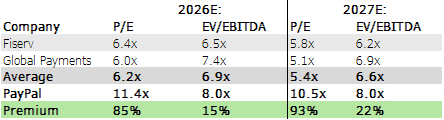
However, on an EV-to-EBITDA basis, the proposed price is below recent comparable transactions in payments:

Although a formal response has not been given, PayPal’s board views the offer as inadequate, according to Reuters. Reporting by Reuters revealed additional important information: first, if regulators force a break-up to clinch a deal, Advent could take Braintree, merging it with Nuvei which it took private during 2024, while Stripe takes the rest, including PayPal’s massive user base, suggesting Stripe sees the most value in adding a consumer side to its platform, not more processing scale; and second, Block was involved in earlier discussions with Stripe and Advent about a potential bid for PayPal, but dropped out before the others moved forward. It’s not exactly clear what Block’s thinking was on the strategic merits of a tie-up with PayPal, and how logistics would have worked under tri-party ownership.
Handicapping Next Steps
With an initial bid seemingly dead on arrival, PayPal’s earnings at the end of July may shape negotiations moving forward: deliver solid results and a plausible turnaround plan for core checkout and PayPal’s hand could be strengthened, emboldening them to hold out for a higher price, which they may or may not get; or continue struggling, making acceptance of a lower takeout price more likely. Regardless of the earnings outcome, I believe it is likely Stripe and Advent will make at least one more bid for PayPal. If I were PayPal, or a banker advising them, which I am certainly neither, I would be asking for at least the low-end of recent comparable transactions, 9.6x on an EV-to-EBITDA basis. This implies an enterprise value of $64.7 billion, or about $73 per share. Therefore, if I was handicapping next steps, I would say a bid between $65 to $70 per share is more-likely-than-not rejected, and a bid of $73, or more, has a better shot of being approved. At this point, I believe it is unlikely another suitor emerges.
Is It Worth It For Stripe?
Ultimately, I am not privy to Stripe’s thinking, or PayPal’s or Advent’s, for that matter. I do not know how ‘badly’ Stripe wants PayPal, or believes it needs them, if at all. It is certainly possible Stripe is taking a flier on PayPal with a low-ball offer and may walk if it is rejected. Advent’s history (see at end) and participation certainly suggests opportunism. Stripe has been a hugely successful company to-date, and a massive acquisition like this would be a striking departure from it’s usual playbook. Further, over time, the market has soured on large-scale payments M&A that adds legacy parts. Finally, if my interpretation of Reuters’ reporting is correct, and Stripe prefers the consumer-focused digital wallet part of PayPal, it is a large gamble for Stripe, in my opinion.
First and foremost, the market for digital wallets and consumer finance apps is highly competitive. Each transaction must be fought for and won…every single time. Incentives are on the rise, suggesting an inability to differentiate. Second, Stripe powers other digital wallets and consumer finance apps that compete with PayPal. While I think channel conflict as a risk has historically been overstated, it is still relevant. As an example, would PayPal’s BNPL offering take precedent over Affirm and Klarna at Stripe’s merchants, and how would that impact those relationships? Finally, any effort to build a two-sided stablecoin platform, or one that circumvents Visa and Mastercard, is wishful thinking, in my opinion, as the ‘on-us’ pipe dream has proven perpetually out of reach for any non-network payments company.
So, to answer my question: no, I do not believe it is worth it for Stripe.
PayPal Stock: What to Do?
I see upside to the mid-$70s for PayPal under an ideal scenario, or about 30%. It would likely take some time to get there with potential twists and turns along the way. If a deal falls through, PayPal’s stock could retrace its 17% gain since the formal bid was reported, or worse, given there was likely some takeout premium in the stock since late February when acquisition interest first surfaced. I certainly believe PayPal could trade down to a Fiserv or Global-type multiple if they decide to go it alone. I am not a gambling man, so I do not participate in ‘special’ situations and will stay far away from this one.
Implications for Payments and Fintech
I think there’s two ways to look at a potential transaction’s impact on payments and fintech: a glass half full and glass half empty approach:
Glass Half Full
The offer by Stripe and Advent, however low it may be, suggests there is an underlying bid for the group at a certain level, putting a floor underneath valuations. That would be welcome news for companies like Fiserv, Global Payments, and Shift4 Payments. However, there is one huge caveat: PayPal has a pristine balance sheet, and those three companies do not.
Consider the math: for the $54 billion proposed PayPal deal, only $17 billion of equity is needed with the remaining $37 billion funded by debt, implying a pro-forma debt-to-EBITDA ratio for standalone PayPal of 5.5x ($37 billion divided by $6.74 billion of EBITDA). The deal’s funding mix would be 2.2 to 1 debt-to-equity.
With starting net leverage ratios in the 3-4x range, significantly more equity is required to fund a private equity buyout of either Fiserv, Global Payments, or Shift4 Payments. To pay a similar 8x Fiserv’s 2026 EBITDA would imply an equity value of $41 billion ($77 per share) with additional debt capacity of $19.3 billion to 5.5x EBITDA (5.5 x $8.67 billion of EBITDA = $47.7 billion – current net debt of $28.4 billion = $19.3 billion) implying equity required of $21.7 billion, resulting in a funding mix of 0.9 to 1 debt-to-equity.
Stripe’s combination with PayPal disrupts the momentum of payments’ arguably most successful company. Additional volume opportunities and partnerships come into play, and innovation slows for Stripe, allowing others to catch up. If Braintree combines with Nuvei, similar disruption takes place, creating opportunities for competitors like Adyen, Checkout, and yes, Stripe.
Glass Half Empty
Stripe’s control of, and magical touch on, both Braintree and PayPal’s digital wallets make them more formidable competitors, placing further pressure on legacy processing platforms like Worldpay, and modern ones like Adyen and Checkout, as well as other digital wallets and BNPL providers. Stripe’s new massive two-sided platform creates an unrivaled data edge, further widening Stripe’s moat, and providing the scale necessary to win in agentic commerce. The unthinkable happens and Stripe finally achieves a viable alternative to Visa and Mastercard, disrupting the entire payments industry.
Advent’s History in Payments: Opportunistic Buyer
Advent has proven to be an opportunistic participant in payments M&A. My knowledge of their involvement begins at the depths of the Great Recession when Advent acquired a 51% stake in Fifth Third Processing, the payment processing unit of Fifth Third Bank, contributing $561 million in equity to shore up Fifth Third’s depleted balance sheet. The unit would later IPO as Vantiv in 2012. In a similar fashion, during 2010, Advent and Bain Capital bought 80% of Worldpay, Royal Bank of Scotland’s (RBS) merchant services business, injecting fresh capital into the struggling bank. Worldpay’s IPO in 2015 netted Advent and Bain a nearly $5 billion gain. Two years later, Vantiv agreed to acquire Worldpay for more than $10 billion. When Worldpay was being shopped by owner FIS during 2023 (FIS bought Vantiv in 2019, try to keep up), the Financial Times reported Advent was outbid by ultimate winner GTCR. More recently, following a significant drawdown (approximately 90% between 2021 and 2023), Advent agreed to take Canadian payments company Nuvei private for $6.3 billion in 2024, following that up with the planned acquisition of cross-border payments company Payoneer for $2.75 billion, a significantly discounted valuation, announced about one month ago.
As always, thank you for reading, and if you’ve enjoyed this, please consider sharing, liking, commenting or subscribing!
Thanks for reading Bob’s Payment Stock Substack! Subscribe for free to receive new posts and support my work.
Disclosure: As of July 20, 2026, of the stocks mentioned in this report and across payments and fintech, I am long Visa, Global Payments, Intuit, Block, Adyen, Shift4 Payments, Paychex, Mastercard, and Broadridge Financial. This report is for informational purposes only and is not a recommendation to buy or sell any stock. Finally, while I rely on the information in this report to guide my investment decisions, you should not, because I cannot guarantee its accuracy.
Comments
Nothing yet. Say the first thing.
Sign in to join the conversation.