
Synopsis: After reaching a cycle low of 12x NTM EPS during October of 2023, shares of American Express (Amex) have re-rated, reaching more than 22x by the end of last year. As a result, AmEx closed its valuation gap to rival networks Visa and Mastercard: at the end of 2025, AmEx traded at only a 24% discount to Visa and Mastercard, compared to its ten, five, and three-year average discounts of 47%, 38%, and 37%, respectively:
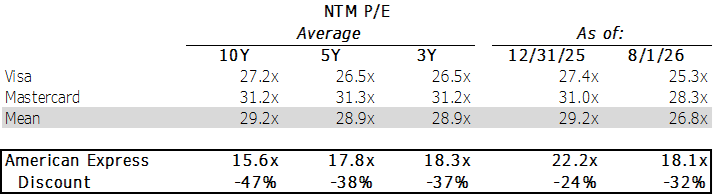
As of today, Amex’s discount has widened back to 32%. Although I believe Amex’s re-rating was absolutely deserved, to close the valuation gap with Visa and Mastercard further, but never completely, Amex must accomplish two things: (1) resume share gains of the U.S. credit card market; and (2) sustain profitable growth. Based on its most recent report, I believe results are mixed with much work left to do. The purpose of this update is to: (1) examine progress against my objectives, weighing all the evidence, including YTD results; and (2) review my estimates for Amex, including fair value.
Resume share gains of the U.S. credit card market
Background. The U.S. credit card market is the largest payment card market in the world (outside of China). It is also the most lucrative for issuers with fat interchange rates, record high APRs (21%), and recently stable loss rates. Outside of the pandemic’s recovery phase, Q2’s volume growth rate of 9.8% was the strongest since Q3 2018, suggesting a secular-led slowdown remains in the future. Therefore, it is no surprise the market is highly competitive, especially for affluent Americans who generate most of the spending but also consume an increasing amount of rewards, including points, cash back, and experiences. Amex’s share of the U.S. credit card market peaked in 2013 at slightly less than 27%. In 2025, it was 19.2%. In addition to its loss of Costco in 2016, the key contributors to Amex’s share decline are increasing competition in the affluent segment and, more recently, struggles among middle market companies in the U.S. commercial card market, where Amex is defending a significant presence. In order to support growth and a potentially higher multiple, I believe it is imperative for Amex to resume share gains, or, at the least, stabilize losses.
Verdict: Amex is falling short with share loss picking up recently:

However, it’s not that black and white. The composition of Amex’s U.S. spend differs from Visa and Mastercard. Over the twelve months ending March 31, 2026, 43% of Amex’s U.S. billed business was commercial, including 35% from small and mid-sized enterprises (SMEs) and 8% from large corporations. Over the same time, only 25% of Visa’s U.S. credit payment volume was commercial. Although Mastercard only discloses total worldwide commercial gross dollar volume (GDV) annually, I believe their U.S. credit purchase volume has a similar commercial mix as Visa’s. Based on the evidence, I believe Amex is gaining share of the U.S. consumer credit market due to their significant presence among affluent households—but not necessarily gaining share within the affluent category—and losing share of the U.S. commercial card market. Below is my approximate estimation of the U.S. commercial card market from 2019-H1 2026:

Recently, Amex called out softness in the middle market, citing competitors Brex and Ramp specifically, which are highly successful fintechs that combine corporate cards with modern expense management software. Divvy, owned by BILL Holdings, also competes in the market and grows volume at an attractive rate (low-to-mid 20% range over the last several quarters). In response to this challenge, Amex recently introduced its own expense management platform, relying on technology from recently acquired companies Center and Hypercard, and is refreshing its commercial card lineup.
On the consumer side, I believe it’s unlikely Amex is gaining share in the affluent category. Here’s why. Although we don’t know exactly how fast the affluent category is growing, we’ve been told repeatedly it’s growing the fastest:
“What you do tend to see is higher growth in the affluent side of spending, but that’s kind of not a new phenomenon. That’s been with us for some time now.”
Sachin Mehra, CFO of Mastercard on its Q2 2026 earnings call on July 30, 2026
“Also, affluent cards are the fastest-growing area of consumer payments…”
Ryan McInerney, CEO of Visa on their Fiscal Q2 earnings call on April 28, 2026
In the most recent period where we have comparable data, which is Q1 2026 (March), Visa’s U.S. consumer credit payment volume grew 8.8% vs. a 9.7% increase for Amex. The narrow spread suggests the affluent portion of Visa’s U.S. consumer credit payment volume may be growing faster than Amex’s. If we assume 40% of Visa’s U.S. consumer credit payment volume was from the affluent category during Q1 2025 (March), a reasonable estimate in my opinion, plugging in a 9.7% growth rate (matching Amex’s) for Q1 2026 (March) would imply Visa’s non-affluent payment volume grew 8.2%, a rather small spread. If we assume 10.5% growth for the affluent portion, a premium to Amex’s growth rate, it implies non-affluent payment volume grew 7.6%, a nearly 3-point spread, which is more likely, in my opinion.
Conclusion. I believe Amex is not gaining share in the affluent consumer category and losing share in the commercial category. Overall share loss is moderate only because the affluent consumer is the fastest growing, where Amex has a significant presence. If the gap between affluent and non-affluent consumer spending narrows, which is unlikely over the near-term, Amex’s share losses may accelerate.
Sustain profitable growth
Background: Amex’s long-term aspiration is to grow revenue more than 10% and EPS at the mid-teens. From 2019-2025, Amex’s revenue and EPS compounded at 9% and 14.5%, respectively. For 2026, Amex now expects 10% revenue growth and 14% EPS growth at the midpoint, largely in-line with aspirational targets. The building blocks for Amex’s EPS growth are for leverage from the marketing and operating expense lines to offset variable customer engagement (VCE) growth, which has been significant both as a percentage of revenue and billed business:


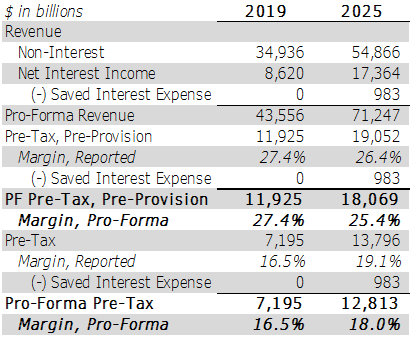
Verdict: The expansion in Amex’s pre-tax profit margin since 2019 has been entirely due to leverage from provision for credit loss as pre-tax, pre-provision profit margin fell approximately 1-point:

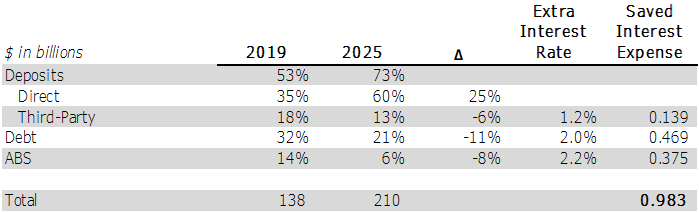
Additionally, Amex benefitted from a significant shift in its funding mix with nearly three-fourths sitting in lower-cost deposits at the end of 2025 versus approximately half in 2019. Based on my math, I believe this shift created an additional $983 million of net interest income (due to saved interest expense) and pre-tax profit for Amex:
Adjusting for this, Amex’s expansion in pre-tax margin since 2019 falls from 2.6-points to 1.5-points on a pro-forma basis while the contraction in pre-tax, pre-provision margin increases to 2-points from 1-point:
The key question moving forward is whether Amex will be able to sustain profitable growth as tailwinds from the funding mix shift become less significant, the credit environment potentially becomes less favorable, and the transition to a primarily fee-paying card member mix runs its course.
Conclusion: To be determined, although YTD 2026 results show some bumps in the road. Even though Amex’s pre-tax profit margin expanded by 60-bps from H1 2025 to H2 2026…
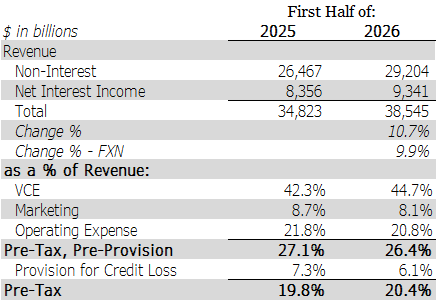
The expansion was driven by a couple of non-recurring, or unsustainable, items, more than offsetting higher-than-anticipated VCE costs: (1) a $215 million reserve release in H1 2026 versus a $347 million reserve build in H1 2025; and (2) an indeterminable amount of favorable items [a tax reversal, gains on Amex Ventures’ investments, and a gain on portfolio sale(s)] impacting other expenses, causing them to fall by $334 million from H1 2025 to H1 2026. If I assume H1 2026 other expense is flat to H1 2025 and the credit loss reserve ratio stayed at the Q4 2025 exit rate (2.86% vs. 2.54% Q2 actual), it reduces H1 2026 pre-tax profit by $1.08 billion, or about 3 margin points.
The Numbers

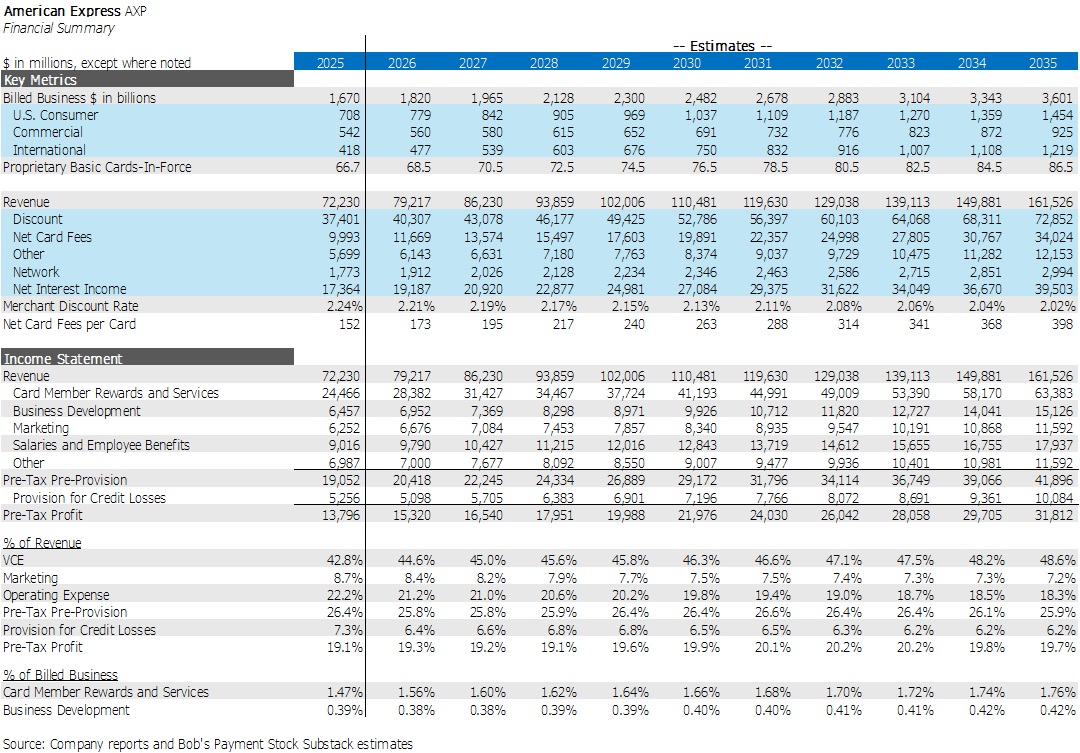
For 2026, I expect revenue of $79.22 billion, up 9.7%. Underlying this is 10% growth in U.S. consumer billed business, 3% growth in U.S. commercial, which incorporates about a 4-point impact starting in Q4 from the loss of the Lowe’s (April) and Amazon (August) portfolios, and 14% growth internationally, including a 2-point FX tailwind, implying 12% FXN growth. I expect a merchant discount rate of 2.21%, down 3-bps from 2025, leading to 8% discount revenue growth. After slowing to 15% growth in Q2, I assume net card fees growth accelerates to 16% in Q3 and 18% during Q4, resulting in a full-year growth rate of 17%. I expect other fee revenue and network partnership revenue to both grow 8% during 2026. I estimate net interest income will grow 10%.
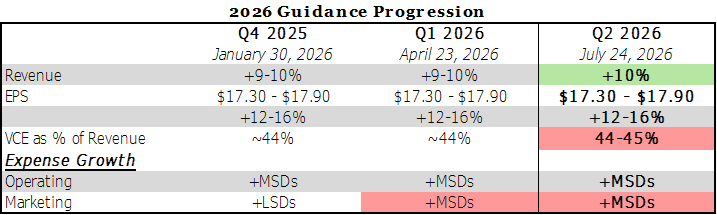
On the expense side, I assume VCE costs will represent 44.6% of revenue, up 180-bps from 2025. If marketing expense grows approximately 10% during H2 as Amex expects, that implies it will represent 8.4% of full year revenue, down 30-bps from 2025. Operating expense as a percentage of revenue will decline by 1-point to 21.2%. This results in a pre-tax, pre-provision profit of $20.418 billion, or 25.8% of revenue, down 60-bps. I expect full-year provision for credit loss of $5.098 billion, down from $5.256 billion in 2025. Pre-tax profit of $15.32 billion is up 11% versus 2025. I assume a full-year tax rate of 21.8% and an average diluted share count of 678 million based on a 4 million share reduction in Q3 and Q4. The result is EPS of $17.47, up 14% versus 2025 and at approximately the midpoint of Amex’s guidance:
For 2027, I estimate revenue of $86.23 billion, up 8.9% based on billed business growth of 8%, weighed down by about three-quarters of 1-point by the commercial portfolio sales. Discount revenue is expected to grow 7%, net card fees 16%, other fees 8%, and network partnership revenue 6%. I expect net interest income to grow 9%. I believe U.S. commercial billed business growth will exit 2027 at 6% growth, reflecting some improvement versus its current run-rate. I expect VCE costs to represent 45% of revenue, a 40-bps increase versus 2026, indicating moderation following the uplift from the Platinum card refresh. I assume marketing expense growth of 6% and operating expense growth of 7-8% due to a normalization in other expenses during H1 2027. My provision for credit loss estimate is $5.71 billion, reflecting average balance growth in-line with billed business growth and a slight increase in the net write-off rate. This results in pre-tax profit of $16.54, up 8% with the margin falling 10-bps. Based on a 21% tax rate and an average diluted share count of 661 million yields a 2027 EPS estimate of $19.56, below consensus of $20.12.
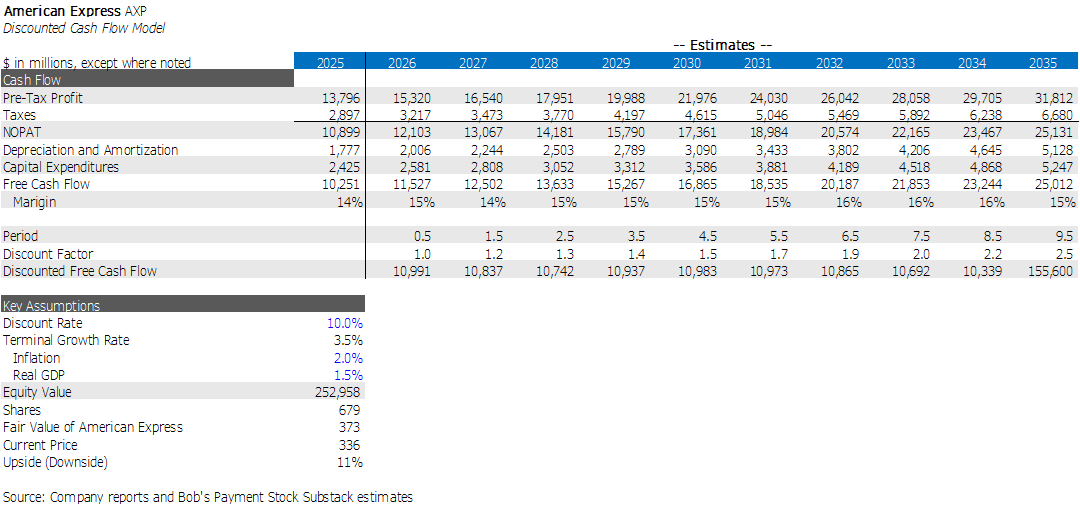
My fair value estimate for Amex is $373, implying about 11% upside:
Over my ten-year forecast, I believe Amex’s billed business will compound at 8% with 7.5% growth in U.S. consumer, about 6% growth in U.S. commercial, and low double-digit FXN growth internationally. Assuming a very low single-digit annual decline in the merchant discount rate results in discount revenue growth of about 7%. Based on card growth of 3% and a 10% increase in card fees per card (annual fees increasing and the mix of fee-paying card members rising) yields average annual net card fees growth of 13%. I assume other revenue grows by about 8% and network partnership revenue 5.5%. Reflecting my belief that card balances will grow in line with billed business, and net interest yield will improve slightly, I assume net interest income grows at a compound annual rate of more than 8.5%, faster than 8% billed business growth. This adds up to compound annual revenue growth of 8.4% over my ten-year forecast period, which in no way is conservative, in my opinion.
On the expense side, I assume many long-standing trends continue: rewards and business development costs make up an increasing portion of revenue (from 42.8% in 2025 to 48.6% by 2035 with the percentage of billed business rising to 2.18% from 1.85%), offset by leverage in marketing (8.7% to 7.2%) and operating expenses (22.2% to 18.3%). I believe credit performance will remain strong with provision expense growing slightly more than 6.5%, below both billed business and revenue growth. The result is Amex’s pre-tax profit margin rising from 19.1% to 19.7% over my ten-year forecast period with a peak of 20.2% in 2033, implying compound annual growth of nearly 9%.
My DCF model uses GAAP NOPAT + depreciation and amortization – capital expenditures as a proxy for free cash flow. I use a 21% tax rate, assume capital expenditures average 4.3% of revenue over my ten-year forecast, and depreciation and amortization increases from 3.2% of revenue in 2025 to 4.2% of revenue by 2035, aligning with capital expenditures. I use a 10% discount rate to reflect a heightened competitive environment and the unpredictability of rewards cost escalation and credit cycles. My terminal growth rate is 3.5%. If I dropped my discount rate to 9%, it would boost my fair value of Amex to $445, implying nearly one-third upside. Conversely, if I raised it to 11%, my fair value would drop to $320, implying minimal downside.
Thoughts on the Stock
By no means am I bearish on Amex. However, I fail to see compelling value at current prices, especially compared to other opportunities across payments and fintech, including Adyen (trading at a moderate premium despite a superior growth profile with significant volume sitting at technologically and operationally disadvantaged legacy platforms), Broadridge Financial (a true monopoly in proxy distribution and processing that spins the flywheel for a best-in-class corporate governance and communications franchise, trading at a discount), and Intuit (QuickBooks is at the center of the SMB ecosystem, providing a launching pad for top-tier growth for Intuit across payments, payroll and HCM, also trading at a discount). In my mind, Amex’s recent results fail to satisfy my requirements for a higher multiple and, in fact, suggest Amex still has much work to do to regain momentum in the U.S. commercial card market and deliver differentiation that drives superior performance among affluent consumers.
As always, thank you for reading, and if you’ve enjoyed this, please consider sharing, liking, commenting, or subscribing!
Thanks for reading Bob’s Payment Stock Substack! Subscribe for free to receive new posts and support my work.
Disclosure: As of August 3, 2026, of the stocks mentioned in this report and across payments and fintech, I am long Visa, Global Payments, Intuit, Block, Adyen, Shift4 Payments, Paychex, Mastercard, and Broadridge Financial.I do not hold a position in American Express. This report is for informational purposes only and is not a recommendation to buy or sell any stock. Finally, while I rely on the information in this report to guide my investment decisions, you should not, because I cannot guarantee its accuracy.
Comments
Nothing yet. Say the first thing.
Sign in to join the conversation.