
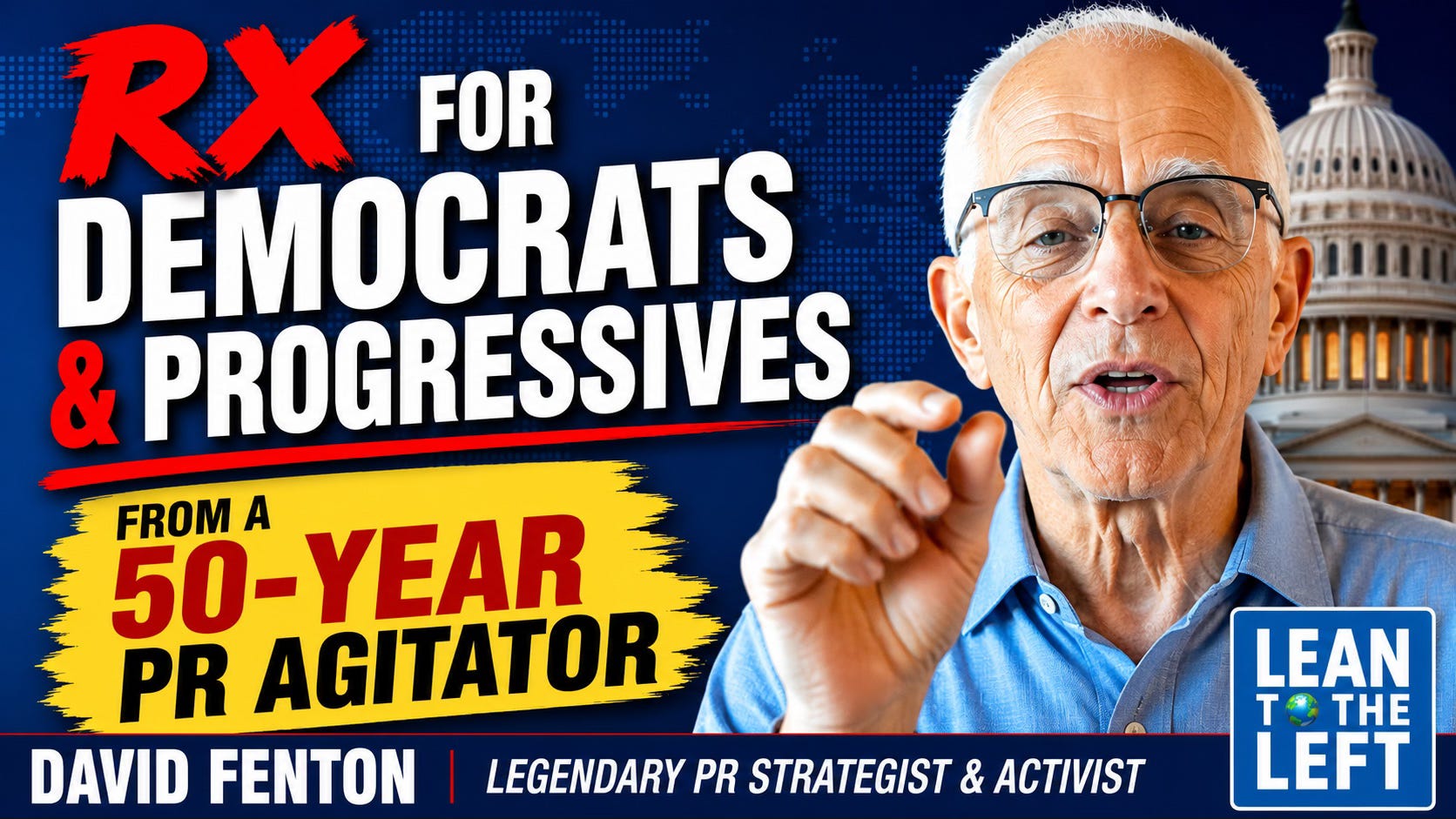
Democrats may have popular policies, but veteran progressive strategist David Fenton says that is not enough to win elections or build lasting political power.
In this episode of the Lean to the Left podcast, Fenton draws on more than five decades of activism and public relations to offer a pointed prescription for Democrats and progressives:
Simplify the language. Repeat the message. Speak to working people. Expose corruption. Build a movement.
Fenton founded the pioneering progressive communications firm that bears his name after years in the antiwar and counterculture movements. His remarkable career has included work connected to the No Nukes concerts, the movement to free Nelson Mandela, marijuana-law reform, anti-fracking campaigns, climate advocacy and numerous human-rights and social-justice causes.
The National Journal called him the “Robin Hood of public relations” because he used the techniques of corporate PR on behalf of nonprofits and public-interest campaigns.
Fenton argues that conservatives have built a powerful communications system encompassing television, radio, websites, social platforms and influential personalities appearing directly on voters’ phones.
Progressives, he says, have failed to build anything comparable.
Instead, Democrats frequently rely on policy details, expert analysis and the assumption that a good idea will eventually persuade people on its merits.
Fenton says that assumption is dangerously wrong.
Political communication requires clear language, emotional relevance and repetition. Republicans understand that. Democrats often do not.
One of Fenton’s central lessons is that communicators should use familiar words that activate ideas people already understand.
Climate advocates, for example, regularly speak about “net zero,” “carbon” and “climate justice.” Those terms may be technically useful, but they do not necessarily connect with a mass audience.
Fenton recommends talking instead about pollution, cost and corruption.
Rather than presenting climate change as an abstract scientific concept, he describes a blanket of pollution trapping heat around the Earth. Instead of lengthy explanations of energy policy, he urges advocates to say: Make Polluters Pay.
The goal is not to dilute the truth. It is to make the truth understandable.
With families struggling to cover food, housing, gasoline, electricity and healthcare, Fenton says Democrats should connect their political arguments directly to affordability.
He believes voters need to hear how Trump’s tariffs, fossil-fuel policies and favors for wealthy donors raise their costs.
Democrats should not begin with an ideological label or a complex program. They should begin with the problem people experience every day—and identify who benefits from it.
Fenton believes cost caused by corruption could become one of the party’s strongest messages.
Fenton is also critical of progressive rhetoric that divides people into small political or identity-based groups.
Respecting identity is important, he says, but winning change requires assembling a broad majority around shared interests.
The most powerful political divide, in his view, is not left versus right. It is top versus bottom: billionaires and concentrated economic power versus the working people forced to live with the consequences.
That approach offers Democrats a way to discuss inequality, corporate influence and democracy using language that reaches voters across conventional political categories.
Fenton’s own story is as colorful as his advice.
He recounts dropping out of school during the 1960s, photographing antiwar leaders and rock legends, learning from Abbie Hoffman and helping organize a concert featuring John Lennon to free marijuana activist John Sinclair.
He later worked at High Times and Rolling Stone, helped produce the No Nukes concerts and created the first PR firm devoted to progressive causes.
He also discusses his book, The Activist’s Media Handbook, and his podcast, The Fenton Forecast, which examines the choices society faces on democracy, climate, artificial intelligence, inequality and the future.
David Fenton and Bob Gatty discuss:
Why Republicans are winning the information war
The messaging mistakes Democrats repeatedly make
Why good policies do not sell themselves
How repetition and framing shape public opinion
Why progressive jargon can alienate voters
How to communicate climate change through cost and pollution
Why Democrats should focus on corruption and affordability
How to reconnect with working-class voters
The dangers of disinformation and concentrated media ownership
What mass movements can accomplish
Lessons from Abbie Hoffman, John Lennon and five decades of activism
The Activist’s Media Handbook and The Fenton Forecast
The takeaway is direct: Democrats cannot win simply by being correct. They must learn to communicate in a way that people understand, remember and feel compelled to act upon.
Comments
Nothing yet. Say the first thing.
Sign in to join the conversation.