
Much of global macro trading is a study in crises. Whether it be the hallmark US depression or GFC, or the series of individual emerging market financial crises of the post-war period, some of the best opportunities in markets from a macro perspective present themselves just ahead or just after a crisis. Heck there is even a book about all these bad times I was involved in writing ages ago if you want some uplifting nighttime reading.
In nearly all cases governments pursue unsustainable policies which create enough economic harm (high rates, inflation, real GDP declines) that they must eventually shift course to more expansionary or stimulative efforts in one form or another. Alpha comes in understanding the consequences of those unsustainable policies and how far they can go before policymakers change in their efforts.
So it’s with a curious eye (and historic lens) that I look at the administration’s latest gameplan to wait out the Iranians by “low-keying it” and hoping for enough economic pressure that they reverse the current disruptions of Hormuz and the Red Sea. The inevitable question becomes, just how significant are the pressures faced by the economy and will it turn policy in short order.
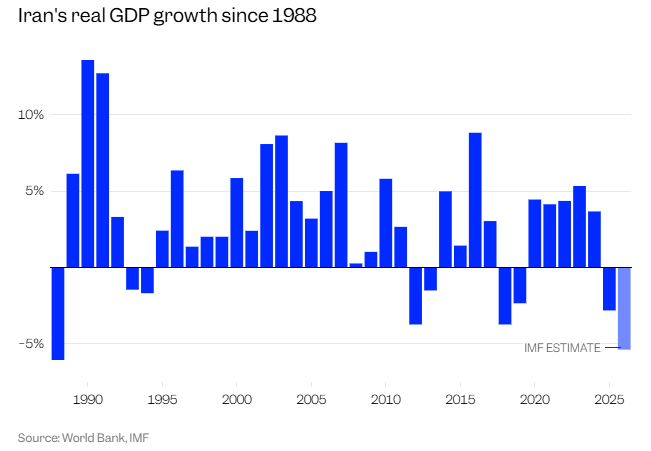
As I thumb through the typical macro stats, the gist is, things aren’t great right now but hardly a crisis. Real GDP is expected to fall about 6% this year. Not great, but not that painful vs. what we saw in many countries in the AFC, LatAm crises, and GFC. Inflation is running at 100% annualized and the currency is down about 1/3rd since the start of the year, which is notable, but again far from the type of runaway conditions seen in others’ crises.
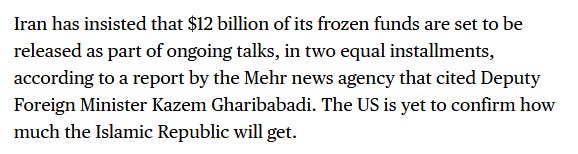
Probably more importantly in the near term, Iran appears to have at least some cushion to stockpile production so as not to ruin their current production infrastructure while it waits for another opening in the blockade to emerge. And the combination of aggressive shipments in the MoU period plus the 12bln likely released as part of the agreement effectively pre-paid several months of exports.
Taken together, the economic conditions look quite far from what would typically force abrupt policy changes in history. Not to mention the views of a hardline government, which is likely to accept more significant pain than a typical elected one, with just how far a bit beyond my perspective as a macro analyst of historic crisis. But I think we can say it is higher than average.
This suggests that if policy is left to a wait and see approach hoping for enough economic pain to create a shift, it could easily go on through the end of the year by which time global oil stocks will be reaching concerning lows. That would be quite the unexpected outcome for a market still pricing in a good chance of a swift resolution.
A Look At The Numbers
The latest macro stats largely paint a consistent picture - an inflationary growth decline, but hardly something that is all that extreme. The IMF projects real GDP to decline 5-6% this year for instance, which isn’t great, but not radically outside the pain seen in previous years.
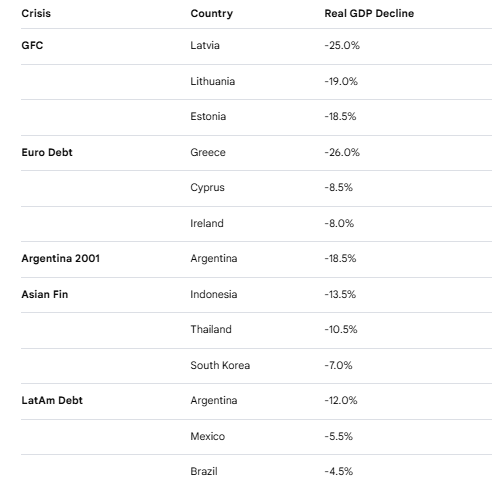
To put this into context, one can look at the type of economic pain seen in other countries that had faced “economic collapse” in history. We don’t even have to go back to the US 25% decline during the depression. Greece’s real GDP fell 26% in the European debt crisis. Latvia down 25% in the GFC. ARG down 20% around the 2001 troubles. Those are big fucking declines. And even then those countries didn’t implode politically.
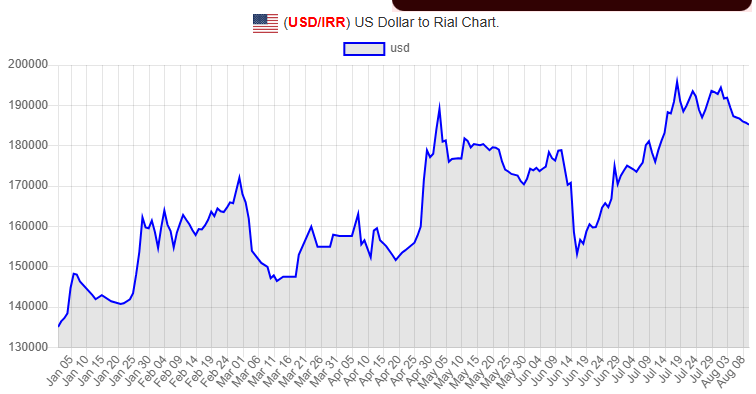
The reduction in foreign currency flowing into the country has also created pressure on the currency, down roughly 30% since the start of the year based upon various black market rates that can be seen. That certainly is not a great outcome, but pales in comparison to the types of currency collapses seen in emerging market crises in history.
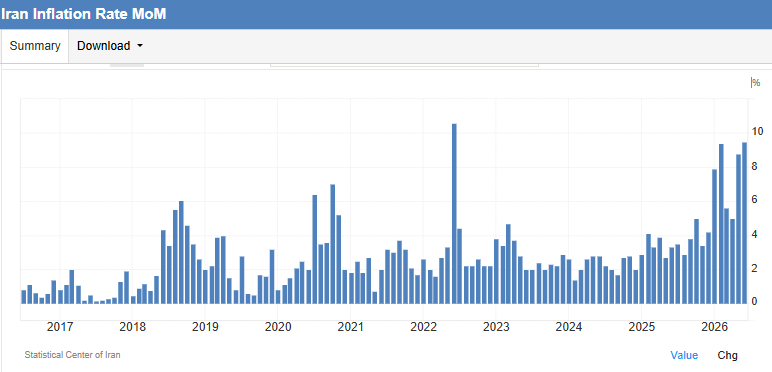
The declines in the currency are creating some price pressures for imported goods and inflation overall. So far this year inflation has been averaging 7-8% a month, which is roughly a doubling of prices on an annual basis. While that feels extreme, for instance it’s about half the run rate Argentina was seeing just a few years ago. Sure they elected a new administration, but the economy didn’t collapse.
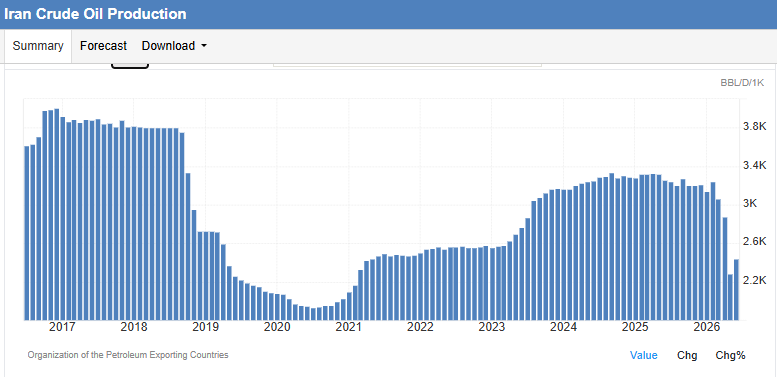
Oil production has also taken a hit in recent months, with the latest July figures showing weak output based on OPEC estimates. Though again it’s worth noting that production had actually been lower back in 20 and 21, so it’s not like this level of output is unheard of.
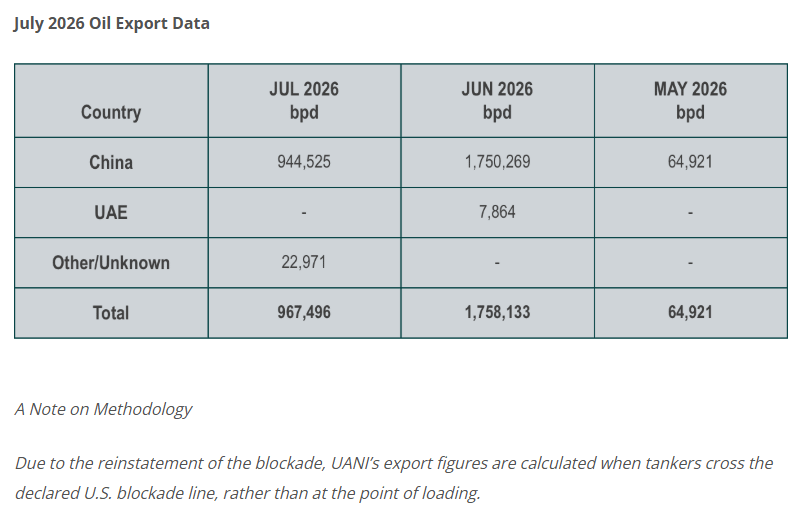
The challenge Iran has right now is that exports are starting to get clogged up as a result of the latest blockade. After a surge in exports in June and early July as a result of the MoU, estimates are that there haven’t been any tanker loadings since the MoU was halted by the US administration.
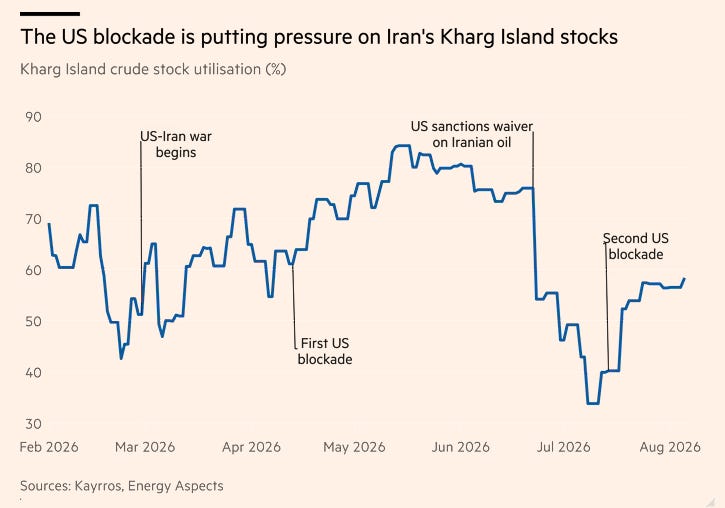
The result is that the Iranians are back to building up their stocks on Kharg island to wait out another round of blockade. Latest data highlighted by the FT suggests those are building again, but remain pretty far from levels seen at the peak of the conflict in May. Through a combination of slowing production, leaking supply overland, and building up stocks, it could be months before there is a meaningful squeeze on tank capacity.
Of course with no exports, revenues are also drying up. But even there, it seems there may be cushion to go for months at least. The reported terms of the MoU suggested that 12bln of the 100bln+ assets abroad were released as part of the MoU deal. That amounts to roughly 5mln bbls of production if oil is 80 bucks, a meaningful cushion to absorb months of blockade.
Bottom Line
A scan through the economic data suggests that while Iran is facing some economic pain, it’s likely reasonably manageable in the short term without forcing an immediate shift in policy. Combined with the oil stock and cash cushion, it looks like Iran could wait out the current economic pressure for months if not for years ahead.
If that’s the case, the oil market and the US administration is likely miscalculating how long the disruptions may last ahead.
Comments
Nothing yet. Say the first thing.
Sign in to join the conversation.