
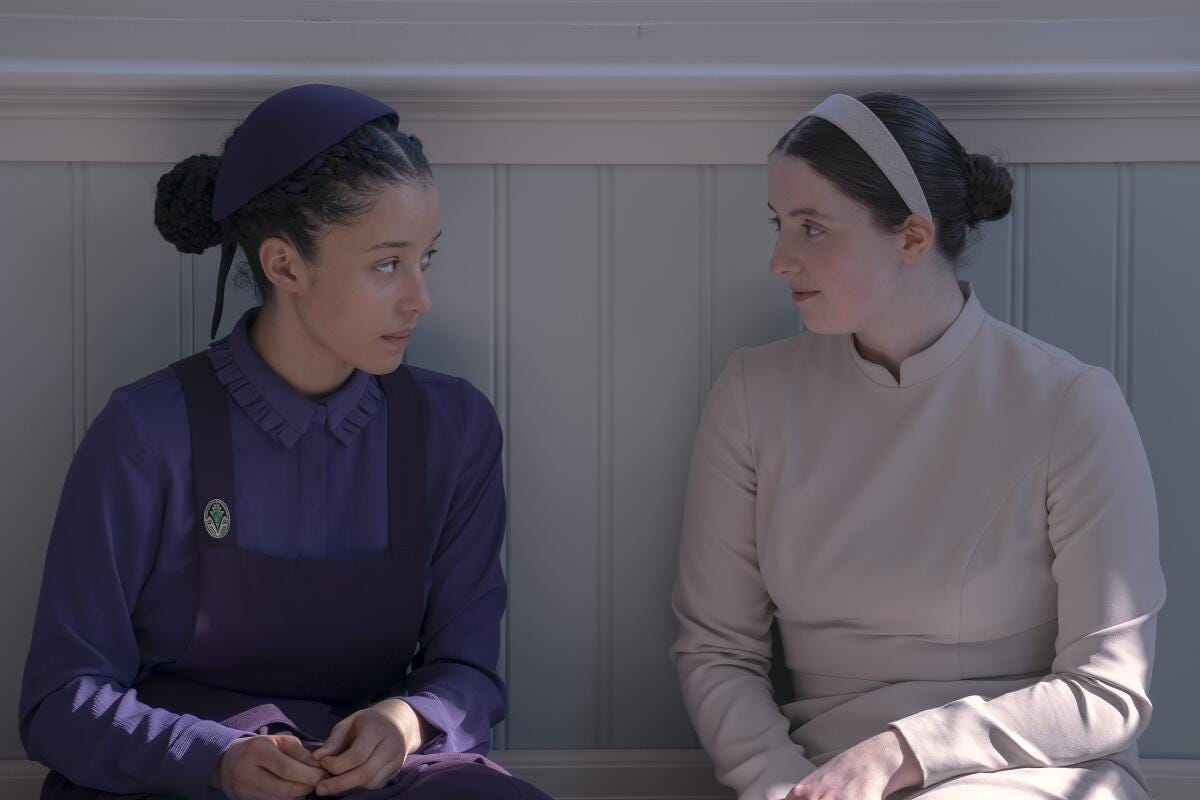
As a steadfast fan of The Handmaid’s Tale and now The Testaments, I have allowed myself to absorb the prickly, volatile nature of the world placed in front of me. Constant unfortunate encounters in the world of Gilead bring painful visuals of sexual slavery, authority, domination, ridicule, and the bastardization of Christianity. Though, to only acknowledge these factors removes us from the sovereignty and sisterhood beneath the surface.
To look at the world of Gilead only through the lens of sexual deviation and control is to miss a vital essence of the story—an essence that The Eyes do not want us to see. It is to misunderstand how the story has balanced the ability to be salacious and unsettling. The true power of The Testaments is not only in the innocence of girlhood but in the way the girls refuse to stay locked in the prison of their own minds. One by one, they are starting to crack. The chasm leaves behind the effervescent belief that the power of self-sovereignty and liberation can, and should, be up to their own discretion. In doing so, it overturns the idea that to be a girl, a woman, feminine, and a wife, we must trap ourselves in the box labeled Innocent, Fragile, Doting, and, as episode eight is titled, Broken.
This Substack is reader-supported. To receive new posts and support my work, consider becoming a free or paid subscriber.
Agnes, so graciously portrayed by the striking Chase Infiniti, our brown-eyed heroine and daughter of the infamous June Osborne, boasts a memorable example of practicing self-sovereignty early on. Subtly and carefully done, we contemporary women may even take it for granted at times. Agnes models the choice to have a best friend. Agnes’ affection and sisterhood are found in Becka, played by Mattea Conforti. In a world that strongarms female souls into believing friendship is where the devil comes to play, choosing camaraderie in their peers is a choice reserved for the brave and the exasperated. In the world of Gilead, leaning into humanity is rewarding before it is damning. But, as a pendulum does, the damning swings back and puts up a fight. We must acknowledge that, even for a brief moment, autonomy will always be worth the wrath that choice brings.
Caused by the heart’s desire, the veil between Agnes and Becka’s innocence and the reality of their circumstances begins to lift. The introduction of the star-crossed-lovers triangle between Agnes, Becka, and Garth—Agnes’ handler and undercover May Day operative—illuminates the reality that even though Agnes and Becka chose each other as companions, the lives they lead ultimately do not belong to them; they belong to Gilead. The triangle delivers an audacious twist on an idea depraved and vile in Gilead’s eyes—the power to choose love. Ashamedly, as a viewer, the triangle is so mouthwateringly scandalous. After all, choosing self-sovereignty is an option we are all tempted by. The story reinforces that a core pillar of humanity is to be free. Free will is our birthright, praise be.
In a sense, free will chooses Agnes. Almost as if it were caused by holy possession, in episode 7, Commitment, she dares to pick up Garth’s unfinished cigarette. The world of Gilead tilted on its axis and did a 180. In a sensual move, Agnes puffs on the cigarette butt. An act that could be punishable by the minimum, public shaming, no doubt. Could this be? Agnes’ transformation to “Hannah” is starting to poke its way to center stage? Somebody hold me.
While Agnes exemplifies her choice in one way, another distinct example of choosing freedom can also be found in our favorite Pearl girl, Daisy. Bouncing from a carefree, unassuming life in Canada to walking directly into the clutches of Gilead, choice comes in all shapes and sizes. Her crystal clear Canadian world is ripped from underneath her feet with the murder of her parents (who are not even her biological parents after all)! Under the newfound restriction of her fragile life crumbling before her eyes, she must actively stop circumstances from simply happening to her. A mindset we can all learn from. Life happens to us constantly, and it is cruel. Though it is up to one’s own self to mold the circumstances of one’s heart’s desires, instead of being an idle, passive girl.
Daisy is a perfect example of why placing confidence in the reality of free will is worth it. She runs straight towards her will, a different approach than Agnes, who seemed to be led into it by a spiritual-like force. With a layup from June Osbourne, Daisy chooses to enter a world that will strip her of her human rights as she knows them. The choice to regress into a world that is designed to choke and suffocate is reserved for those who either have full confidence in themselves, nothing left to lose, or both. In Daisy’s case, it is the last. This choice reinforces the idea that liberation, no matter the extremity, is necessary to find one’s desired path.
Another core pillar of humanity is to discover the path or pillars most personal to a person. What is the point of being human if the meaning of humanity remains a mystery? Daisy is walking this path and answering this question by diving headfirst towards the unknown, in an act of rebellion. Though she had a cushy life in Canada, it is a passive choice to continue living the life one is born into without question. Disrupting the status quo is an act of self-sovereignty.
May the Lord open the hearts of the pinks, plums, greens, and pearls of Gilead. The itch to run towards free will inspires this story. It is bleak and uncomfortable and shocking, but worth it. The intersection of freedom, belief, and desire is a theme that The Testaments does not take lightly. As viewers, we do ourselves a disservice by not paying careful and extreme attention. Take notes as we eagerly tune in to our Hulu apps and Smart TVs. The penultimate episode is upon us. Where will the urge to unlock humanity’s core take the story next? We will find out soon, Lord willing.
This Substack is reader-supported. To receive new posts and support my work, consider becoming a free or paid subscriber.
Comments
Nothing yet. Say the first thing.
Sign in to join the conversation.