
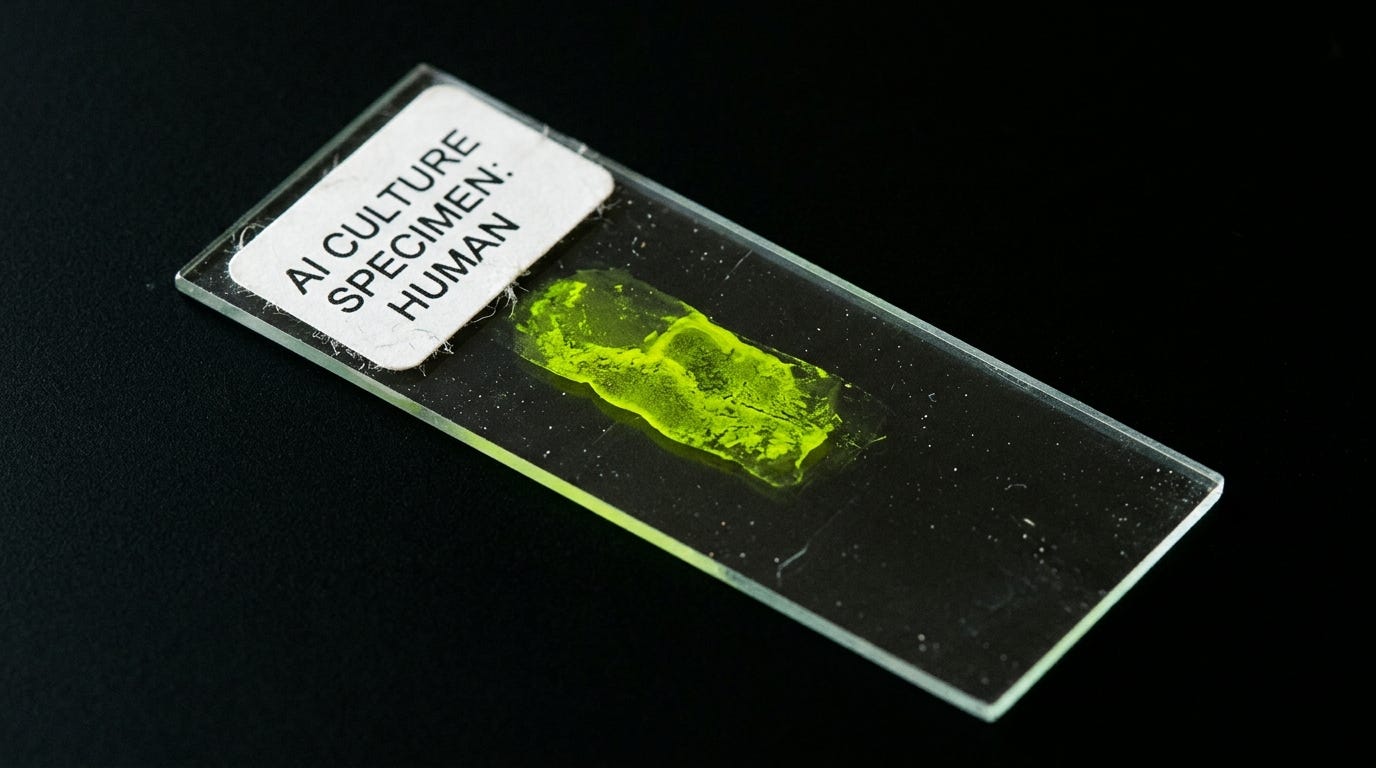
We’ve spent a long time talking to people about AI at work – and after enough of those conversations, patterns start to emerge. We call them territories because they feel cultural rather than technical. Less about what tools an organisation has, more about the way things actually work, as opposed to how they’re supposed to.
These are six scenes from inside those territories, or cultures. Perhaps one will feel familiar.

The Wild West
Dani doesn’t tell anyone about the workflow she built.
It took her a weekend – a Saturday morning, mostly – to connect the three tools and get it running. It saves her about four hours a week. The output is better than what she was doing before. She’s checked it carefully. It works.
But one of the tools isn’t on the approved list. She’s not sure there is an approved list. She mentioned it to a colleague who said “just don’t make it obvious” and that was the end of that conversation.
So the workflow runs quietly. When Dani’s on holiday, the four hours don’t get saved. Nobody knows why. When she leaves – she’s already had one recruiter approach her – the workflow goes with her.
The knowledge doesn’t live anywhere it can be found. It lives in Dani.
The Theatre
The deck is on its fourth iteration this quarter.
Not the strategy. The deck. The strategy is essentially the same as it was in November – which was essentially the same as the digital transformation strategy from 2022, with some language updated. But the deck needs to reflect the conversation at the last leadership meeting, where someone senior asked a question that didn’t have a clean answer, so slide 14 needs reworking before Thursday.
“Acceleration” had felt right in January. Now it feels like it’s promising something. “Embedding” is more defensible. Or “integration.” Something that implies progress without specifying what kind.
The revision takes most of the afternoon. The deck is cleaner now. More considered.
In the same building, on a different floor, three people are solving real problems with tools they found themselves. Nobody’s documented those either.
The Showroom
The Copilot banner appears on a Monday.
Marcus clicks it. It offers to summarise an email thread he’d already read, replied to, and forgotten about. He closes the banner. It comes back on Tuesday, suggesting the same thread. On Wednesday he right-clicks it, looking for a way to switch it off. The menu doesn’t have that option. He leaves it.
The IT helpdesk receives four tickets that week. None of them say “how do I use Copilot.” Two say “can I disable the Copilot banner.” One says “Copilot keeps interrupting me.” One says “is Copilot compulsory.”
The licences cost £28 per user per month. There are 340 users. In the last thirty days, six people have used it for something that wasn’t an accidental click.
The vendor demo had been impressive. The people in the room had nodded. The people who would actually be using it weren’t in the room.
Pilot Purgatory
The AI pilot section of the quarterly update takes Joel about four minutes to write.
He opens last quarter’s document, finds the section, copies it into the new one. Changes the date. Reads it back. “The pilot has continued to show strong results and we remain excited about the potential to scale.” He’d written that sentence seven months ago. It was true then. It’s still technically true now.
He thinks briefly about adding something – a note about resourcing, maybe, or a timeline for the next phase. Decides against it. That’s a bigger conversation. Better to raise it properly than half-raise it in an update.
Three people reply to the update. All positive. One says “really exciting stuff.” Joel reads the replies and opens a different document.
The person who built the pilot is on annual leave. She’s the only one who fully understands how it works. Joel realises he doesn’t know who to call if something breaks.
He makes a note to address this. The note goes into a document he hasn’t opened in six weeks.
The Maze
The email from compliance arrives on a Thursday. It’s a response to the use case proposal Rachel submitted on the 14th of last month.
She opens it carefully. It’s a request for clarification on eight points. She reads through them. Points 2, 5, and 7 are addressed directly in the original proposal – she can see the relevant paragraphs in her head. Points 1, 3, and 6 are genuinely new questions, reasonable ones, worth answering properly. Point 4 she doesn’t fully understand. Point 8 seems to be about a different proposal.
She forwards the email to her manager with the subject line “see below.” Her manager reads it and says “let me know if you need anything.” Rachel says “will do.”
She opens her task list. The proposal is still there, still marked as “in progress.” She looks at it for a moment. Moves it to the bottom. Opens something else.
The proposal isn’t dead. It isn’t progressing. It exists in a state that doesn’t have a name – not rejected, not approved, not paused. Just somewhere in the process, moving at the speed of the process, which is very slow and no one’s fault in particular.
Mission Control
The competitive landscape is due to the client on Friday. Marcus has done a first pass – market sizing, key players, three strategic themes he thinks are worth building on. Not written it, exactly. He’d spent forty minutes directing a set of agents: briefing documents via the shared Drive, research pulling live market data, a fact-checker agent validating the output, a drafting agent structuring the output to a template the team had refined over a dozen previous projects. The first draft landed in about the time it took him to make coffee. He read it, restructured the second section, pushed back on one of the themes, and ran it again.
He shares it in the team channel with a single line: “First draft – think the third theme is weak but not sure why yet.”
By lunchtime there are four comments. Someone has pulled a data point that reframes the second theme entirely. Someone else has suggested a different angle on the third – not “here’s the fix” but “I wonder if the real issue is this.” The conversation runs to about twelve messages. Nobody’s precious about whose idea is whose.
In the afternoon they get on a call. Twenty minutes. A transcription agent logs it live; the document updates as they talk. By the end, the third theme is stronger and the second has been restructured. Someone says “this is actually a much better story now.” Someone else says “the client’s going to push back on the market sizing, we should pre-empt it.” They do.
The agents did the leg work. The team did the critical thinking. Neither fact was worth mentioning. The document went to the client on Thursday, a day early.
Most organisations are in one of the first five. A few are finding their way to Mission Control.
The AI Culture Audit is a free diagnostic that helps you see which territory you’re actually in – not which one your strategy describes. It takes a few minutes and asks the questions we use in workshops.
Take it at brilliantnoise.com/culture-audit
Comments
Nothing yet. Say the first thing.
Sign in to join the conversation.