

Last week, the biggest companies in the world formed a defensive alliance in response to a new model developed by Anthropic.
Amazon Web Services, Apple, Google, Microsoft, NVIDIA, JPMorganChase, Cisco, CrowdStrike, Broadcom, Palo Alto Networks and the Linux Foundation launched a consortium called Project Glasswing. Within days, the US Treasury Secretary and Federal Reserve Chair summoned Wall Street bank CEOs to an emergency meeting in Washington. The Bank of England scheduled urgent discussions with UK banks through its Cross-Market Operations Resilience Group. The Bank of Canada held its own meeting with banks and financial companies. The Financial Conduct Authority and UK Treasury will join the Bank of England’s discussions over the coming weeks.
The catalyst is a model called Claude Mythos Preview, built by Anthropic. It hasn’t been publicly released, except to Project Glasswing members and around 40 additional organisations that maintain critical software infrastructure. AI models have now reached a level of coding capability where they can surpass all but the most skilled humans at finding and exploiting software vulnerabilities.
In pre-release testing, Mythos found thousands of serious security flaws – ones that had been missed by every previous method – across every major operating system and web browser. Some of these flaws had been hiding in plain sight for over two decades, meaning that the software millions of people and businesses rely on every day has been quietly vulnerable this entire time – and nobody knew until an AI found it.
The focus of Project Glasswing is on playing defence – how do we harden the security of the software that runs banking systems, utility grids, and almost everything else that depends on code in 2026. Anthropic has committed $100 million in usage credits and $4 million in direct donations to open-source security organisations to support that work.
But here’s the part that should concern every business leader, not just the ones in the consortium. Mythos Preview won’t be released publicly – Anthropic has been explicit about that. But Mythos-class capabilities will be built into future Claude models, and independent analysts expect open-source competitors to reach similar capability levels within 6 to 18 months. The capabilities that prompted this unprecedented response are coming to everyone.
Your organisation – even if it isn’t one of the select few in Project Glasswing – should be looking at what we already know about Claude Mythos and asking what it means for how you operate, innovate, and remain competitive.
This isn’t a chatbot. It isn’t a writing assistant. It’s a system capable of doing sophisticated technical work – autonomously, across multiple steps, inside real environments. And the fact that some of the most powerful organisations on earth felt they needed to coordinate a defensive response is unprecedented.
So where do you start?
Most organisations have so far prepared for a version of AI that looks like a clever assistant. You open a chat window, type a question, get an answer. You paste in a paragraph, it rewrites it. Microsoft Copilot, ChatGPT, Google Gemini – they all work roughly this way. You do the thinking, the AI helps with the doing.
This is useful. It saves time. But the underlying shape of your work doesn’t change. Same people, same processes, same approvals. Just a bit faster.
There’s a second kind of AI – the kind that prompted a consortium of trillion-dollar companies to mobilise. This AI doesn’t wait for your prompt. It takes a brief, breaks it into steps, uses tools, pulls data, produces outputs, and flags what needs your sign-off. Not “help me research this” but does the research. Not “draft something for me to fix” but produces the report, builds the slides, pulls the numbers, and tells you what’s worth checking.
If it can find and exploit software vulnerabilities better than almost any human, it can also do research, analysis, and reporting at a level most organisations aren’t remotely prepared for.
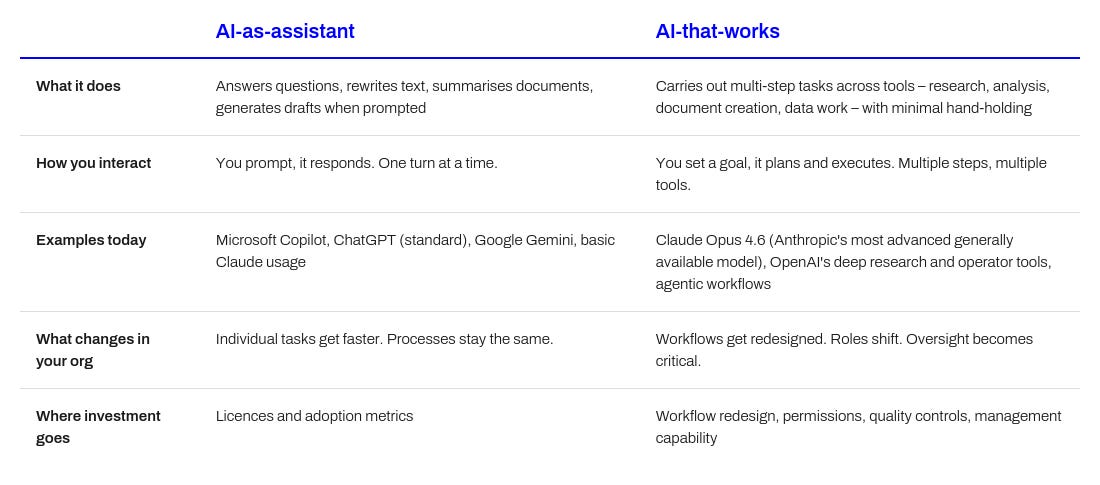
Claude Opus 4.6 – Anthropic’s most capable generally available model – is already being used for tasks that mirror full analyst workflows: pulling data across spreadsheets, producing slide decks, writing research reports end to end. OpenAI is building similar capabilities with its deep research and operator tools. Google’s Gemini is moving in the same direction. The entire frontier is shifting from “answer my question” to “do this piece of work.”
Mythos Preview sits a clear step beyond all of them – and the evidence for that isn’t just Anthropic’s benchmarks. It’s the behaviour of the companies that have seen it. You don’t form a cross-industry consortium involving Apple, Google, Microsoft and Amazon because a model is incrementally better. You do it because the capability jump is large enough to change the risk landscape.
Anthropic itself changed its own internal processes before deploying Mythos internally – introducing a 24-hour cross-functional safety review gate because the capability increase warranted it. When a frontier AI lab changes how it works because of what a model can do, that’s a signal the rest of us should take seriously.
In February this year, software stocks lost an estimated $2 trillion in market capitalisation. That didn’t happen because of a chatbot. It happened because investors grasped that AI systems capable of doing real work, not just assisting, will restructure the economics of entire industries. Companies selling software that organises human work suddenly looked vulnerable to AI that does the work directly.
If you’ve prepared for AI-as-assistant, you’ve solved for: How do we get people to use the tools? How do we measure adoption? How do we justify the licence cost?
But you haven’t solved for:
Which workflows should be fundamentally redesigned, not just sped up?
Where should AI have access to systems and data, and where must it not?
How do you quality-check work that AI produced rather than a person?
Which managers understand enough about these systems to supervise them?
What happens when a competitor redesigns their operation around AI-that-works while you’re still optimising AI-as-assistant?
The advantage doesn’t go to whoever has the most AI licences. It goes to whoever redesigns their operating model first.
1. Move from adoption metrics to workflow redesign. Stop measuring how many people are using AI and start identifying which workflows can be fundamentally restructured. Research, reporting, analysis, triage, document production – pick two or three. Redesign them properly: clear hand-offs, human approval points, quality checks, fallback routes.
2. Build capability beyond IT. This is not a technology deployment. It’s an operating model shift. Functional leaders, managers, and senior decision-makers need to understand the difference between AI-as-assistant and AI-that-works, not just the IT team.
3. Use current models to prepare for stronger ones. Mythos is restricted. Opus 4.6 is not. It’s powerful enough right now to start redesigning workflows and building proper controls. Organisations that do this work now will move quickly when the next generation arrives. Organisations that wait will be scrambling.
When Apple, Google, Microsoft, Amazon, and JPMorganChase form a consortium because of what one AI model can do, that’s not a cybersecurity story. It’s a capability story. And the capability that prompted their response doesn’t stay inside a security lab – it’s the same underlying shift that’s about to reshape how every knowledge-intensive organisation operates.
The imperative isn’t to buy more AI tools. It’s to build an organisation that can use stronger AI intelligently, safely, and at scale – before that becomes an emergency rather than a choice.
Brilliant Noise helps organisations build AI capability – not just adopt AI tools. If the gap described here feels familiar, get in touch.
Comments
Nothing yet. Say the first thing.
Sign in to join the conversation.