
I don’t know what the schedule is for everyone else reading The Device Files, but in the southern United States kids are back in school!
In Gainesville, FL this means we have a month of absolutely nutty traffic with the college kids back in town driving like complete idiots. For everyone else, it means holiday season is over and we’re getting back to work.
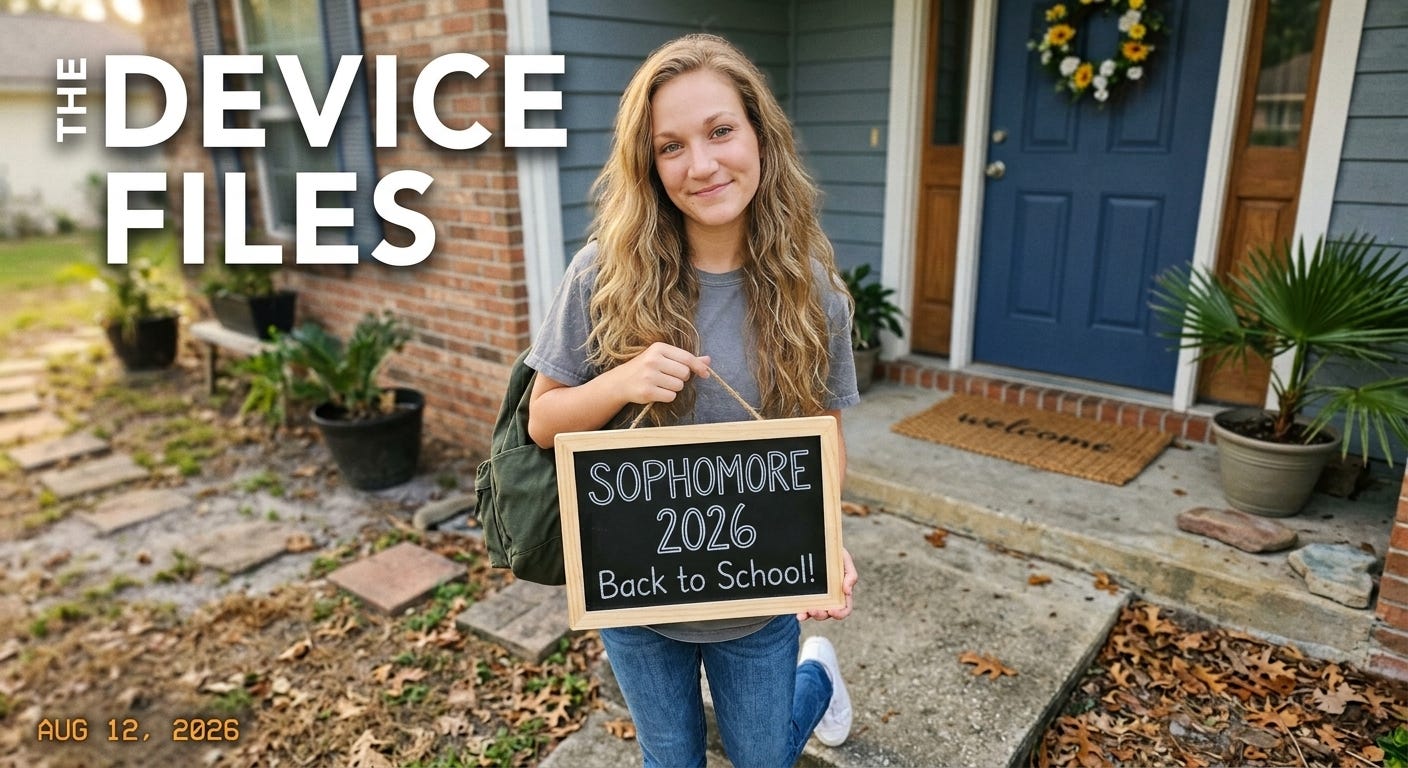
It seems that now in our sophomore year of The Device Files, just like in academics, the bar is being raised. Things are getting a bit more intense and we’re going to have to up our game.
Last year publishing one, long-form piece once a week seemed like a pretty serious level of commitment, but the times are definitely changing. I could almost keep up with the important news with one article a week, although it was sometimes hard to juggle. However, more and more has been happening at this convergence of wearables, ai, and medtech, and just in the last few weeks the news has been coming at us hard and fast.
Between the beginning of June and the middle of August, I counted at least a dozen announcements in wearables and MedTech that I would have happily written individual articles on. So, for the first time (and please trust me that this will NOT be replacing my long-form articles) I’m going to give you a rundown on all of the news you might have missed while out on summer vacations.





This summer has seen multiple new product launches in the wearables market, which has been interesting since just a couple of months ago the media was sounding the alarm on the commoditization of wearables, as if the whole industry was about to take a nose dive. What we’re seeing instead is steady growth and a remarkable number of companies that looked at the wearables market in 2026 and concluded there was still plenty of room.
Garmin launched the CIRQA, a screenless band announced July 21 with orders opening three days later. It runs $199.99, gets up to ten days of battery, and requires no subscription. Garmin did briefly put real-time workout heart rate behind a paid tier and reversed course within days after the response from their user base. Garmin Coach and AI Insights have remained behind the wall.
Casio shipped a smart ring in late July, the CRW-H001M-8 (really gotta hand it to their branding team on that one), at roughly $294 and sold only in China. Nineteen grams, three fixed sizes, four to six days per charge on the health module, and the interpretation runs on AIZO Ring, a third-party app. This one is a headscratcher but I actually really want to take some time to dig in and see if they’re offering something new and exciting.
Google Health Guardian
Lets dive into this one a bit. Announced August 12 alongside the Pixel Watch 5, Google introduced a suite called Health Guardian, which includes three new monthly trend summaries:
Blood pressure trends
Insulin resistance trends
Sleep breathing quality
Lets skip BP. We were totally into BP our Freshman year, but we’ve matured now that we’re a sophomore, and we’re moving on!
Insulin resistance trends.
Estimating insulin resistance from a wrist is a genuine technical accomplishment. I’m pretty sure its normally derived from fasting labs. Google is inferring a metabolic state from optical sensing, motion and temperature, and a crazy good ML algorithm - and they’ve published a peer-reviewed article to back it up!
Then you read the label. Health Guardian is described as general wellness and informational only. It is explicitly not a pre-screener for diabetes, hypertension or sleep apnea. It does not provide real-time clinical readings. It should not be used to adjust medications or treatment plans.
So its cool, but what DO we use it for? I’m at a loss.
Sleep breathing quality
Is this just like all the other wearables telling me about my “waking moments”? Yes and no.
We ALL know that waking moments are just wearable (wellness) speak for sleep apnea - just like you can say stress but not anxiety or sleep aid but not reference insomnia. They tell you how often you have an episode without giving you details on whether you stopped breathing for a certain period of time or how much you woke up (they know, they’re just not telling you, because telling you would cross the FDA line).
So, what’s sleep breathing quality? The reverse.
They don’t tell you how often you woke up, but they tell you the “quality” of your breathing throughout your sleep so you have an indication of whether you’re not breathing sometimes (although, of course, they would never say it THAT way).
I’d say that one is a bit more useful to me than insulin resistance trends, but I still really want to track insulin resistance trends now so I can see what it thinks those trends are - and then run to my doctor to get her to tell me what it all means! I’m sure my doctor will love that convo!
Google is still trying to skirt that legal border of wellness vs device on a lot of these features, but they’re one of the companies I think that has really shown a desire to lead on crossing the chasm into FDA cleared features, and I’m here for it! (P.S. - Call me!)
Google also launched a breathing emergency detection feature in several European countries (though not in the United States - yet?)
Here’s what they have received clearance for:
Fitbit ECG app, 510(k) K200948, cleared September 11, 2020. Spot-check single-lead ECG for AFib.
Fitbit Irregular Rhythm Notifications, 510(k) K212372, cleared April 8, 2022. The PPG-based algorithm that passively watches for AFib.
Loss of Pulse Detection, 510(k) K242967, cleared around February 2025.
So Google has AFib covered both ways, plus cardiac arrest detection.
What Google does not have is anything on the respiratory or metabolic side. Apple and Samsung both hold clearances for sleep apnea, and none of the big players has a cleared cuffless blood pressure product.
The platform
I also want to take a moment to say I really like this platform, in theory. I say theory only because I haven’t actually tried it out and maybe its not as nifty as I envision. It sounds like its becoming really robust. Not only have they added these interesting new features I haven’t seen other wearables attempt, but it allows you to create a dashboard of information with a variety of connected wearables.
So far, when my other wearables we wont mention have invited me to connect to other wearables or apps, it doesn’t help me pull useful info into one central dashboard. For example, getting women to connect with a Clue app or track GLP-1s - just gives the companies more data to play with on the backend while providing the end user with no helpful centralized display or interpretation.
The other pattern this summer was how many companies with the resources to build something themselves went out and found a partner instead.
Abbott and Google Health announced a multi-year partnership on August 11. Glucose data from Abbott’s Lingo biosensor, an over-the-counter continuous glucose monitor for adults not using insulin, flows into the Google Health app alongside sleep, activity and heart data. Google’s Health Coach turns it into guidance. The two are also running a large real-world metabolic health study combining continuous glucose, wearable, lab and survey data. Abbott brings the sensor and the regulatory track record. Google brings the interpretation layer and the phone in your pocket.
Eli Lilly took an equity position in Oura on July 15, terms undisclosed, three weeks after the two announced a LillyDirect collaboration that gives customers a complimentary Oura sizing kit and explicitly involves no data sharing. Oura launched GLP-1 Insights in May and says more than 100,000 members have logged GLP-1 use.
Dexcom put $75 million into Oura in late 2024, and the Stelo integration is live. This might give some really interesting insights in the future. For now, it sounds like more companies collecting our data.
Medtronic signed an exclusive US distribution agreement with Corsano Health on June 4 for an FDA-cleared, multi-parameter wrist wearable, covering hospital and hospital-to-home use. Notable as the one that went toward clinical grade rather than consumer scale.
Oura put Counsel Health’s medical AI triage and board-certified physicians inside its app, live in 43 states. (I’m guessing I’m not in one of those states, because I don’t see anything in my app? Wish I could check it out!)
ChatGPT Health opened to all US users on July 23, with OpenAI reporting 300 million weekly health-related queries.
The FDA named Dexcom the first participant in its TEMPO pilot on July 22, covering two ACCESS clinical use areas. TEMPO, if you recall, is the FDA counterpart to the ACCESS program at CMS, allowing certain digital health devices to be used without premarket authorization while real-world data is collected through the ACCESS program.
CMS launched the ACCESS Model on July 5, a ten-year voluntary model paying Medicare-enrolled providers for technology-supported chronic care, with full payment contingent on hitting clinical outcome targets. Many have poo-pooed this program as having payment too low to bother with, but not WHOOP!
WHOOP launched Connected Care on August 12 through WHOOP Physician Services, PC. The program, which operates through the CMS ACCESS Model, went live in 14 states. Eligible Original Medicare beneficiaries with at least one qualifying cardio-kidney-metabolic condition will receive a 12-month WHOOP membership and an FDA-cleared blood pressure cuff, both at no out-of-pocket cost.
That last one I have thoughts on and also questions. So, instead of delving into it here, I reached out to WHOOP to see if I could get some of my questions answered. I’ll let you know what I hear back!
All of this activity is exactly why we are expanding The Device Files!
No longer just a Substack, The Device Files is in the process of expanding into a full-fledged media brand. We are building it right now and launching this fall. It will include:
The long-form strategic pieces you already read, unchanged
Proactive news updates across MedTech, AI and wearables
A reimagined podcast: two episodes a month covering all manner of topics and special guests
Expanded social media presence so you can choose how you want to stay connected
-and-
The Device Files Thought Leadership Series - a series of invite-only events aligned with specific conferences across the US and Europe where we can convene to think big thoughts together and share amazing experiences
More on all of this to come!

Blythe Karow is a strategic management consultant and founder of The Karow Advisory Group. The insights shared here reflect Blythe’s strategic expertise navigating the complex world of MedTech and wearables. Imagine what that same thinking could uncover when applied to your business.
How Blythe can help:
Commercialization & Market Readiness Reviews
Product & Business Strategy
U.S. Market Entry Planning & Education
Strategic Advisory for MedTech, Wearables, and HealthTech
[1] Blythe Karow, “Two ‘Whoop Killers’ in Two Weeks? Don’t Trust the Headlines,” The Device Files, June 3, 2026. https://blythekarow.substack.com/p/two-whoop-killers-in-two-weeks-dont
[2] Garmin, CIRQA product announcement and pricing, July 21, 2026.
[3] Casio CRW-H001M-8 launch coverage, July 2026.
[4] Google, “Track subtle changes in your body with Health Guardian features on Pixel and Fitbit,” blog.google, August 12, 2026. https://blog.google/products-and-platforms/products/google-health/pixel-watch-health-guardian/
[5] Metwally AA, Heydari AA, McDuff D, et al. “Insulin resistance prediction from wearables and routine blood biomarkers.” Nature 2026;652:451-461. https://www.nature.com/articles/s41586-026-10179-2
[6] Google, Pixel Watch 5 announcement, blog.google, August 12, 2026. https://blog.google/products-and-platforms/devices/pixel/pixel-watch-5/
[7] FDA 510(k) K200948, Fitbit ECG App, cleared September 11, 2020.
[8] FDA 510(k) K212372, Fitbit Irregular Rhythm Notifications, cleared April 8, 2022. https://www.accessdata.fda.gov/cdrh_docs/pdf21/K212372.pdf
[9] FDA 510(k) K242967, Loss of Pulse Detection, cleared February 2025. https://www.accessdata.fda.gov/cdrh_docs/pdf24/K242967.pdf
[10] FDA De Novo DEN230041, Samsung Sleep Apnea Feature, February 2024, https://www.accessdata.fda.gov/cdrh_docs/pdf23/DEN230041.pdf; Apple Sleep Apnea Notification Feature, FDA 510(k) cleared September 2024.
[11] Abbott and Google Health partnership announcement, August 11, 2026.
[12] Oura, Eli Lilly equity investment announcement, July 15, 2026; LillyDirect collaboration announcement, June 23, 2026.
[13] Medtronic, “Medtronic expands its Acute Care & Monitoring wearables portfolio in the U.S.,” June 4, 2026.
[14] FDA, Digital Health Center of Excellence, TEMPO pilot, Dexcom named first participant, July 22, 2026.
[15] CMS Innovation Center, ACCESS Model Request for Applications, version 1.1, February 12, 2026. https://www.cms.gov/priorities/innovation/files/access-rfa.pdf
[16] WHOOP, “WHOOP Launches Connected Care to Help Eligible Medicare Beneficiaries Better Understand Their Health,” August 12, 2026. https://www.whoop.com/us/en/press-center/whoop-launches-connected-care-to-help-eligible-medicare-beneficiaries-better-understand-their-health/
No posts
Comments
Nothing yet. Say the first thing.
Sign in to join the conversation.