
I live in Minnesota (I already know what you’re thinking, we’re good here but taxes are a little high) and there isn’t much here outside major healthcare organizations like United Healthcare or the Mayo Clinic. I suppose we also have Best Buy and Target, but for the most part the financial industry is non-existent and the tech community is nascent at best. So here, in a small town in, rural Minnesota, I stand alone with my curiosities, and interests, that are usually found in coastal regions like: LA, NY, the Bay Area, Austin, or even parts of Florida like Miami (I love where I live btw, it’s peaceful). These interests are unique to the area, so in passing, I’ll occasionally get asked, “Dillon, how do you invest in stocks?”
That’s a loaded question. I’m not usually able to answer it in the time they (people) usually give me, so it’s easier to deflect and just say, “I like Tesla”. Coincidentally, I also don’t use options and consider 25% CAGR to be the goal over the long run, so of course delayed gratification may not sound as exciting as get rich quick strategies like options trading or crypto. It sounds uneventful compared to a “get rich quick” scheme, the next 10x stock, or something that provokes emotions of excitement.
Despite the difficulty of being able to explain exactly how investing works, at the core of what I do, what most investors do, is to understand the future. This is essentially why Wall Street has future earnings estimates or discounted cash flow models.
*On a side note, that’s essentially the purpose behind my writing. It’s to be creative and articulate my thoughts in an organized way that can make sense.

This passion and natural curiosity I have for investing, although out of the ordinary, has me deeply think about:
Politics and economic policy
Economic trends and economic systems
Federal reserve policy and fiscal policy
Technological trends and emerging tech coming out of Silicon Valley
To me, these topics are not necessarily work, but the future of these ideas, theories and philosophies fascinate me. The future, in a broad sense, fascinates me. I love to identify trends and what’s “likely” to happen in the not-so-distant future based on the collection of knowledge on the above. Think of it as… ‘putting the pieces of a puzzle together’. The future is the puzzle, the current events and trends of today (sprinkled in with the patterns and cycles of history) are the puzzle pieces.
However, until now, the future hasn’t ever really felt like it’s here. For the most part, the significant portion of innovation that has existed (until recently) has been in the digital space. If we look around at our world today, our vehicles, our style or just our world in general, it hasn’t really changed much. I recall back in the late 1900’s, people used to imagine a world in the 2020’s that would be transformative, exciting or maybe even scary. Instead, our cars look almost exactly the same except with the exception of heated massage seats and a panoramic sun roof (exciting, I know).
Innovation typically works in cycles. For example, think of the airline industry. Did you know that the technology for the major airline carriers has largely remained stagnant since the 1960’s? The Boeing 707 was introduced in the late 1960’s, early 1970’s, and is even still in operation today! This is roughly 50 years of nascent technological advancement since the industry matured. However, the previous 50ish years started with the Wright Brothers and their first flight in 1903.

I have never seen a moment in time (probably since the early 1900’s for historical reference, but this is bigger) where I see a title wave of innovation about to crash over the shores of “the status quo”. I’m not talking about something new on our phone, that’s mostly in the meta-verse, or a new app like Uber that’ll democratize a taxi network. I’m talking about a new era to the human civilization, an era of abundance, an era of exploration. I’m saying that we’re standing at the bottom of an S curve and we’re just about to see this thing go vertical and it’s almost impossible to comprehend what we’re about to see. Today, we are making history.
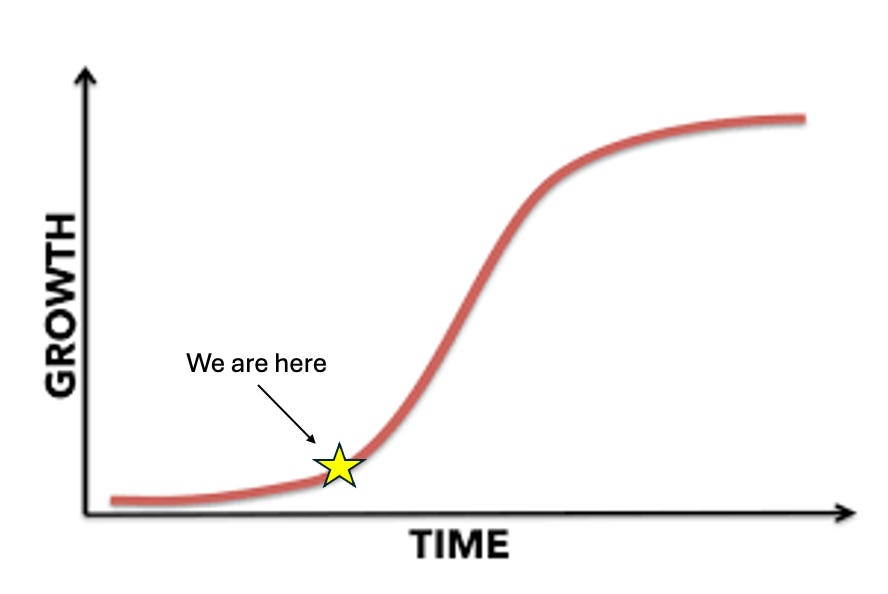
In 2026, looking forward to this year, there are going to be 2 major milestones we reach as a human civilization. The first will be reusable rockets/spaceships ready for commercial use, the two stories that I am following right now are SpaceX’s Starship and Rocketlab’s Neutron. The second is real world AI and robotics. Robotics have existed for decades, however, only now with Nvidia’s progress with its super computing infrastructure, robotics are ready to take the leap from a high school science experiment to interacting with the real world like we do, as humans, with neural-nets. The convergence of these two technologies are going to lead to an explosion in the human civilization and they’re ready, this year and the years to come.
If you haven’t watched Nvidia’s CES presentation, I highly recommend you do so before I speak more about robotics. Jensen’s portion was approximately 2 hours long, but it was worth listening to. To overly summarize in the meantime, this particular presentation heavily emphasized the emergence of real world robotics that will change. the. world. In particular, the physical world as we know it.
Jensen isn’t blowing smoke to pump his stock price either, robotics are here today. If you scroll X, or search YouTube, there are multiple companies (FigureAI, Tesla, Google, Boston Scientific, etc) working on humanoid robots and self driving vehicles (Nvidia, Rivian, Google and Tesla). With the rapid advancements being made in neural nets, 2026 is the year that we will begin to see massive breakthrough’s. Truthfully, there is an argument to be made that they (the robots) are already here. Outside of Tesla FSD, which still is not fully 100% complete but is astronomically good (I use it every day), there are presently few applications ready for commercial use.
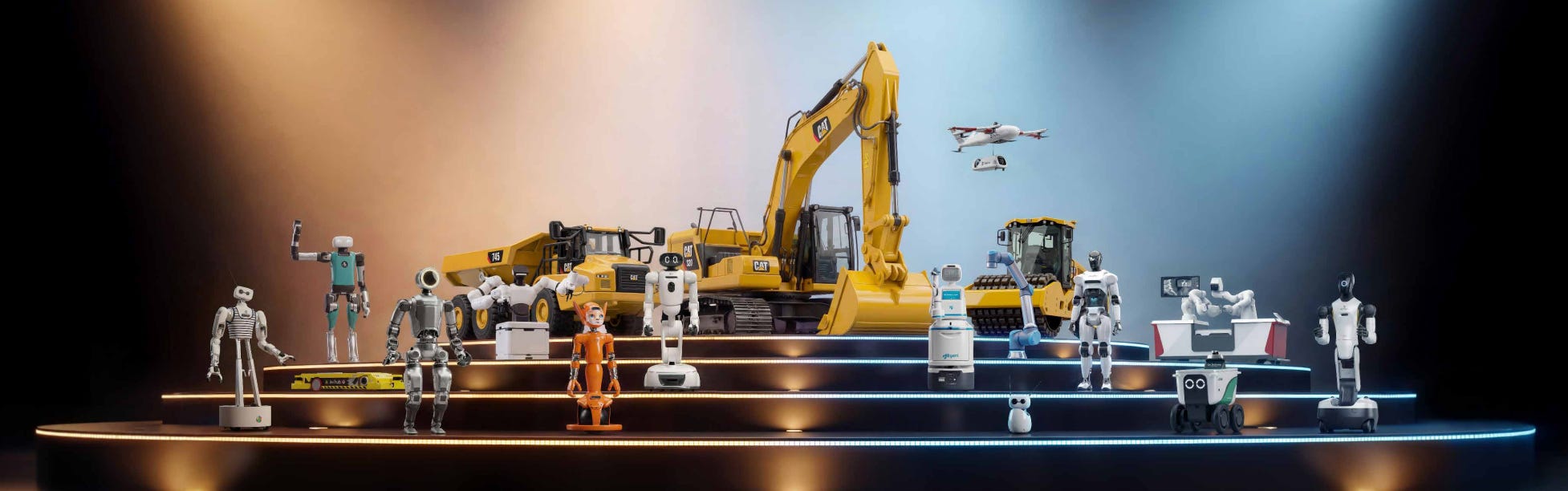
The world has long imagined exactly what it would look like to see robot counterparts working with us hand in hand. Will they be strong? What will their limitations be? Will they interact with us like we interact with each other? I distinctly remember watching movies/shows like The Terminator, or Futurama, as a kid and imagining a world both scary but full of opportunity. Imagine what the world could do with robots that are both specialized or are for general purpose. What I do know is that they, the robots, are the worst they will ever be (today) and they will only get better from here.
Imagination aside, let’s calculate the GDP growth that could manifest itself with a limitless supply of robotic labor. For example, it has long been held that GDP growth can be calculated as:
Note: I cannot emphasize how important this point is.
For the entire existence of humanity, we have been solely dependent upon both the birth rate, and the survival rate, of humans to determine the labor force side of the above equation. In essence, our GDP growth has been capped purely by the number of people we have in the world, especially in the first world. For example, in America, our population has grown (it’s a little below 1%) but our work force (think of adults between the age of 20 and 65) has remained stagnant for years. The vast majority of our GDP growth has come from either inflation, or an enhancement in the productivity side of the equation through the technological advancements we have made as a country.
Are you seeing where I am going with this yet?
Going back to our equation, our equation for GDP now disconnects from the traditional:
GDP = Human Labor Force x Productivity
The equation will now become:
GDP = (Human Labor Force + Robot Labor Force) x Productivity
Or, if we break this down even further and factor in the fact that Robots don’t get tired, don’t need to eat, don’t need relationships and don’t need to sleep. The GDP equation will likely look more like:
GDP = (Robot Labor Force x Robot Productivity) + (Human Labor Force x Human Productivity)
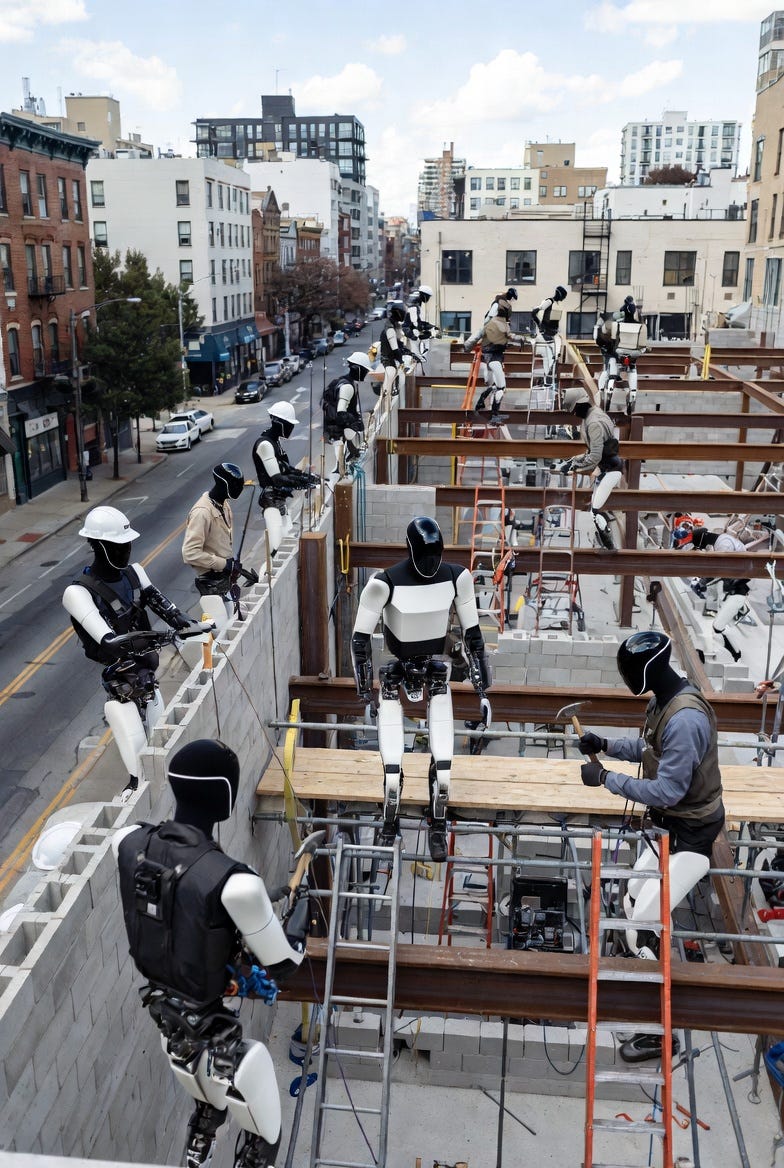
Do you see now? We essentially alter the original GDP equation for the first time in HUMAN/WORLD HISTORY and now make it infinite, we make it limitless, only confined by terrestrial resource limitations and production capability.
Note how I mentioned terrestrial limitations, which leads me to my next point. There are two things that we will need to manufacture/produce and train a limitless workforce:
Energy: Fossil fuels won’t be and are not enough, neither is domestic nuclear at scale. These robots won’t be operated by engines that have dominated the past 100 years, they will be operated by batteries which will need to be charged. Aside from the centralized energy sources that’ll be needed to charge the robots, we’ll need energy to train the necessary models (via data centers) and run inferencing at a massive scale. Today, we are already energy constrained just trying to train a couple LLM’s (Anthropic, xAI, OpenAI, Google and others). In the future, we are going to need significantly more energy, fast.
Natural Resources: Earths natural resources will quickly deplete while scaling up an infinite workforce. The materials required to build the robots, the rare earths for battery production, let alone the energy (see above) resources are finite. On this earth, there are only so many resources that we have and we’ll need more.
To me, and to the CEO’s and thought leaders that I follow, the answer is obvious for what we need to do. In our robotic future, where we can satisfy the insatiable need for goods and services, there is only one place left to go… Space, where there are no limits on resources, or on energy. The vastness of our Solar system alone is within reach now more than ever and robotics converge perfectly with the emptiness of space because they don’t require food, an atmosphere, or water. Robots only require an energy source, which can be obtained via solar energy and batteries, additional parts and maintenance.
The Vacuum of Space offers the ability to harness solar power (solar in space is 30% stronger) and also has the ability to cool the GPU’s for free, making the potential economics of moving to space very appealing.
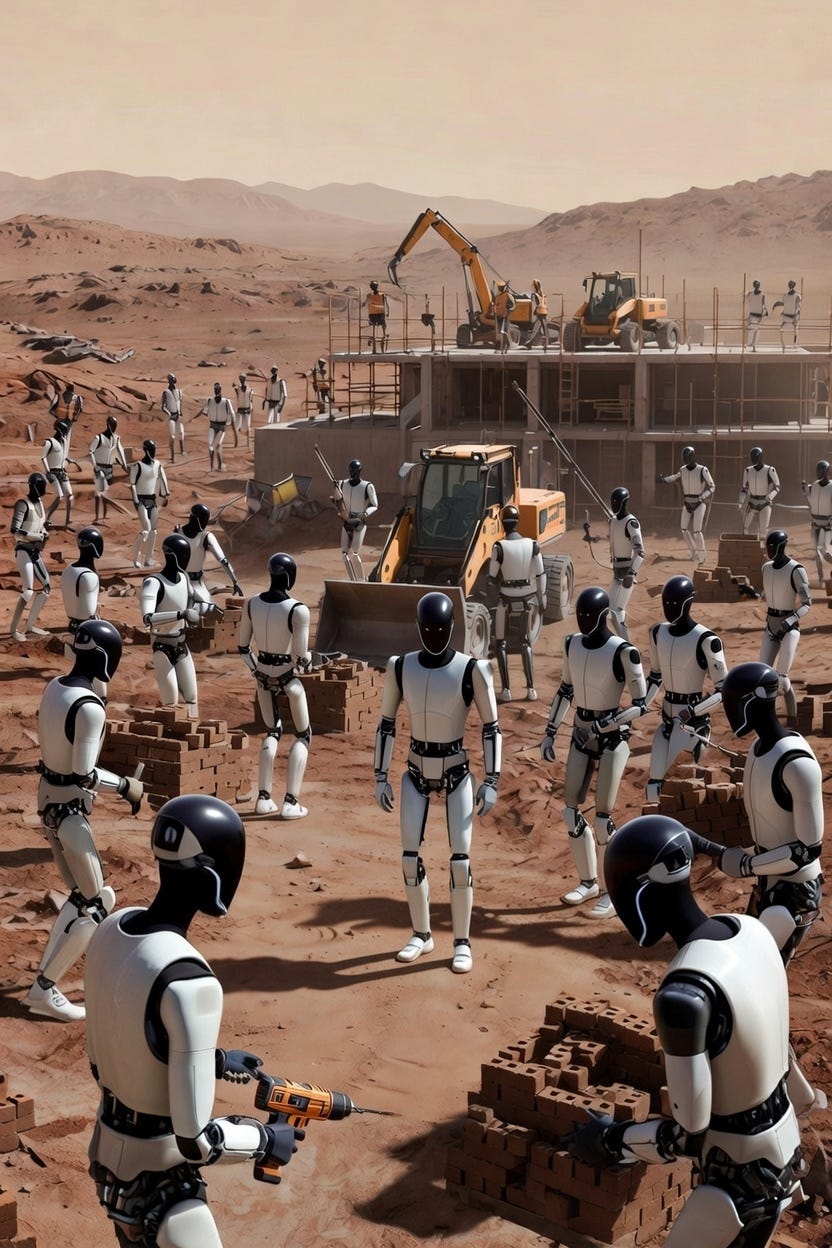
This is the part of the article where this is going to start sounding like science fiction, as if it’s 10 years away, but it’s not. This industry is here today and will gain even more traction in 2026, which I’ll explain my thesis, but to simplify, the economics of this initiative (the space industry) start to make sense when you run the calculation of what the costs to launch do when you have rocket reusability. For example, Starship is expected to drop the cost to launch from some where in between $1,000 - $2,000 to $100/kg (90% decline in the cost to launch). Once rocket reusability reaches scale, the ability for space exploration, space defense and the space economy will to take off (figuratively and literally).
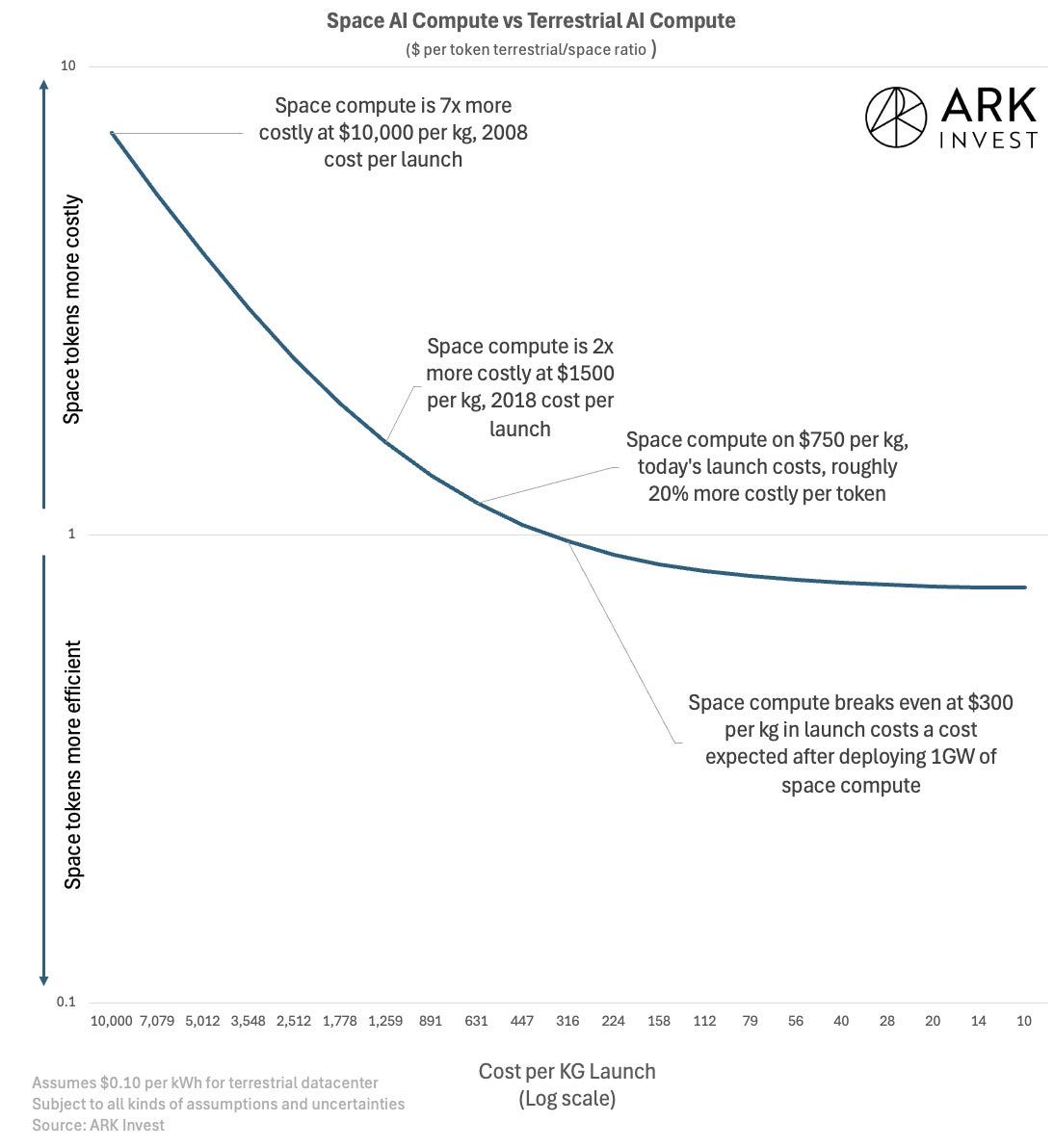
But what exactly can we do in space? Launch Satellites for observability? Space exploration, or is there a more profitable venture that we can pursue?
Link: Starcloud - The Future of AI Data Centers
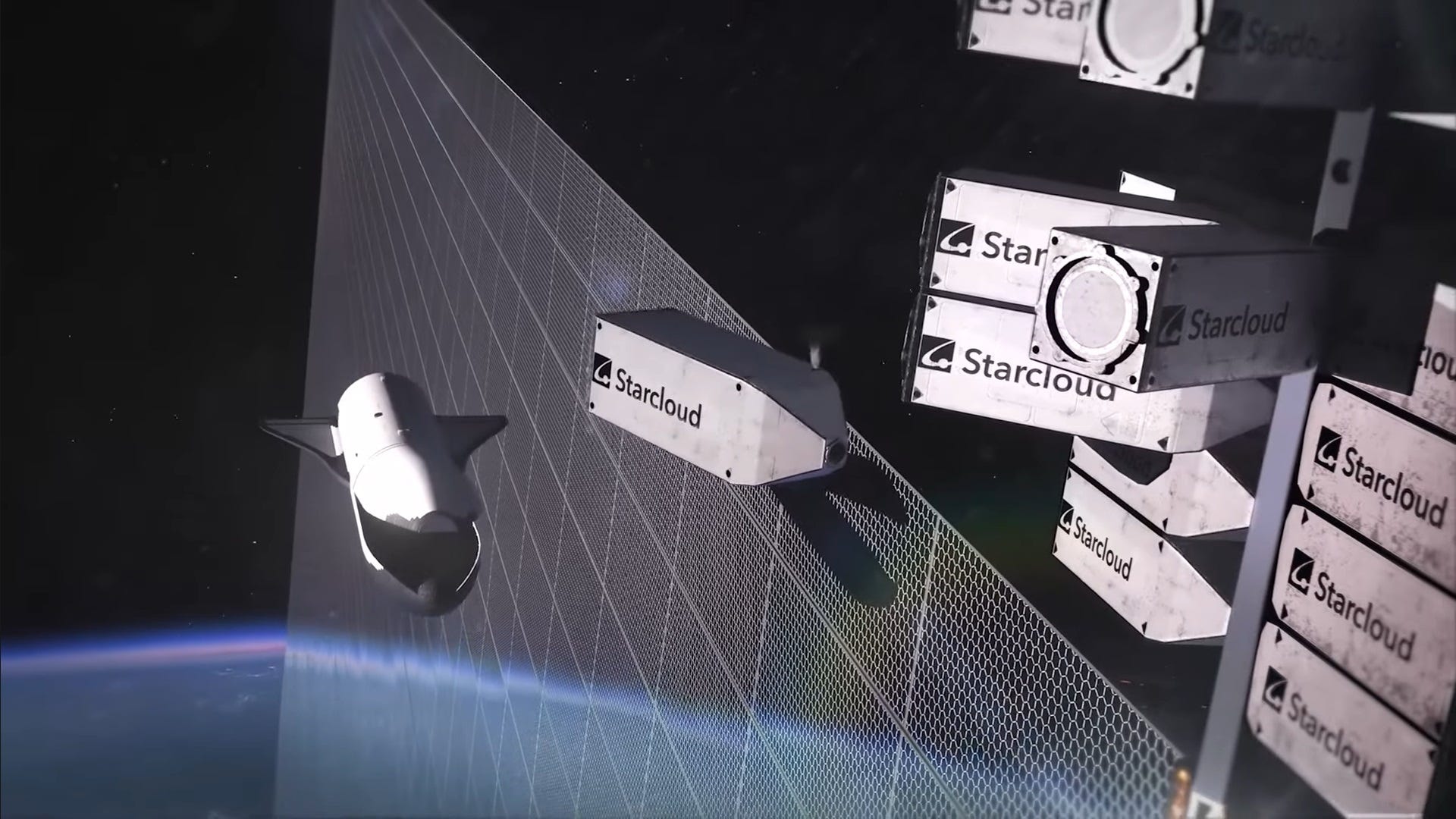
The expense Hyperscalers are paying for AI Data Centers is not “only” the original cost of GPU’s, LPU’s or TPU’s. There’s immense cost in energy and cooling, let alone the permitting required for State and Local governments. In fact, the expense is so astronomical that many on Wall Street, as well as highly credible investors like Michael J Bury, are rightfully poking holes into the data center expenses along with the depreciation and amortization that goes along with buying and maintaining an AI super computing cluster.
As a balanced investor, I get it. I really do. The internet bubble was only 25 years ago, along with the housing bubble (less that 20 years ago). Investors today have every right to be skeptical of the infrastructure buildout, especially since they witnessed internet infrastructure companies like Cisco, Dell, Oracle and many others collapse 60-90% in stock price. However, the more I look into AI scaling laws, the more the current AI infrastructure buildout makes sense and the more the a continuation on that build out appears justified. This buildout, I believe, can last an entire decade longer from today (2035). There is an end goal in mind.
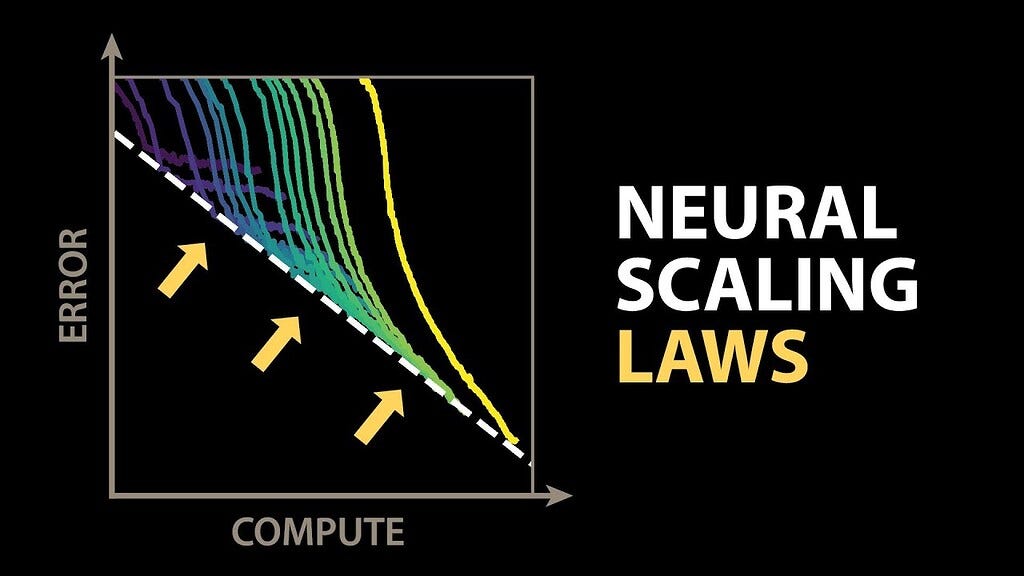
So before I go further, let me state that I am not technical. Bare with me as I attempt to explain how I understand AI scaling laws (I’ll tie this into Space in a moment) from a non-technical, investor focused perspective. To overly simply exactly what AI scaling laws are, note the lines above image, as this was taken from OpenAI’s research paper. Each line represents a starting point for compute (for a model) which showed that the more compute a model has, the less errors a model produces.
If you’re not 100% familiar with how LLM’s, or AI models in general, work, they essentially are a predictive program. This means that when you give, let’s say Grok, a prompt. Grok computes the prompt and then generates language that is most likely to be used from a probability perspective (this is overly simplified), in a series of 1’s and 0’s. Basically, AI researchers have found that once you put a certain amount of data within an AI model, it’s able to generate probabilities and AI scaling laws suggest that the more data and more compute you put into a model, the more accurate these predictions become.
As I mentioned, I’m not technical and there’s much more that goes into how AI models work. However, from first principles, this means that the quality of the AI model is solely dependent on the data input, the size of the data input, as well as the compute to both train and run inference on the model. The more compute, the more data can be trained and the better/faster the model can run inference. So, once we establish this concept, what can we (humanity) do with better AI Models? Based on what I know and using my imagination based on what I know, this is how I see it:
Achieve AGI, ASI and Solve the Most Complex Equations in Physics: For just a moment, I’m going to get philosophical and define physics, which should be an interesting concept. Physics, from how I think about it (not taking an official definition) is the mathematical representation of our universe. When calculating space travel, this is a mathematical equation that represents velocity, speed, thrust, etc, as well as other mathematical equations that factor in heat, propulsion and atmospheric re-entry. To AI, these type of calculations are child’s play. Furthermore, If we take this one step further to calculate our greatest engineering tasks, like creating new space craft engines, discovering/creating new elements or even calculating a 4D reality (which space might be), AI can push our existing laws of physics far past conceived notion.
Super intelligence can also have us discover new drug compounds, provide precision medicine and cure diseases thought originally to be un-curable.
Train Generalized Robotics: One of the most fascinating conversations I stumbled upon was how AI is a direct representation of us. More importantly, it’s also a direct representation of our evolution as humans. When we think about this, applying the concept of human evolution and model capability, it makes sense as to why the newest and latest industries (medicine, coding, accounting work or routine processes) were developed first in Frontier Models, as these industries required the shortest amount of time in our evolutionary process perfecting. Basically, the least data intensive industries are the ones that are the newest. The industry, or capability, that is the most data intensive may not be super intuitive to guess, after 10’s of thousands of years of human evolution but it is extremely hard for AI’s to do. This capability (that we do well but AI struggles with) is interacting with the real world, moving or general spacial awareness.
With the correct compute and scale, and -only- with the correct amount of scale and compute, we can train robots to have spacial awareness and move around in the world as we do.
Automate All of Todays Human Labor: The concept of human labor being automated “can” be scary to many as it leaves plenty of unknowns. In a world of automation and robotics, what exactly are we supposed to do? If labor, all labor, or all knowledge can now be done by robots and executed by robots, what are we, Doctors supposed to do? Engineers? Coders and developers? Marketing managers? Movie Directors, Actors, etc? If AI can and will do all of this, what will we do? There is a way to think about this.
During the Gilded Age, which was the late 1800’s and early 1900’s, there was a mass industrialization of America. During this time, new inventions emerged like the internal combustion engine, railroads and factor lines. With this advent of the engine specifically, the world changed with new machinery and one of those pieces of machinery was the Tractor. Historically, people needed to work the fields themselves but after the advent of the tractor, this freed up labor to do other things. Much like how AI will automate mundane tasks.
To build further on this time frame (coincidentally, this is the same time frame as the Wright Brothers), think about the jobs today that have surfaced that didn’t exist back then, only 100 years ago.. To name a few, I think can of social media jobs, computer networking, AI researcher, stock researcher, medical sales, automotive sales, hospital administrator, talk show host, TV news anchor, mechanic, semi-conductor engineer, etc. Building the Tractor took people out of the fields, which temporarily left them unemployed, but people found other things to do for a career.
For thousands of years of human history, technological advance has only led to underemployment (meaning we need more people) and not unemployment. New industries emerge as a result of new technologies and people still find ways to be useful to other people. People still find ways to discover new progress.
AI will unlock new industries that we cannot even fathom, only people in the year 2100 will know what will be unlocked as we unlock the industries of the future.
To overly simplify my thesis of space being a necessity in the AI and Robotics revolution, we can break it down like this:
The need for compute is theorized to be infinite because of AI scaling laws. AI scaling laws suggest more data, more compute, the better the model.
Because there is a need for infinite compute, the data center build out will continue for the for-seeable future
Better data centers = better models that can unlock real world robotics which will influence, and directly contribute to, both American and global GDP
Terrestrial limitations with energy and cooling (also apart of the energy equation) force us to look toward space for multi-gigawatt data centers, and eventually, terawatt data centers.
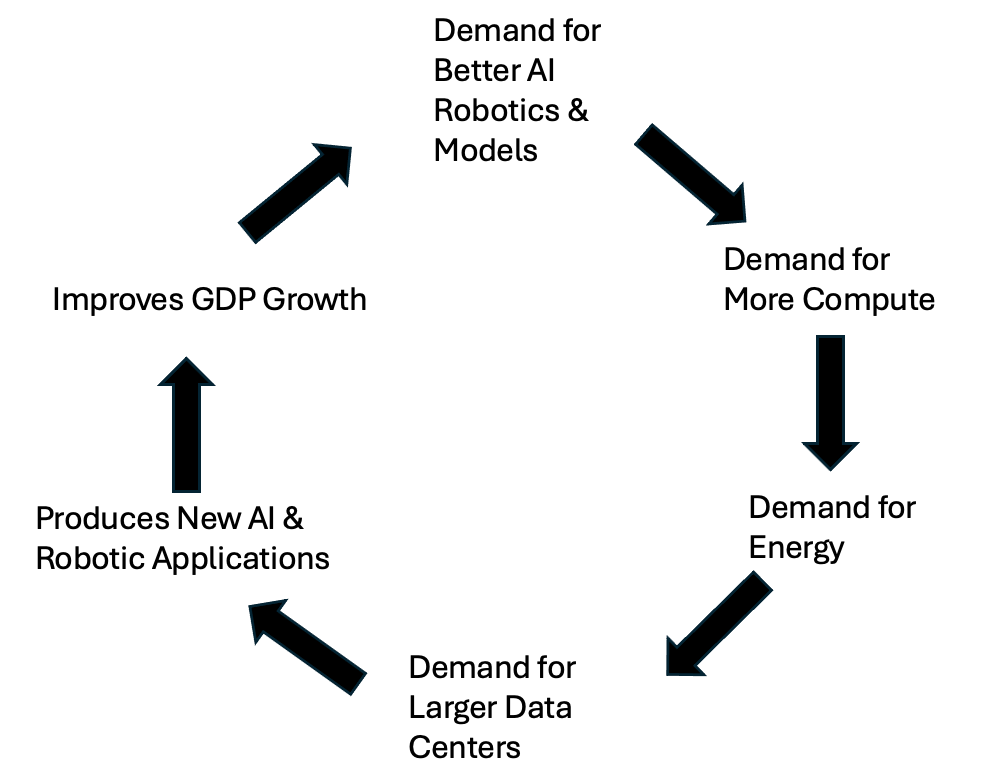
Essentially, as we look into the future, with AI, humanity is about to be bench marked not to dollars and cents, but to our ability to harness energy. Our ability to harness, and create, energy feeds into our ability to create smarter AI and Robotics. Smarter AI’s lead to new discoveries in astro-physics and quantum physics (this will lead to new elemental discoveries and drug discoveries) which can also lead to more capable robots that don’t have biological limitation. More capable AI’s and Robotics will lead to higher GDP growth. Higher GDP growth will lead to a higher quality of life. Now, as we live longer, healthier lives, we progress faster as a civilization and collective consciousness. The best way to think about this is that artificial Intelligence is human intelligence that is limitless and feeds into itself through a fly-wheel approach.
To Conclude: The biggest investment themes of our lives are here today. The first theme being artificial intelligence, which will create multi-trillion dollar companies. The second theme being space, and the space economy, which will be unlocked by building data centers in space, that’ll feed robotics and extremely advanced AI’s. What I presently cannot fathom is what will happen as our space economy advances to a point that we begin building on extra terrestrial planets. There are still so many questions.
What will we discover?
What resources exist on Mars? On other planets?
What are the astrophysics that we can discover that allows us to travel across both space and time?
What will we explore?
What alien civilizations will we discover?
Will we be the alien invaders that we’ve wrote movies and novels about?
The future of humanity is exciting. Our limit has no bounds and today, is no longer even limited by the stars as we make our home, as a species, in the stars.
If you’d like to see how I am investing in, and positioned in, the future, please feel free to subscribe to my portfolio.
Until Next Time, Stay Tuned, Stay Classy,
Dillon
No posts
Comments
Nothing yet. Say the first thing.
Sign in to join the conversation.