
It has been 3 years since I have seriously produced content. The dogma and narratives that circulate retailed investor focused social media doesn’t necessarily lead to honest, trustworthy results that people can trust to either learn from, or simply find entertainment from. What usually happens is that people will get hindsight posts where someone will say they’re “hedged” at the perfect moments, or that someone made a move that they should just “trust”. I knew back then (3 years ago) as I equally know now that trust and honesty is the best way to accomplish my personal mission as a financial content producer.
It is my mission to help people take control of their financial destiny.
Over these 3 years, I remained focused on changing the brand that I created in the past to create a new one of trust, transparency and most importantly, some thoughtful entertainment. However, I knew that the best way to build that trust and transparency was to find a way to document and record every transaction I ever made or will make now and into the future. At the beginning of 2023, January 15th, I started my Savvy Trader portfolio and have recorded every transaction made since then. To me, it was about building credibility first and content second, rather than content first, credibility second.
This leads me to the purpose of this publication. We’ll talk about the past 3 years and my lessons learned managing money in the public eye (no where to hide), what I’m thinking today about my current positioning and how I am thinking about the year(s) ahead. I do believe there is an extraordinary amount of insight to be shared in the lessons that I have learned, as well as the perspective about current positioning, and future trends that I see in today’s economy and financial markets. At the very least, you’ll gain a couple stock ideas that you could potentially add (after your own DD) to your portfolio.
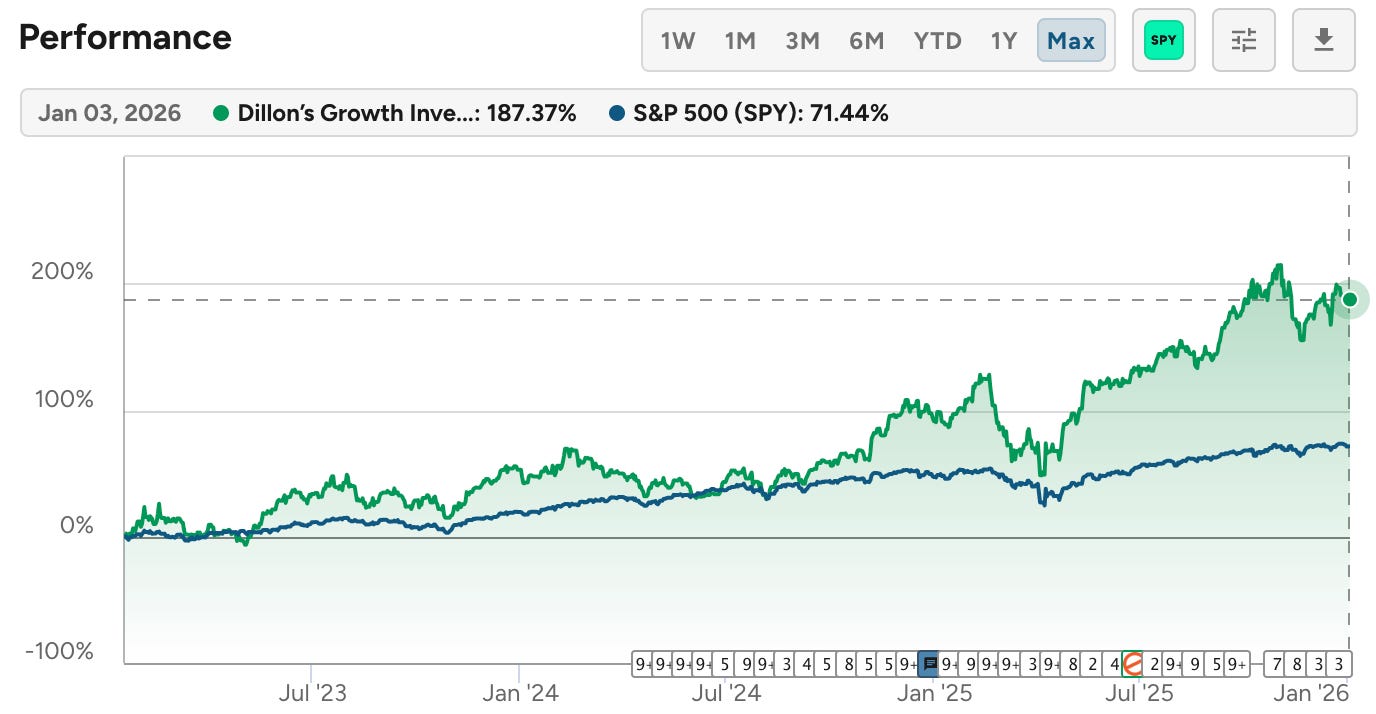
Portfolio performance benchmarked to the S&P 500 over 3 years:
Portfolio performance benchmarked to the QQQ over 3 years:
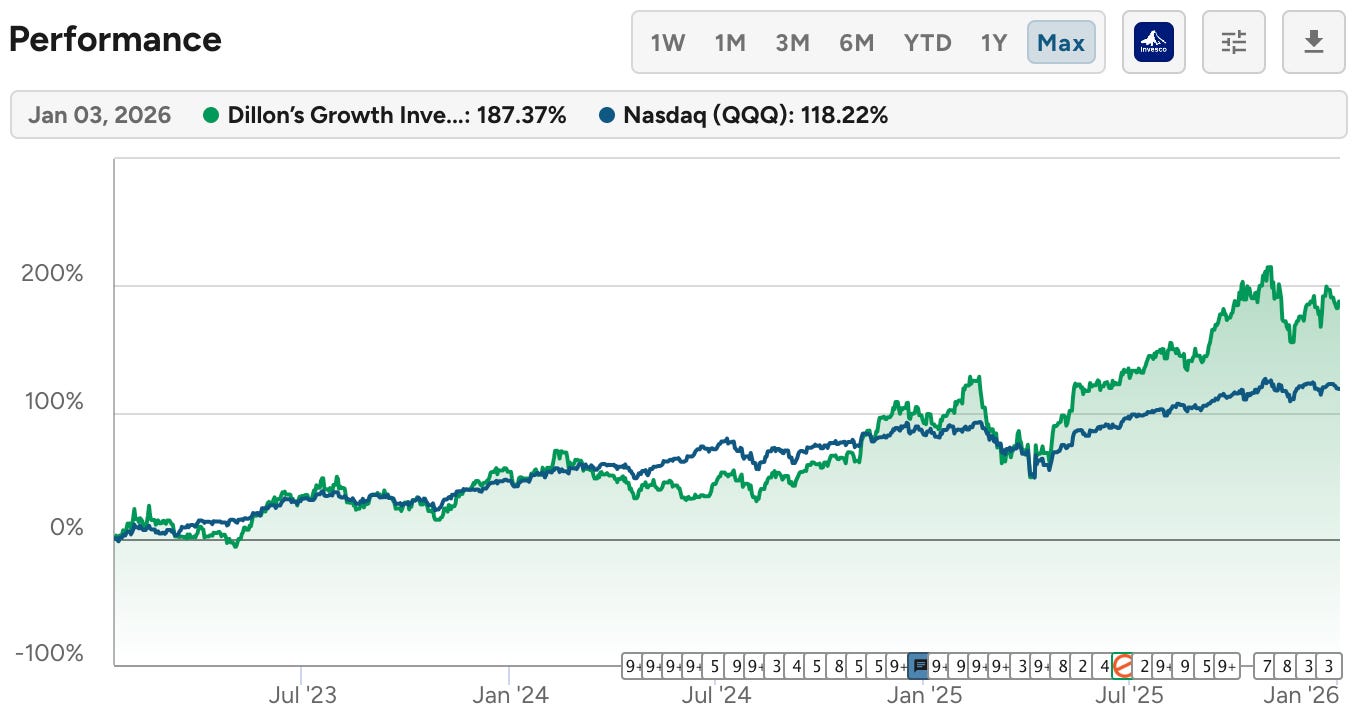
Coincidentally, for a couple years, I found myself performing in-line with the NASDAQ 100. During 2024, after the 2023 market recovery, this was the year of Megacap tech stocks like Amazon, Meta and most of all, Nvidia. Those who held the largest companies (which historically wasn’t necessarily something I focused on) outperformed, especially if they owned every other mega-cap tech stock outside of Tesla! However, I stuck to my core strategy and held on to my two biggest positions during that time, TSLA 0.00%↑ and PLTR 0.00%↑. Fortunately, my conviction paid off and Tesla, as well as Palantir, really started to run during that time and I finished the year above the QQQ.
From my perspective, market cycles change like the season. Growth strategies work well during expansionary markets, other strategies (like value investing) work better risk off markets. Some markets favor large caps, other markets favor small caps. Some markets favor tech stocks, other markets will favor energy or consumer staple stocks. It is only over time that we can truly tell if a portfolio strategy is a good strategy, or if an investment thesis will truly work and play out as expected. It takes time for companies to accurately reflect their intrinsic value.
Despite my early struggles in 2024, I learned one of the most important and valuable lessons that I have learned in all my years of investing. Big companies, especially with a strong thesis, can get bigger and can often yield the best returns, while small companies, who may also have a strong-ish thesis, can quickly dwindle and fade as the larger companies dominate and lead the markets. To simplify exactly what I mean by this, historically, I always thought to that if I were to outperform the markets, it was wiser to hold small companies (growing fast) that have a ton of room to grow rather than a large company.
For example: If I buy a $3B company that I think could become a $10B company (think 300%+ gain) and I pass up a $100B company simply because it’s already big, this is a crucial mistake. It’s not uncommon for the $100B company (assuming they’re growing effectively) to become a $300B company and that $3B company to become a $1B company (-60% decline in the stock price) due to how difficult it is for a company to scale from small cap (sub $10B) to mid cap ($10B to 50B).
Investing in only small caps, or mid caps, thinking that they somehow have the most room to grow only because they’re smaller than the worlds largest companies is a fundamentally flawed concept. The truth is that the best stock to own is the best company to own. The best companies have durable, competitive moats with ample amounts of cash, improving (or strong) margins along with above average market revenue growth. The concept of how to find great companies will be saved for future publications, for now, let’s stick to analyzing my portfolio as well as lessons learned.
As markets change, thesis’s change. Each investment that I own, I hope to own for 5, 10, 15 or even 30 years. For example, my Grandfather (who is an extremely risk adverse investor) bought Pepsi stock with a couple hundred dollars that he had when he was younger simply because he loved drinking Pepsi. Today, that has grown to a $150,000+ position. Funny, right? Just a young man who liked Pepsi, putting a couple bucks into one stock and now he collects the dividends in retirement. Obviously, it’s not much in today’s value, but the lesson learned here is that 1 or 2 stocks can completely change your life. For me, so far, that position has been Palantir.
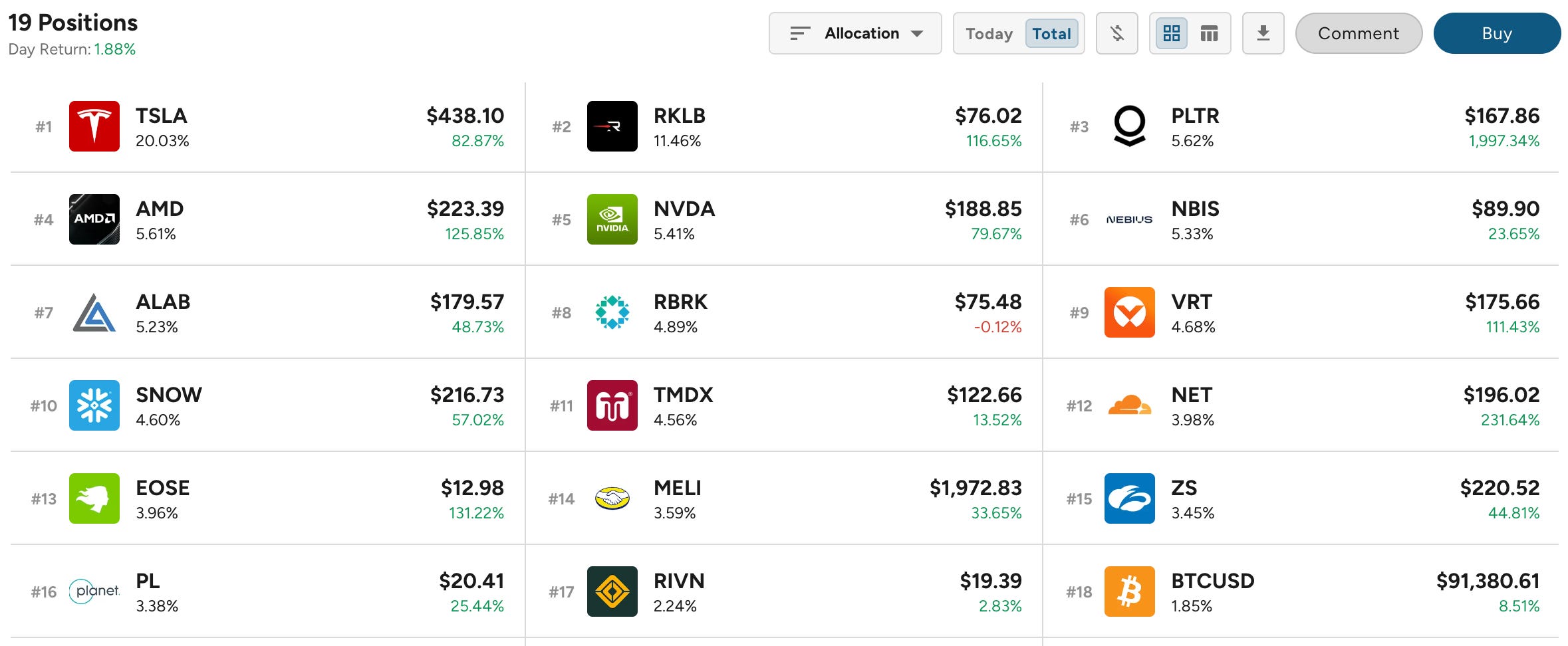
Above, you can see how my positioning is weighted as well as the total gain on each position. Since Palantir’s peak, I have trimmed a substantial part of my position (about 3/4th’s of my original position) and diversified it out into other winners like Nvidia, AMD, Rocketlab, Nebius and AsteraLabs. Tesla, which is weighted at 20% of my total portfolio is my highest concentration and highest conviction bet. I am aware that, at first glance, my portfolio may appear to be random or maybe even lucky. However, I assure you, each position represents a distinct strategy for how I see the world playing out ahead, which gives me confidence and conviction as to why I believe analyst future expectations will prove to be conservative. At the end of the day, Alpha is found in the Delta between expectations and achieved results.
Before I break down each position, and why I own them, I think context about what the future holds will be helpful. Think of this as first analyzing the macro to understand the thesis of the micro.
First, I have to emphasize that I am not a hype-man or an overly euphoric bull. I do my absolute damndest to ensure that I maintain a level head, ignore the crowd and make my own decisions. After hours, days, weeks and months of research or listening to company calls or even testing my own personal conviction, I am convinced with every bone in my body that the artificial intelligence revolution is not like the internet bubble of the late 90’s. Instead, it reminds me of a continuation/acceleration and natural progression of the cloud computing era that began post GFC.

Elon Musk@elonmusk
@DavidSHolz We have entered the Singularity
9:00 AM · Jan 4, 2026 · 1.99M Views
1.43K Replies · 1.95K Reposts · 14.7K Likes
Let me explain further, I am not technical at all and I am the furthest thing from an AI researcher. I’m significantly more business minded in the sense that I think in terms of dollars and cents, which means I am thinking more in terms of the total opportunity, the economic growth that could result from this technology and what a companies earnings could be in the free market place. However, I do think it is important to “take a jab” at how I understand AI (from a non-technical perspective) along with the opportunity that’s ahead of us in the US.

⚍ HERSE ⚍@liquidatd
@elonmusk @DavidSHolz We are now entering the parabolic part of the curve

9:23 AM · Jan 4, 2026 · 36.9K Views
14 Replies · 8 Reposts · 210 Likes
At the moment, the only companies that are currently making money on AI (that people know of) are the AI Hardware companies like AVGO 0.00%↑ NVDA 0.00%↑ AMD 0.00%↑ and the supplementary products that go along with the buildout like VRT 0.00%↑ , ALAB 0.00%↑ or MU 0.00%↑. As you can see, I do still own many of these companies because I don’t think that the AI buildout is going to be just a flash in the pan, but it’s going to be a sustainable transformation that lasts decades. My rationale for this thesis has to do with AI scaling laws, which I recruited Grok to help me hyper summarize this for all of you.
Note: None of my content is or will be produced, or edited, with AI unless specifically sourced.
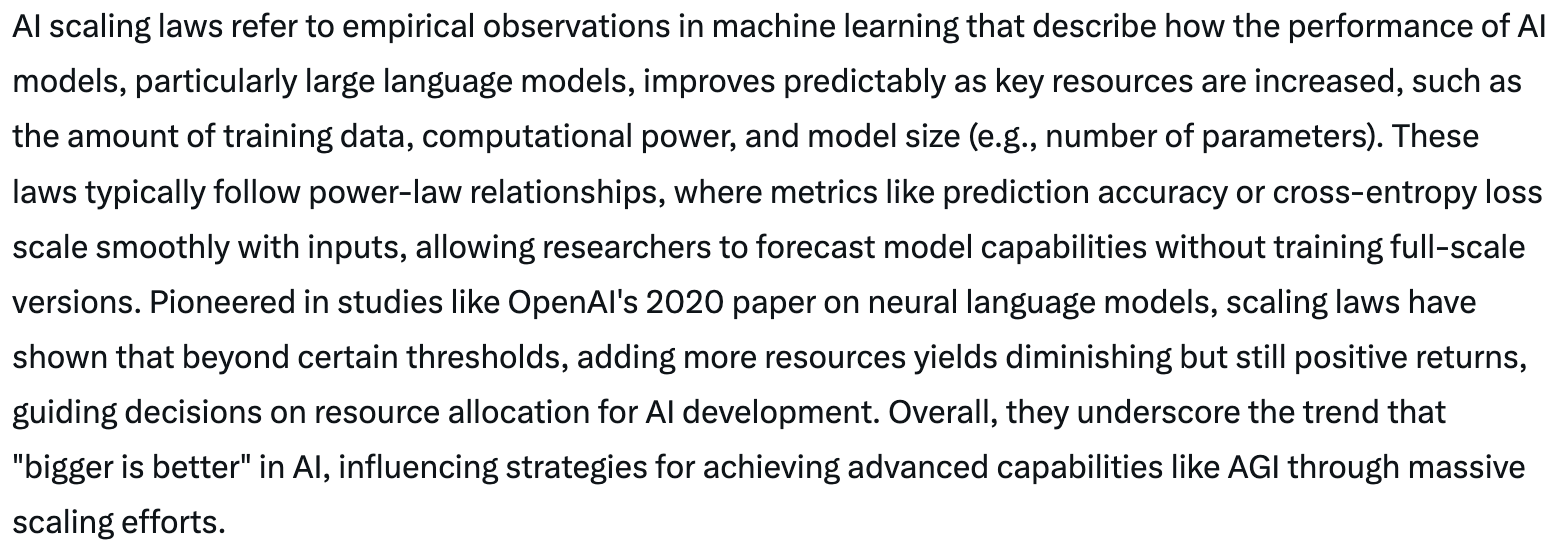
To overly simplify Grok’s definition of the AI scaling laws that AI researchers at major labs are referring to… The bigger, the better. More compute (both training and inference), more parameters and bigger data centers, this is precisely how we achieve limitless potential as a species. To further understand exactly what we can do with AI, it’s important to detach ourselves from the LLM’s of the world (which includes Grok or ChatGPT) and start thinking about this from a real world robotics, prediction and organizational perspective.

David Moss@DavidMoss
Earlier this morning December 30th 2025 I crossed 10,000 consecutive miles of non rounded up actual true 100% intervention free FSD 14.2 driving in my 2025 Model 3 Premium Long Range RWD This journey has taken me to 24 states & has done all my driving for over the last month
5:23 PM · Dec 30, 2025 · 235K Views
181 Replies · 327 Reposts · 2.78K Likes
AI is not just an LLM, which I am made hyper aware of every time my 2024 Tesla Model 3 drives me autonomously. AI is the collection and organization of major data sets that allow for some sort of prediction, both physical or through words (like LLM’s). From a philosophical perspective, AI is essential us (you and I) and all of humanity rolled up onto a compute platform to take what we have learned and generate an output. This is exactly like how we learn, and accomplish tasks, in our every day lives.
For example, how did we learn how to drive? We watched our parents for 15 or so years (in America, I’m referring to the age we obtain a drivers permit) and then we went to classes to teach us the road signs. After we learned what the road signs meant, we spent a certain amount of hours driving ourselves and then eventually we earned our license to drive. Basically, we took historical examples of large data sets to generate an output to transport ourselves, safely, from point A to point B. We learned from a data input to generate a data output based on predictions of historical data, ie, “I’ve seen this before, I know what to do”. AI works no differently than this, except it’s much larger and can retain vastly larger amounts of data.
When you ask the fundamental question of, “what can I do with this?”, it’s easier to ask what it cannot do. The limitations of AI are directly correlated with the limitations of humanity since AI is humanity and the physical form of this humanity is coming, rapidly, in the form of humanoid robots. If you find yourself to be a skeptic of humanoid robots, what’s truly the difference between a humanoid robot and Tesla cars, which can drive autonomously today? It’s a physical machine with eyes, and ears, that interacts with the real world through a set of parameters and rules which is nothing more than the laws of physics and time.
At the risk of going down a rabbit hole more than I already have, because this entire publication can talk about the implications of AI and how I’ve come to understand it, we must stick to the investment implications of why I hold what I hold. So, let’s go back to first principles, as I discussed earlier:
First, we know that the more compute we have the better these models become at predicting and understanding the world around us.
Second, we know the applications of Artificial Intelligence is not limited anymore than we, as humans, are limited.
Third, we know AI is not just limited to a chatbot but can (and already has) transition to the real world, physical, applications.
Compute infrastructure buildout with GPU’s, TPU’s and LPU’s. Basically, data centers and things connected to them such as cooling, power and hardware.
Space buildout. I know this sounds crazy, but I’m not kidding. Data centers in space make more sense than you think when you start thinking of the economics starship (and other re-usable rockets/spacecraft) provides. The cost is nearly similar and the scale can be significantly larger since cooling (vacuum and space) and energy (the sun) will be free. Data centers in space are not confined by terrestrial limitations. The math makes sense and it’s extremely early.
Data Storage, Organization & Security. The world is, and has been for sometime, hungry for data, more exploration, further understanding and we need a place to store and organize all of it.
Real World Robotics. Autonomous robotics, which includes vehicles or drones. There is zero doubt in my mind that when people are able to watch movies while driving, or take naps, scroll on their phones, work on their computer, etc. Autonomous vehicles will be a standard and not a glorified cruise control. Drones also fall into this category, which have a strong military presence today but I’m really looking for commercial use cases. If you know of a stock, comment below.
As I mentioned above, all the stocks that I own today fit into these categories in some way. I do appropriate the weighting of my individual positions based on conviction or their current financials/profitability. For example, I tend to hold profitable positions at a higher weighting and more speculative positions at a lower portfolio weighting. This is a personal preference to manage risk and give me extra conviction to not dump my positions during bear markets or brutal market corrections.
For simplicity sake, as each position could be its own individual article, I’ll provide brief spark notes of each and why I have it at the weighting that I have. These will be in order, as reflected above.
Tesla deserves its own article, which I am sure I’ll get around it it, but this is the most future proof stock in the market. Autonomous vehicles, Optimus Robots, renewable energy and energy storage. There is no better play on real world AI than Tesla. Optimus has the chance to become a product that revolutionizes human history. Truly exciting times we live in.
The 2nd best launch company outside SpaceX (in the US) that’s currently about to launch their first reusable rocket called Neutron, which will dramatically improve the economics of space. They also sell Satellite components to other space companies. Rocketlab is index’d to the space economy.
Did you see what happened in Venezuela? That was Palantir, full stop. AI on the battle field makes it so that precision and decision making is so advanced, our adversaries can’t keep up. This application is also usable in the commercial sector, which is still accelerating. If you haven’t figured out why they win, it’s their Ontology, or how they organize the data, which makes AI useful.
Market leader in CPU’s and the solid #2 in GPU’s behind Nvidia. It’s hard to imagine a world where AMD is not a $1T company before 2030.
Market leader in GPU’s, specifically training and cuda software. Nvidia isn’t just a “chip company”, they’re a super computing company and they’re the best. If quantum ever hits its prime time, it’ll come through Nvidia.
“Neo-cloud” for lack of a better word. In the future, there will be hyper-scalers for AI as it takes an enormous amount of time and resources to deploy AI infrastructure buildouts, which is why it makes sense to hire an AI cloud company. Smaller players can build agents on NBIS and major players like Microsoft use NBIS for excess compute demand.
AsteraLab’s is the market-leader (in a heavily competitive space) in scale up and scale out AI racks. Note, the other players have similar connectivity solutions but they don’t specialize in AI computing as much as AsteraLab’s does, which is why they have experienced hyper growth over the past few years. Strong compute demand = strong ALAB demand.
Finding its niche with major players like ZScaler and Crowdstrike, emphasizing a “assume breech” approach. To put it simply, ZScaler and Crowdstrike focus on preventing people getting in and Rubrik focuses on securing the operations and data if someone does get in, like an insurance policy.
Market leader in liquid cooling for data centers. This is a huge, huge, huge problem for Nvidia Blackwell (and future generations) GPU’s. Essentially, next-gen GPU’s are require massive amounts of energy and have no real way of cooling themselves with the traditional fan approach. This requires next-gen liquid cooling to get rid of the heat in AI racks. They’re extremely profitable, growing quickly and even have a dividend, which is a dream for an investor.
One of my longest held positions. Snowflake is the original “Datacloud” with new AI capabilities. Essentially, it helps people store and process existing data where they can build applications and even run AI agents on-top of Snowflake.
Outside the AI theme and more in MedTech. Transmedics has a massive opportunity to scale its organ preservation technology into other organs (lung and kidney) to help patients receive what they need. As someone who works in healthcare, especially hepatology, there’s a laundry list of people still waiting for a new liver. There’s even more people (like my Grandpa who had pulmonary fibrosis) whose life could have been saved from an organ transplant. This seems weird till you live it and no other company in the world is doing more to save peoples lives (in this field) than Transmedics.
They’re also very profitable and will continue to be so now and into the future.
Cloudflare has their hands in everything because they essentially built a massive backbone for the internet which improves speed for browsers all around the world. They have also been able to include security solutions and developer solutions for AI agents. Believe it or not, but the majority of your internet traffic is somehow connected to Cloudflare.
Scrolled TikTok lately? Notice how fast it is? That’s Cloudflare.
Energy storage is going to be huge. Like huge, huge. This is most obvious when you look at the growth of Tesla Megapack growth which serve as a stabilizer for xAI’s data centers. Essentially, if we add only batteries to our existing energy grid (that’s currently being strained due to energy demand), we can double our energy capacity since there is no energy loss during off peak hours. EOSE’s batteries also work great with renewable energy sources, like solar, which will play a larger role in the future for energy demand.
LatAm is currently undergoing a capitalist revival both in Argentina and Venezuela, this will inevitably accelerate GDP growth. MercadoLibre is essentially the Amazon of LatAm, as their name literally depicts “Free Market”. Their logistics capability, along with brand familiarity among LatAm consumers and merchants is 2nd to none in the region. They also have payments and AdTech offerings that assist with their top and bottom line growth.
The originator of “ZeroTrust” security infrastructure. The cloud isn’t going anywhere and ZScaler will continue to play a role in the age of agents.
A leader today in satellite constellation management and a leader in managing GPU’s in space. Don’t believe me? Ask Google who signed an agreement called Project Suncatcher. PlanetLabs presently hosts a 200 satellite imagery constellation, which is the largest in the world outside SpaceX, and has the ability to launch, host and manage Data Center TPU’s in space for Google.
Rivian has recently been left for dead due to it’s cash burn problem. However, they’re anticipating on launching their “affordable” R2, which competes in the midsized SUV market like the Jeep Grand Cherokee. The R2 has high expectations and, at scale, can have them achieve profitability. In addition to the R2 ramp, Rivian is a very solid #2 behind autonomous vehicles.
It’s not that Tesla needs to lose for Rivian to win. Legacy auto-manufacturer’s need to lose and Tesla/Rivian’s bet for EV + Autonomy needs to win. This is a bet I’m willing to take before they scale their R2.
Bitcoin is the ultimate play on the US Dollar losing value, which is a guarantee. This is about Macroeconomics, which is worth its weight in a different article. For now, I’ll just say that the US has a spending problem and I don’t believe it’ll go away, which means the US Dollar will slowly lose buying power over time. Bitcoin is a hedge against that.
There is so much more to talk about with all of you this year. What’s funny is that I’ll spend hours writing these articles (during my weekends) and by the end, I realize how much I still have left to talk about with all of you. I encourage you to follow along as I share more about my process, how I think about the markets and positions I make in my portfolio.
This is only the beginning of 2026 as I re-initiate my passion for producing financial content. Only today, now, I have 3 years of 3rd party, transparent and honest, documented results to show for it.
Credibility first, content second
Dillon
No posts
Comments
Nothing yet. Say the first thing.
Sign in to join the conversation.