
There’s something quite contradictory about curating an exhibition on ecological topics in a location that relies entirely on digital screens. It’s like standing in a beautiful forest and being asked to talk about the importance of silence—while a chainsaw is cutting down a nearby tree.
That’s how it felt when we started to discuss a potential digital art exhibition at the Artverse Galerie in Paris, in collaboration with the Tezos-based NFT marketplace OBJKT.
As I am being invited to curate more and more IRL exhibitions of digital art, so many questions and ideas are being raised to stay conscious about the footprint and do our best to lower it.
Of course, I am all about supporting environmental digital artists as much as I could by giving them a stage and connecting them with new communities and potential collectors. But I couldn’t help but wonder: how do I create a meaningful, impactful exhibition on ecology when everything in this exhibition space relies on electricity and technology?
The exhibition space of the Artverse Galerie is fully equipped and composed of 10 vertical Samsung Frame screens at 43” and 5 larger 55” Samsungs screens. They’re already fixed in place, which, in one way, is already a big win when it comes to reducing our footprint as we don’t need to buy or rent new equipment. The embodied carbon of new tech equipment is immense, covering everything from raw material extraction to production and transportation, and much more heavier than the usage footprint. Just to put things into perspective, generally, large TVs have an embodied carbon footprint in the range of 200-400 kg of CO₂, depending on the exact technology and manufacturing practices used. This is comparable to driving a car for roughly 1000 kilometers, for 200kg of CO₂.
Please note that this article will focus on Samsung screens as this is how the gallery space is equipped + this is not a promotional article ;)
In this sense, simply using the screens already on-site significantly reduces the environmental load. Reusing what’s already available is often the most sustainable choice.
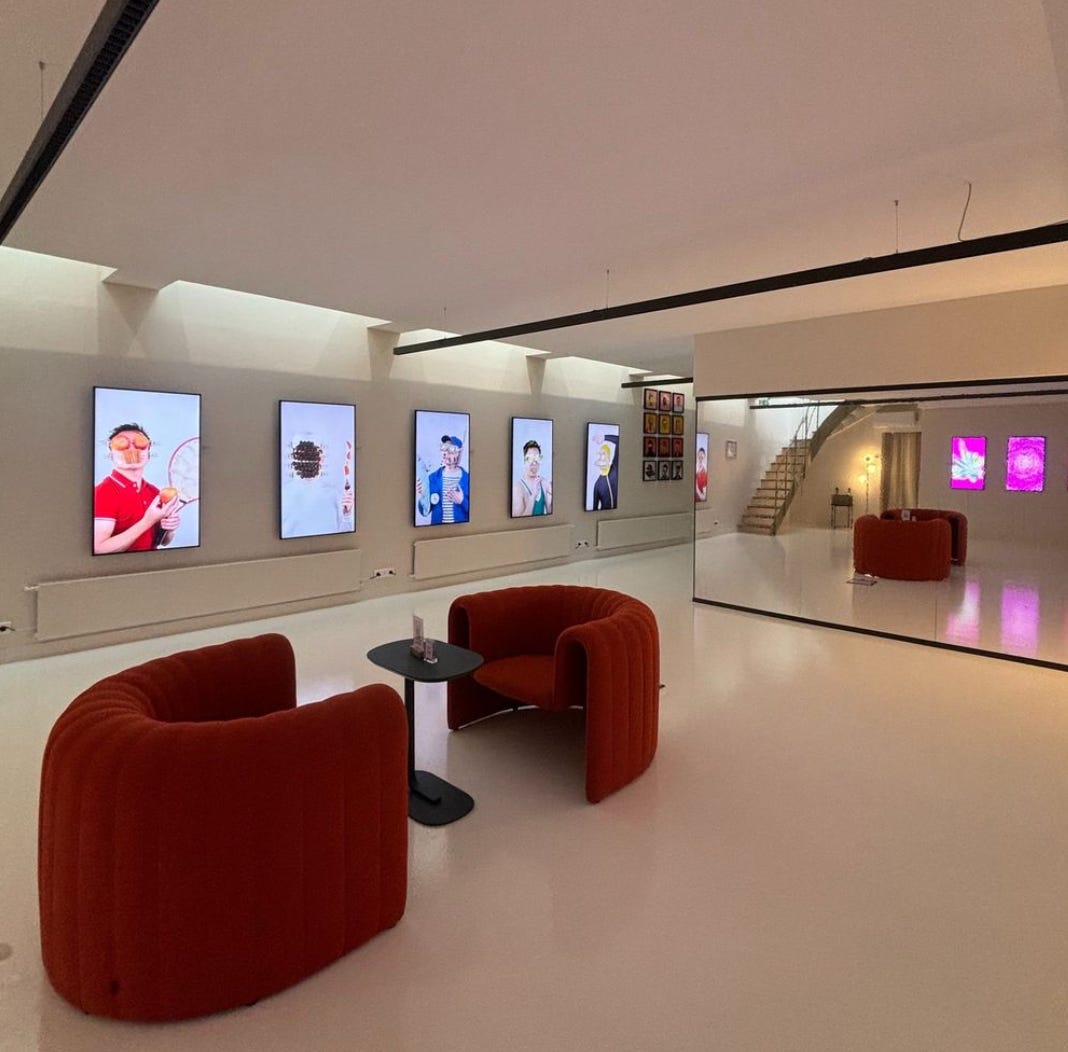
But then, I wondered if we should really use all the screens available at the same time?
I always felt that a wall full of screens tend to pollute each other visually. It is often visually chaotic with different colors, styles and topics so close to each other, and then, some colors take more space than other, impacting the nearby screens. It easily created an overstimulating environment, each competing for attention, and consuming great amount of energy.
So, how do we solve this? I’m considering a few ideas.
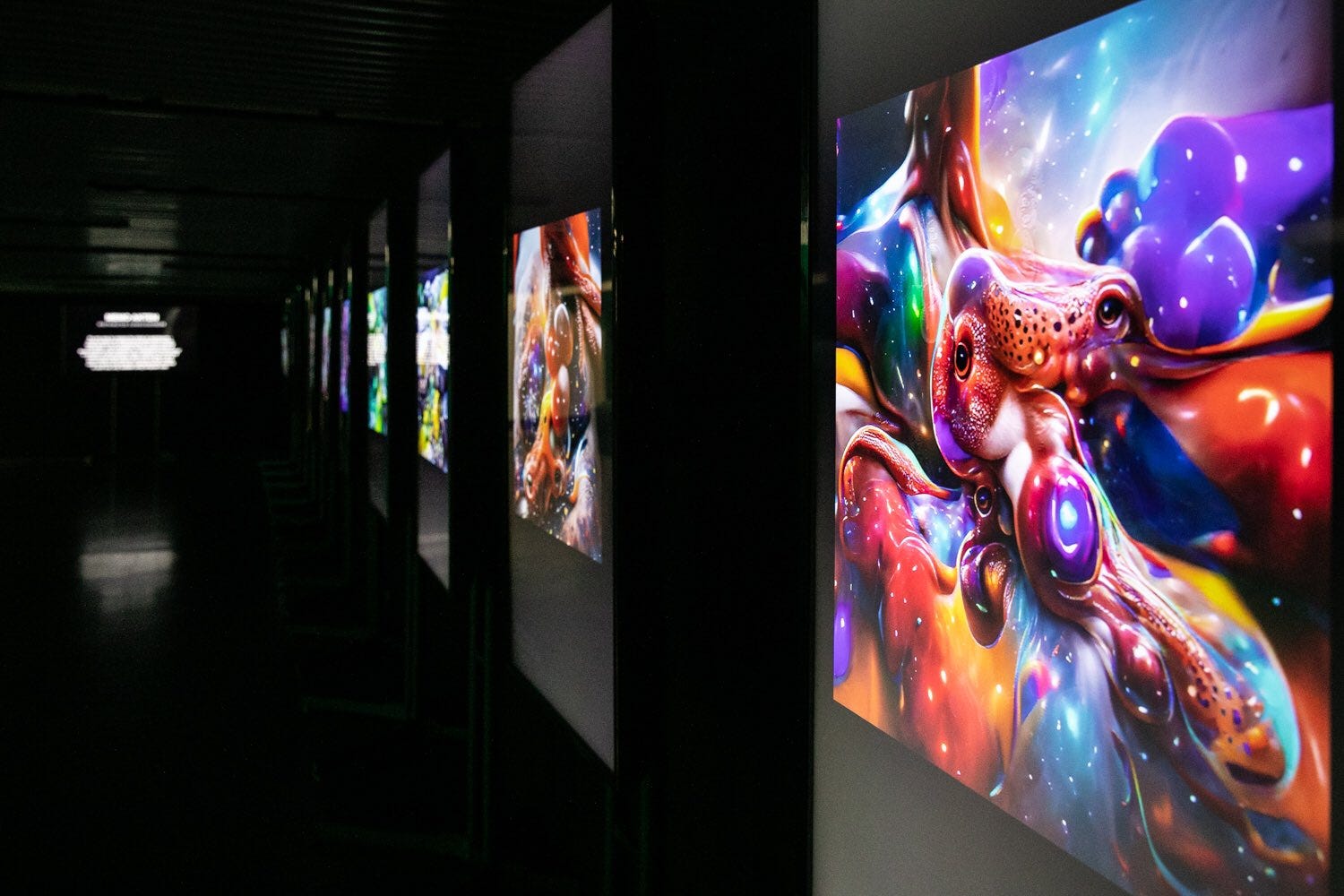
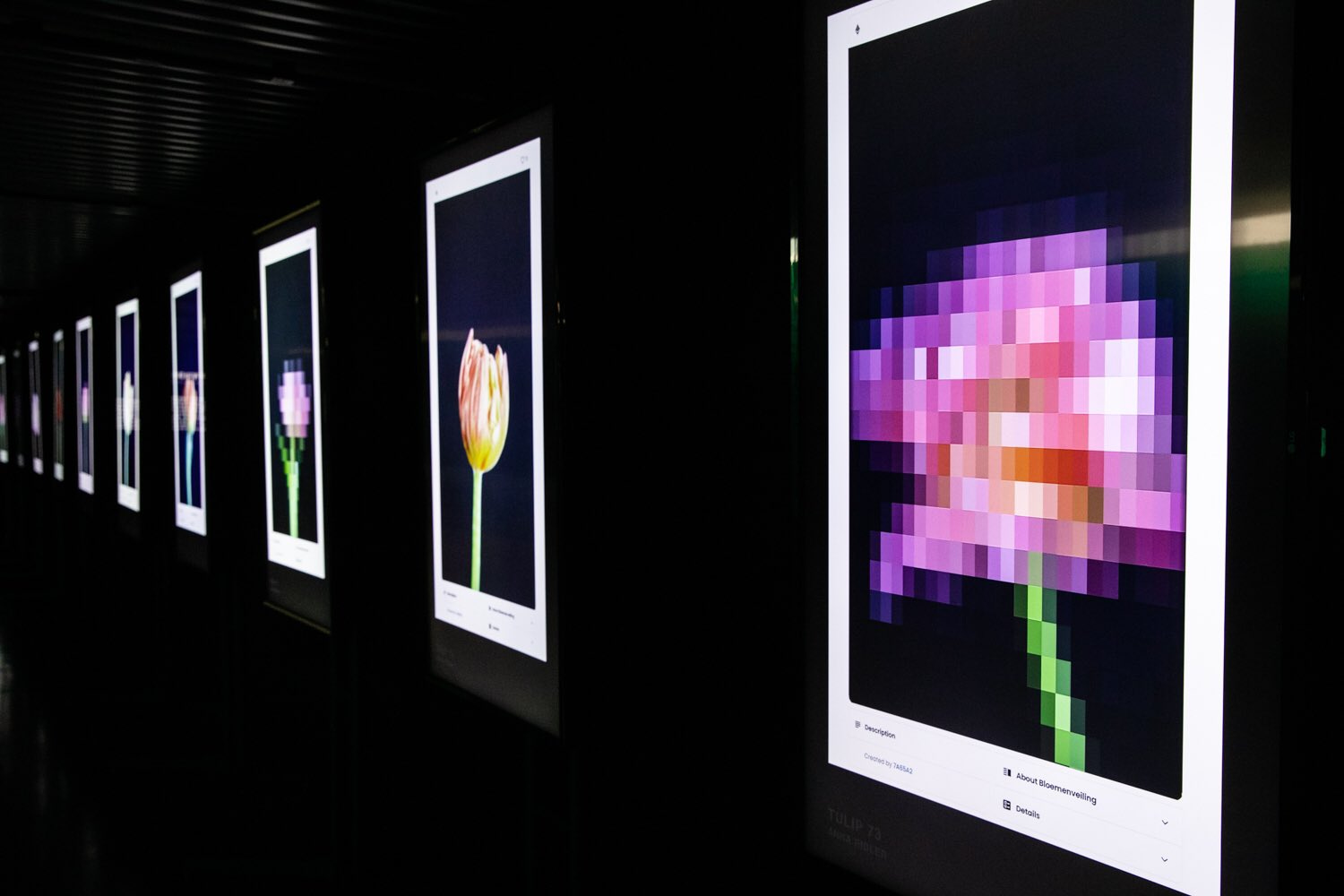
One approach might be to use the screens as a cohesive series, giving one wall over to a single artist or theme. It’s something we set-up for the Sonar+D edition 2022 “SonarMàtica”, a show I co-curated a the Tezos booth. For this show, we invited 15 artists to explore the possibilities of Artificial Intelligence (AI) and blockchain to reflect on the climate emergency and the natural world. Each artist was invited to take-over an installation made of 12 multi-channel screens. Organized like a long dark tunnel, every series created a very special atmosphere, changing the color tones and identity of the space. This set-up give visitors the opportunity to view and experience the series of artworks in an exhibition format, like a solo show.
Here is how it looked like with the “Distributed Consciousness” series by Memo Akten:
And here is the series “Bloemenveiling” by Anna Ridler:
One we found a way to curate a screen-only exhibition in a coherent and non-polluting mechanism, the question of reducing the energy consumption of the individual screens comes to play.
One of the first idea I had was to control screen activity duration so they aren't switched-on when no one is in the room. This simple addition could cut down on unnecessary power usage. And while this might not seem like much, those hours add up. Imagine if every gallery adopted this approach—how much energy could we collectively save? To do so, we could, for instance, implement a sensor system by the entrance so that the screens only light up when a visitor steps into the room.
Then there’s the question of screen brightness. Can we dim the screens a bit to save energy without compromising the visual quality of the artworks? Reducing brightness might seem like an easy fix, but it’s tricky as it could dull the vibrancy and clarity of the artworks presented. Fortunately, even a small reduction in brightness (to around 70-80% of maximum capacity) can lead to noticeable energy savings without compromising too much on display quality, especially in ambient-lit environments. I think it is definitely worth experimenting!
Another aspect to consider is the technology behind the screens. For example, OLED screens tend to be more energy-efficient at lower brightness compared to LCDs, as OLEDs only light up the pixels in use. Also, screens operating using QLED technology are more energy-intensive than OLED screens, especially when brightness is at maximum.
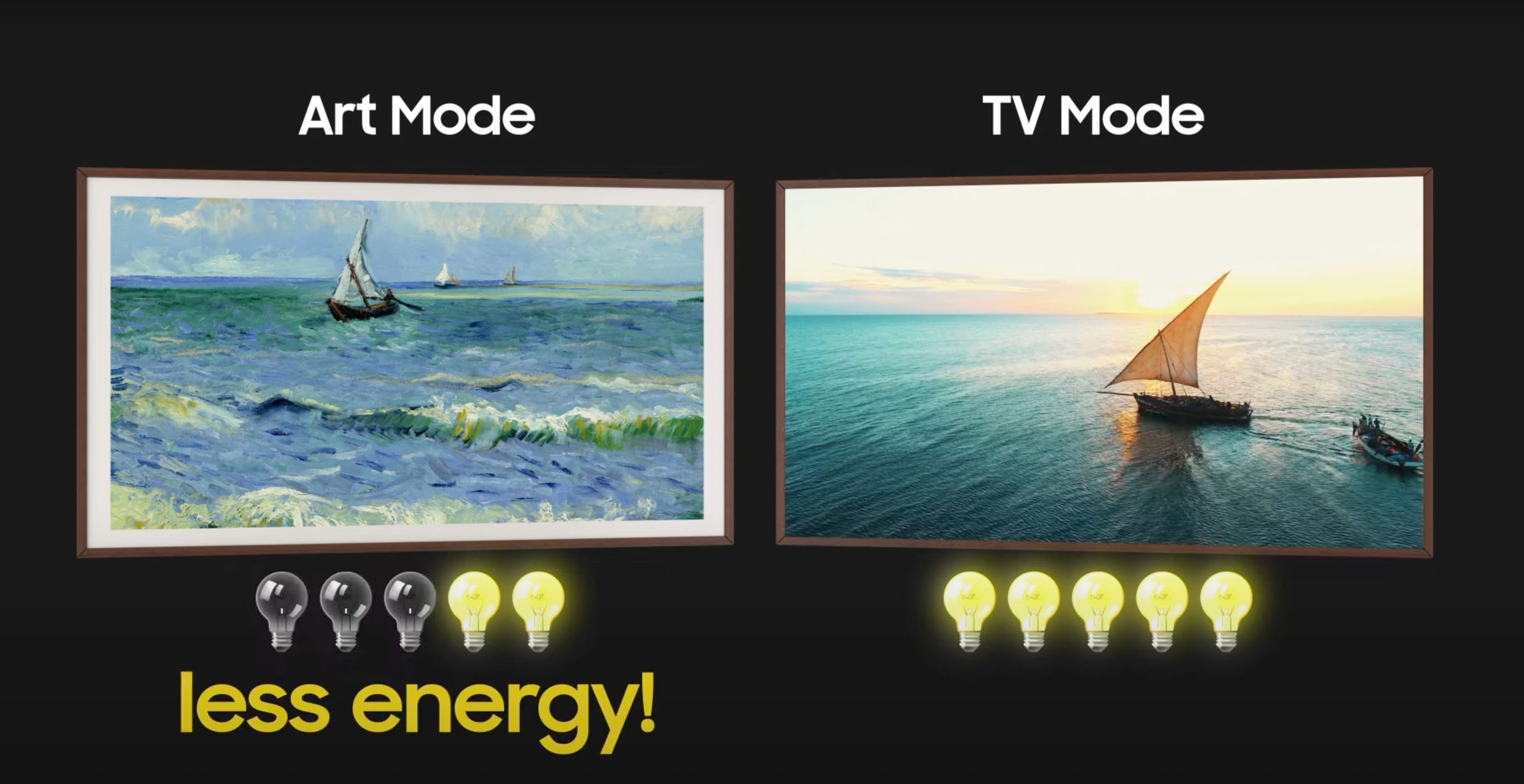
To get back to my example with the screens at Artverse Galerie, Samsung Frame screens use QLED to ensure better visual quality. To mitigate their intense energy consumption, the "Art Mode" can be activated to use around 30-50% less energy. In practical terms, the "Art Mode" reduces the backlight and have slower processing as images stay fix for a while.
Also, apparently newer Samsung Frame screens have motion sensors so they switch off when no one is around, and brightness sensor so they adapt when it is getting bright.
Once all of these considerations taken into account, a more radical solution started to appear: what if only one screen was active at a time, with artworks appearing randomly across the space?
In this choreography, each artwork could have its moment and the opportunity to change the ambiance of the room. This would be like inviting the visitors to experience a performance, where the art is savored, one piece at a time.
Curating in a digital space is full of these tensions: between energy use and visual impact, between presence and restraint, between tech-driven possibilities and ecological responsibilities.
I don't believe it is about avoiding technology but finding a way to use it more consciously, more thoughtfully. I think that’s what sustainability in the digital art world has to look like—small, intentional decisions that acknowledge the impact of every watt, every lumen, every pixel.
—
if you want to read more on the topic, follow Alistair Alexander or dive into the Gallery Climate Coalition website.
No posts
Comments
Nothing yet. Say the first thing.
Sign in to join the conversation.