
A few weeks ago, I had the chance to visit a very special exhibition at the Loevenbruck Gallery in Paris: Spiritism - Victorien Sardou. For the first time, 6 drawings by Victorien Sardou were gathered in the same place. The experience was strong, deep, and totally changed my view on the creative process.
Victorien Sardou was a French dramatist from 1850’s. While his career began with misfortunes and a series of screenplays rejections, chance knocked at this door when he got typhoid fever and started to be guided by a guardian angel. Convinced that this being was in fact the 16th-century ceramist Bernard Palissy, Victorien Sardou began creating automatic drawings, prompted by Bernard Palissy's spiritual hand. He then embarked on a year dedicated to the production of 10 ultra-detailed drawings. They were representations of their celestial homes, which he placed on Jupiter, in the imaginary city of Julnius. But we can easily wonder if they were not portals to other dimensions? Mediumistic micro-architectures emerging from the gardens? Symboliste and surrealist elements composing an unreal universe? It lasts a year, no more.
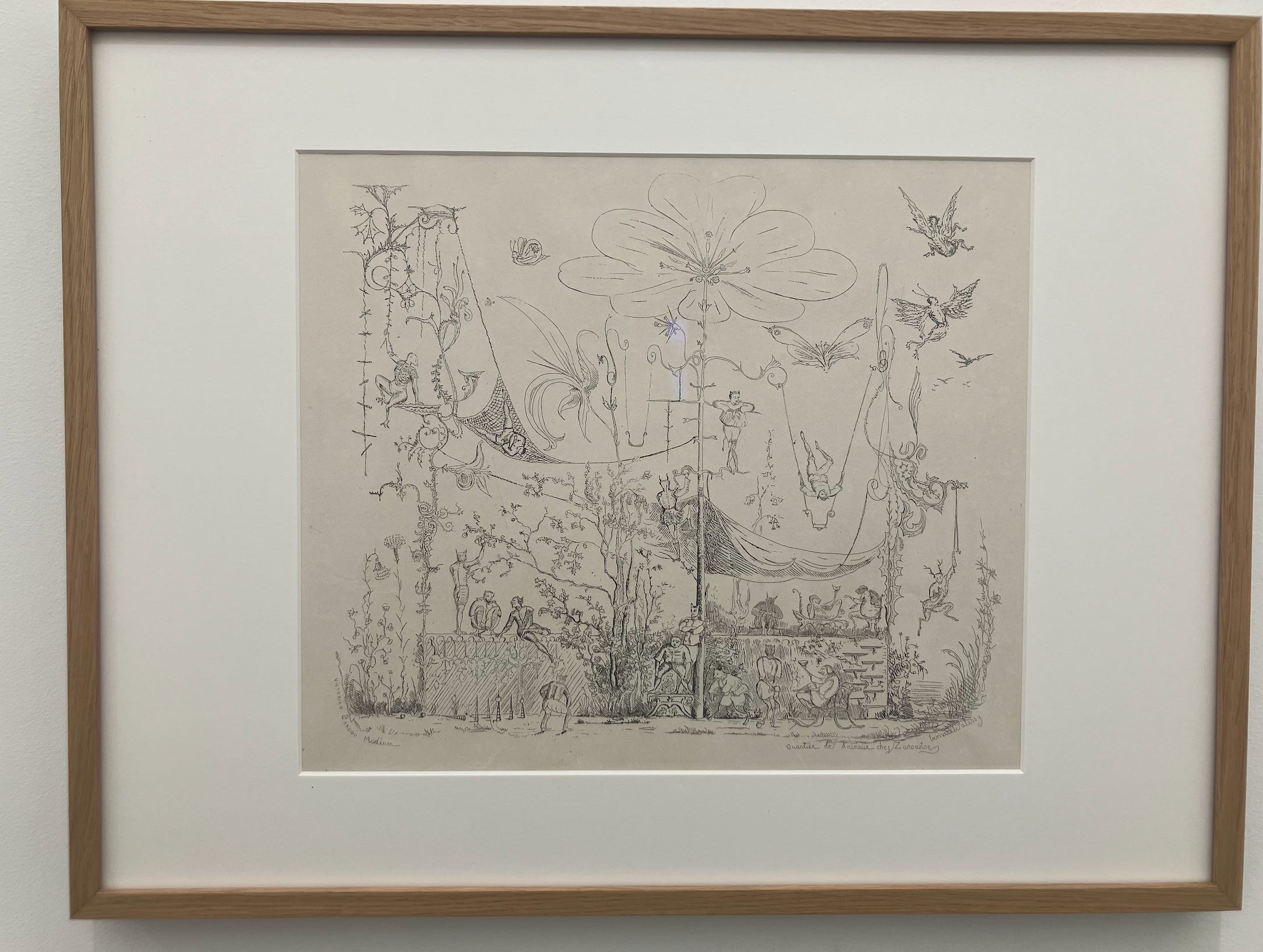
A few decades later, these drawings resurfaced and became key to the Surrealist movement. For the Surrealists, the automatic drawings of Sardou were an example of their initiation into Art Brut and automatism (the fact of creating without conscious control). For André Breton and his peers, this was more than an artistic technique; it was a way to reach much deeper, subconscious worlds.
Currently celebrated in a major exhibition at the Centre Pompidou “Surréalisme”, artists like André Breton, Salvador Dalí, and Marcel Duchamp saw in Sardou’s automatic drawings a precursor to their own exploration of the unconscious mind. In many ways, they were trying to escape rational thinking just as AI art tries to break away from human limitations.
Artists like Sofia Crespo, Anna Ridler, Refik Anadol and CROSSLUCID are among the first to create art using AI in cooperation with natural forms and computer technology. They compose surreal and speculative worlds in which the boundary between nature and machine, dreams and reality is removed; where hallucinations are leveraged as new creative processes.
In the words of Sofia Crespo: “A neural network can’t create something out of the blue from a dataset that hasn’t been fed to it, but it can recombine elements from data that has been given to it.” (Clot Magazine, 2020)
In her collaboration with AI, Sofia Crespo explores themes of biodiversity, ecosystems, and the entanglement of human and non-human life forms. In her “Artificial Natural History” series (2020), she raises a few inspiring questions: What would the evolution of species look like if influenced by AI? How can we re-imagine nature not as something separate from technology but as something it shaped and co-created by? What if we are turning AI into a collaborator that generates entirely new realities?
Sardou’s automatic drawings imagined architectures and gardens that didn’t exist in reality but might exist in another dimension.
That's what artist collective CROSSLUCID and writer Orion Facey explored in their last artwork commissioned by LAS Art Foundation: red the ocean around u. How AI can generate synthetic worlds, imagine other dimensions?
The artwork is all about "testing the boundaries of latent space and the universe that escapes consciousness." Guided by Claude, a personified LLMs, visitors are being asked questions that will affects the construction of the narrative and the virtual space. For once, the collaboration is not led by humans but by AI directly. And the more this AI hallucinates, the better it is for the creation of new worlds.
Let's go a bit further.
Just as the Surrealists were searching to unveil the inner working of the mind, AI holds the potential to unlock modes of operations of ecosystems, climate threads, and biodiversity in ways that go beyond human understanding. What if AI could generate complex environmental systems?
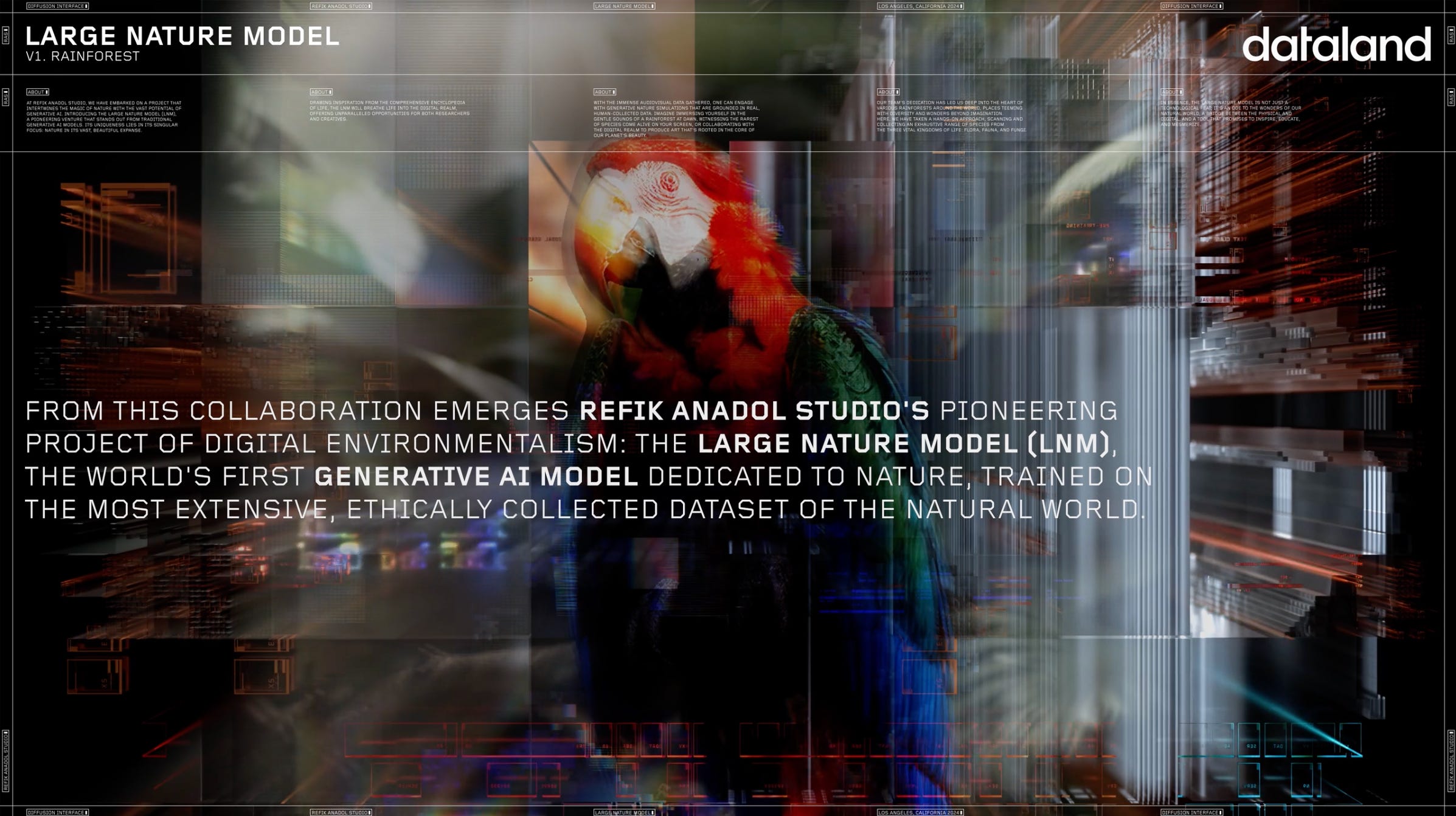
Artworks by Refik Anadol, for example, simulate organic fluidity of water, forests, and weather systems through machine learning for predicting and visualizing ecological futures. And with his Large Nature Model, he pushes the use cases even further! This is where AI’s automated process can transcend the speculative and engage with real-world ecological concerns.
AI may be a surrealist tool not only in the imagination of nature but to enter into its unseen depths, exploring connections between species, or even predicting future biodiversity under the pressures of climate change.
I hope this article inspired you to think about AI differently, giving it a role in the creative process and even more, in the understanding of our natural ecosystems.
Of course, when talking about AI, we should not forget about its tremendous environmental footprint! I believe there are ways to reduce it and having a climate and future-conscious consumption of AI-- An article on the topic is currently in the pipeline.
No posts
Comments
Nothing yet. Say the first thing.
Sign in to join the conversation.