
Do you often find yourself staring at something without really looking at it? Seeing what is there, but also what is not there at the same time? Feeling as though the image is moving delicately while remaining frozen? There is something unique about floating spaces, floating in time or space.
For seven long years, this former lighting shop stood empty in the middle of the bustling Baker Street in central London. Emptied of its meaning and purpose, new lives took over, turning this negative space into fertile ground for new possibilities. Less than three years ago, the Bleur Gallery team moved in and transformed it into a third place where art and community come together around visionary themes.
It is in this context that the exhibition After Light, The Bloom was born.
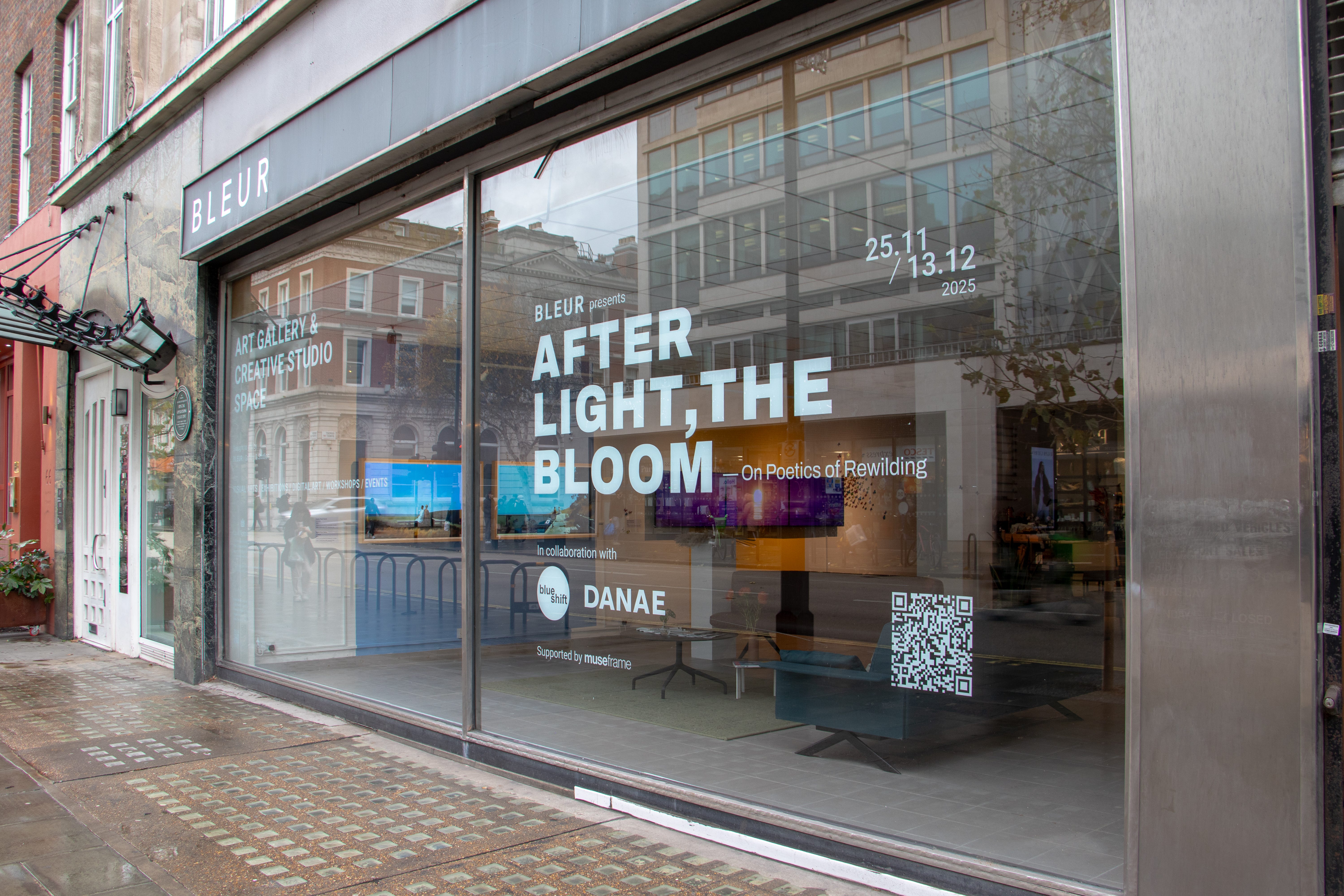
More than just an exhibition, it also presents a counterpoint to dominant digital art trends. While so much of the field veers toward the spectacular, the hyper-immersive, the interactive, or the futuristic, After Light, The Bloom shifts our attention toward something else entirely: restraint, ecology, slowness. It asks how digital art can attune us to presence rather than escape, to observation rather than interaction..
Curated by Diane Drubay for BLUESHIFT and currently on view at BLEUR Gallery in London, the exhibition brings together four artists working with digital media and ecological speculation. What links their practices is a shared attunement to slow shifts, soft futures, and transitional space.
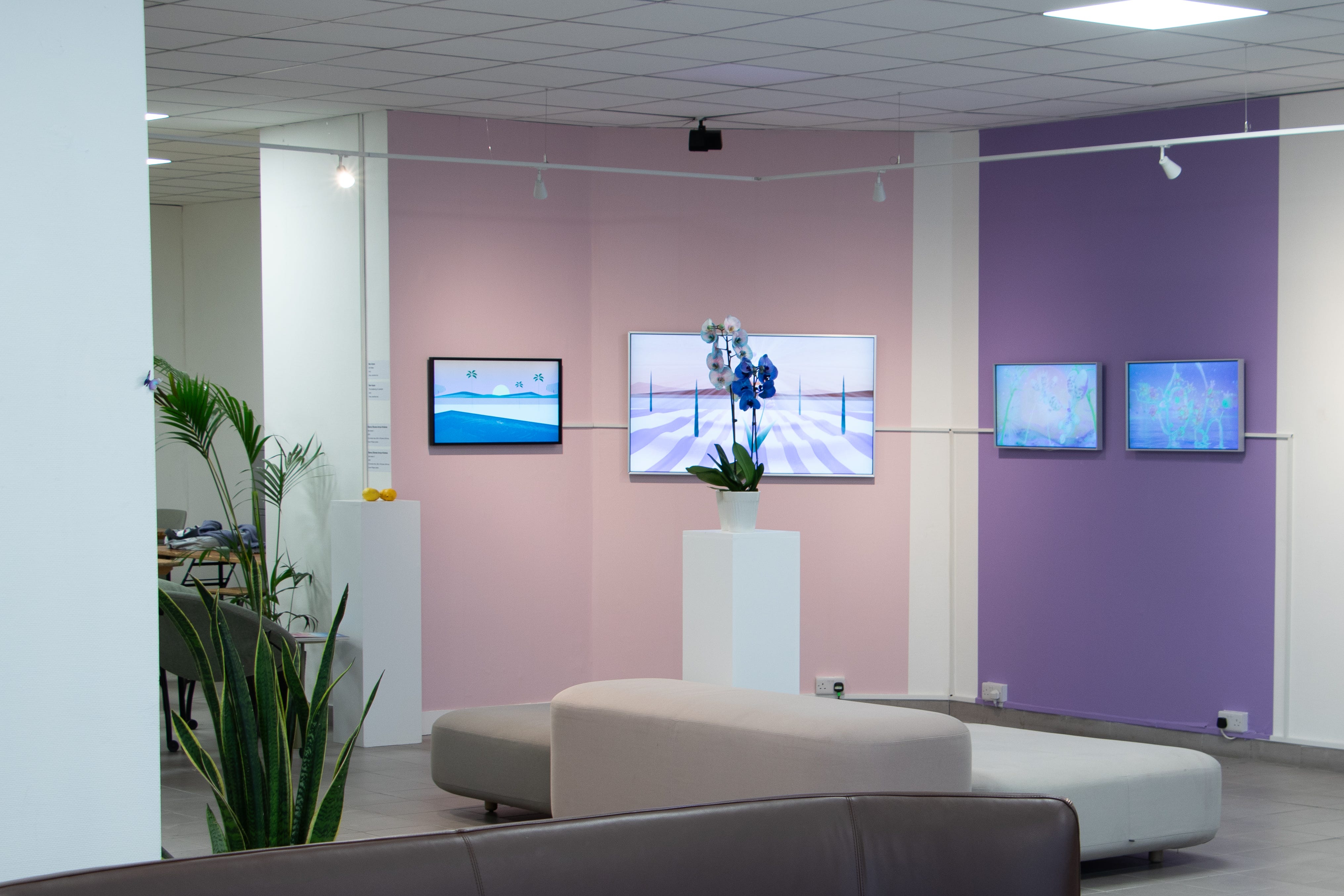
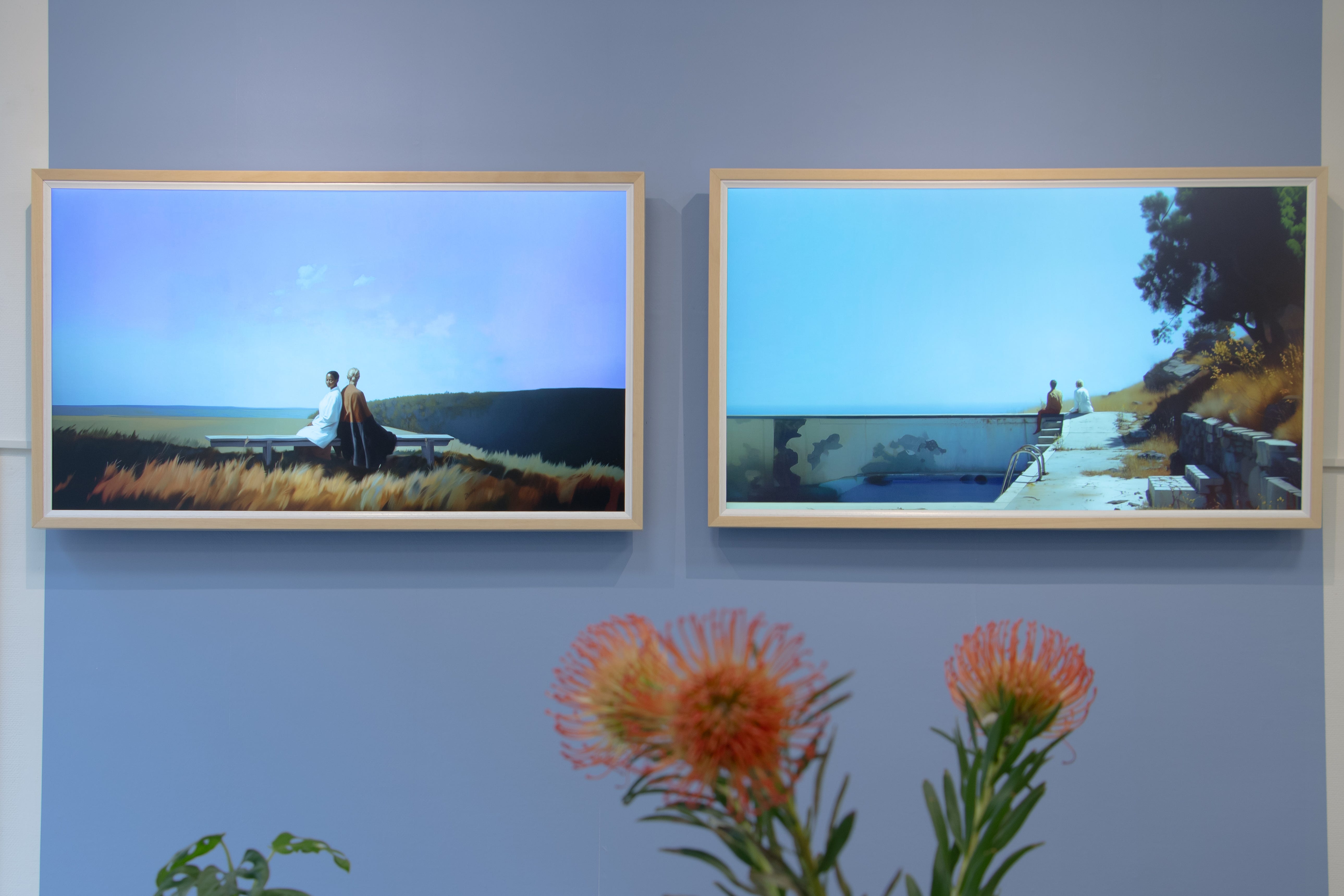
All eight works unfold in landscape format, like slow-moving paintings or open windows. Sunsets, horizons, sky lines mark these points of thresholds. In art history, this symbolic framing goes back to the Romantic and early modern painters like Claude Lorrain, William Turner, or even James Turrell and Bill Viola’s elemental scenes. All use the horizon to mark a moment of suspension. A pause that holds the potential of transformation.
Louis-Paul Caron stages this threshold in La Colline, literally. Two women sit back to back, facing a rural horizon. One closes her eyes, the other looks out. The landscape is gently brushed by the wind. Monoculture fields on the left, wild woods on the right. A moment of choosing, or just of co-existing. An AI-generated image slips over almost imperceptibly, like breath across stillness. Louis-Paul Caron’s La Piscine takes us to a similar quiet wound: an abandoned swimming pool, its concrete cracked and blooming with weeds. These works don’t mourn. They watch. They wait. They are suggesting that even in loss, there is still the space for quiet continuation.
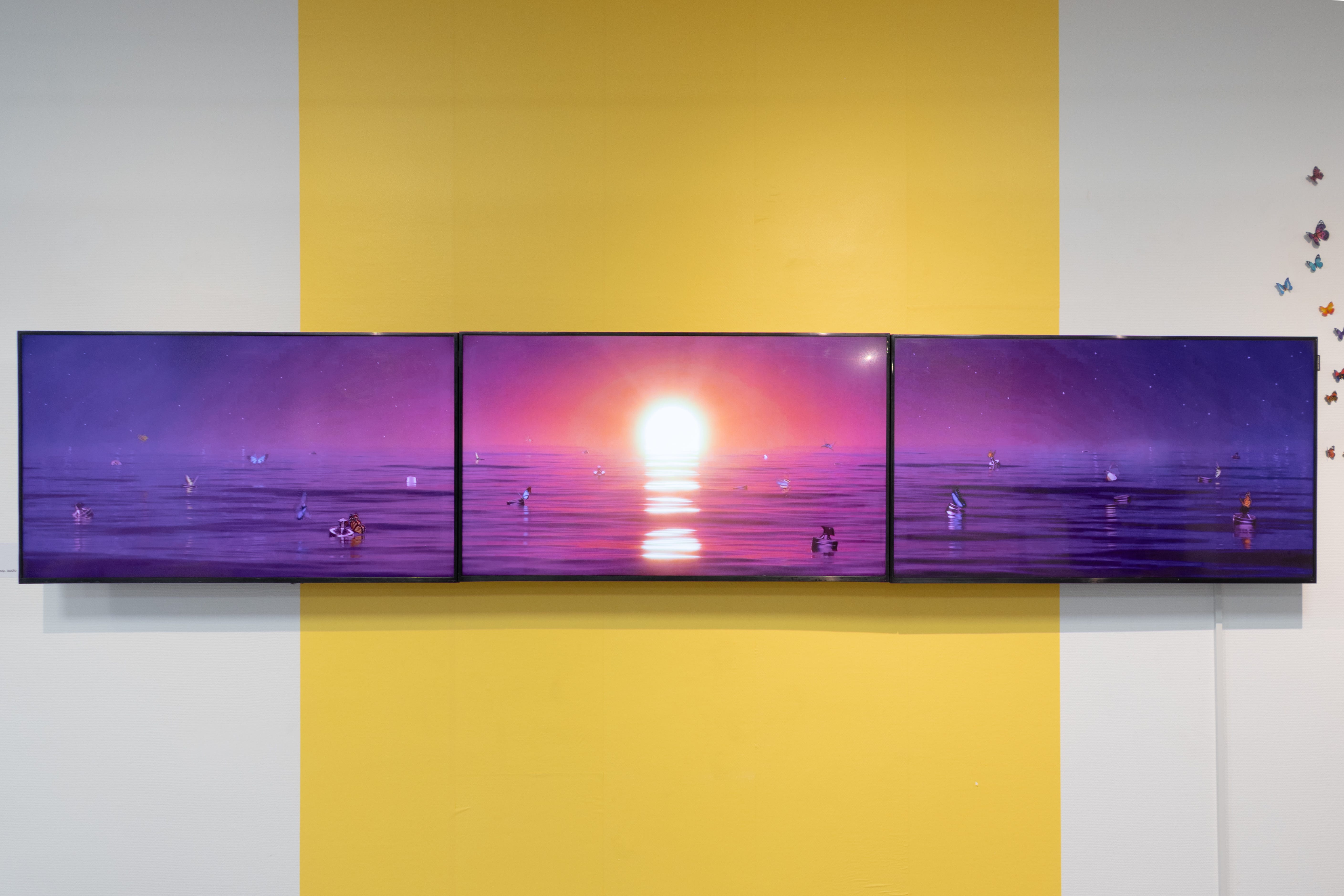
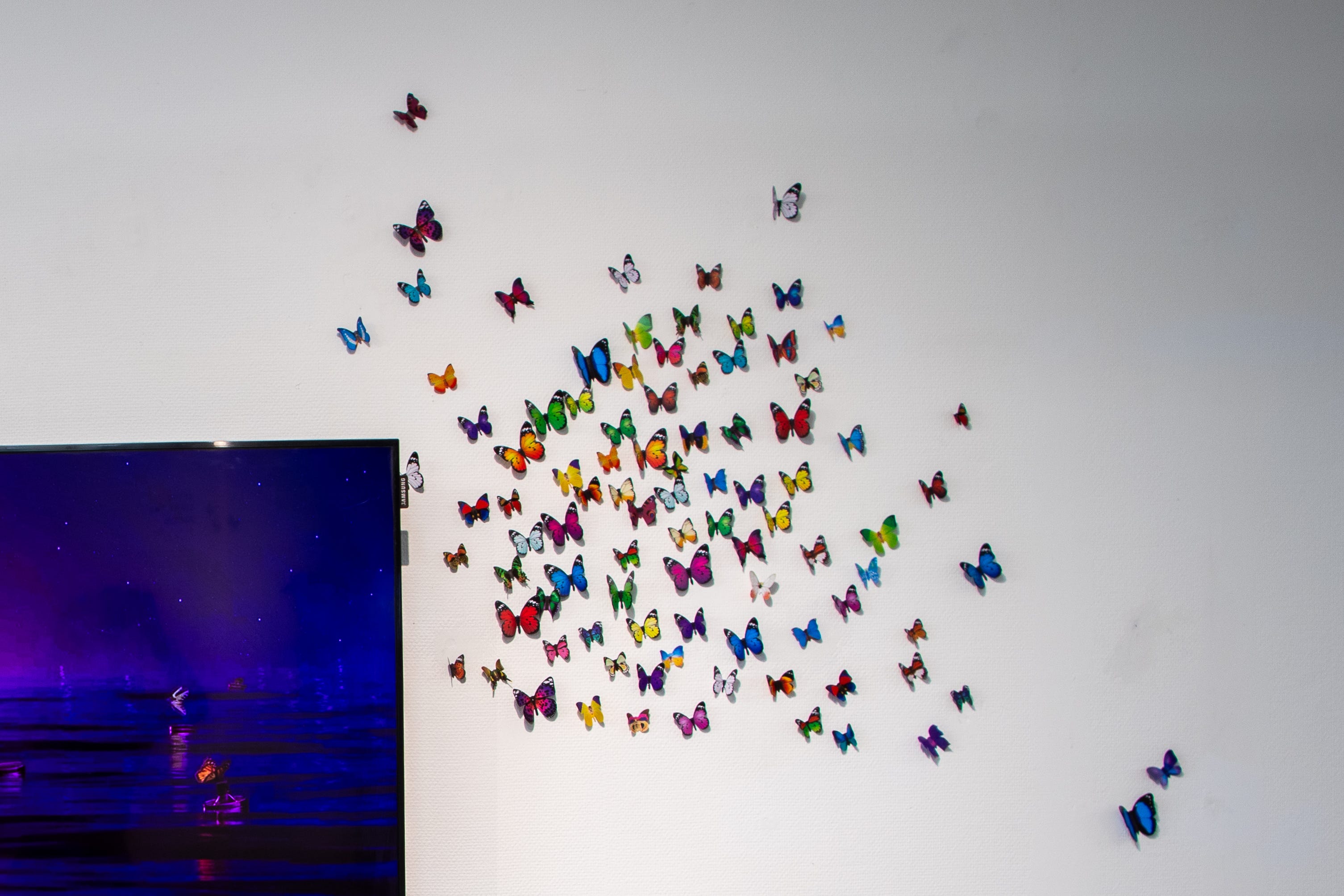
Kelly Richardson’s Journey to the After adds another level. A panoramic video installation of tear gas canisters suspended over a still lake, evoking the Fairy Creek protests, the largest act of civil disobedience in Canadian history. Butterflies first stop at the metal then lift away. Each species is chosen symbolically: they cannot cohabit in nature. Their presence here may be deliberate fiction but it does seem to have implications. Destruction is there, but so is care. Richardson writes: “We aren’t defined solely by destruction. There is also the possibility of repair.” It’s what I return to: not just ecological grief but ecological imagination.
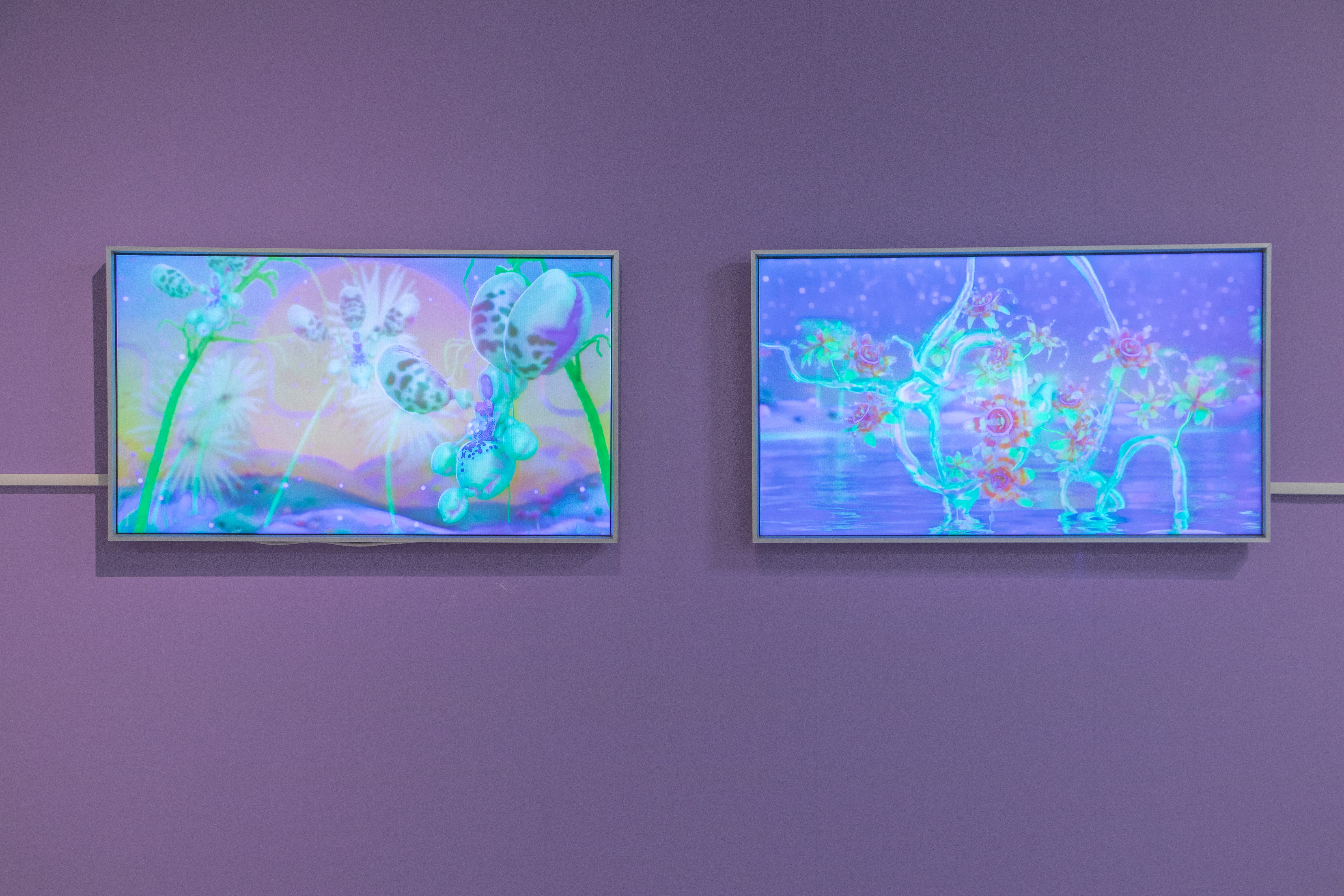
Bianca Shonee Arroyo-Kreimes goes further, to satire and myth. Her Tele Garden series features two digitally animated ecosystems, tropical kitsch rendered in plastic hues, hyperreal palettes and purposefully staged textures. They are like postcards from nowhere that exist on this planet, outside of the synthetic world built by humans. Nature, stripped of meaning, endlessly looping on a screen. But the degradation introduced by VHS-like effects is a reminder: this too is dying. Or already dead. In Post-Mortal, Arroyo-Kreimes charts a story of death and transformation in the digital environment. The mantis hunts a moth, but both vanish through the synthetic world until they appear in a glitchy, televised portal. Birth and death collapse. What is natural, what is simulated, what is spectral becomes indistinguishable. What does it mean to experience nature not in place, but in code?
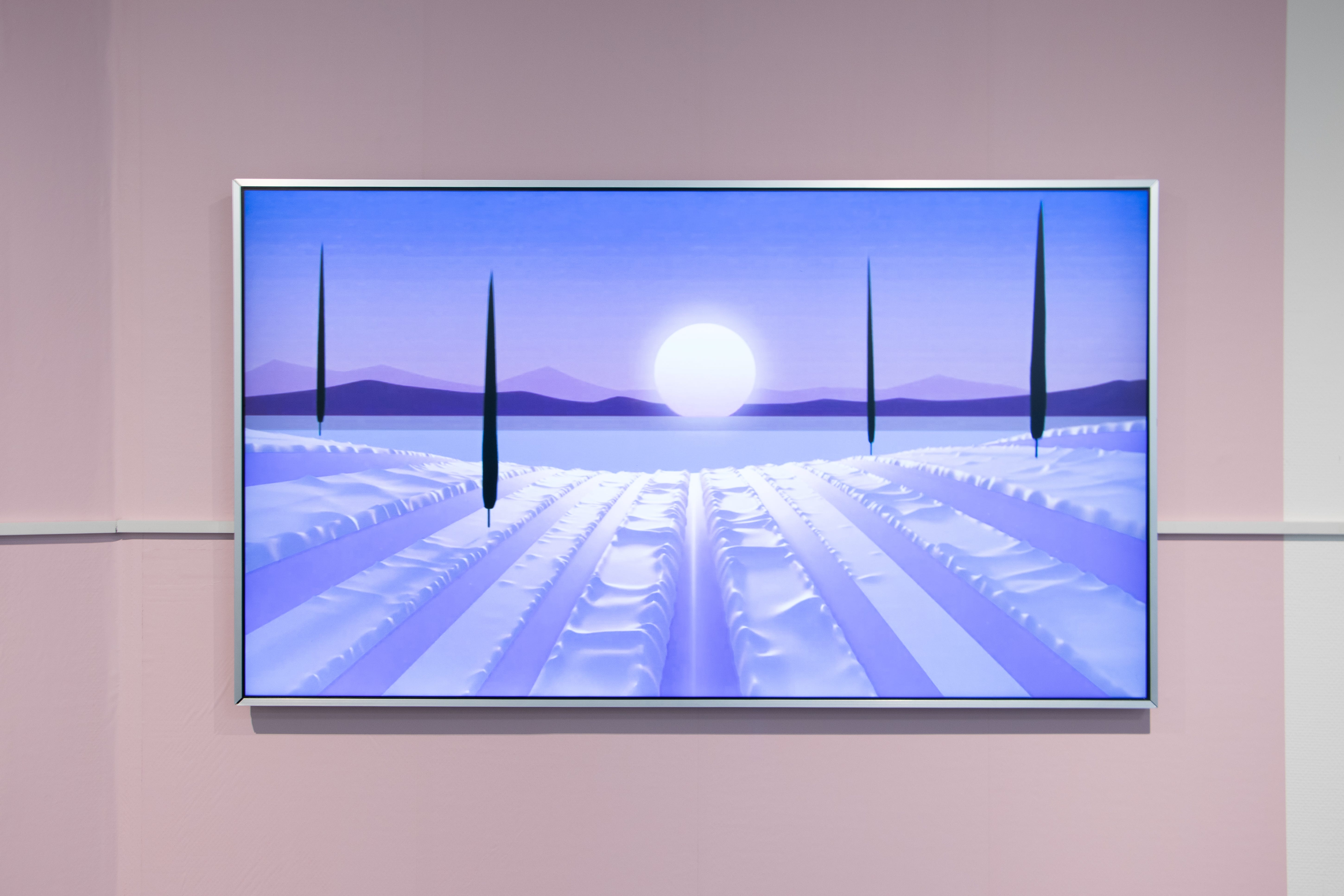
And then there’s Ben Arpea, whose works are perhaps the most serene. Memory in Still Water and The Awakening of Lavender is stored in light and color. There are no humans, but the settings are deeply inhabited. You can almost smell the lavender, hear the insects, feel the warmth vibrating off the sun-soaked surfaces. These are not landscapes, they are recollections. Those spaces where memory operates through sensory architecture.
One symbol keeps recurring through the exhibition, quietly: the butterfly. It wends through a number of works, a guide, a metaphor, a ghost. Its connotations are profound: metamorphosis, migration, impermanence. Here, it has a still additional meaning: of the frail drift from what was to what might be.
After Light, The Bloom makes a different proposition: that the digital can be quiet, that it can bear the poetics of rewilding without converting wildness into image culture. That speculative futures need not be loud. And that negative space, so often feared, so often ignored, can be among the most radical forms of presence in art today. In this exhibition, the works do not take over space, they resist immediacy. In doing so, they subtly challenge what we expect digital art to be.
Collect the artworks here: https://www.danae.io/
After Light, The Bloom runs until December 13, 2025 at BLEUR Gallery, London (62-64 Baker Street). Presented by BLUESHIFT in collaboration with DANAE and supported by Muse Frame.
No posts
Comments
Nothing yet. Say the first thing.
Sign in to join the conversation.