
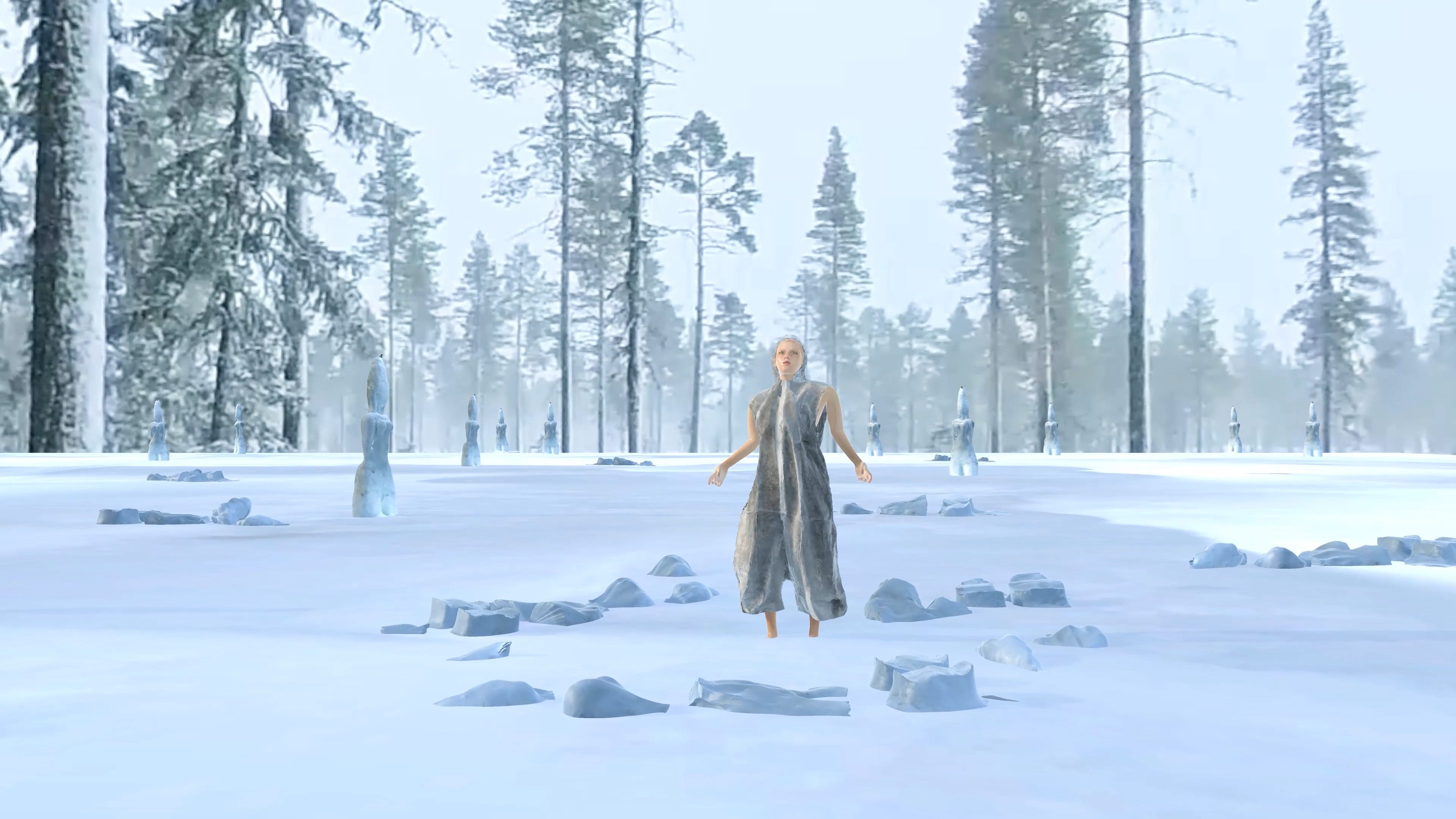
Looking at the artwork, Andrea G. Artz’s “Albertina the Snow Woman” feels like witnessing an intimate ritual, something that you are not supposed to see. A figure, part sculpture, part avatar, moved through a luminous, snowy environment with gestures that evoked both dance and dissolution.
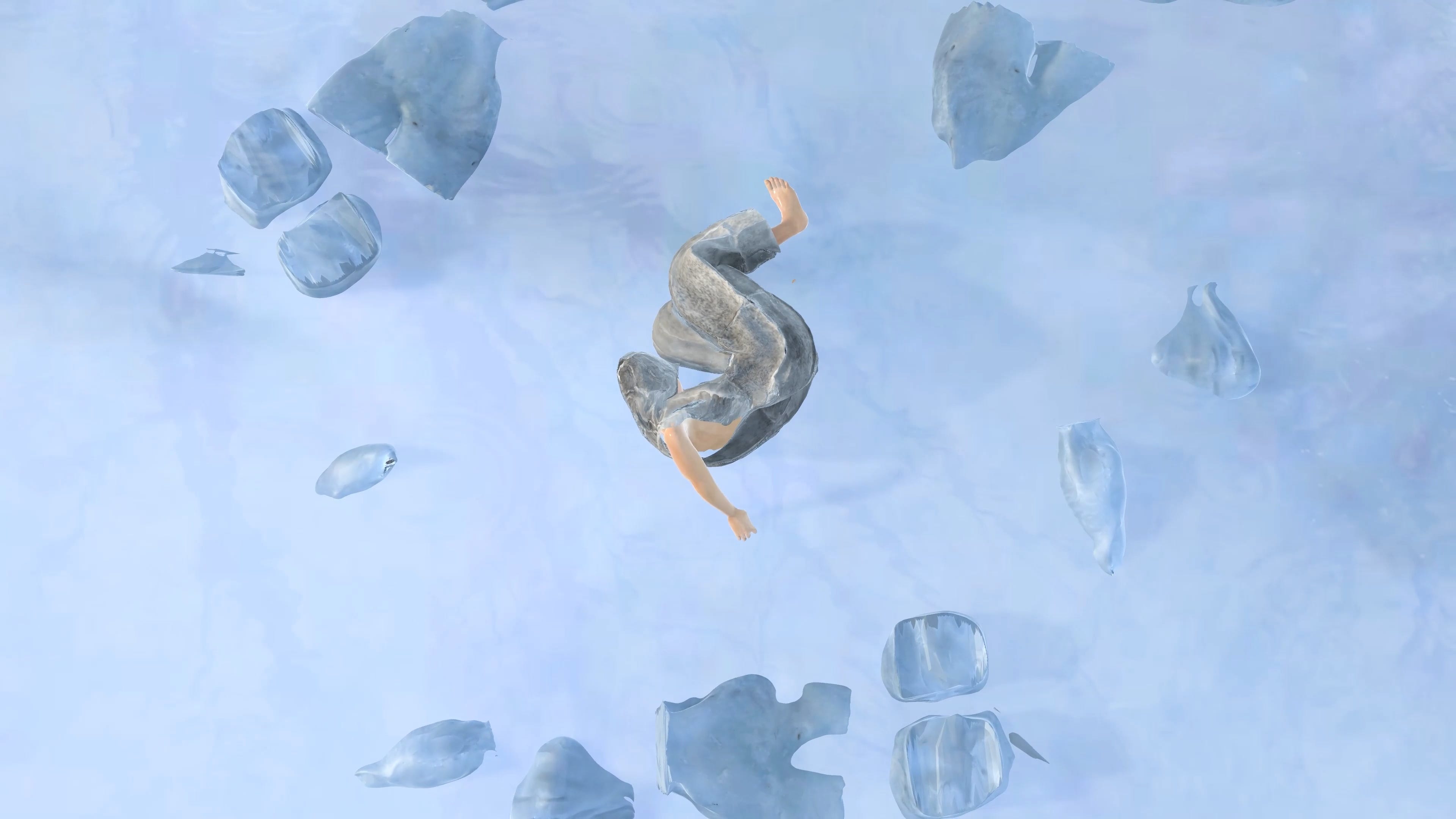
I learned later that Andrea had sculpted the original snow woman by hand during a residency in Lapland. Knowing this made it even more powerful. Her melting avatar wasn’t just digital; it was the memory of a moment, the grief of what is lost. The artwork sits somewhere between an art performance, the memory of a feminine figure, and ecological grief.
Diane Drubay: Can you take us back to the beginning of Albertina the Snow Woman?
Andrea G. Artz: Yes, it was actually very emotional. I went to Lapland during an artist residency. The inspiration came from Angela Carter’s novel The Infernal Desire Machines of Doctor Hoffman. One of the main characters is Albertina. She's a woman of glass, and she's a shapeshifter. She always takes on different kinds of personas. There's one section where she is melting like a snow woman in the arms of her lover. So I decided to build a snow sculpture of this avatar while I was in Lapland.
DD: Can you tell us more about the transition from the ice sculpture to its digital version?
AGA: Each morning, I would go out early to find fresh snow and shape her. A week after I left, everything melted. One of the artists actually sent me a photograph of my melted snow sculpture. That disappearance was powerful. It reminded me of melting glaciers, of nature breaking down. But even as things dissolve, something else always begins to take shape. That’s what I wanted to explore.
DD: You often work with your own body, or with dancers, to create avatars. What role does physicality play in translating the emotional tone of your work into digital space?
AGA: I scanned the sculpture before leaving and then recorded a dancer embodying Albertina’s movement. I asked the dancer to evoke a melting snow woman, a melting snow sculpture, and what it would feel like to melt. And then I built a digital world where she could melt again, this time more slowly, more symbolically. The whole process felt spiritual. The snow woman became something like a ritual figure for me, standing between the natural and the artificial, the ecological and the emotional.
DD: Albertina, as a character, feels speculative. What kind of ecological narrative are you shaping with her?
AGA: In Angela Carter’s novel, Albertina is a shapeshifter and a woman of glass, almost like a digital figure or AI avatar before its time. For me, it became about creation and disappearance—like the melting glaciers, or the way digital nature replaces physical nature. It’s not just about loss, but what might emerge from it. Something spiritual, something symbolic. I wanted to explore that kind of transformation.
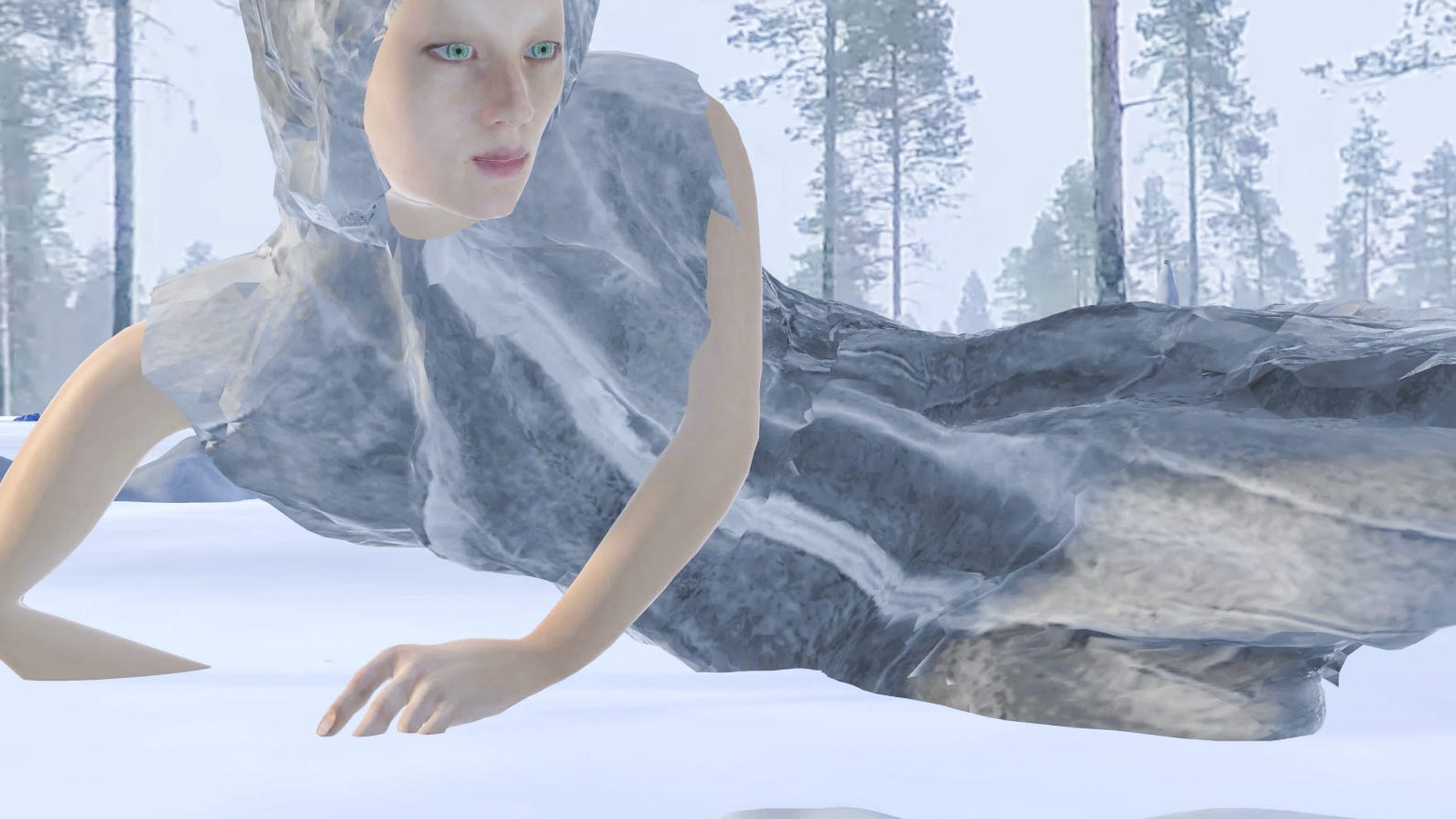
DD: The way the avatar melts isn’t literal though. Can you tell us more about the decision to use symbolic motion instead of realistic melting effects?
AGA: Yes. I tried using other kinds of techniques to make it melt in Blender, but it didn’t really work; it didn’t look good. So instead I let the avatar’s movement and form suggest melting. It becomes a block of ice and sinks into the ground. It’s symbolic, and that actually felt more powerful.
DD: The sound in Albertina the Snow Woman feels elemental. Can you tell us about your approach to sound in this piece?
AGA: Yes, there were a couple of other artists at the residency, and one of them, Christoph Zeckel, is an experimental sound artist. He gave me one of his recordings, which I used in the piece. He's done recordings of radio waves, the Aurora, and melting ice. It has this texture that feels almost real but slightly off; there’s a surreal quality to it. I also added a dripping water sound from another source to emphasize the melting and overlaid a video of a puddle with water droplets falling into it. You can hear birds chirping, and near the end, footsteps from someone jogging. That final detail grounds the experience; it brings the surreal environment back into something real and embodied. The soundscape is a hybrid: part elemental, part constructed, but all natural. It creates a post-natural environment that mirrors the visual world of Albertina.
Andrea G. Artz, Albertina the Snow Woman, HD Video with sound, 3840 x 2160 px, 1 min 33 sec (collect it here)
In many ways, Albertina is less an avatar and more a digital spirit, part shapeshifter, part snow relic, and part feminist echo. Here, shapeshifting becomes an ecological process: loss, regeneration, and reformatting. In a world where most forests are planted and most glaciers are melting, Andrea G. Artz’s Albertina is a ritual performed on the skin of a frozen lake, an ephemeral body dissolving into a post-natural griefscape.
This interview has been conducted on the occasion of the online show “On the Edge of the Horizon,” co-curated with Tina Sauerlaender from RadianceVR. The show can be viewed here: https://on-the-edge-of-the-horizon.common.garden/
Stay tuned for our next artist interview!
No posts
Comments
Nothing yet. Say the first thing.
Sign in to join the conversation.