
Last week, I visited the "Paysages Mouvants" exhibition at the Jeu de Paume in Paris. There, I saw myself enjoying spending time wandering through nature films from the Democratic Republic of Congo projected onto tulle, creating new spaces and above all new materials. Moving and sensitive, Léonard Pongo's work “Tales from the Source” invites the senses to understand what reason seems to omit. I also visited the latest exhibition at the Centre Wallonie Bruxelles in Paris: “25 Arts Seconde: Soluble & Simulacrum”, which speaks of utopias in the liquid age, and mutations of species and genres. Aure Sakellarides' “Strates de peau” presents a video projected on different layers of tulle, referring to the different layers of skin and questioning identity and what we show.
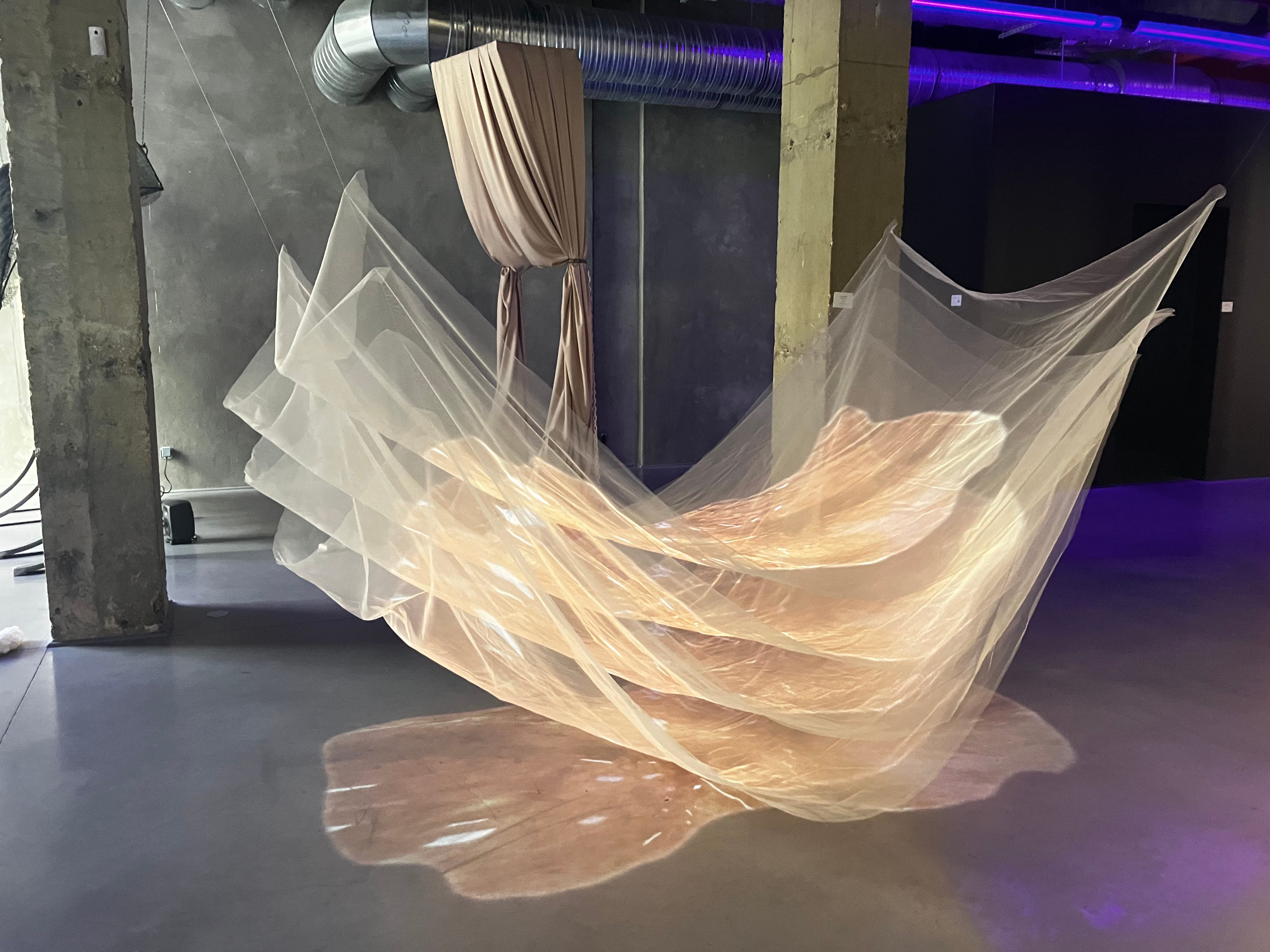
Video works projected onto fabric are not a new concept. But strangely enough, the effect they had on me was much deeper than usual. Is it the subject matter? Is it the intention behind them? The invitation to look differently, to look further, deeper? Whatever it was, the result was clear: I wasn't just looking at art; I was within it.
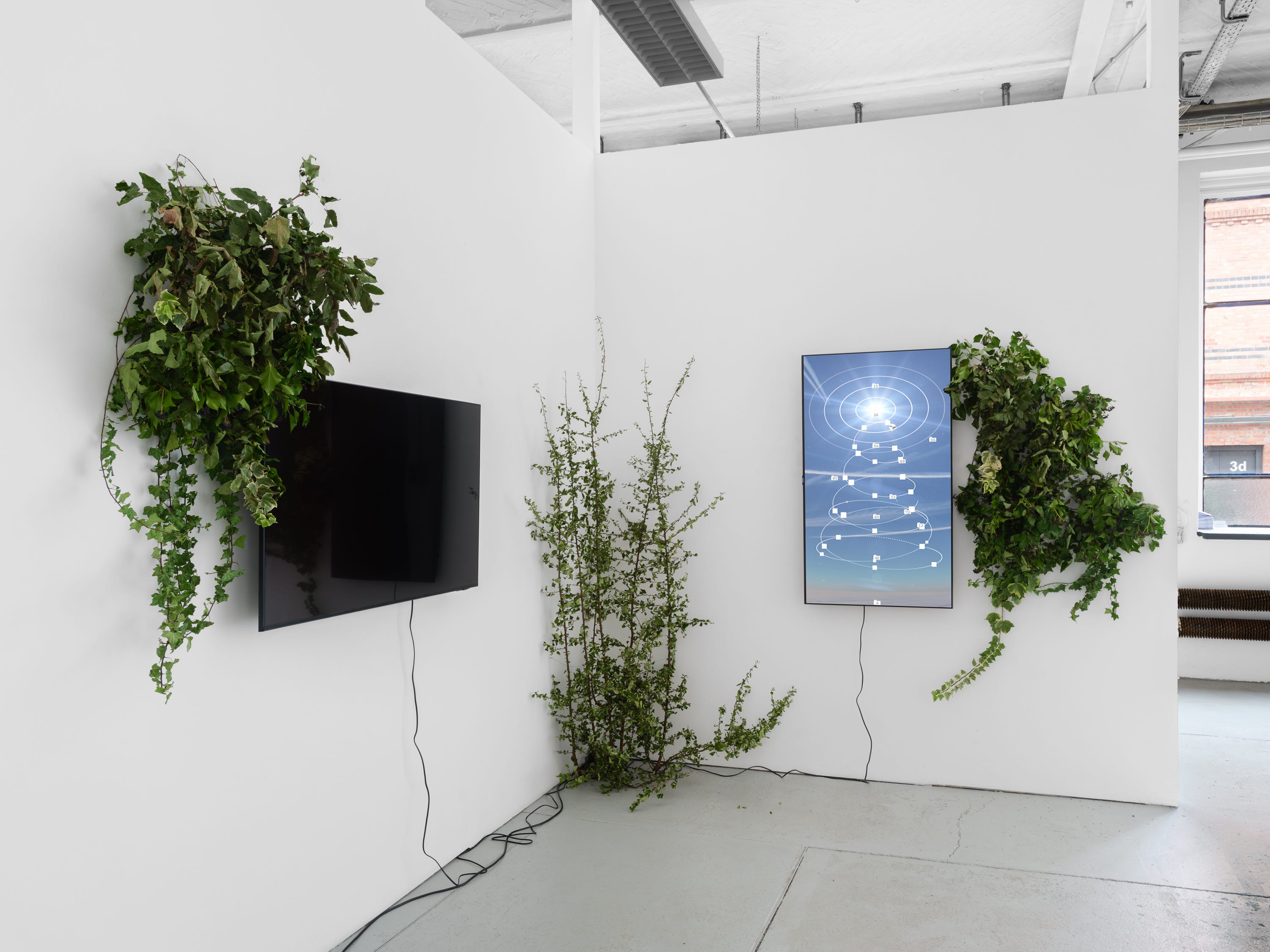
It was a rare moment. In an age of infinite screens, digital art is often fast, high consumption, and easily shared, but true presence seems like so hard to get or to make. Walter Benjamin, writing in the 1930s, when photography and film were disrupting traditional art forms, knew this was happening. In “The Work of Art in the Age of Mechanical Reproduction”, he discussed how mass reproducibility undermines the "aura" of an artwork, meaning its one-of-a-kind existence in a particular time and space, its "aura," its almost otherworldly presence. He also raised concerns about diversion, where art is no longer a focus of attention but a mere element that competes for people's attention alongside other stimuli. That’s a topic I have been exploring with the choreography of screens I set-up for the “Soft Mutations” exhibition at Artverse Gallery in Paris, and with teh “Down the Silicon Meadow” exhibition at Office Impart in Berlin, and the reactions were even better than I could have imagined. (Read my article about it)
Nearly a century later, as we transition from mass reproduction to mass creation with AI, the question is: How can we restore the enchantment of art in the digital era? How can we move away from digital art, which is something to scroll through, consume, and toss out, and return to the moments of presence, of the magic?
Walter Benjamin claimed that technological reproduction breaks art's connection to ritual and tradition. A painting or sculpture is there in a fixed place, made to be in a temple or a home, while photography and film are everywhere at once. Today, digital art goes even further than that; it exists across an infinite number of screens and is considered to be real based on the number of views, likes, and shares it gets.
However, this means that digital art has either lost its aura or the aura has changed.
This is a very important idea: Digital art does not have to be constrained by the logic of mechanical reproduction. It is not unique; it is simply unique in the present rather than in the object. The issue is how can we curate these encounters to induce presence, not just consumption?
One of the biggest challenges of digital art today is its exhibition model. Too often, we see screens—endless screens, demanding attention rather than inviting contemplation. The result? Digital artworks become indistinguishable from the flood of media we consume daily.
But what if digital art was installed differently? What if it wasn’t on screens but in spaces? Of course, experimentation in terms of presentation and scenography around screens has multiplied in recent years. With sand, soil, plants and water, there are physical textures to bring the digital into the real world. But it seems like the screens are just “decorated” but not really changed or transformed. It seems like we are avoiding the elephant in the room by adding natural elements around this technological material. How can we free ourselves from the screen while serving the purpose and aura of the artwork?
For instance, the projections on the fabric make the frame of the screen seem to melt away, and the space feels more fluid. In artworks discussing topics of fluidity, mutation and transformation, the material used serves the intention of the artwork.
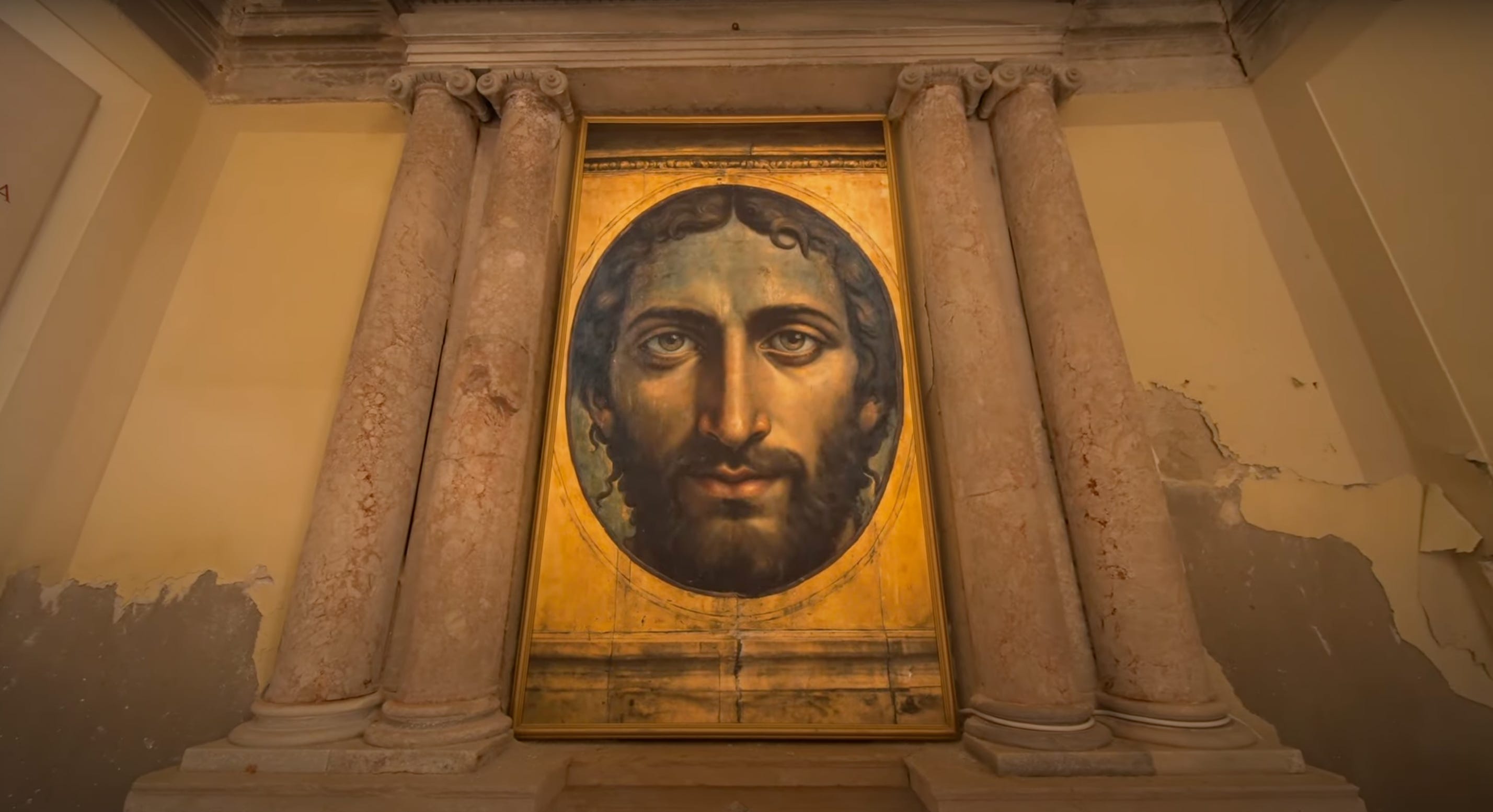
Presented by BrightMoments in Venice in 2024, the artists Huemin and Ganbrood have taken it further with the Dream Cathedral. They placed a screen at the centre of a church and using them as if it was a modern altar. This brings digital art back to what Benjamin thought it had lost: a ritual role, a sense of the sacred. These are not just more images to be briefly consumed, but works that can be contemplated and even worshipped.
If Walter Benjamin warned of the loss of aura, Guy Debord and the Situationist movement proposed a way to reintroduce it—not through preservation, but through action.
In a world of passive spectatorship and when behavioral change is commanded by our Planet, we need to construct situations: purposely shaping what is around us to make it meaningful, impactful, and even transformative. This idea applies directly to how we exhibit digital art today. It’s not enough to simply display artworks on screens; we must build situations that turn passive viewing into embodied, participatory experiences, and even trigger actions, preferably climate actions in our case. Of course, there is nothing new here as visitor participation and interaction have been experienced for more than a few decades in contemporary art or in museum exhibitions, but 1/ this is still not a standard in the digital art sector while lines of screens are still the preferred exhibition option, 2/ participation is often superficial and doesn't make a real-life impact.
This change is necessary to take digital art beyond the category of fast consumption. If we are to move digital art out of the realm of the spectacular and into that of the present, we will have to design slow spaces that encourage engagement and even a sense of ceremony.
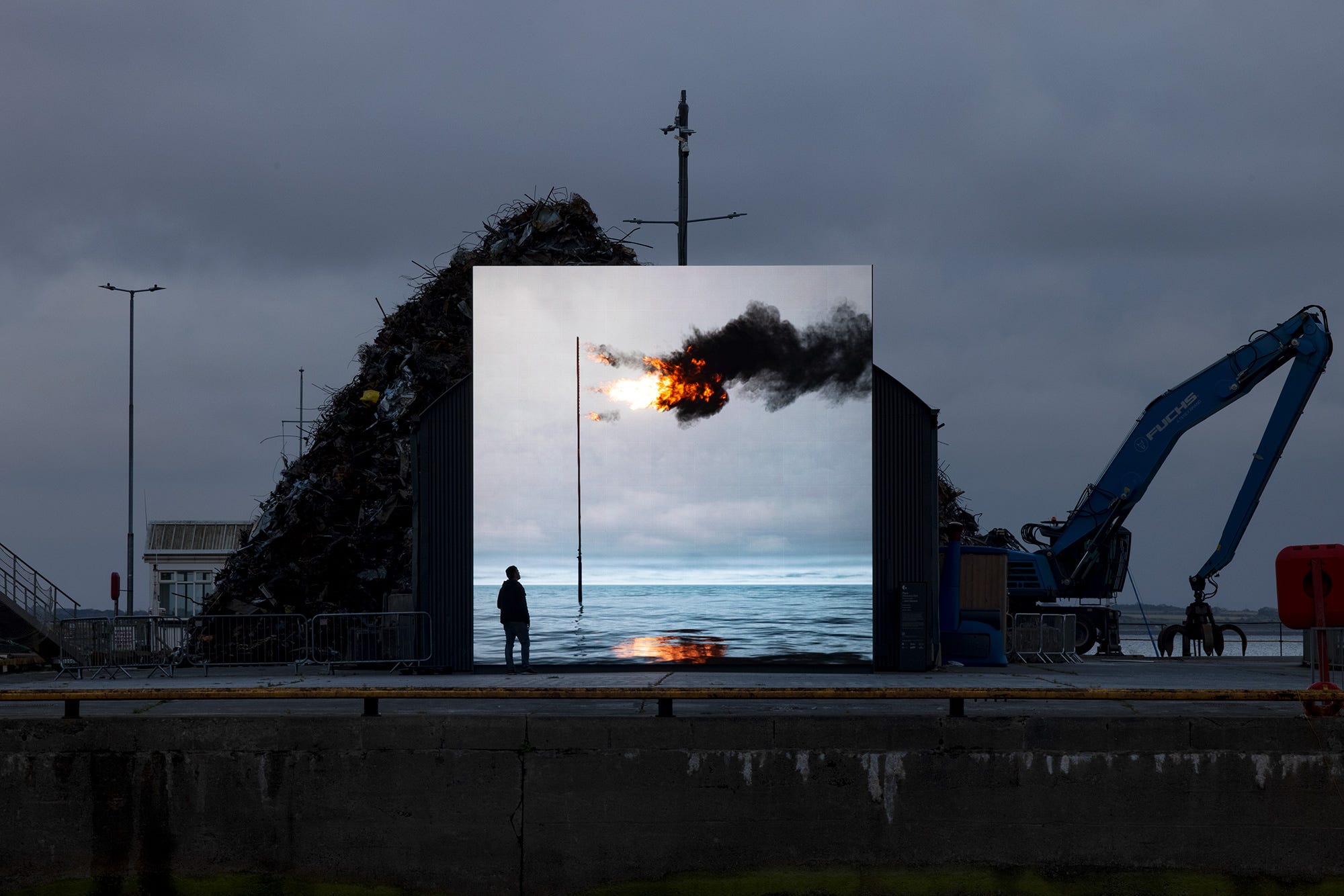
While writing this, images of exhibitions by Kelly Richardson, Pierre Huyghe, Gregory Chatonsky, John Gerrard or Laurent Grasso appear in my head. Each time, a sense of physical immersion, with less rather than more, and one unique and strong message, are resonating.
Walter Benjamin distinguished between cult value—art as a sacred object, which is surrounded by mystery, and exhibition value—art meant to be seen by the masses and are political because of their visibility. Digital art, being digital, is everywhere at once, and it seems to belong entirely to the exhibition value. But what if it could have both?
NFTs, in a way, tried to bring back cult value through making digital art scarce again. However, the emphasis on artificial scarcity in their approach is still problematic; it seemed too often, even if not always, more market-driven than artistically motivated. The real issue isn’t really about making digital art ‘ownable,’ but rather, to make it so that it feels like it’s rare when you encounter it in person, and its presence shifts the space around it.
But what if we thought about impact value in addition to cult and exhibition value? Digital art, especially if it is shown in real-life settings, is not only there to be seen, but to shift perspectives, to elicit emotions, and, in the best case, to incite action. Some shows today link digital art to ecological activism, donating the proceeds to reforestation, creating immersive installations that use climate data to paint a picture, or even using regenerative materials in their construction.
Could this be the next evolution of art’s aura? Not just the uniqueness of an object, nor just its mass visibility, but its capacity to create real-world change?
Walter Benjamin thought the decline of aura was inevitable. But perhaps it was never lost, and we have just been waiting to rediscover it in different shapes. The power of digital art is not in its ability to be infinite replicated. It’s in the spaces we build around it, in slowing down and paying attention to it, in the way it demands not just that we see, but that we feel, that we experience, and that we are changed. And all of that at a global scale!
So how do we exhibit digital art today? How do we turn screens from distractions into portals? How do we create new rituals for the digital age—rituals that bring us closer, spatially and humanly, to the art itself?
It might be that the answer isn’t to try to bring back the aura of the past, but rather to foster a different kind of presence, one that is fluid, immersive, tangible and global.
“Machina Fauna - Exploring Post-Natural Wild” will be presented at Galerie Data (Paris, France) from 27 February to 15 March.
“Down the Silicon Meadow”, the exhibition co-curated with OFFICE IMPART (Berlin, Germany) is still accessible online via Common Garden.
No posts
Comments
Nothing yet. Say the first thing.
Sign in to join the conversation.