
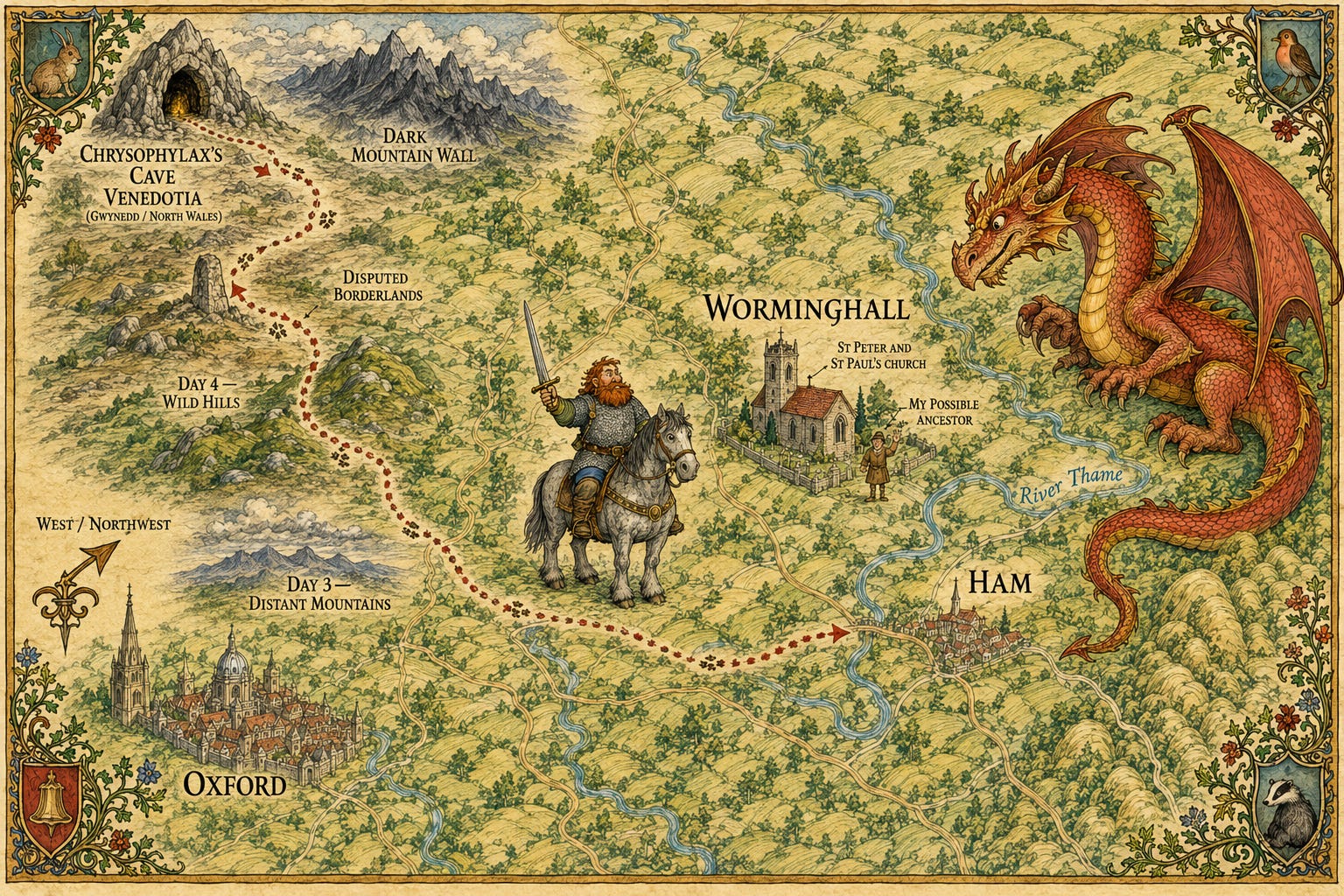
Farmer Giles of Ham is set in the fictional medieval “Little Kingdom.” The geography is based on the Thames Valley and countryside east of Oxford. In Tolkien’s earliest version, Giles adopts the surname Worming, and his village of Ham is renamed Worminghall. By a strange coincidence, I have an ancestor who came from that very village estate region of Worminghall, a dozen generations or so ago. This does not make Farmer Giles a family story, but it makes Tolkien’s imaginary landscape feel strangely close to home. I do not have any relation to any name Tolkien used in the story, other than Worminghall, but the minute I picked up the story, I immediately noticed the name of the fictional village.
In the revised, published version, Ham corresponds more closely to Thame, while Worminghall becomes a hall or estate built by the men who helped Giles bring the dragon home. Giles eventually becomes “Lord of Tame” and “Count of Worminghall.” The name is a philological joke, Tolkien connects Worminghall with worm, the Old English word, for dragon; giving his real world location, a legendary origin. The “Count of Worminghall,” is a made-up title, Tolkien invented it for Farmer Giles. It is part of the story’s mock-medieval grandeur and imaginary explanation of the name Worminghall. England normally used earl, rather than count.
Before 1066, the manor belonged to the estates of Queen Edith. After the Norman Conquest, it was held by Geoffrey de Montbray, Bishop of Coutances. It later passed through the Honour of Gloucester and families associated with the Earls of Gloucester and Stafford. In 1315, John de la Rivere, lord of the manor, obtained permission for a weekly market and an annual fair. In 1827, the estate was purchased by Henry, Lord Clifden and Baron Mendip, later descending through the Viscounts Clifden. I have no relation to any of them. However, there is a local family, from which I do have one English ancestor, who comes from that very location of Worminghall, that Tolkien mentions in his story.
According to the family story, we have a great-grandmother who is a Chadbone of Worminghall, who is somehow a niece or second-cousin ( I am not sure ) of a Sergeant Chadbone from WW1. All from the region of St. Peter and St. Paul local church. Apparently, according to Geni.com, about 97% of Chadbones come from the region, so it may be almost impossible to location exact relatives who are now so distant it just does not matter. Inside Worminghall’s parish church, Sergeant Herbert Chadbone, a possible relation is therefore, commemorated among the village’s seven First World War dead. He died of wounds in Mesopotamia on 22 November 1915, probably during the Battle of Ctesiphon.
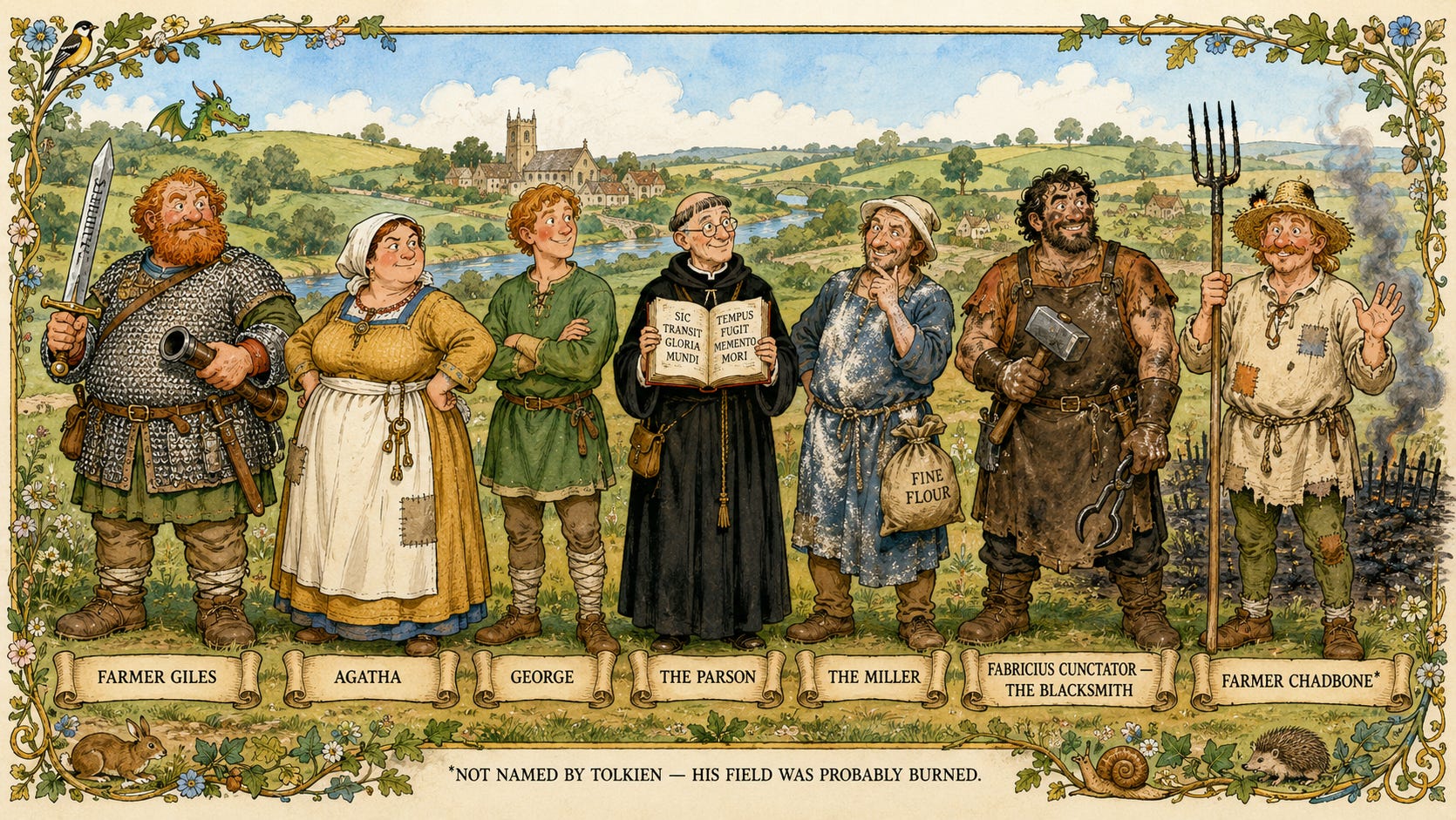
In the story by Tolkien, Giles rides out searching for Chrysophylax, Tolkien says that he crosses “other farmers’ deserted fields.” These neighbouring farmers had evidently abandoned their land because of the dragon, but none is named or developed as a character. The only characters mentioned in the story are Giles’s wife Agatha and son George, the parson, miller and blacksmith as its other notable inhabitants. I like to think that if Tolkien’s fictional world was real, I might have an extremely distant dark age British ancestor by the name of Farmer Chadbone, or something similar.
I am grateful to the Tolkien Estate for making available Wayne G. Hammond and Christina Scull’s account of the story’s development, particularly its explanation of how Giles first became Worming, how Ham became Worminghall, and how Tolkien rearranged those names in the published version. For the avoidance of doubt, I understand perfectly well that the Little Kingdom, the Count of Worminghall and Farmer Chadbone are fictional, the last being entirely my own joke, and that having a real Chadbone ancestor from Worminghall does not place my family inside Tolkien’s story. Nevertheless, that accidental meeting of documented family geography and invented literary geography is what makes the tale feel personal to me: because Tolkien demonstrated how readily legend can grow from a real and beloved landscape.
No posts
Comments
Nothing yet. Say the first thing.
Sign in to join the conversation.