
Progressives are “right” accidentally: But Not in the Way They Think
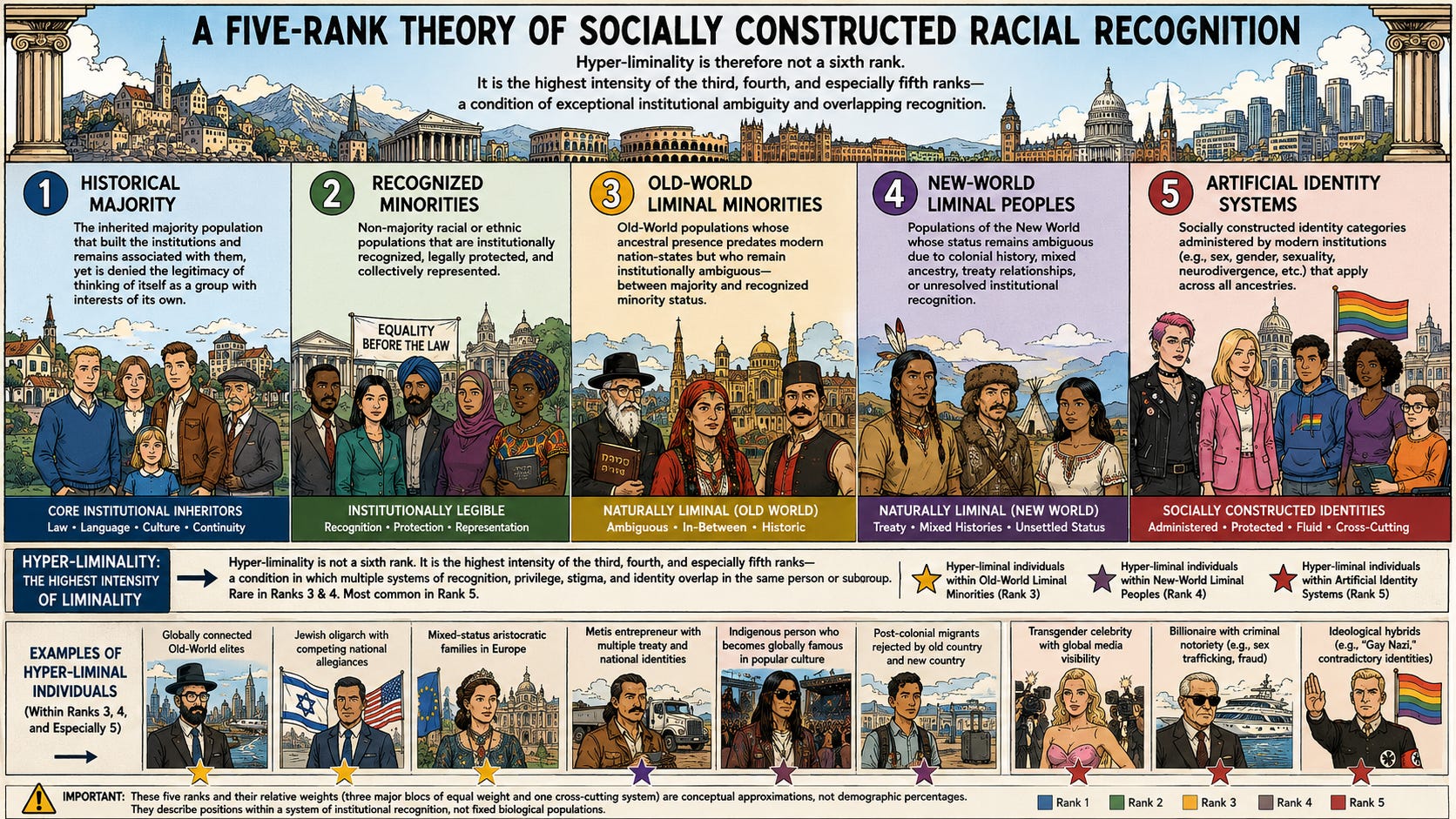
( *The author of this Substack Article might be taken as an example of a “hyper-liminal category,” though not a Jew. )
The Five Questions
Who is the institutional reference population against which this group is measured?
Does this group possess stable institutional recognition, protection, or representation?
What is this group’s historical relationship to the institutions that govern society (founding, incorporated, or later recognized)?
Is this group’s institutional position stable, or does it shift between categories depending on circumstance (liminality)?
Is this identity primarily inherited through historical continuity, or primarily created and maintained through modern administrative, legal, political, or cultural institutions?
Race is biologically real. Human populations are not interchangeable abstractions, and ancestry did not disappear merely because modern institutions found it morally inconvenient. Nevertheless, the social constructionists are also right about something important, although not in the way that they usually imagine. Modern society does functionally engage in constructing races, through legal, political and social engineering. Ben Shapiro, once did a segment on his show, in which he sardonically asked and answered, that while America or progressive values in America, does have a “racial hierarchy” of some kind, it is impossible to know who is “on top” and who is “on the bottom.”
One moment it may be “women” as a collective who are seen as morally virtuous and superior, worthy of recognition, privilege, “rights” and accomodation; at another moment it may be homosexuals, at another moment it may be Transexuals and crossdressers, at another moment it may be Blacks and their anti-racist industries, at another moment it may be American Indians, and their historical agreements and grievances; at another moment it may be recent immigrants with high ethnocentric assertiveness trying to dig up their own narrative about the British empire, at another moment it may be Jews plagued by Neo-Nazis denying their Holocaust. No matter, who is “on top” and who is “on the bottom” I think modern institutions, absolutely have “created” a sort of hierarchy which I would sort out by importance to their moral narrative, size and origin.
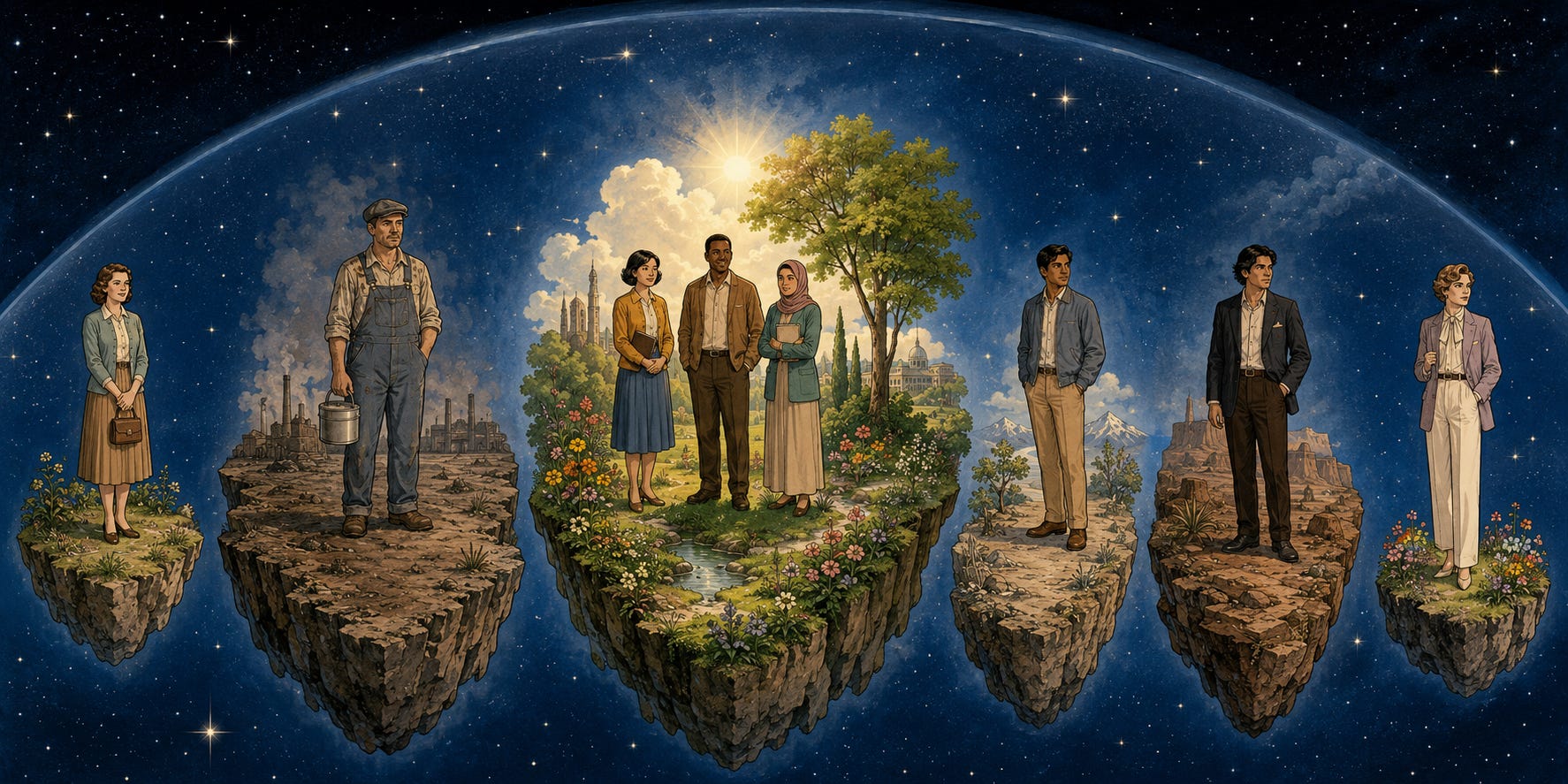
It is not creating biological populations out of language. It is producing a second racial order on top of the biological one: a system of legal, bureaucratic and social classifications that determines which identities will be protected, which will be blamed, which will be celebrated, and which will remain ambiguously suspended between the recognized categories. This is the peculiar accomplishment of modern legalistic, bureaucratic, competitive, urbanized left-capitalism. It has not abolished race. It has reorganized racial consciousness around institutional recognition. The resulting “social races” do not correspond perfectly to biological races. They are defined instead by a population’s relationship to the institutions that distribute moral recognition, representation, protection and blame. Biological ancestry remains real beneath this order, but the social meaning attached to ancestry is increasingly determined by bureaucracies, universities, corporations, media institutions and legal categories. My argument is that this system has produced, or is now producing, at least four principal social races, accompanied by two additional categories that function in a partly similar fashion. I like the analogy of continental drifts, and I would apply them to these “social races” as an attempt to more clearly answer the question of Ben Shapiro.
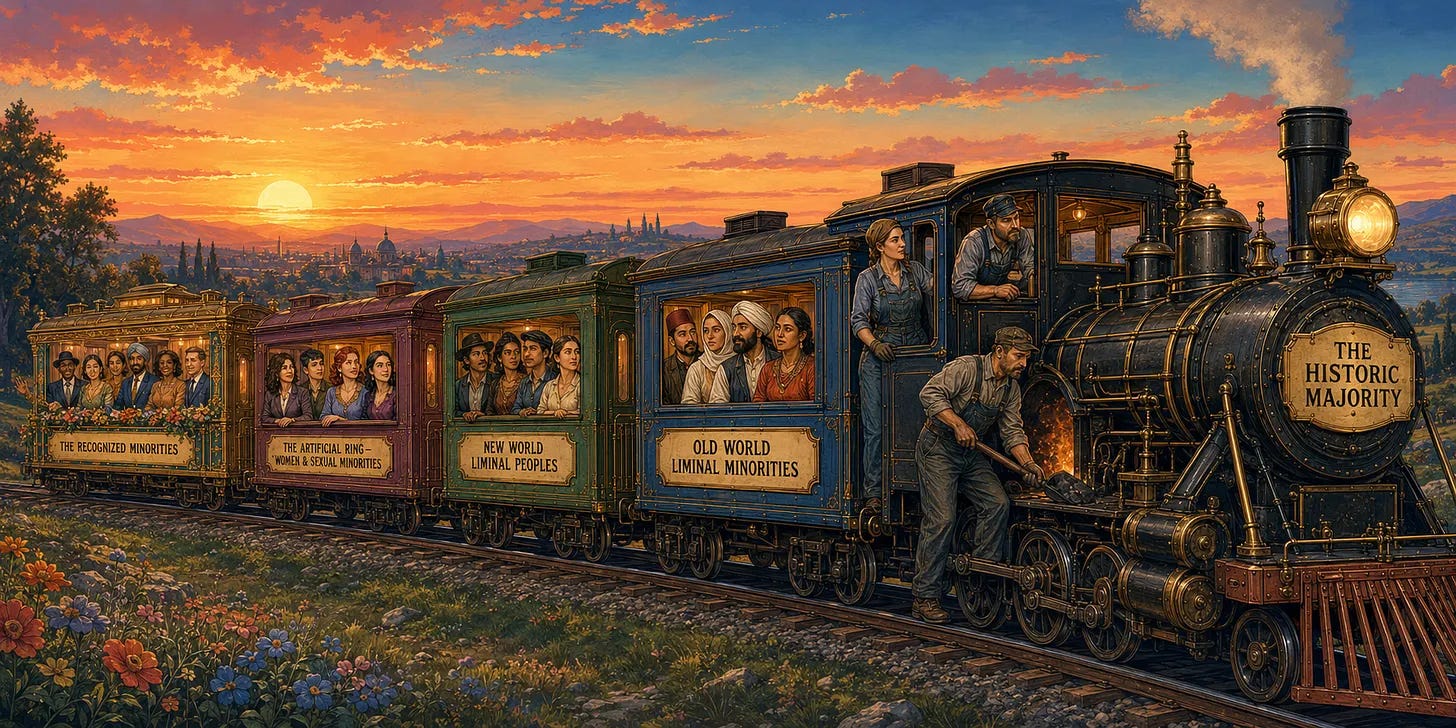
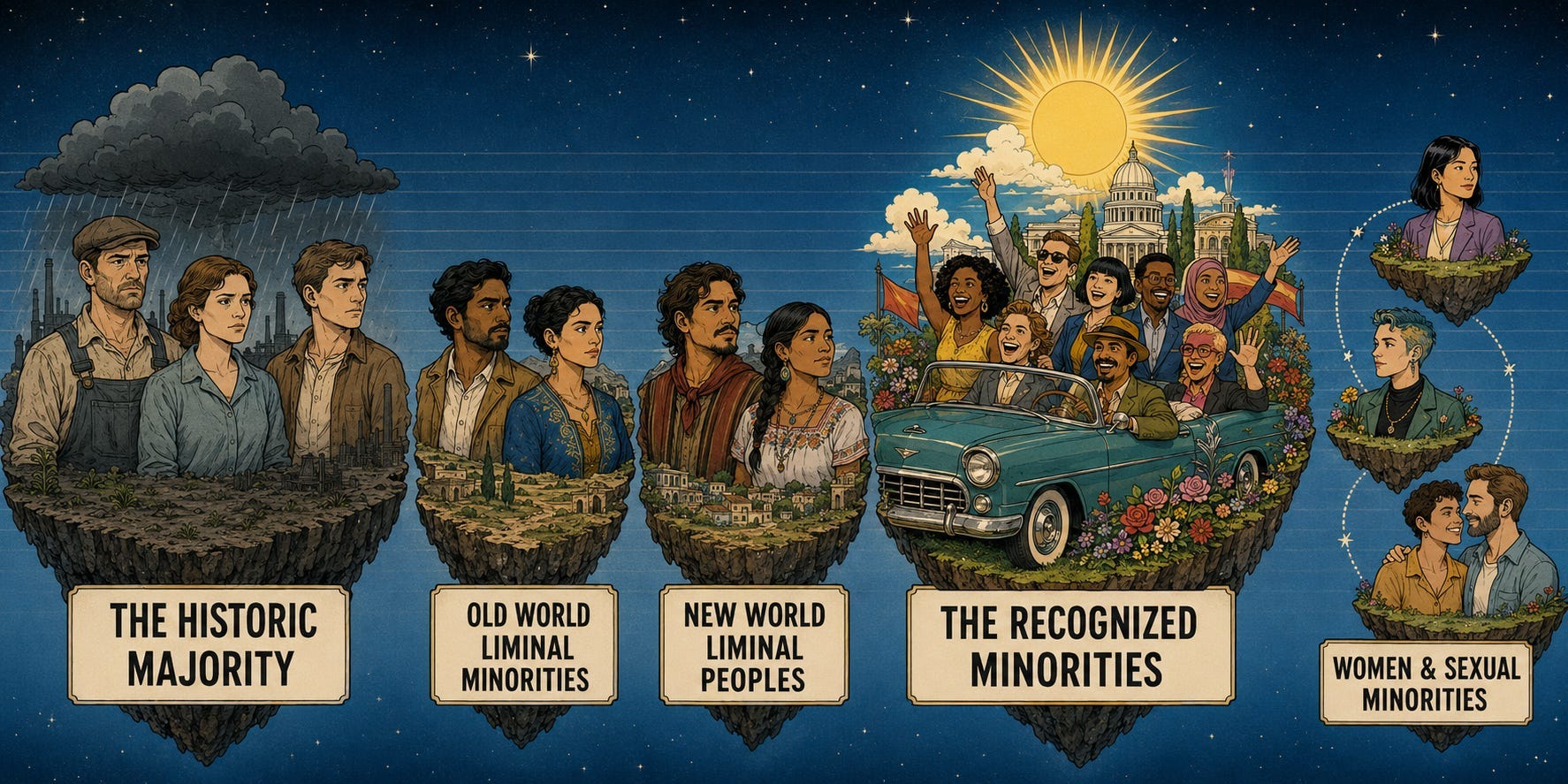
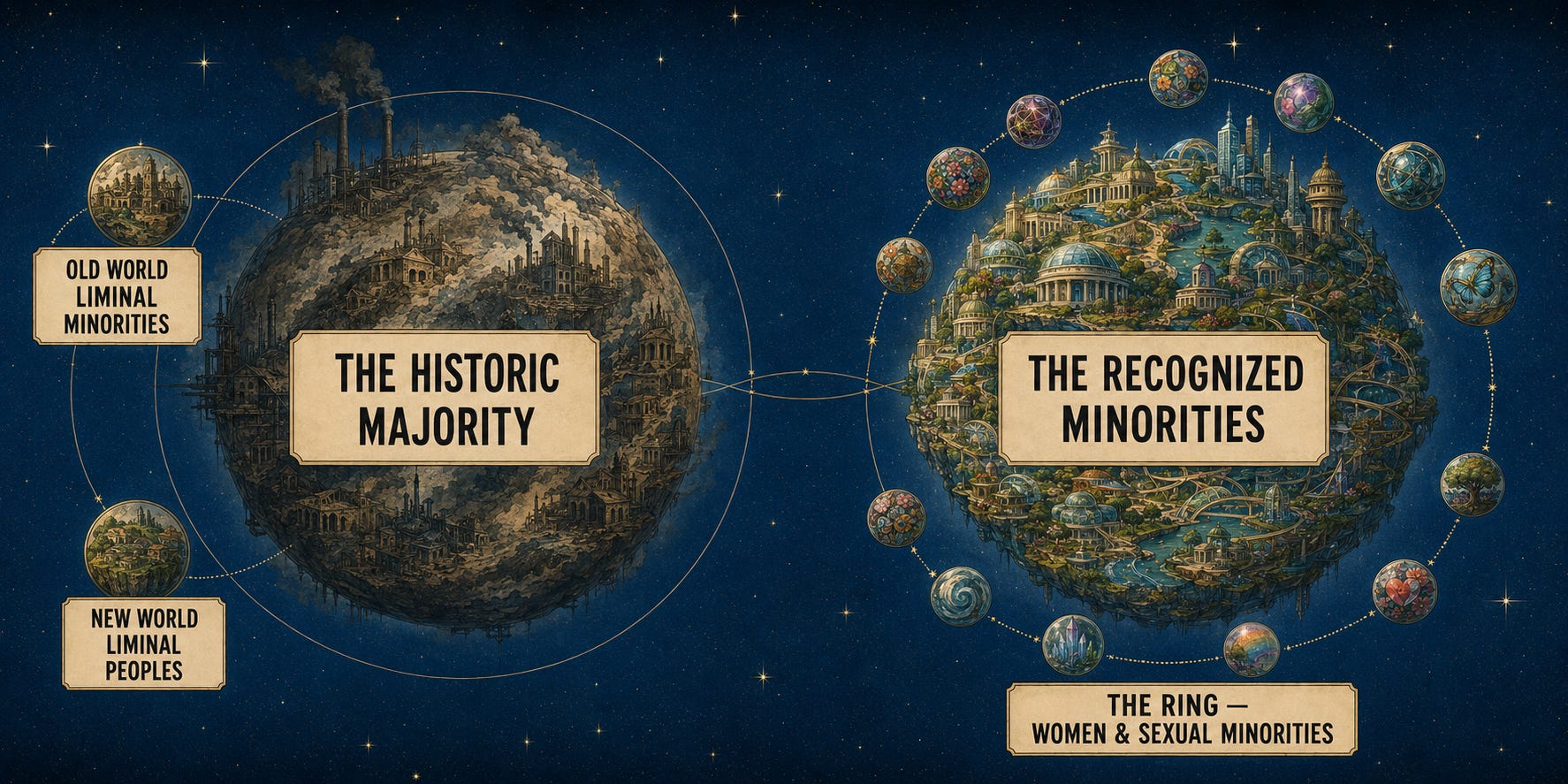
My theory holds: modern multiracial Left-Capitalism, has two major continents, forms two smaller ones, and creates a bunch of artificial island chains between them all. My title refers to five social races, but these require clarification. The first four are the Historic Majority, the Recognized Minorities, the Old World Liminal Minorities and the New World Liminal Peoples. The fifth is an auxiliary category consisting of “identities,” most obviously sexual-identity categories, and political subcultures that wield them. Institutions increasingly process through the same machinery of collective recognition, representation and protection. “Hyper-liminality,” which I will describe below, is not a sixth race. It is an intensified condition that can appear within several of the categories. These categories should not be understood as permanent boxes into which every member of a biological population must be placed. They are positions within a system of recognition. The same ancestry may occupy different positions depending upon legal status, class, institutional setting, public presentation and historical circumstances. My map rather describes recurrent social positions rather than five new biological populations.
The First Social Race: The Historic Majority
The first category is the historic Anglo-American or European-descended majority. This population remains associated with the inherited institutions of the country, but it is increasingly denied the legitimacy of thinking of itself as an ethnic group with interests of its own. They start out with a mostly Anglo-Celtic base population, and a preceding much more assertive Anglo-Saxon cultural unity, often Anglo-Protestant in its legalism and formalism. It assimilated quite healthily, many and most Germanics, Finns, Western Slavs like Poles, and even near-Latins such as the French, the Spanish, the Italians etc. For the most part, this majority is the most tolerant, the most race blind. Even Richard Nixon, could present his clearly “White” Cuban-American friend, Charles “Bebe” Rebozo, as part of the “historic majority.”
Its members are treated as culturally ordinary and institutionally powerful, yet morally suspect; the average “White” has very little power, and yet are held liable for any powerful or glorious thing ever done in the Ancient past; they are held to morally account. They are expected to accommodate other identities while suppressing their own ethnocentric instincts. Their inherited habits and institutions remain and are considered useful by the state, but the people who created them are increasingly required to regard those inheritances as morally compromised. Even their very appearance and identity and historical accomplishments are trivialized wherever possible.
This does not mean that every White person is powerless, persecuted or virtuous. It means that “Whiteness” has become an administrative category carrying a specific moral function: it is the identity against which protection, inclusion and diversity are measured. Under this arrangement, Whites can retain individual wealth or authority while becoming collectively muted; hence why many acceptable forms of protest take the forms of apparent libertarianism or blanket capitalism defense. Why? Because these are the only spaces where this group will not be subjected to a historical racial blood libel. Meanwhile, “they” are encouraged to interpret their own group preferences as prejudice while interpreting the corresponding preferences of other groups as identity, solidarity or cultural preservation.
The Second Social Race: The Recognized Minorities
The second category consists of the officially intelligible minorities: populations whose identities possess established places within the moral vocabulary of multiculturalism; these would be your American Blacks, Somalis, Nigerians, Asian-Americans in some cases when not folded in to the White majority for reasons of social-economic envy, American Indians for historical legalistic reasons, and any more assertive and clearly defined Old world-non White identity that has decided they would prefer to claim to be “non-white” as opposed to “being White” for the sake of access and moral approval.
Their claims can be readily translated into the institutional languages of discrimination, representation, inclusion and historical injury. This does not mean that every member receives material advantages or necessarily lives an easy life. It means that the identity itself is legible, and their assertive moralistic life-story is much less likely to be contradicted; it means they are considered the moral default, just as “the Whites” are the immoral default.
The institutions understand what the group is, how its grievances should be described and what forms of recognition should be extended to it. These identities therefore possess something more important than simple social approval: they possess institutional definition, they are permitted to be assertive, permitted to have feelings, without supplying a thousand footnotes and scientific articles like a Jared Taylor type has too. The fundamental division within official multiculturalism is consequently not between majority and minority alone. It is between recognized and unrecognized identities. Some minorities have an established position within the system; others remain uncertain whether they are insiders, outsiders, oppressors, victims or merely inconvenient exceptions.
The Two Hidden Social Races
This leaves two growing populations that the familiar majority-versus-minority model does not adequately explain. If the historic majority and the officially recognized minorities are the Old World and New World of the modern “social racial map,” the immense territories everyone already knows, then these ambiguous populations are our Australia and Antarctica. They are less visible within the prevailing map, but their position may make them more, rather than less, racially conscious. These are the two hidden social races.
By liminal, I mean neither simply “oppressed” nor simply mixed. I mean uncertainly situated at the threshold between accepted categories. A group may be socially accepted without possessing legal recognition; legally recognized without being socially accepted; protected in one institutional setting but treated as suspect in another. It may be permitted to identify as a minority for one purpose and abruptly assimilated into the majority when blame, eligibility or representation is being distributed. Liminality therefore has at least three dimensions: legal recognition, social acceptance and institutional legibility. A population becomes especially liminal when these three dimensions point in different directions. The more frequently its classification changes with the audience or circumstance, the more intensely liminal its position becomes.
The Third Social Race: Old World Liminal Minorities
The first hidden category consists of culturally distinct Old World populations whose position within “Whiteness” or “non-Whiteness” remains unstable. Greeks, Serbs, Croatians, Armenians, Turks, Lebanese people, Jews, Arabs, South Asians and members of comparable communities cannot all be treated as culturally or biologically identical. My point is precisely that they are not identical. What they may share is an ambiguous relationship to the official racial order. They may retain strong ethnic loyalties, inherited grievances and habits of comparison while receiving neither the presumed security of the historic majority nor the consistent moral recognition granted to officially protected minorities. They may be classified as White in one dispute, non-White in another and simply ignored in a third.
Romanians, Albanians, Serbs and other Balkan populations illustrate the difficulty. Many individuals are ordinarily perceived as European or White, yet retain a pronounced Old World ethnic consciousness and may not experience themselves as interchangeable with the assimilated Anglo-American majority. They can be incorporated into “Whiteness” whenever institutions want to treat them as members of the majority, while discovering that their particular history carries little independent moral or political recognition. Their liminality does not arise from phenotype alone. It arises from the mismatch between outward incorporation, internal group consciousness and limited institutional recognition.
South Asians show why no entire population can be classified automatically. Sikhs, Hindus, Muslims, Christians, Anglo-Indians and secular South Asians may occupy quite different institutional positions. A visibly recognized minority with established organizations may belong largely to the Recognized Minority category. Another person may discover that the institution recognizes him as non-White but grants his particular community comparatively little symbolic attention. What matters is not simply whether someone is a minority, but whether his identity supplies a stable and publicly credible explanation of his social position.
There is little advantage in being told that one is “White” when blame is being distributed, only to become foreign, ethnic or insufficiently White when belonging and acceptance are at issue. Once South Asians fought whole legal cases, desperately demanding to be regarded as “White.” Now, they openly sneer at “Whiteness” as the Pakistani MP did in Scotland recently, because “Whiteness” confirs no legal or institutional advantage; quite the reverse. Thus the South Asians as a majority enter into The Recognized Minority, socially constructed race.
These differences produce what I also would label as, The self-perceived unprotected minority: a population that considers itself distinct enough to experience competition, envy and exclusion but insufficiently recognized to translate those experiences into the approved language of public grievance, and thereby compete for privilege and moralizing rights in the public sphere. Such groups may consequently become especially conscious of rank, achievement and comparative status. They can preserve intense ethnocentric loyalties while learning to present themselves through whichever institutional vocabulary is useful in a given setting.
It is a predictable adaptation to an order in which identities receive radically unequal degrees of recognition. In some cases Jews, may very well fall into this category, or even a special category, or even “the White” category in other cases; but typically if someone has a race consciousness, is liminal and “old world” completely in origin, and is typically permitted and allowed to be racially agggressive or racially duplicitious without penalization, I would put such a group in my “self-perceived unprotected minority” category. Jews, and may other odd groups, might well fall into a kind of “Hyper-Liminal category.” A hyper-liminal population or individual is highly visible, legally protected or institutionally connected, but also persistently challenged, scrutinized or resented. Such a person may possess unusual access in one sphere while remaining vulnerable to exclusion in another. He is neither simply inside nor outside the system: his contested position may itself become a source of both power and insecurity. A Trotsky type might be hyper-liminal when speaking to a James Burnham, a Stalin type might just be normal-liminal when speaking to his Russian wife.
We might add a final category, which functions as a blending of the Liminal categories and that of the artificial minorities; this category consists not of another ancestry or historical people, but of what might be called Global Artificial or Hyper-Liminal Identities. Unlike the previous categories, these are assembled through combinations of wealth, institutional status, sexuality, profession, ideology, technology, celebrity, criminality, or deliberately cultivated public identity. They often occupy multiple recognition systems simultaneously, making them more liminal than ordinary protected categories.
Hyper-liminality is therefore not a sixth rank. It is the highest intensity of the third, fourth, and especially fifth ranks, a condition in which institutional recognition becomes exceptionally layered, unstable, and socially conspicuous.
A billionaire sex offender, an internationally famous influencer whose identity is inseparable from online performance, a transgender celebrity, an internationally mobile oligarch, a person whose appearance has been extensively altered through cosmetic surgery, or an individual whose ideological identity radically contradicts another protected identity may all become difficult to classify within ordinary institutional categories. Their significance lies less in ancestry than in their exceptional relationship to recognition itself. They become socially legible precisely because they combine otherwise incompatible classifications. In this sense they are not merely liminal but hyper-liminal: individuals whose social position is defined by continual movement across multiple symbolic boundaries rather than by membership in a single stable population.
Hyper-Liminality: The Highest Degree of Liminality
The five categories described here are intended to be exhaustive at the level of this conceptual model. Hyper-liminality is not proposed as a sixth social race. Rather, it is an intensified condition that may emerge within the two liminal categories and, most commonly, within the fifth category of artificial identity systems. It represents the highest degree of institutional ambiguity, where multiple systems of recognition overlap within a single individual or subgroup.
Where ordinary liminal populations exist between established social classifications, hyper-liminal individuals occupy several symbolic worlds simultaneously. They may be privileged in one institutional setting, stigmatized in another, celebrated in one public narrative, and condemned in the next. Their social position is not defined primarily by ancestry, but by the accumulation of overlapping identities, exceptional circumstances, public notoriety, institutional patronage, celebrity, wealth, sexuality, ideology, or other socially constructed markers of recognition.
For this reason, hyper-liminality should be understood as the extreme edge of liminality itself, rather than a separate category. It functions much like the most unstable tectonic zones at the boundaries between continents: rare, highly visible, and often disproportionately influential relative to their size. Some Old World liminal populations may occasionally produce hyper-liminal individuals; some New World liminal populations may do likewise. However, the phenomenon is most commonly associated with the modern artificial identity system, where legal, bureaucratic, medical, sexual, ideological, and cultural classifications increasingly overlap.
The Fourth Social Race: New World Liminal Peoples
The second hidden category consists of New World populations that emerged through mixture, migration, conquest, regional isolation and incomplete assimilation. These may include Cajuns, Acadians, Melungeons, culturally distinct Southern populations, people of mixed European and Indigenous descent living inside or outside legally recognized tribes, and other regional peoples who possess a real historical identity without occupying a stable place in the official racial system. They are not always accepted as members of the historic majority, but neither are they consistently treated as protected minorities. If institutions extend recognition or benefits to them, others may regard those advantages as fraudulent. If institutions withhold recognition, their distinct histories disappear into an “undifferentiated category of Whiteness.”
They can therefore attract resentment under either arrangement. This population is “off-White” in the sociological rather than biological sense: close enough to the majority to inherit its collective blame, but too culturally, genealogically or historically marginal to enjoy an uncomplicated sense of majority possession. Like the Old World liminal minorities, these New World populations may develop an aggravated racial consciousness precisely because the system cannot decide what they are; should they privileged, for being “wronged by history” or should they be condemned for being the biologically mixed-race or displaced remnants of past empires? Thus, modern multi-racialism, as much as they might be trying to condemn, penalize and slowly exterminate “Whiteness” are faced with a new problem, when it comes to people of only partial Black or Amerindian ancestry, who might nevertheless preserve “White traits” and ancient histories, very much tied to deep Old World European cultural habits. Their ambiguity is not an escape from racial classification; ambiguity becomes their classification.
The decisive variable among these populations is often documentary and legal recognition. Two people may possess comparable mixed ancestry while occupying radically different social positions because one belongs to a constitutionally or federally recognized people and the other belongs to an unrecognized heritage association. Recognition supplies more than benefits: it supplies an authoritative institutional answer to the question, “What is this group?” Without that answer, ancestry, community continuity, collective memory and self-identification can all be disputed.
Eastern Canadian organizations claiming a Métis identity provide one example of the controversy. Some identify communities outside the historically recognized Métis Nation, while established Métis governments and First Nations logically dispute and object to the notion that such organizations represent distinct “rights-bearing Indigenous peoples.” The theoretically important point is not to decide every genealogy from a distance. It is that self-identification, community acceptance and government recognition can produce three different answers. That disagreement is almost a perfect instance of New World liminality; too White to matter, without legal definition, possibly mixed genuinely in some cases, in others completely fraudulent. This is what I mean by liminality. A fraudulent group can be liminal, but so can a genuine inherited biological political community if it is unrepresented and undefined.
The Lumbee provide an especially revealing example of movement between categories. For many years they possessed North Carolina recognition and limited federal treatment without full federal recognition. That changed in December 2025, and in January 2026 the United States formally added the Lumbee Tribe to its list of federally recognized tribes. Their position therefore demonstrates that a population can move from prolonged legal ambiguity into formal institutional legibility, even while historical and intertribal disputes do not disappear immediately. U.S. Bureau of Indian Affairs. It is for this reason that I would regard the Lumbee as a liminal socially constructed people-group. They are not widely known and regarded as one of the classic elect diverse enrichments, The Recognized Minorities, which Liberal Progressive bureaucracy, will acknowledge and privilege. And yet, they do form a very Ancient “diversity” in North Carolina, and are locally known, despised or not. Too White and too Black, to count legally; too White to be worshiped, but also too Black and too Amerindian, to be accepted either by the “White” Founding Fathers of the United States, or by contemporary liberal blessings.
Two Additional Race-Like Categories: The 5th “Social Race” or the 5th “Socially Constructed Race”
Women and sexual minorities are not biological races, and I do not propose pretending otherwise. Nevertheless, modern institutions increasingly administer them through machinery originally justified in racial terms. They receive representation targets, collective narratives, protected status, advocacy institutions and publicly recognized accounts of structural disadvantage. In this limited institutional sense, they operate as minor or auxiliary social races: categories whose members are treated as participants in a continuing historical relationship between collective injury and collective protection. The inclusion of these categories demonstrates how far the modern meaning of “race” has moved beyond ancestry. The administrative system increasingly groups together race, sex and sexuality because its actual concern is not biological taxonomy. Its concern is the organization of recognition. This is what I mean by “social races” here; by including them, I am suggesting that women and “sexual minorities” function more like a “privileged island chain” running between the “favored continent” of the diverse enrichment, and the “disfavored continent” of White Anglo-Western Heritage.
These auxiliary categories are liminal in a different sense. Unlike ancestry, some identity labels can change during a person’s life, and the boundaries between identity, conduct, medical status, personal presentation and legal category remain contested. Institutions may nevertheless treat these categories as administratively definite for purposes of accommodation and representation. This creates a peculiar combination: strong formal recognition alongside continuing social, familial or conceptual disagreement.
I call these categories an “island chain” because they intersect the larger continents without mapping neatly onto them. A White woman, a Black gay man and a transgender person of mixed ancestry do not cease to occupy racial categories; instead, an additional protected classification is layered over their existing position. The model is therefore intersectional in a literal administrative sense, although I disagree with many of the moral conclusions ordinarily drawn from intersectionality. It may well be more useful to see them as their own liminal island chain, or even their own Socially Constructed Racial Planet.
Race After Multiculturalism
The social constructionists are therefore partly correct. Institutions do construct racial categories, but they do not thereby render biological ancestry unreal. They construct a political and administrative order around populations that already possess different histories, appearances, cultures and degrees of cohesion. The mistake is to imagine that this constructed order simply divides society into a “privileged White majority” and “oppressed non-White minorities.” In reality, institutional multiculturalism produces an uneven hierarchy of recognition; at least, that is my theory, and personal experience.
“Whites” are blamed, and heavily denied, penalized and shamed at many levels of educational and public propaganda narratives against having any assertive aggressive identity and interests the way other groups are; White Anglo-Saxons are especially demonized, despite in many cases being the descendents who arguably “won the war” for the Western allies post-1945. Meanwhile, The protected visible often-darker skinned “enriching” continent is celebrated, their past histories embellished or flat out lied about and flattered; their every aggression protected. This can be true regardless of their biological category, some may be African, some may be Asian, some may even be “White,” what matters is that they are in the administrative category considered “the good.”
“Others” remain suspended between categories, recognized only when convenient and ignored when recognition would complicate the prevailing narrative; these are the more ambiguous people-groups, sometimes trotted out when useful, sometimes favored, sometimes heavily disfavored if they go against the grain. Someone like a Nick Fuentes, for example, had the potential to be heavily favored as a Hispanic, but ( and this is my personal suspicion ) he may have been visibly sneered at as “too White” in his teens, leading him to enter into a mental “fight back” mode. This, for many of us, is how race consciousness starts. It starts when we realize that there are indeed social administrative categories which heavily disfavor Whites, both in the public sphere and even humiliatingly, in many private spheres as well.
These ambiguous populations may become the most racially aggravated of all. The historic majority is pressured to mute its racial consciousness, while officially recognized minorities possess established channels through which collective grievances can be expressed. Liminal groups possess neither condition; they retain ethnic consciousness without secure recognition and experience competition without an accepted language in which to describe it. Modern “multiculturalism” has therefore not transcended ethnocentrism. It has created a market in which ethnic groups compete for institutional legibility.
That is the central irony. The effort to overcome race by classifying, protecting and representing populations has generated a new set of social races. These races are not substitutes for biological ancestry. They are institutional positions layered over it. The official map still shows only its Old World and New World: Evil, Hated, Envied and Sexually Coveted “Whites” vs, “the protected enriching delightful morally superior minorities.” But beyond them, two additional continents are becoming increasingly visible, the Old World liminal minority, which can include many groups we might consider “White” such as Russians, Greeks, Serbs, Bosnians, Romanians, and many we might consider Old World “off-White,” such as Jews, Iranians, Armenians, Turks, the Lebanese, Alawites, etc; alongside this we have Old World populations that we might considered biological “non-white” but which are not always worshiped in the diversity hierarchy, such as lower-class Arabs or lower-class South Asians.
Meanwhile, we also have another micro-continent, or “Social race” emerging, that of the New World liminal peoples, created by contact; this groups includes, the Métis, mestizo populations, Louisiana Creoles, Cajuns, Acadians, Melungeons, New Mexican Hispanos, Afro-Indigenous communities, mixed Indigenous descendants outside legally recognized tribes, and multiracial Latin American and Caribbean diasporas. Groups that can be hated by all sides, heavily favored or heavily disfavored at the same time, as opposed to being clearly favored or clearly disfavored, are precisely the conditions upon which “race conscious” grows.
Whites who are called “racist” frequently come from economic and social backgrounds, where they have been made “liminal” by other circumstances. The map of race is not disappearing. We have simply failed to notice that modern institutions are drawing a new one. My theory begins to break down when a description of group position is confused with an explanation of individual position. A criminal concealing a plan which hovers between legality and morals, a conservative employed in a predominantly liberal profession, or an atheist dissenting from his inherited religion may all experience forms of personal liminality. But these individuals do not thereby constitute additional social races. Their uncanny valley uncertainty arises from conduct, occupation or belief rather than from a durable, inherited relationship between a population and major institutions.
It is people on the fringes of acceptance and institutional legibility who I predict will be the most “aggravated” but aggravated in a “low-key” and sometimes incoherent way; an institutionally non-legible way. A Hispanic, a Lumbee, a Melungeon, or even a “lower class White trash” may both in one instance, at the same time in life, or at other points in life, have a self-perception, and indeed a real experience of liminality, which will construct a certain biological awareness over time, which more comfortable non-primitive civic race-blind Anglo-Saxon Christian liberals have lost. When looking at it this way, perhaps my explanation can provide at least one reason, why someone of good stalk, good genes, good socialization, Christian conditioning, who belongs to a perfect stable domestic life story, can be so easily victimized by the liminal and the institutional groups. Why? Because such a person has simply not been put into aggravating states of social development, and thus, does not align his or her self-worth with a biological group, outside of institutional recognition. In fact, she may not be aware of liminality, at all.
The distinction is one of scale. A social race exists when institutions repeatedly classify a recognizable population through law, administration, representation and public narrative. Individual liminality exists whenever a person stands between incompatible roles or systems of judgment. The two phenomena can overlap, but they are not identical. Otherwise, “liminal” would expand until it meant merely unusual, dishonest, alienated or unpopular, and the theory would cease to explain anything. A member of a Recognized Minority can be personally isolated and powerless; member of the Historic Majority can possess enormous institutional authority; and vice versa on both. The categories describe the public intelligibility of identities, not the happiness, morality, wealth or personal power of every individual member.
Conclusion
In order to answer the original Ben Shapiro question, I have created this four continent island chain model, in order to lay out why the “hierarchy” in the West is so confusing, and what despite that is painfully clear. “Whites” are of course “on the bottom” entirely, morally and legalistically, they are “The historic majority social race” and therefore inferior in the hierarchy, expected to work and suffer, without pity. Above them are “the Recognized minorities” or the “privileged because they were oppressed majority,” a kind of inversion whereby minorities are collectively put into a majority camp, and they are held up as morally and intellectually superior to the old majority. Between them, are two-micro continents; a class of nebulous “Old World” “off-Whites,” who are liminal by choice and advantage; and a class of historic hybridized “New World” identities, often Amerindian or similarly derived from Melungeon or Hispanic groups, which are treated as liminal often, not by choice.
Between them, modern society has created an even more confusing “island chain” inhabited by relatively socially privileged “women and sexual minorities” who despite their legalistic and bureaucratic privilege, may not always be mentally or socially desired. Artificial, because these islands, often function more, as a way for White women to “escape Whiteness,” ( “I am a lesbian.” ) or for “White males” to “escape” the ultimate penalty of “Whiteness.” As in, “I am a transgender, neurodivergent,” or some other magical category, which, while not biologically or normatively distinct under any useful social function, nevertheless, carries with it real world normative social privilege, under progressive capitalist multiracialism. This is the “racial hierarchy” or the “social construction” that most of us have experienced as Millennials since at least 2001, and has been the social order for Zoomers their entire lives. By this point in history, everyone who has observed social legibility, progressive ideological and social commandments, and the liberal legal order, understands implicitly, that “to be White” is default “bad, immoral, no advantage.” Everyone understands, that “enrichment, diversity” equals social recognition and license. But there are also, at least two historically created “liminal categories” that I define as New World and Old World, liminal types. Alongside these, we now have a 5th layer, or a completely artificial layer, which has to do with sex, sexuality, and neuro-divergent claims and issues. People do not need to be Nazis or read any political literature to understand this social order; any sharp Onlyfans girl understands it implicitly.
The Five Tests of Institutional Recognition
1. Reference Population
Against whom is this group normally measured?
Every institutional order possesses an implicit reference population. In the contemporary West, “Whiteness” frequently functions as the default comparative category against which privilege, discrimination, diversity, representation and historical responsibility are evaluated.
2. Institutional Legibility
Does the group possess a stable institutional identity?
Can governments, universities, media, courts and corporations readily classify the group through established narratives, legal protections, treaties, civil-rights legislation, diversity programs, or recognized representative organizations?
3. Historical Foundational Relationship
What is the group’s relationship to the institutions themselves?
Rather than “before capture,” you could say:
Historical Foundational Relationship
or
Relationship to the Founding Institutional Order
This asks whether the group largely founded, inherited, entered, or later became incorporated into the institutional framework now governing society.
4. Degree and Type of Liminality
Can the group’s ambiguous position itself become either an advantage or a disadvantage?
Some groups occupy stable categories.
Others move between categories depending upon the institution, audience, legal setting or political moment. The more variable this classification becomes, the more liminal the group.
5. Origin of Recognition
Is the group’s institutional position primarily inherited or administratively constructed?
This distinguishes:
historically continuous peoples
naturally evolved regional communities
legally recognized peoples
administratively constructed identity systems
Rather than ancestry alone.
Classification Rules
Rank I — Historical Majority
Reference population
Historically foundational
Institutionally ordinary
Low liminality
Rank II — Recognized Minorities
Institutionally legible
Stable legal recognition
Established public narrative
Rank III — Old-World Liminal Minorities
Historically continuous peoples
Institutionally ambiguous
Classification changes with context
Rank IV — New-World Liminal Peoples
Historically evolved regional peoples
Mixed or colonial historical origins
Recognition remains disputed or incomplete
Rank V — Artificial Identity Systems
Recognition derives primarily from modern administrative, legal, medical, political or cultural institutions rather than from ancestry or long historical continuity.
Often overlays all other categories.
Finally:
Hyper-liminality
Not a sixth rank. Rather, a condition in which multiple institutional recognition systems overlap within a person or subgroup, producing an exceptionally unstable or highly visible position. It most commonly appears within Ranks III, IV and especially V.
Comments
Nothing yet. Say the first thing.
Sign in to join the conversation.