
The Three Basic Life Paths: School, Prison or the Army
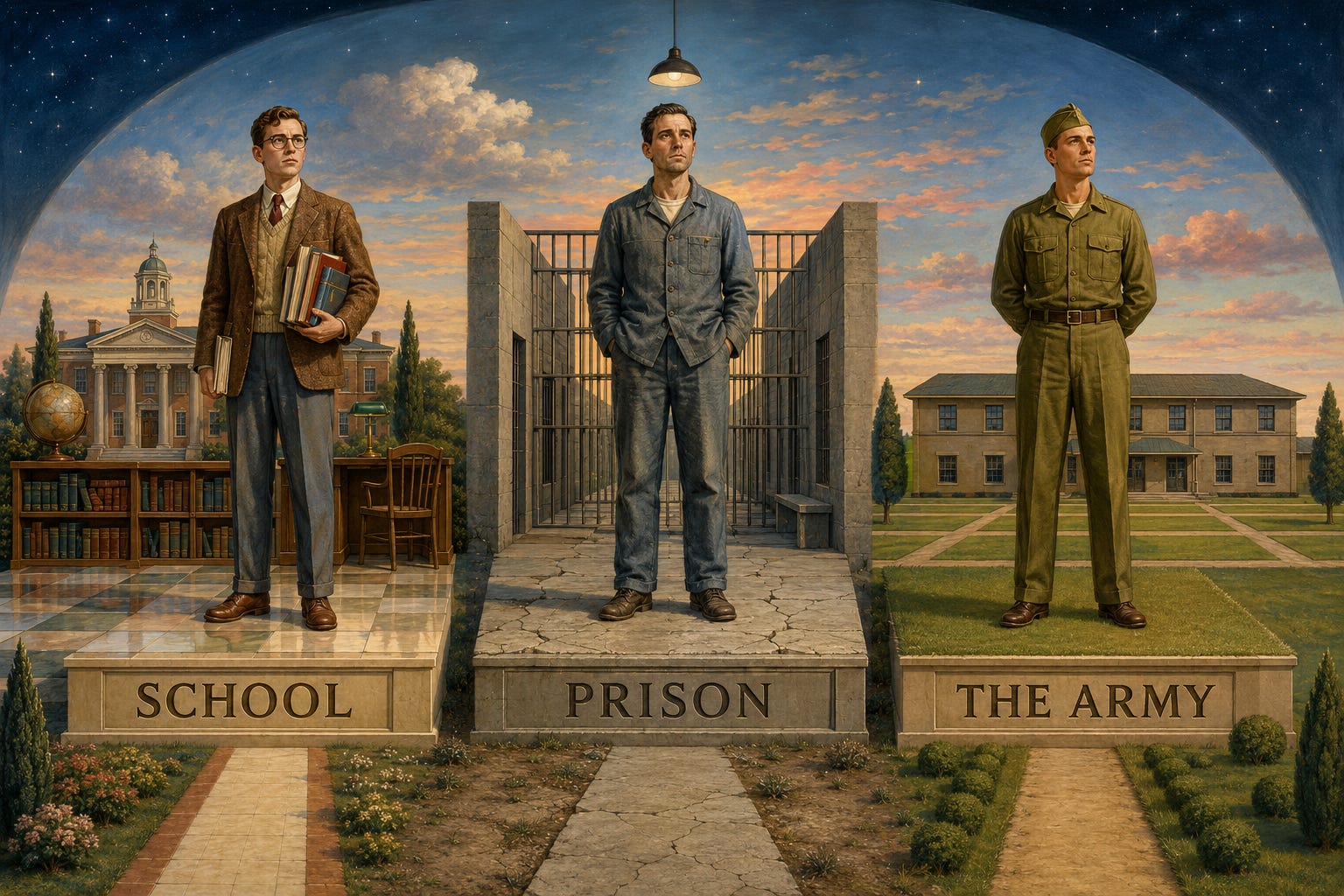
School is the civilian order: advancement through work, family, property, credentials, reputation or recognized dependency.
The Army is the command order: belonging through hierarchy, discipline, service and mission.
Prison is the coercive counter-order: belonging or containment through criminal hierarchy, punishment and exclusion.
I am not going to pretend that I derived this formulation myself. I originally encountered it in an anecdote told by Stephen Kotkin. Nevertheless, I think it is useful and important, for young people to understand.
Our thinking in our teens and twenties is frequently clouded by complexity. We are overwhelmed by the “diversity,” classes, religions, generation differences and ways of life. One person becomes a banker, another an engineer, teacher, welder, lawyer, architect, administrator or politician. From close up, these appear to be radically different paths. However, if we simplify modern society brutally, there are really only three basic paths, three social worlds into which a young person can enter, knowingly or unknowingly. Those are “School,” Prison, or the Army.
School ( academia and the general civilian order )
“School” represents the credentialed civilian world: universities, corporations, professions, bureaucracies and respectable administration. It rewards verbal intelligence, patience, conformity, credentials and the ability to navigate institutions.
Most people choose this path or at least want to choose it. Even the dropout, the incompetent graduate, the indebted student and the person who complains constantly about academia usually accepts the basic authority of School. We still need its credentials, employment and respectability. The banker, teacher, lawyer and administrator may appear to inhabit different worlds, but they generally belong to the same institutional world.
Prison
“Prison” represents the coercive and criminal world. It includes people who could not survive School, were excluded from it, rebelled against it or discovered that another hierarchy existed outside respectable society.
This world has its own rules, loyalties, punishments, reputations and forms of advancement. It may also contain people who fell into it from more prestigious positions. Not everyone who enters Prison was born into its social world, and not everyone who belongs to that world necessarily spends time inside a literal prison. It is nevertheless a real alternative order, one which absorbs many of the people whom respectable institutions cannot discipline, employ or understand.
The Army
The Army represents disciplined service outside both academic respectability and criminal disorder. It is for people who may not flourish in School but are not suited to Prison: people who require hierarchy, comradeship, direct standards and mission.
The Army asks less about how elegantly someone can explain himself and more about whether he can arrive on time, follow and eventually give orders, endure discomfort, master a practical responsibility and remain dependable under pressure. Of course, actual lives are vastly more complicated than this. People move between these worlds. Each contains subdivisions, exceptions and mixtures. A university can be authoritarian; a prison can contain intellectuals; an army can become bureaucratic. Trades, families, churches and businesses can also form partial worlds of their own.
The “Proletariat” does not really exist in a Post-Industrial World
The first analytic mistake of the contemporary Marxist, or those who maintain the Marxist tradition ( As a Weberist I might be accused of standing inside a kind of material analyst tradition or Marxist tradition, but would likely be rejected from the main Marxist tradition ) need to pretend that the “workers” or Proletariat, exist in a Post-Marxist scientific world, or even a Post-Kautsky reformist world. Of course, I maintain that this is completely incorrect. What we have today is not a “proletariat” but a “precariat,” especially with the rise of Artificial Intelligence and mass migration, further cheapening the power of “workers.” There are not “workers.” There are no Unions, merely career-clans for limited policy changes. There is no “building socialism” in a post-industrial system. What there is, is a “precariat” that is funneled into one or more of these three worlds, and the differences between social types that Jean Baudrillard described. People who are organized around signs, images, consumption and simulation.
The “worker” survives for the moment as a political sign after the social world that produced him has disappeared. Politicians, academics and activists continue speaking in the name of an industrial proletariat that exists primarily as an inherited image. The representation remains after the represented class has fragmented. This is another thing that many of us ( like me ) did not understand, when we felt morally supportive for socialist principles and preferences for regimentation and reevaluation. We think logically, that those who labor, should be morally upheld, their needs prefered, to those who merely direct finance or policy. The problem is that conditions have changed, rendering “building socialism” materially meaningless to those men, who once would have made up the backbone of that coalition logic.
The Marxist reply, that workers still exist because millions of people continue selling their labour, misses the political point, entirely. Workers mattered to Marxism not merely because they worked, but because their concentration at the commanding points of industrial production gave them leverage. They could stop factories, railways, mines and ports; they could organize collectively; and, under revolutionary conditions, they could provide the indispensable urban force behind a seizure of power. The peasants supplied demographic mass, while credentialed intellectuals such as Lenin and Plekhanov supplied doctrine and organization. That historical coalition has disappeared. Advanced post-industrial societies possess no politically decisive peasantry and no unified industrial working class. They possess an educated managerial stratum presiding over a fragmented precariat. Calling that arrangement “the proletariat” does not preserve Marxist analysis. It preserves its vocabulary after the material coalition has vanished, as Baudrillard might say. The surviving Marxist intelligentsia did not lead the workers to power; it entered the institutions without them. This is the mistake, and central subtle deception of Marxism. It is not “wrong” in focus, merely in never mentioning that the material analysis is currently meaningless.
There are still people who work, obviously, but there is no longer the Worker as a coherent social type. There is no unified proletarian culture. There are no unions in the old historical sense, merely occupational career-clans bargaining for limited concessions on behalf of particular sectors. There is no “building socialism” inside a post-industrial system. The decisive political question is therefore no longer simply, “Who owns the means of production?” It is: Which institutions can absorb, discipline, protect and make use of people whose labour has become increasingly replaceable? When family, trade, church, neighbourhood and independent property cease to provide stable adult identities, the three large institutional systems of school, prison and army, compete to classify and absorb unattached young people: the credentialed order, the coercive order and the command order.
What really exists materially is merely a “precariat” ( increasingly weakened, dismissed, easily directed at election time ) which is funnelled into one or more of these three institutional worlds, while the political system continues to simulate the language of class solidarity around it. School converts insecurity into credentials and managerial aspiration. Prison absorbs those processed through the criminal and coercive order. The Army offers discipline, hierarchy and usefulness outside both academic prestige and criminal disorder. Marx explains the material insecurity; Baudrillard explains why our institutions continue representing that insecurity through obsolete images; Weber and Burnham explain the organizations that actually classify, discipline and manage the people living through it.
The point is not that every human being fits perfectly into one box. The point is that young people should ask a more serious question: “What world situation do I want to end up inhabiting?” People who exist in the drop-out sphere, the precariat sphere, either due to incompetence, domestic issues, economic pressure or institutional rejection, eventually get refunnelled into one of these three worlds. Therefore it is important to ask: Which social world can actually recognize, discipline and make use of me? Not everyone can survive School and not everyone can survive the Army. Prison remains for those who fail at reaching for the other two. But failing to understand these three worlds can leave a person attempting to live inside an institution whose demands, rewards and conception of human worth he was never equipped to satisfy.
Comments
Nothing yet. Say the first thing.
Sign in to join the conversation.