
In early March, 10,500 writers and publishing types gathered in Baltimore, MD, for the annual Association of Writers and Writing Programs conference. In case you couldn’t make it to Baltimore—or you just want to relive the experience—Bloom is pleased to bring you two special reports from the conference.
This week, we bring you an edited transcript from the opening of Deborah Brown English’s exhibition Time’s Breath at Creative Alliance Baltimore. Deborah joined fellow debut author Margaret Hutton (If You Leave) and Bloom senior editor Leah De Forest to discuss creating visual art and writing fiction, and their experiences of publishing a debut novel over the age of forty.
On April 7, we’ll publish a special report from the at-capacity AWP panel on debuting over the age of fifty, which had to turn a large number of hopeful attendees away.
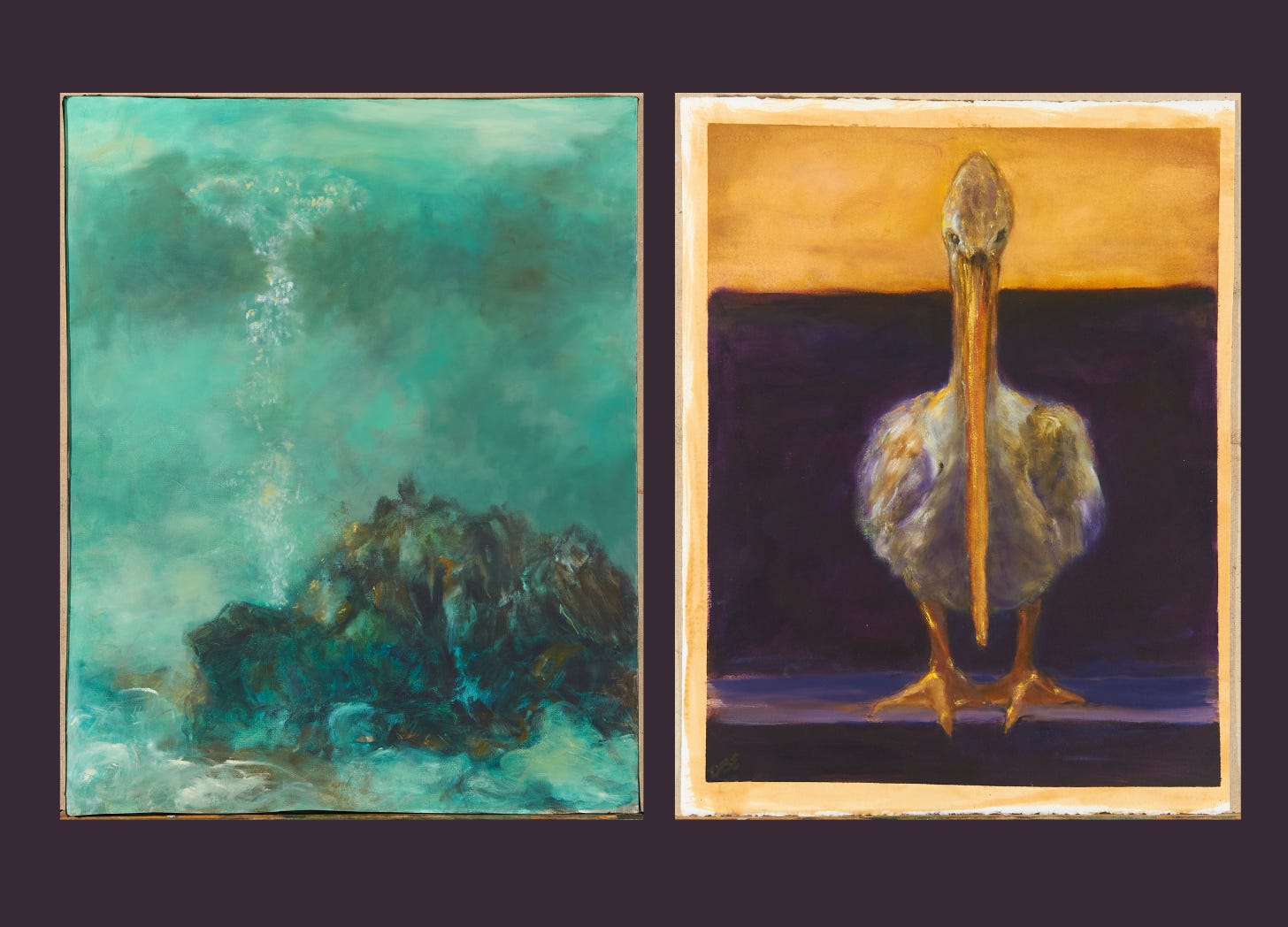
Leah De Forest: Welcome, everyone. To be in this space enjoying these beautiful paintings and works on paper, and with all of you, literary and visual artists, and people who love and appreciate literary and visual art—it feels like a gift.
It’s my pleasure to introduce:
Deborah Brown English, who grew up on Maryland’s Upper Eastern Shore, and intended to be a fiction writer. She studied English and creative writing at Southern Methodist University in Dallas and graduated from the Maryland Institute College of Art (MICA) with honors in 1985. Her work has been exhibited in Maryland at Steven Scott Gallery, Paper Rock Scissors, the Annual Gala Show of the Choral Arts Society of Baltimore, the Academy Museum, and at the former Sales and Rental Gallery at the Baltimore Museum of Art; as well as in galleries in Pennsylvania and Nebraska. She and her husband, Philip, live in Baltimore and are known together for their joint collecting and support of the arts.
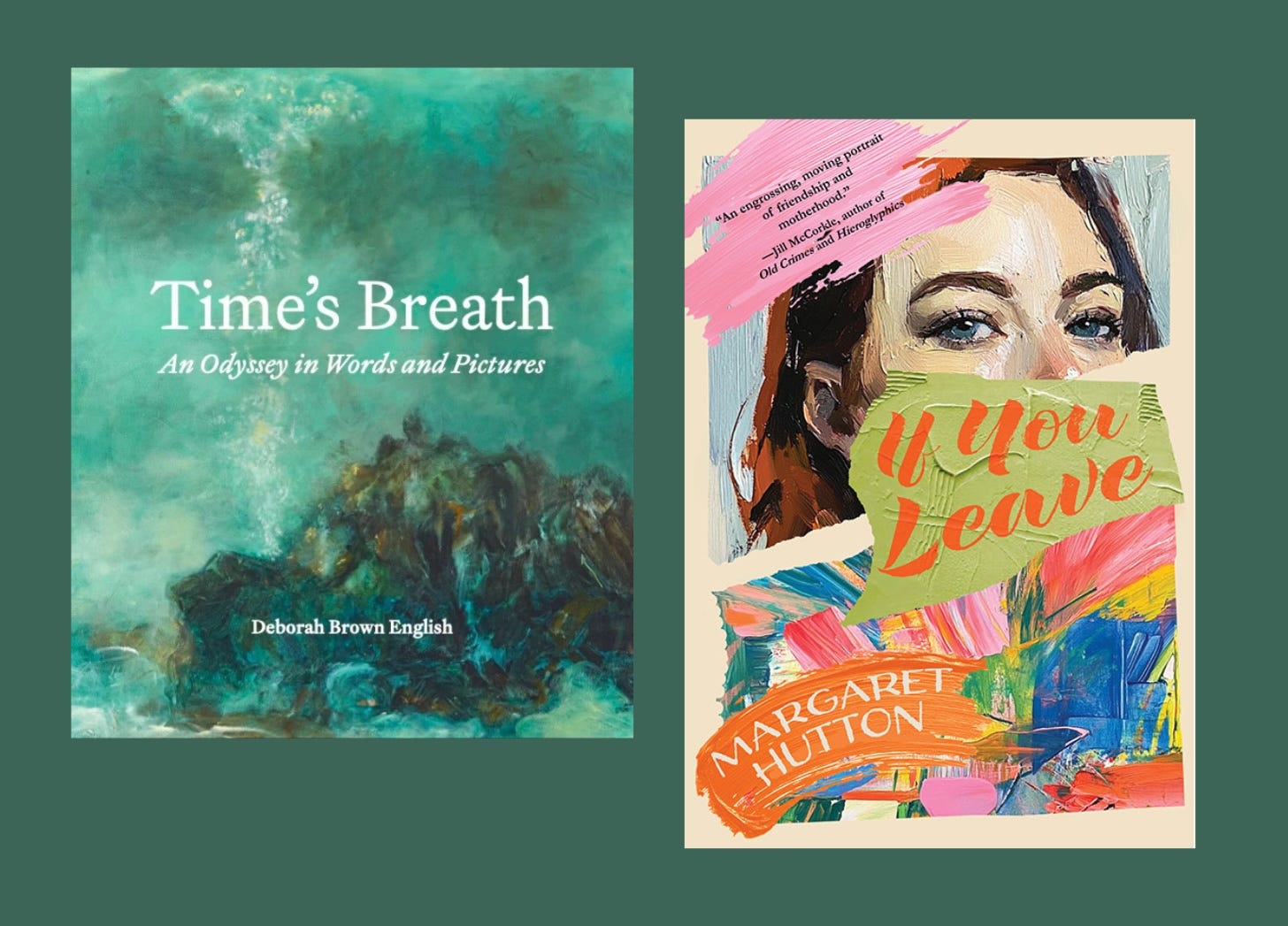
Deborah’s first book, Time’s Breath, which serves as a catalog for this exhibition, was published in September 2025. Time’s Breath tells the story of an island in the North Atlantic and the mythical beings and people who live there—including Thomas, a young and philosophical English sailor, who is rescued after a shipwreck, and Ismitta, the woman with whom he falls in love.
John Benditt, author of The Boatmaker, calls Time’s Breath “a daringly innovative book that pairs an author’s fables … with her own paintings and drawings.”
Margaret Hutton’s debut novel, If You Leave, was published in Fall 2025. Her fiction has appeared in The Sun, The South Carolina Review, The Chattahoochee Review, The Antioch Review, and Abundant Grace. She graduated with honors in creative writing from UNC-Chapel Hill and holds an MFA from George Mason University. A native North Carolinian and former environmental reporter, she now divides her time between the Washington, DC, area and her art studio in Chester County, Pennsylvania. Margaret described herself, in a recent essay in Memoir Land, as having been a “secret painter”.
Congratulations to you both on these debut books, and to you, Deborah, on this wonderful exhibition.
I thought we could start by talking about how each of you came to writing and to visual art. Did one form or the other come first, and how have those forms intersected over the years?
Deborah Brown English: There are a lot of artists on both sides of my family, but I was educated to think that the career of an artist was one that led to disaster. I had a great aunt who was sent home from Paris in 1907. I never did find out why. Another aunt became an alcoholic with a wild crowd in New York in the 1940s and died early. So it was just not generally considered a good idea for any woman to pursue a career in art; it was much too dangerous.
But I was also interested in literature, and my parents passed the love of literature on to me. I decided early in my life I was going to be a writer. In college, I majored in English and I studied creative writing. Later, I wanted to design my own projects. My husband persuaded me to apply for art school. I said, “I’ve never had a drawing class in my life. Nobody’s going to accept me.” But college-educated women coming into the classes elevated the level of discourse; I was accepted because I’d been an English major. I was required to take drawing for one of my first courses, and I had to pass it. But within six weeks of being there I knew what I wanted to do; I wanted to study as much as I could about art.
Margaret Hutton: In fourth grade, I was really bad at kickball. [Laughter.] I was the last person to be picked. I struggled through recess, couldn’t wait till it ended and I returned indoors for our reading period. There was something about how sensitively the characters felt the world, which I responded to. And I remember later saying to myself, I want to do that. I want to do what this writer has done for me in terms of relating to those feelings.
In college I discovered the stories of Flannery O’Connor. She had these exquisite sentences. I didn’t realize she was an artist herself, but I read her essays and she says again and again, If you want to write, you need to draw. You want to look at a thing really closely and observe it. And that is going to help you be a better writer. So I thought, well, what do I have to lose? And as soon as I was out of school, I started taking classes.
I loved the process. I loved the materials, the nonverbal aspect of it, and it just kind of took off from there.
Leah: Thank you both so much. I’m curious to understand how the flow state feels when you’re working in each discipline. What does it feel like to be in the work of a visual piece when you’re painting or drawing, versus like how you feel when you’re in the work of a written piece?
Deborah: I don’t think in words when I’m painting and drawing. I can’t tell you what I’m thinking about, really. It’s like a dance. I often have music on in the studio. The rhythm of the music will inform the rhythm of whatever I’m working with.
When I’m writing, I hear the words, you know, I have a sense of structure; when I’m painting it really is more rhythmic. So I guess that would be the difference.
Margaret: Painting is so physical. I would say that flow state is much more accessible with visual art because it’s non-verbal. As soon as you involve words, you’re in your head. It is great when you really are in a story and you forget that you’re working—that does happen. But I think it’s a little harder. The non-verbal part of making art really allows you to play. You can do that with a ball or any kind of sport, right? You’re physical, you’re out of your head. I think that’s the difference.
Leah: One of my favorite books is Virginia Woolf’s To the Lighthouse. I often think about the character Lily Briscoe: she spends most of the book working on a painting. Near the end of the book, she lays down her brush and she says, “I’ve had my vision.”
That moment has always fascinated me. I’m wondering if either of you have had that experience with a visual or written piece?
Deborah: I have had that with paintings, not drawing so much, but with paintings, it feels like: I know I’ve got nothing left. With writing, I have a sense of what I’ve accomplished because I write the same thing over and over again using outlines.
Margaret: When I’m writing, my imagination works best when I’m doing it. It’s like how Deborah describes how the dance of the brush over the canvas brings the painting into being. I have to be doing it, right?
But I’ve had some weird—and I really want to talk to Deborah about this—
I’ve had some visions, and they come to me pretty whole in a non-sleep, deep rest state. This is true: this morning, I think it was because I was coming to this writing conference and we were going to have this conversation tonight, I was dreaming … my dreams are usually so boring. They’re all about logistics. But in this one, I was unpacking my backpack and I pulled out what looked like a business card—except it had a painting on it. A whole painting. I could tell you the colors, I could tell you the shapes, like asteroids, like comets. But you know, how do you hold that in your mind long enough to transcribe it for the canvas? Have you had that experience, Deborah?
Deborah: Yes. I don’t have a lot more to say about that, except, yes. Many do.
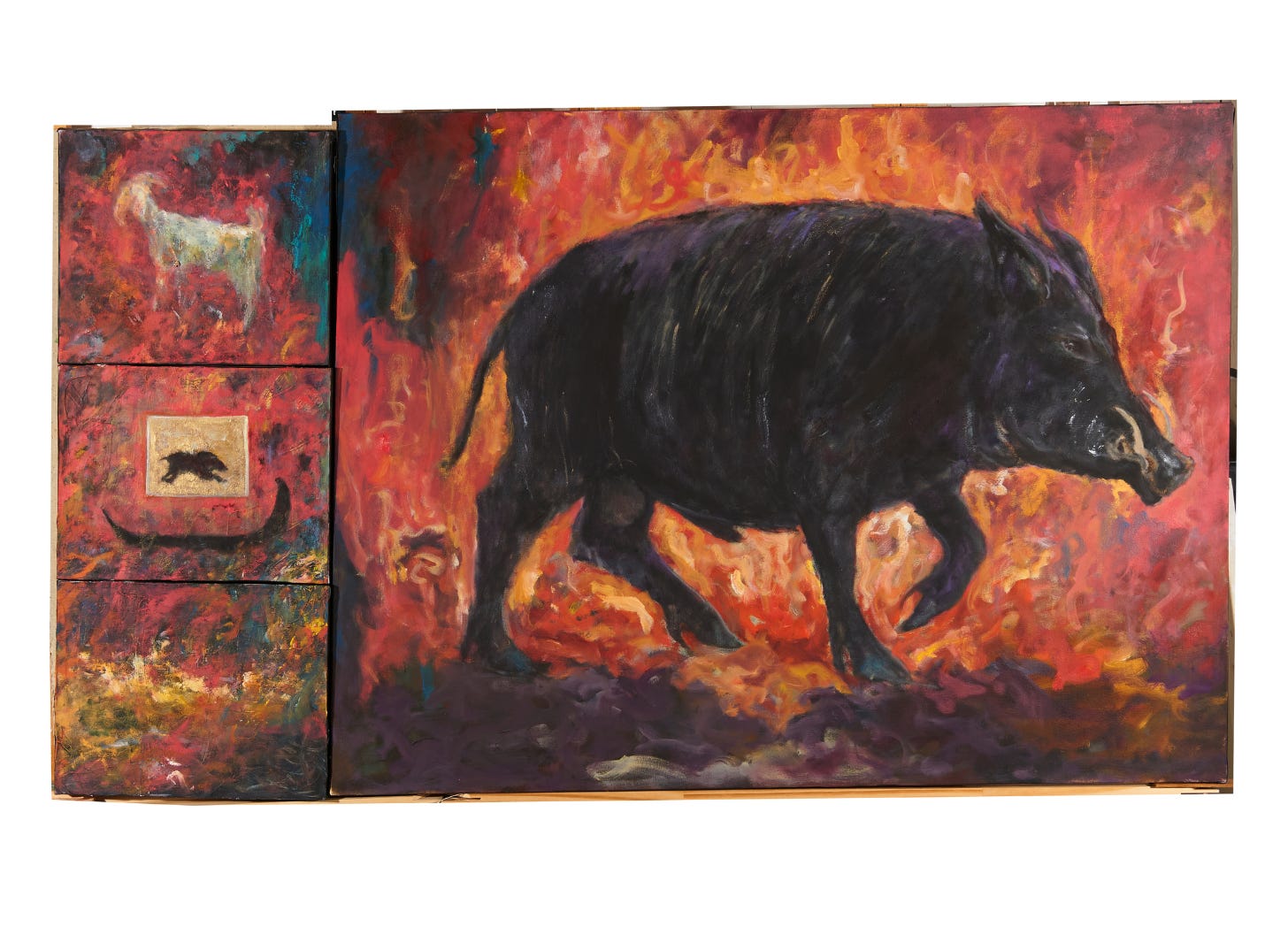
I’m looking at this painting right here [“The Invasion”, pictured above]. I don’t remember when I envisioned the black boar on the red background. It happened sometime while I was working on the idea of what it meant in the story. So I guess you could say that in this case, the literature came first, but only in a vague way. So I think it was really the color and the mass that I was starting with. That was an example of the story informing what the painting was going to be.
Leah: Thank you both. We’re going to change direction a little bit now. Yesterday, I was at an AWP panel about publishing a debut work over the age of fifty. The room was overflowing. I heard they had to turn a lot of people away.
I want to share this quote from Sonya Chung, the founding editor of Bloom: “Beautiful, urgent literature takes the time it takes to create, regardless of increasing demand for fast production and a linear career trajectory. A zigzag personal and professional path is not something to be sheepish about or penalized, but rather embraced as the basis for a rich creative process.”
I wonder if each of you could speak a little bit about your experience of having published a debut in your own time.
Deborah: Well, I think I thought I was out of my mind. I’m blessed to have been given this wonderful team who worked with me on Time’s Breath, such as my editor Eleanor Hughes, and everyone who has helped me get here.
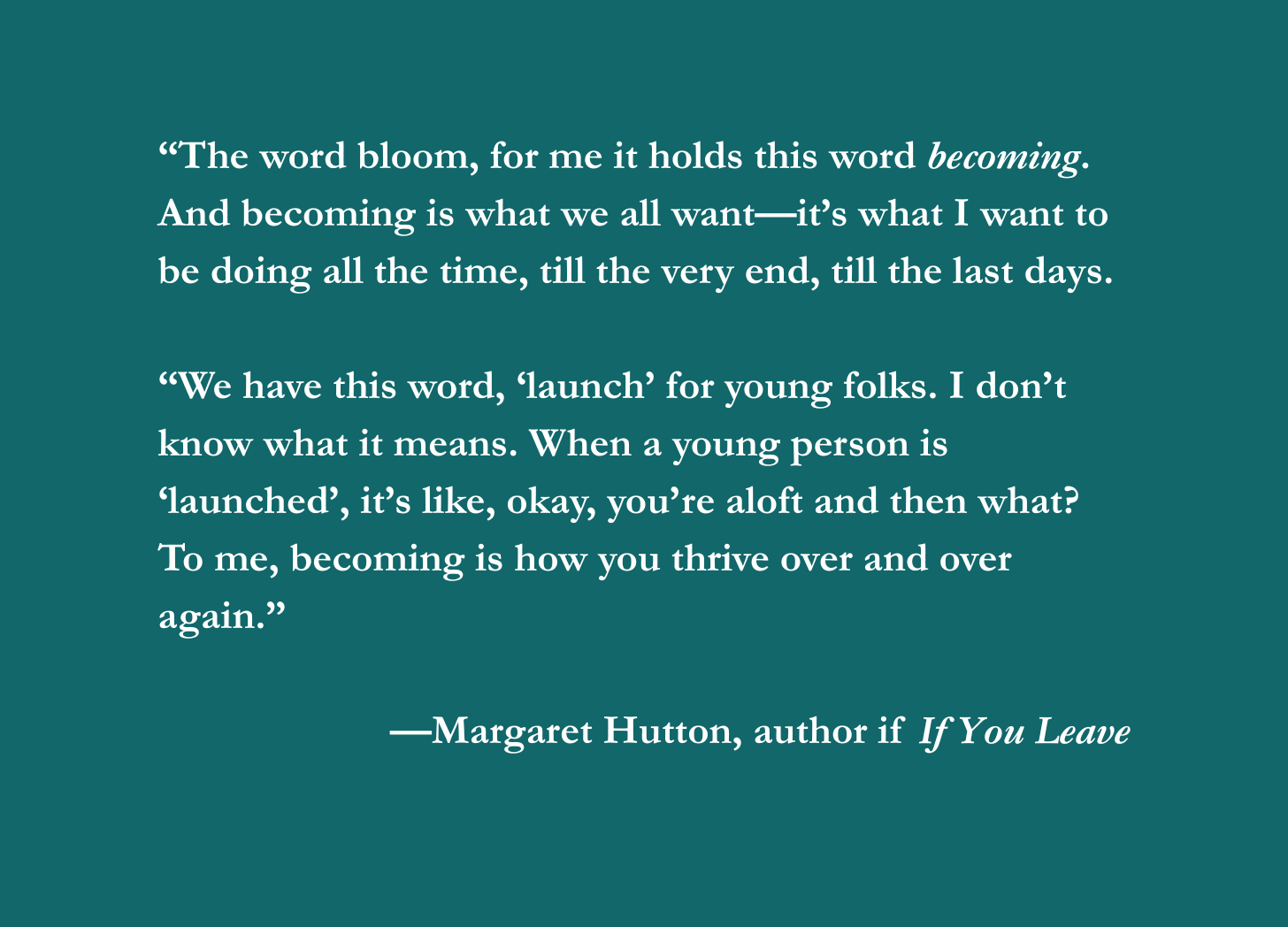
Margaret: On the word Bloom from your Substack: it really does capture something, beyond the metaphor of the flower and so on. For me it holds this word becoming. And becoming is what we all want—it’s what I want to be doing all the time, till the very end, till the last days.
We have this word, ‘launch’ for young folks. I don’t know what it means. When a young person is ‘launched’, it’s like, okay, you’re aloft and then what? To me, becoming is how you thrive over and over again.
Also, just a few things about fear: when you’re thirty, maybe the fear is about failure, right? Now, the fear is that I won’t get to do it. That’s the worst feeling.
So it’s great to be 57 and have a debut.
Leah: Okay, so having launched this debut—that’s just one step. I’m wondering, from where you are now, is there something you wish you could tell your younger self who was wondering how things were going to turn out?
Deborah: Just to have faith in the project and ask yourself if you really want to do it. That’s all I can say.
Margaret: I spent a lot of time dreading putting myself out there. I’m an introvert. It’s been one of the biggest surprises of my life, how much fun it has been. Because what you’re really doing, when you’re putting yourself out there, is connecting with people.
That’s what I would say. It’s fun to connect with people.
Leah: That’s what we’re here for, right? To connect with one another.
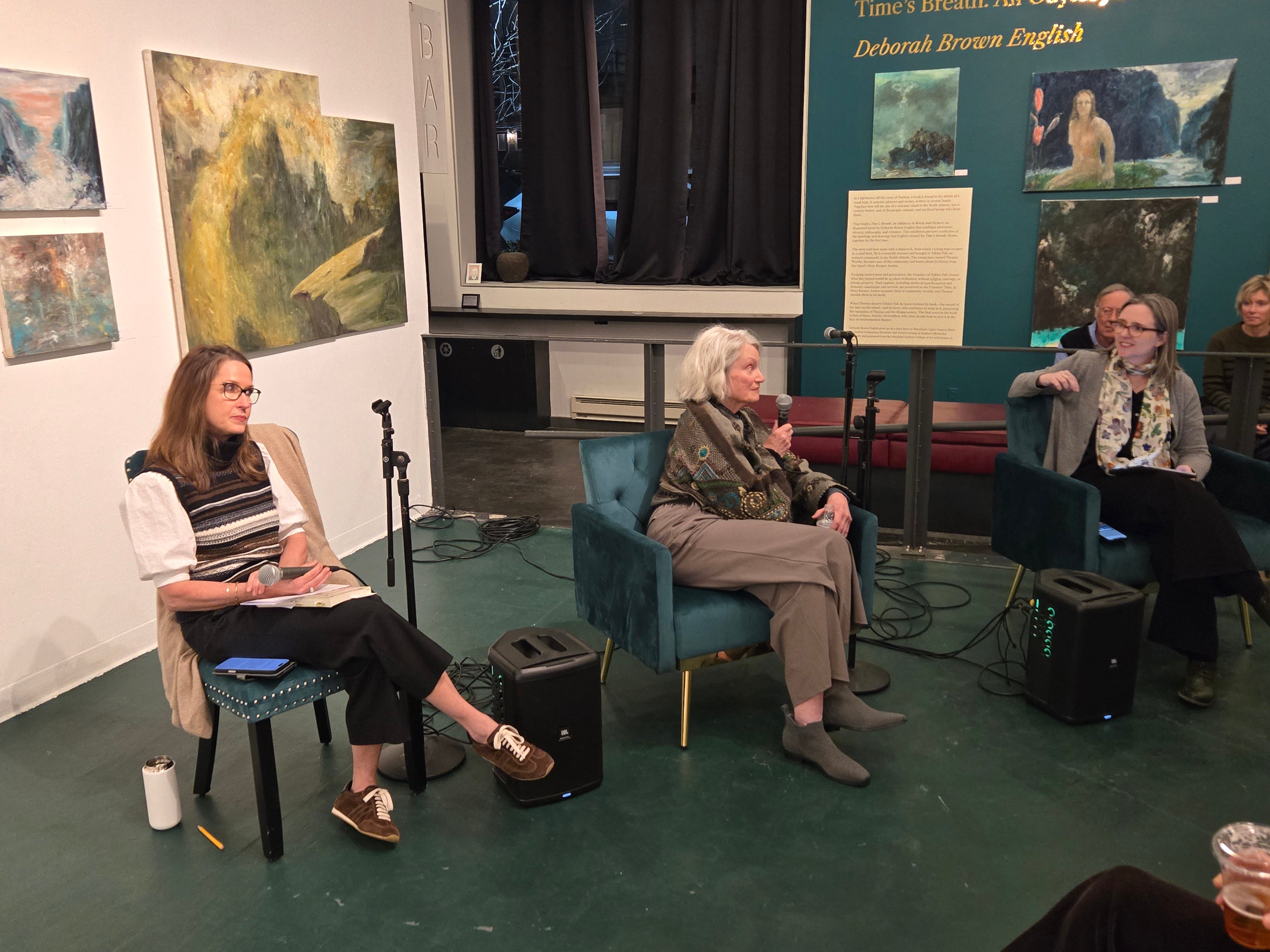
Time’s Breath is on view at Creative Alliance Baltimore until April 11. There will be a closing reception on April 9.
Leah De Forest was born in Geelong, Australia, and lives in Boston. Her debut novel, ANY KIND OF KNOWN TOMORROW, is out from Betty on 9/15/26. Her fiction, essays and criticism have appeared in Griffith Review, CRAFT Literary, Fiction Writers Review, and Kill Your Darlings, among other venues. Leah is a senior editor at Bloom.
Comments
Nothing yet. Say the first thing.
Sign in to join the conversation.