
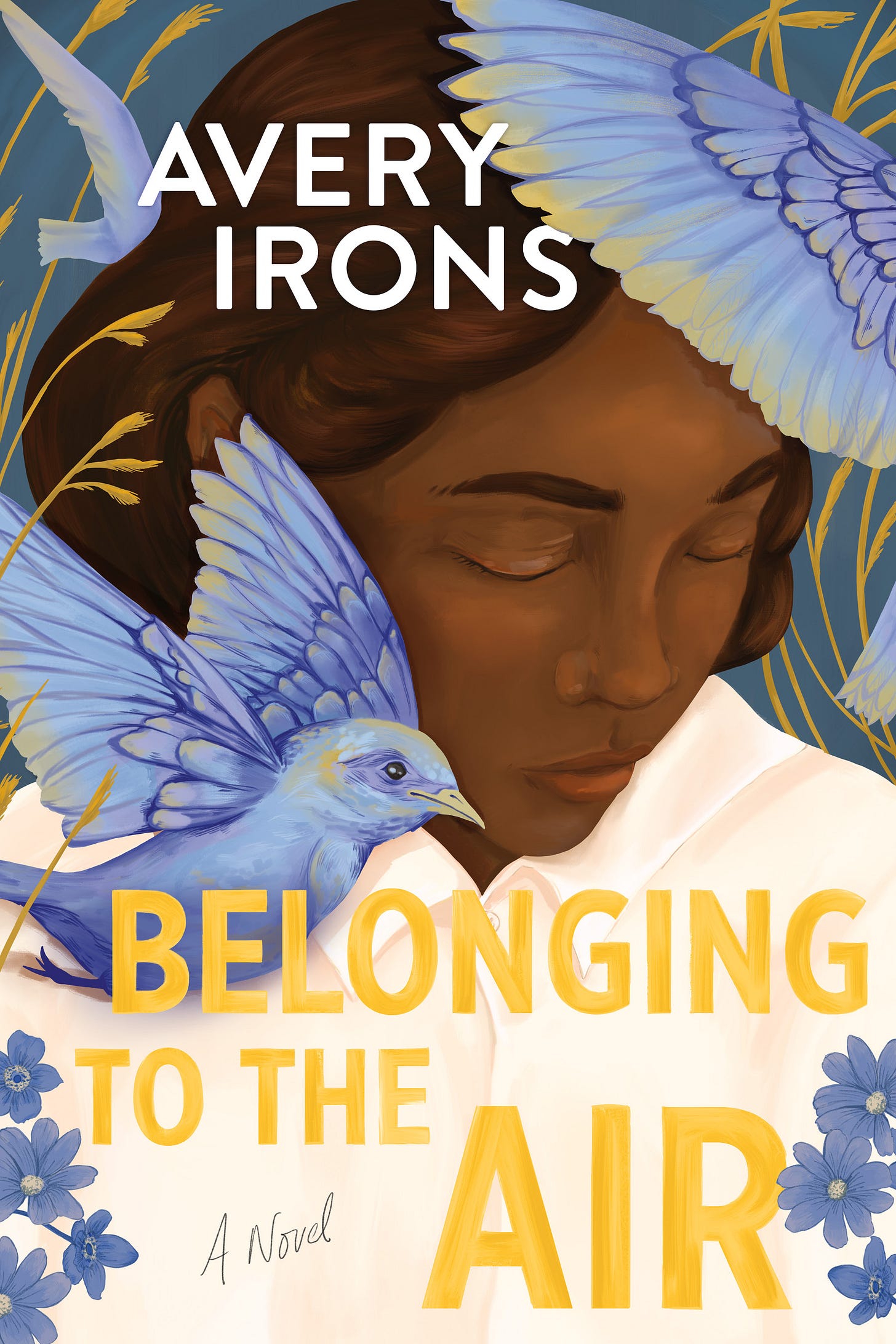
We are delighted to share with BLOOM readers an excerpt from the recently released debut novel by Avery Irons, Belonging to the Air. The novel was selected as an inaugural title by Screen Door Press’s editor and NAACP Image Award-winner Crystal Wilkinson (Perfect Black, Praisesong for the Kitchen Ghosts). Screen Door Press is a new imprint of the University of Kentucky, dedicated to discovering unique, exceptional, and varied voices within Black literary traditions and celebrating the very best in fiction.
Forward Reviews describes the novel as “incandescent” and “a lovely bildungsroman about family, community bonds, forgiveness, and love.”
Award-winning poet R. Erica Doyle writes, “Avery Irons’s sexy and gripping historical fiction debut unapologetically elevates the strength and brilliance of Black queer women throughout history.”
And novelist David Haynes (Martha’s Daughter) writes, “I savored Bird [Bennett’s] every step: her triumphs, her setbacks, her heartbreak; her tenacious determination to survive and find peace despite a world equally determined to deny her identity and her truth. Bird is a revelation.”

In the author’s own words:
So much of fiction and history focuses on patriarchy, and my sense of these histories were strongly grounded in matriarchies or at least moments of more give and take between the genders… I had no problem finding strong Black women and men in my family histories, but I couldn’t find much, if any, queerness. Bird’s story started here in a search for girlhood in the Great Migration to the Midwestern prairie, and in safety, and in that hidden space in history where our ancestors who experienced same gender attraction and/or gender non-conformity have been sequestered.
The following excerpt, from Part I of the novel, takes place in March 1913 in the fictional town of Bennettsville, IL—a town founded by protagonist Bird Bennett’s free Black ancestors.
On a Thursday afternoon, the Charleses carried Bird home after her lessons. Odelia greeted them from the porch swing. “Good day, Mr. and Mrs. Charles. It’s a pleasure to have you for a social visit.” Helena Charles stood straight as a yard stick, and her husband removed his hat as they all made polite small talk about the early spring before Mr. Charles turned the wagon back up the lane to Uncle Vernon’s place. Bird pecked her grandmother on the cheek and held the screen door open for the guests.
Maddy met them in the living room in a simple skirt and collared blouse. Bird appreciated the conservative tone of her mother’s selection.
“It’s so nice of you to come by.” Miss Maddy offered her hand. With the effort of this simple welcome, Bird understood the reason behind her mother’s detached directness: sugariness did not become her.
Mrs. Charles shook her hand. “Thank you for having me. Mr. Charles and I figured that since our daughters have become such good friends, we mothers should be better acquainted.” Mrs. Charles glanced at the settee.
Maddy chuckled. “Oh no, let’s go back to the kitchen where it’s more comfortable. Odelia entertains here, but the only people I have sit here are the white folk who come for their clothes. They are always so curious about how we live, so I just leave them in the room that’s exactly like theirs.”
The white kitchen walls and countertops glowed yellow in the bright afternoon sunlight. “Would you like tea or coffee, Mrs. Charles?” Maddy asked as the mothers took their seats. “Birdy, why don’t you and Bessie go keep your grandmother company?”
“Tea, please. You keep such a clean house.”
“It’s easy with just the three of us,” said Maddy as she poured the tea. Bird watched to see if Mrs. Charles would actually take a sip. With a second, more stern dismissal, Bird and Bessie sulked out of the kitchen and to the porch. Bird opened the screen door and let it bang closed.
“Don’t tell on us, Granny.” She whispered through the screen door.
“Ok, darling. Just remember the price of my silence.”
“Yes, ma’am.” The girls tiptoed back across the living room until they could hear their mothers’ voices once again.
“Bird is an excellent student,” Mrs. Charles offered. “I wish she’d raise her hand more, but when called on, she always knows the answer, and her penmanship is impeccable.”
“Thank you. She is a good girl.”
Bird flushed, uncomfortable with the praise.
“I appreciate how Bessie is helping her come out of her shell. I didn’t know if it would ever happen.” Miss Maddy took her turn.
The mothers sat in silence for a moment. Bird imagined each woman sipping and grappling for something to say.
“And this is such a lovely house,” offered Mrs. Charles. “Do you have many visitors out this way?”
“Mostly just my customers coming to have something made or altered, and sometimes family.”
“You know, naturally, Mr. Charles and I are concerned about the type of company to which the children are exposed. They’re so impressionable.”
“Yes, I feel just the same way about Bird.”
“Well, yes, I’m sure you do. I guess I’ll just be blunt; we’re both grown women. It isn’t such a delicate matter. You being an unmarried woman and all, I’m just concerned about the type of people who Bessie will meet here.”
“You mean my mother and Uncle Vernon? She can be as mischievous as a schoolgirl, but I assure you she’s quite harmless. And Uncle Vernon is gruff, but that’s only to hide all the softness.”
“Please don’t be coy, Miss Maddy. I’m sure that you have gentlemen friends.”
Bird’s back snapped straight like Mrs. Charles had just smacked her spine with the schoolhouse paddle. Bessie’s mouth dropped. Bird felt the throbbing sting and everything else beneath her mother’s pause: a swallowed gasp, the clicking and slow grind of her teeth, and the forced smile that gave lie to the true depth of the cut.
“Gentlemen friends? No, Mrs. Charles. I don’t have gentlemen friends.” Maddy emphasized the “s.” “Bird’s father comes by to visit her now and again, usually during the week. Don’t you think that it’s good for a girl to know her father?”
“Why yes, of course. But don’t you think it’s appropriate for children to be exposed to a more traditional arrangement?”
“That’s a luxury not many of us have. I’m not the only one.”
“Why, I know—” Mrs. Charles didn’t get to finish her sentence.
“I assure you Mrs. Charles, that I am just as concerned about the upbringing of your child as I am about my own. Whatever Bennettsville’s gossips say about me, this is no den of iniquity. This is my home and place of business. These girls mean a lot to each other. I’d hate to see that ruined because of low-minded gossip.”
“Well said, Miss Maddy. I didn’t mean to imply otherwise. Perhaps it’s best if we proceed with that understanding.”
Bird and Bessie sprinted back through the house and screen door and landed on either side of Miss Bennett. Their mothers returned to the porch to find them muddling through embarrassed discomfort between them.
Mrs. Charles fitted her hat. “It was a pleasure seeing you Miss Bennett and Miss Maddy.”
She extended her hand to Maddy but hesitated and tipped her hat to Miss Bennett. “Bessie, Miss Maddy says that you are welcome to visit on weekends. You be a good girl when you are over here.”
Bessie offered her polite goodbyes to the adult women and frowned an apology to Bird.
As the Charles women walk back down the lane, Bird slipped her hand into her mother’s. The girl wished she knew words to heal her mother’s wound. A high price had been paid for this friendship. All this time, Bird thought, I’ve been worried what the schoolchildren think of me, and I should have been worried about the schoolteachers. And for this, she forgave her mother’s initial anger, current reluctance, and all the days of melancholy in between.
It had all seemed so easy in Bird’s imagination. Mr. Charles would bring Bessie over on a Saturday morning, and they would play, maybe read a bit, and eat lunch. Later, she and Uncle Vernon would take her back home again. And then one Saturday afternoon, Bessie stood expectantly in front of the Bennett house. As Bird and her mother stepped onto the porch, Mr. Charles bid them good day and turned the wagon back up the lane. Maddy gave the frozen Bird a nudge before returning to her work. The near silence of her world embarrassed Bird. Who visits a friend’s home to read and play with fabric? She wondered at her own stupidity.
“I have some fabrics in the backyard,” she mumbled as she stepped off the porch. “I thought maybe we could pretend to be in a play.” Bird swallowed and led her friend to the house’s back and mound of cloth scraps she’d begged from her mother. They stood before the pile. Bessie glanced around the yard. “Or, anything you’d like to do is fine,” said Bird wishing her mother was more like Mrs. Charles who always had activities planned for them, even though most of them were educational. What she wouldn’t give for her mother to call out some tasks for them.
An upstairs window opened. “Bird,” Odelia’s melodious soprano floated out into the blue sky. “Won’t you bring your friend here to meet me formally this time.”
A relieved Bird feigned duty as she led Bessie through the house’s shadows and upstairs to her grandmother’s bedroom.
The room was bright and simply furnished with only a four-poster bed, dresser, and sitting table with two chairs. Pictures and framed embroidery nearly filled the walls, leaving just a few inches of faded baby blue paint showing here and there. Odelia sat facing the window in a canary dressing gown and robe.
“Bird, bring your friend here by me.”
Bessie trailed slowly behind.
“Odelia Bennett, pleased to meet you,” she said holding out her hand.
Bessie giggled and shook Odelia’s hand. Bird tried to see her grandmother through Bessie’s eyes. She was a tall woman, skinny but with strong shoulders despite her sixty-two years. The wisps of salt and pepper hair that had escaped her bun framed her pale face. Blue veins showed through her eggshell skin. Was the old woman she loved frightening to her friend?
“Do you mind if I touch you? It’s how we blind folks see,” asked Odelia.
Bird wanted to reach out, to intervene, but Bessie spoke before she could.
“No ma’am . . . I don’t mind.”
Odelia’s hands ran down the length of Bessie’s arms. Bird glanced around as Bessie took in the bedroom. The pictures revealed a young and beautiful Odelia Bennett who’d been stylish and vivacious in youth and then more solemn as she aged. The pictures’ timeline stopped abruptly in her early 30s as if a day hadn’t passed since then. Only the old woman sitting before them belied this.
Examining the girl’s fingers, Miss Bennett asked, “Your siblings do most of the housework?”
“I do some.” Bessie squirmed. “How can you tell?”
“Your fingers are soft like there are older children who do most of the rough work. I tell Maddy she’s working Honest too hard. She’s a little thing, but her hands are almost as strong as a woman’s.” Odelia’s hand slid to Bessie’s waist. “Oh, you’re going to be a curvy one. Your husband will like that.”
Bessie relaxed and giggled again.
“Do you mind if I touch your face?”
“I think it’s fine.”
Odelia’s fingers found her cheeks and slid along her nose and cheek bones and up to her eyes. “You’re quite a pretty child. You’re going to be a looker when you grow up. I hope you won’t break too many hearts.”
“My father says either school or early marriage.”
“Those are often the options depending upon the young lady.” Odelia smiled.
“Honest, would you and Bessie mind taking me down for tea in the sitting room?”
Bird and Bessie made much ado of making tea and a platter of cookies. Odelia entertained them with stories of grand stores in New York City and ocean liners to and from London. Later this day, when Bird and Bessie retired to the hammock to read, Bessie would ask about the old woman napping in the house. “Why didn’t your granny ever get married?”
Bessie stared at Odelia’s bedroom window with a concern and sorrow that surprised Bird and set her at ease. Satiating the curiosity would do better than silence’s fan, decided Bird. “She did. She traveled lots with a white lady she worked for. She met my grandfather on a trip to England. But some white men killed him in Mississippi for teaching. When her sight got too bad, she and my mother came back here.”
“Then why does everybody call her Miss Bennett?” Bessie asked.
Bird could only shrug.
“I thought white people were always happy.”
“She isn’t white. And no, I don’t think so.”


Avery Irons was born and raised in central Illinois. She is the author of the novella Glass Men, which won Big Fiction magazine’s Novella Prize, and short fiction that has appeared in the African American Review, Ragazine, and Sinister Wisdom. She holds an MFA in creative writing from the University of Illinois Urbana-Champaign and received support for the completion of Belonging to the Air through the Kimbilio Novel Mentorship Program. You can learn more about Avery at her website.
Comments
Nothing yet. Say the first thing.
Sign in to join the conversation.