
by Lesley Bannatyne
In Raised by Ferns, nothing is class-free or immutable; not in our built and human world, and not in the world of rhizomes and mycelium beneath our feet. Maya Jewell Zeller’s memoir in essays tells of a life begun in poverty—in-and-out of schools and rentals while trailing her entrepreneurial parents in their (not often successful) businesses selling Guatemalan blankets, re-covering pool tables, opening gas stations, a tavern—that morphs into one with a tenured professorship and a home in middle class suburbia subject to an HOA. (As she writes, “[her children] cannot yet fathom that the amount we spend each month for piano lessons is the equivalent of what my family once paid in monthly rent.”)
But this is not “ruin porn” or a rags to riches story. Using the lilt and percussion of language so close to poetry you want to stop and savor her sentences, Jewell Zeller immerses the reader in the miracle of bookmobiles and motherhood, of the wisdom of trees, ferns, and water, and the joyous resilience there, where everything is always becoming something else.
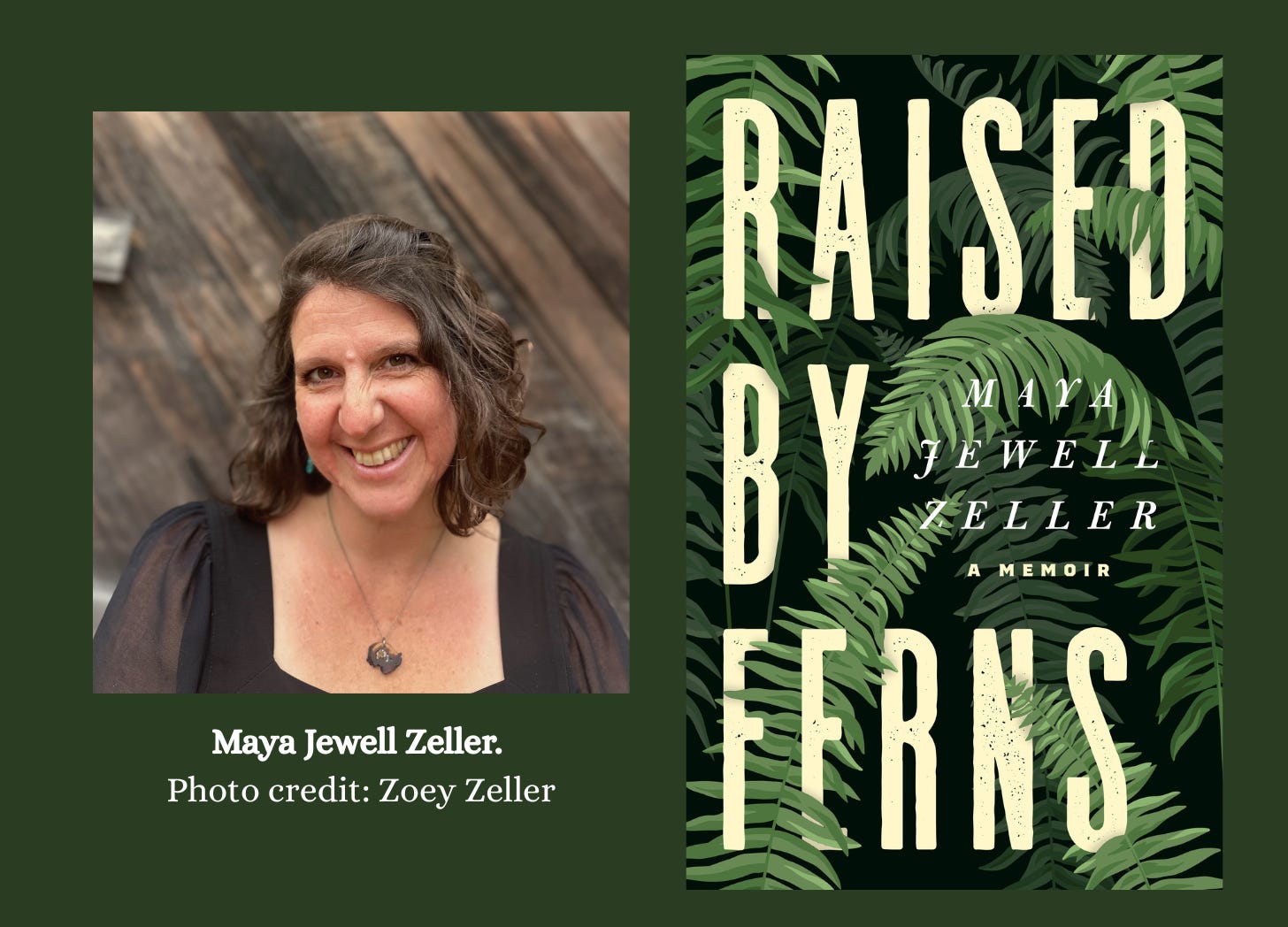
Lesley Bannatyne: Congratulations on this beautiful book. Can you say a bit about how it came about?
Maya Jewell Zeller: Thanks Lesley. I was lucky to have my start in poetry (music, image, and distilling coal to crystal!), so I already loved playing with received forms and projects. The memoir started as essays over a decade ago and evolved into an arc over a few compressed years in the middle; once I knew for sure that I was writing a book-length memoir project, I worked on it diligently and finished it in about a year. Then I put it away for about three or four years while I was going through some life stuff, which ended up providing the events of the closing epilogue and completing something in terms of theme and plot. That was a challenge: figuring out where the book ended, and how to stop writing it as I was (am) still living it. Anyone writing a memoir faces this—figuring out the time container of the book. I think the book happened as a way to move in and out of telling my story in between time living it. Altogether it was about an eleven-year process.
During that time I also worked on other book projects (poetry, a writing craft guide, a book on mushrooms, a collaboration) and I earned tenure and then full professorship. I didn’t spent a lot of time announcing those things, because they feel like privilegeflex, but the truth is, I achieved them during a period of traumatic life events mixed with writing books, so now I want to point it out as a way to model the strength of it, tell myself it’s okay to have some pride in what I’ve worked all my life for.
LB: Raised by Ferns is a treasure for anyone who loves language. It’s clear from the first page that you do.
MJZ: It means a lot that you love the language of it. Language is very important to me—I think of writing as making art with words, so the language is as necessary as what it tells us in terms of story, if not more so. But I am not totally sure I am writing in the right language—I always feel with English, a colonial and violent language, I’m somehow getting it wrong. I wish there were a way to write in the shadows a rose makes with its stamens on its own petals, informed by the angle of a solitary star. Or the “tracks of roe deer in snow” that Tranströmer calls “language but no words.” Humans are poor translators of wonder and image. He gets close with that one. I, on the other hand . . . well, I tried.
LB: These essays are not linked in chronological order, which makes the book feel as if we’re discovering a consciousness rather than a series of events.
MJZ: I love that idea of discovering a consciousness. I am sure you know that rhizomes and mycelial networks and tree roots have consciousness? I think a book is like that; there’s something happening just under the surface, an exchange of ideas like nutrients. When we read, we get a passport to that secret world—we have to be willing to go under. If someone chose a day in their life to narrate, they would have a tough time staying on track, just like looking under the surface of the earth would reveal side channels and a kind of memory tangle of roots—we’d ask, where’s the through line? It’s there under the tangle of influence, but it also is the tangle.
LB: The details of your childhood are so clear—the Sarah Jo caramel box, the pool halls, routes, apartments, landscapes. How did you access those? Did you keep a journal? Have a family member to talk with?
MJZ: I am lucky that I spent so many of my adult years writing poetry, which is all about distilling or preserving details. I had an archive of journals, poems, and yes, the luck of having a sister. I didn’t so much ask her to provide details as have her read and tell me which of them rang true to her. I also have had, for most of my adult life—until recently, with betrayal/relationship trauma and perimenopause somewhat wrecking and cauterizing neural pathways—a pretty sharp recall. Now I’m relying on what I wrote down in my past life phases, and my poet-brain, which is trained in sensory image.
LB: Why essays rather than poems?
MJZ: I did tell a lot of my story in poetry, especially the coming-of-age rural stuff—those who know Rust Fish will recognize some of this material—but I felt that I needed to break into a fuller, more comprehensive narrative to make sense of some of the cognitive dissonance of my life experiences. I also wanted to speak to a new audience about it. Poetry will always be a deep love, but I wanted to give the permission of these pieces to people who read prose.
LB: When you teach writing, you advise students to watch for “ideas that have buzz or hum.” Is this the way you look at crafting your essays?
MJZ: Yes. A little music, a little vibration that wants to move into something. I follow it. I don’t try to direct it so much as let it carry me—that’s where I discover. We can always shape during revision, I think. Go back and find those gems—the ideas and images that resonate. Then build on them.
Most of my writing process is improvisation. That’s why the containers (shapes/ forms) are useful, I think. I do not tend to think narratively, or linearly, so the containers help make sense or counterpoint the content. I love playing with how narrative works. Jane Alison, in Meander, Spiral, Explode, writes about narrative patterns in nature, in mixing up how we tell our stories. I hope I am doing that.
LB: You go into detail about certain subjects—panorama, scavenging, the science of disease, always plants and landscapes—what sort of research did you do as you were writing?
MJZ: I love this question! Thank you for noticing. I think of reading and immersive living as research, so when I was reading Carl Zimmer’s Planet of Viruses I was taking notes. I was also reading things from natural history and a lot of poetry. Those came in as influence but also as supportive research, I think. Also, when I was revising, I was simultaneously finishing up a book on fungi phenomena, so my thinking was mycelial. That absolutely affected how I thought about this book as an ongoing rhizome woven through with hyphae/ mycelium.
LB: You circle back to seminal events and each time, add new details—your dad’s drinking, the scar on your head, your gas-station birth. Each time your return to the base note, there’s a new layer and our understanding of the story grows deeper. Was this circling back a way of touching down before you headed off again? Grounding us in your origin story before we go off into another chapter of your life?
MJZ: Yes, and. Yes—I think those events and core images are part of the psychological core, and they inform the ways the adult self reacts to the wrongs done to her. They also characterize those who surround her—if you know someone’s specific triggers, and you love them, usually you try not to re-harm them in those ways. I think of books that operate through image as operating through accretion—there’s a stacking, a kind of spiral of rock that builds and builds to its angle of repose. I think there is a point near the end, in section three, that reaches the angle of repose. Some of the things that repeat are intentional and I hope create a calling back and a revisiting of image after the reader gains more consciousness or context—and the book that’s left I think has a clear narrative arc even while leaping and looping in time (how our minds and actual trajectories work—moving forward while looping back).
LB: In describing the natural world, you often choose words that evoke an almost religious ecstasy. Your meditations among the ferns feel prayerful. In order to deal with the chaos of your world (and our world) of people, things, and money, are you suggesting it’s important to separate from it and be still? I’m thinking monastery or nunnery here—the life in which quiet matters as much as productivity.
MJZ: I often daydream about monasteries/nunneries. Not in the sense of religion, though I guess if walking into fields and moving slowly around and in old buildings is enough, then yes, religion. My ideal life would involve 100 times the quiet it has now. I crave it. I hunger for it! When I was working on revisions, I was staying in an apartment of a 900-year-old cottage in the English countryside. That sounds more romantic than it was—I had my 11-year-old son with me and was homeschooling him!—but we did take a lot of walks and bike rides along the Thames to this Abbey, Godstow, which felt held up by ghosts and thistles. And we walked through Hopkins’ meadows on the regular, which were full of horses, and sometimes cattle. It was a pretty dreamy couple of weeks during which I was supposed to be finishing research on and writing a novel but just kept coming back to this book and other projects. And it was quiet—even with my son along, it was a pretty chill time compared to my typical life.
LB: Which I imagine is rather full! You write in one of your footnotes that inside your house there is “Another Book.” Is there room for that in the near future?
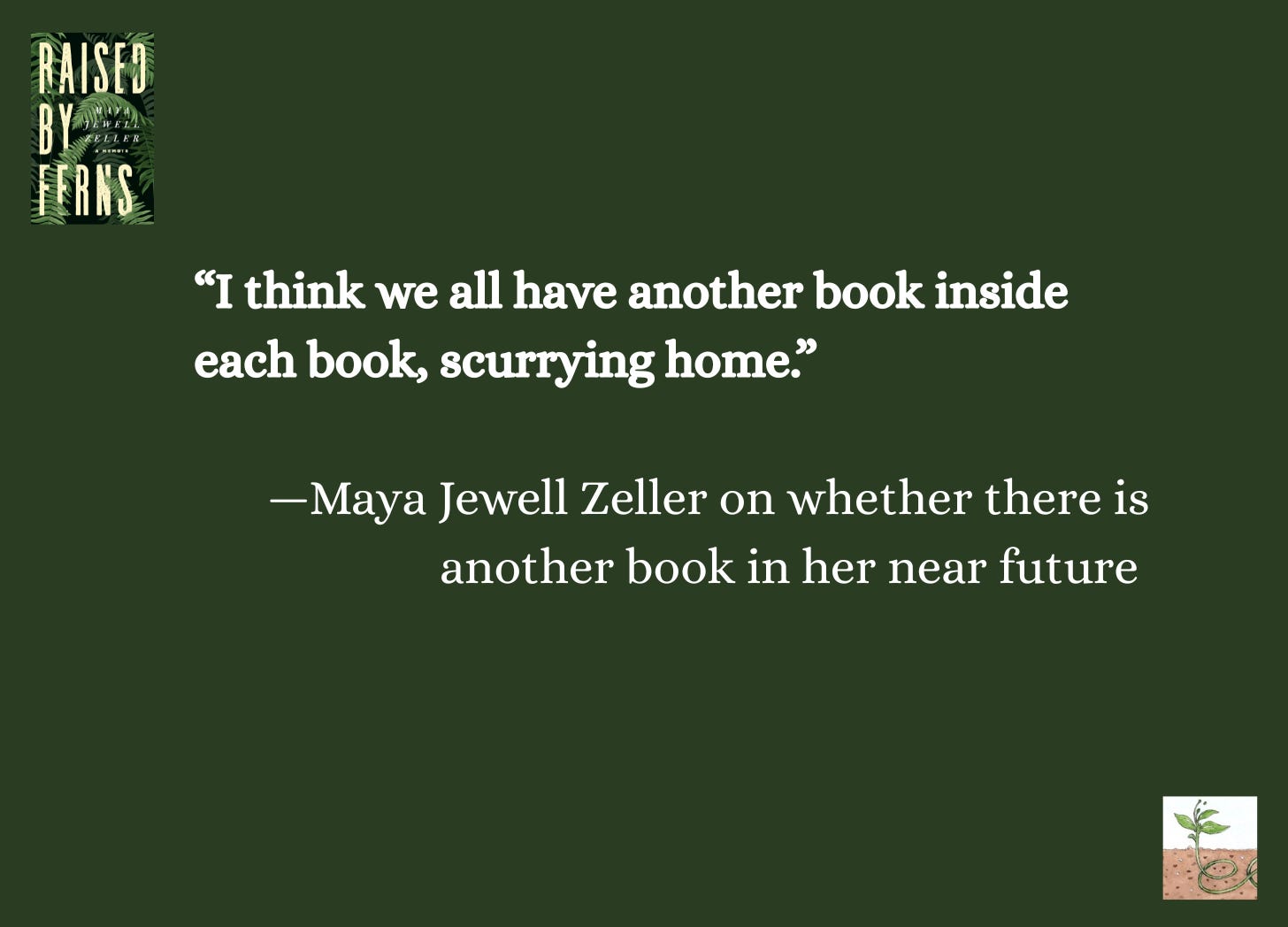
MJZ: I always think of the Little Fur Family by Margaret Wise Brown. I think we all have another book inside each book, scurrying home. Or several of them. I keep hoping for quiet so I can work on those, but I will have to do it in my scrap minutes. I have that novel I set aside, and a short story collection that keeps announcing itself (it has claws and teeth), and a few poetry collections, and lyric essays—all of those in various files. But I want to be patient, too, and let myself play. So, if and when I ever have time to write something new, I hope I will just let myself write whatever delights me. Last week I finished a short story called “Man vs. Bear vs. Bear vs. Man,” about a witch who comes home from Milk Island and is starving for connection and intimacy, as well as revenge. Then she dates bears. I cackled the whole time I was writing it. That’s what I want for what’s next: more laughing.
Born in a Pacific Northwest gas station to itinerant, countercultural parents, Maya Jewell Zeller came of age in a landscape where poverty, wildness, and self-reliance intertwined. Raised by Ferns traces the path of a feral girl craving both freedom and safety to a middle-class adult life shaped by academia, motherhood, and uneasy privilege.
Read more about Jewell Zeller and Raised by Ferns in the New Ohio Review and The Rumpus.
Lesley Bannatyne is the 2024 recipient of the AWP Grace Paley Prize for Lake Song, which is also a finalist for the 2026 Massachusetts Book Award. Her debut collection of short stories, Unaccustomed to Grace, was published by Kallisto Gaia Press in 2022. Bannatyne’s fiction and essays have appeared in the Boston Globe, Smithsonian, Christian Science Monitor, and Zone 3, Electric Literature, Craft, Pangyrus, and many other literary magazines. She won the 2018 Bosque fiction prize and received the 2019 Tucson Festival of Books literary award for fiction and her work has been nominated for the Story Prize, Pushcart, and Best of the Net. As a freelance journalist, she has covered topics ranging from druids in Massachusetts to relief workers in Bolivia. She holds an ALM in Creative Writing and Literature from Harvard University Extension Studies.
Comments
Nothing yet. Say the first thing.
Sign in to join the conversation.