
We’re thrilled to share an advance excerpt from Nita Noveno’s prize-winning debut Mud on the Moon (Red Hen Press, 8/18/26).
Mud on the Moon, which won the 2024 Women’s Prose Prize, intertwines a daughter's exploration of her Filipino immigrant father's obscured past with a reimagined version of his untold story.
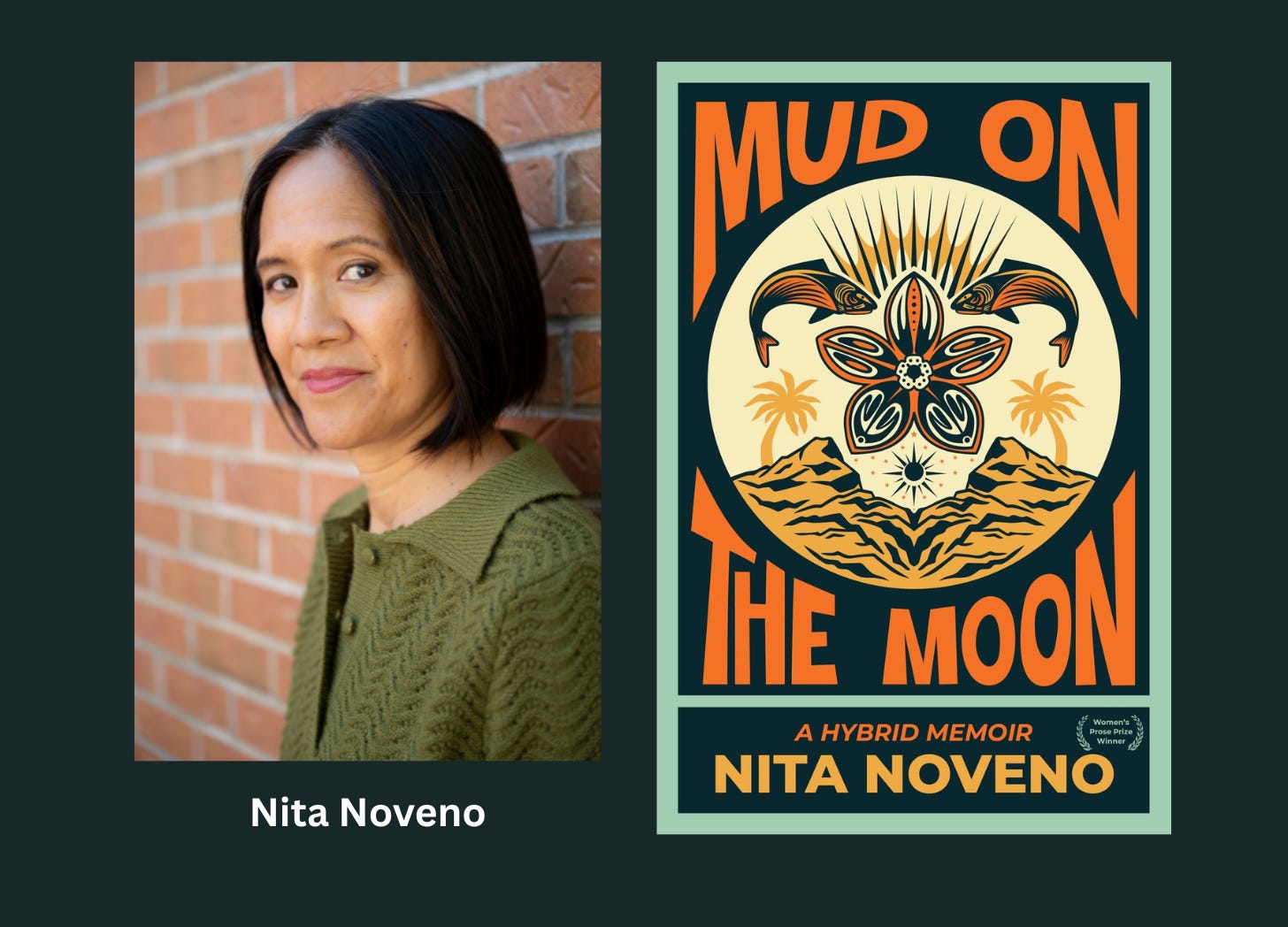
Noveno traces the legacy of her father, who arrived in the US in 1928 as part of a wave of Filipino men seeking better opportunities through agricultural and cannery labor. Alternating between her own coming-of-age narrative and imagined chapters of her father's life, the book weaves together personal memoir, archival research, and family photographs. It is a meditation on how family, memory, and identity are shaped by the stories we inherit, spoken and unspoken, across generations.
Publisher’s Weekly calls the book “a moving blend of autobiography and imagination” and “an auspicious first outing.”
Ice covers the trees, the roads, the windows of our house like frozen skin. I stay curled in my warm bed. Wake up! I hear my mom say. Time for school! I love sleep more than school. No fourth grade today, please. Wake up! I am a bear in hibernation, a soft lump of slumber, slipping back into dreamland and what seems like a long quiet. Then, a low growl turns volcanic eruption. BOOM!
The next moment, my covers are gone. I feel a cold wet smack. I jump sit awake. Water and soggy rice drip and drip down my hair and face. I am screaming and crying like a drowning bird. A dark brown figure stands at the foot of my bed. My father with a rice pot in hand, a declaration of the end and of the beginning. Get up! You’re going to school!
Red-hot, dried, and dressed, I wait for the school bus on the side of the road like I do every early morning on a school day, back turned against a forest wall. Until the yellow bus comes chugging down the gravelly road, I listen to my teeth chatter and the wind rustling through the trees. Then, the silence. I don’t hate school, but I hate my father and I want this day to end. Puffs of breath come and go, disappearing into the air, an air that is glowing like I’ve never seen before. I look up. Something is moving in the sky. The sky is moving, rows and rows of shiny white strands of ribbon shimmering in the dark blue. They stretch and dance like octopus tentacles or streams. I search for their beginning and end. They don’t rise from the treetops or the mountains. No—they are born up above.
I have heard stories about the northern lights, seen pictures in books, but I have never seen them in person until now. In the wake of this explosion, I am breath, surprise, attention.
Later I will read about the science, about particles colliding with atoms.
I will learn about the origins of its name, Aurora, the Roman goddess of the dawn.
She, Aurora borealis, is “dawn of the north”, traveling from east to west to proclaim the coming of the sun.
That winter, the skies were cloudless. The temperatures dropped.
In the mornings, a fire grows slowly in its oil-filled belly, tepid air blowing from its small square vents as the giant metal box heats the house. Outside, the world is white. Snow covers the trees, yard, and road like a thick blanket.
Against my will, I slide out of bed and drag myself to my coveted spot in front of the heater where I sit hunched over crossed legs. I hate waking up early for school, especially in the winter months. I am nine, long black hair hanging over the sides of my face, a small body dragging in drowsiness.
The heated air billows my pajamas and sends my hair in erratic flight. I hear the intermittent squeal of a radio tuning, a weatherman’s announcement of what I already know: January is so very cold in Ketchikan, Alaska. Sitting in the kitchen in a white tank top and shorts, my father, a dark-skinned man with skinny limbs, fiddles with the radio’s dial, listening to the news: current rising gas prices and highlights from President Ford’s State of the Union Address—“Progress and solutions can be achieved, and they will be achieved.”
“Get up! Get away from the heater,” his gravelly voice orders. “Get ready for school.”
Unmoved, I relish the air like a warm bath. Feel the pull to go under. I am a good student. My fourth-grade teacher, Sister Carol, and her endless tasks, can wait another day. Warmth on my skin, hair in full flight, just seconds away from falling asleep. I ignore the second warning from the kitchen.
My father has recently retired. They threw a party for him at the post office where he was a maintenance man and janitor for more than ten years. My mother snapped photos of my father and his co-workers. Of the cake with white frosting. Then, we returned home that evening and life seemed unchanged, except that he was at home a lot more.
Soon after my father retires, my mother begins full-time work as a nurse’s aide at the hospital after a series of small jobs—babysitter, daycare worker, Avon Lady—over the past few years. She has always been eager to work. As a result, my father is cooking more for the family, frying salmon and steak, boiling rice. He is an apt cook, if not a little on the sloppy side, and it is not uncommon to see the kitchen fill with smoke. A keen taste for salt, he douses his meat with MSG. However, I prefer my mother’s magic in the kitchen—spaghetti, meatloaf, pancit noodles, lumpia, and baked goods: cookies, pies, cupcakes. My father does not make dessert. He makes messes.
Now, he has time on his hands. If he isn’t outside digging up the front yard for his pea garden, my father pads around the house replacing pipes, fixing the toilet, and mis-repairing the water heater. He goes fishing more during the summer of his retirement. Fishing becomes his new job. He wakes up in the morning before everyone else in the family and drives to the docks or to his favorite spot along the island’s rocky coast called Mountain Point, bringing his fishing pole and well-oiled reel and a tackle box full of various hooks and lures. He stays until the early afternoon, sometimes returning home with a bucket of fish. He cleans his catch in the kitchen, fish blood and slime dripping on to the tile floor.
He has introduced us to his love of the sea, has taught us how to tie a hangman’s knot for the swivel, how to cast properly, and how to tug at the pole to make the lure appear like live bait to the hungry schools of fish. When I catch my first salmon, I shriek in excitement, reeling in the lure as quickly as possible, challenged by the pull of the line like a dare. I gleam at the sight of my catch flapping on the rocks. My sister and I take turns striking the fish on the tops of their heads with a heavy stone, justifying the cruel act to a quick death, placing the fish sooner than later into the bucket to ward away pangs of guilt. Fishing becomes a fun sport for my sister and me. We cast our lines with enthusiastic impatience, but once the summer is over, we don’t miss it. My father, on the other hand, keeps his fishing poles clean and reels oiled, preparing for the next season.
His retirement checks arrive in the mail. So do his subscription to monthly National Geographic magazines and our own encyclopedia set we flip through on the living room floor. From a sweet-talking but suspect Filipino couple who appear at our doorstep one day, he buys a knife set and then, later, property in California, a small lot in Deer Valley. One he’ll never see in person or build on. One his family will sell for less than buying price after his death. When my father returns to the Philippines three years after the first family trip to the country, he brings back jewelry for us, a gold pair of heart-shaped earrings, a jade necklace in the shape of a heart.
I remain still by the heater, eyes closed, hear the shuffling of feet in front of me.
“I told you to get ready for school,” his voice grumbles.
Father pulls me by my hair, dragging me away. I scream and cry. It hurts. It hurts. I can’t see through tears and hair. My mother yells for him to shop. I sob face flat on the stubby carpet.
The beast emerges then. A shapeless volcano. Infernal. Bottomless.
This isn’t the first time we’ve met. When I grow demanding or refuse to listen to my parents, my mother cries out in exasperation. However, when my father has had enough and he takes out his belt, striking me across my legs until I cry, I stomp back to my bedroom and the beast appears in full force. It has grown bigger since my father’s retirement, his aggravating presence stoking its flames of anger and resentment.
That January morning, it follows me from the floor to my room where I get dressed and ready for school. In the silence, my head throbs, my heart pounds. I feel like I am breathing through a twisted straw. My skin is red and clammy. I shiver. The snot and salt in my mouth feeds the beast as it rages and mutters, How can he do this? How?
I take a deep breath. Grab my school bag.
I HATE him. I will hate him forever.
I do not look at my father when I leave the house that morning, trudging in my boots down the thick snow-covered steps down to the road to catch the bus.
When I return home later that day, I declare war in the only way I can, calling my enemy by a new name. I no longer address him as Father or Dad because he isn’t. I call him It. The beast approves.
Nita Noveno is the recipient of the 2024 Women's Prose Prize from Red Hen Press for her debut hybrid memoir Mud on the Moon (August 2026). Her creative nonfiction and hybrid work has appeared in MĀNOA, Hippocampus, The Margins, and elsewhere. She holds an MFA in creative writing from The New School and teaches creative nonfiction, composition, and literature at Borough of Manhattan Community College, City University of New York. She is the founder, curator, and host emeritus of Sunday Salon, a long-running New York City reading series. She lives in Astoria, Queens.
Comments
Nothing yet. Say the first thing.
Sign in to join the conversation.