
The signals that citizens and businesses are willing to leave their country when the tax burden becomes too high are growing rapidly. At the same time, the governments, including mine, appear eager to raise taxes at every setback, even when it may not be necessary. As a result, a 50-year-old economic theory, long dismissed as little more than a theoretical curiosity, is moving firmly back into the spotlight: the Laffer Curve.
Little Napkin
In the fall of 1974, four men gathered at a Washington restaurant to vent their frustration about President Gerald Ford’s planned tax hikes. Present at the table were Donald Rumsfeld, then Ford’s chief of staff, Dick Cheney, his future successor, Jude Wanniski, journalist at The Wall Street Journal, and Arthur Laffer, professor of economics at the University of Chicago.
During their conversation, Laffer argued that higher tax rates wouldn’t necessarily raise tax revenues. Lower tax rates, by contrast, could spur economic growth and ultimately increase total tax receipts. To make his point, Laffer grabbed a napkin and sketched what would become famous as the Laffer curve.
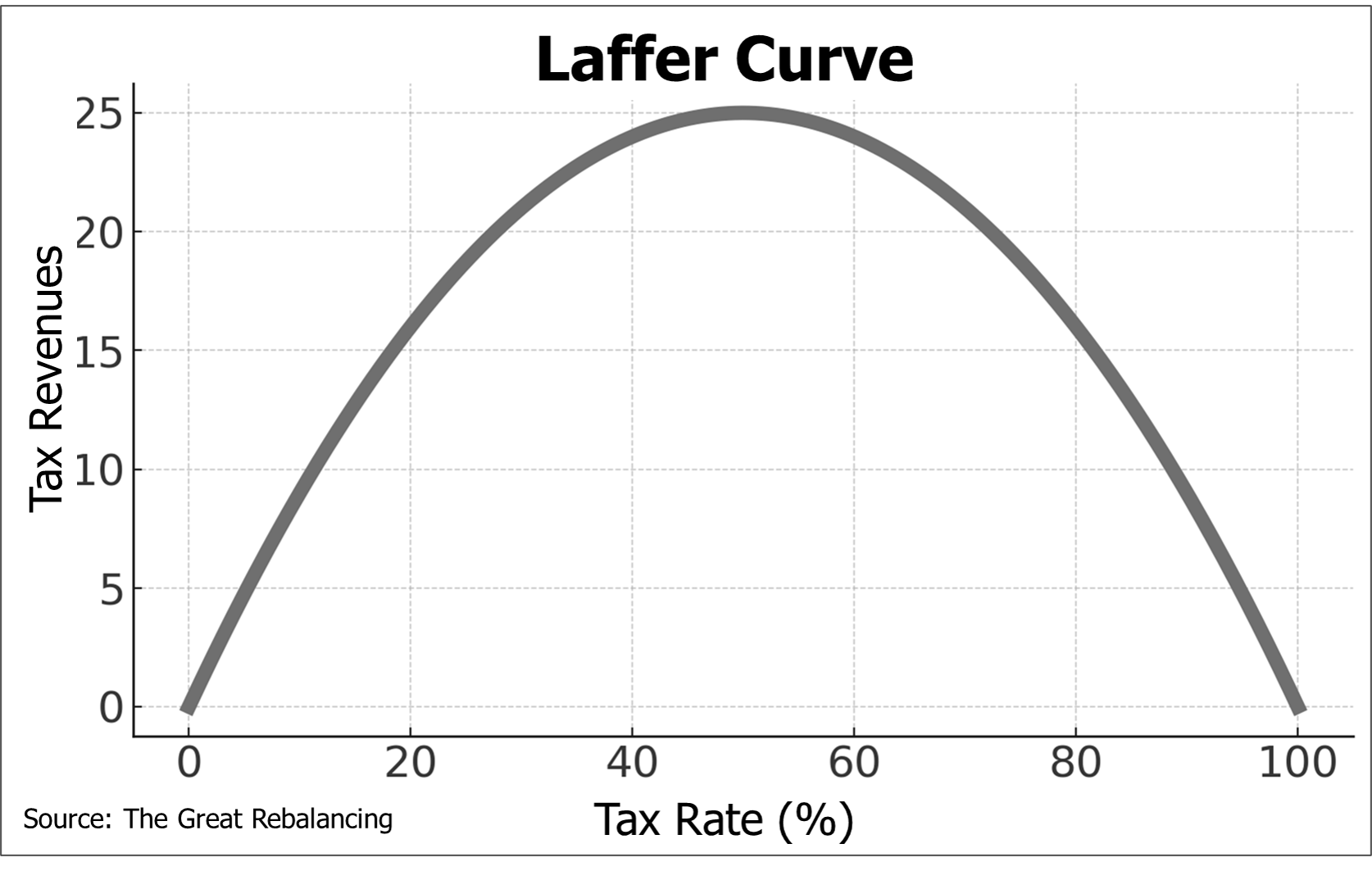
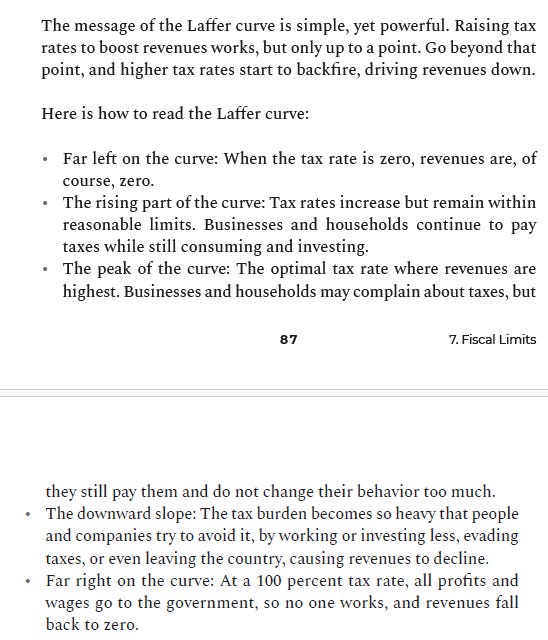
The two paragraphs above are from my book The Great Rebalancing, where I emphasize that the concept of the Laffer Curve should be taken very seriously. When governments impose taxes on income, profits, or wealth beyond a certain threshold, the effects become counterproductive. Individuals and businesses gain incentives to avoid taxes, relocate, or simply reduce their economic activity.
Headlines
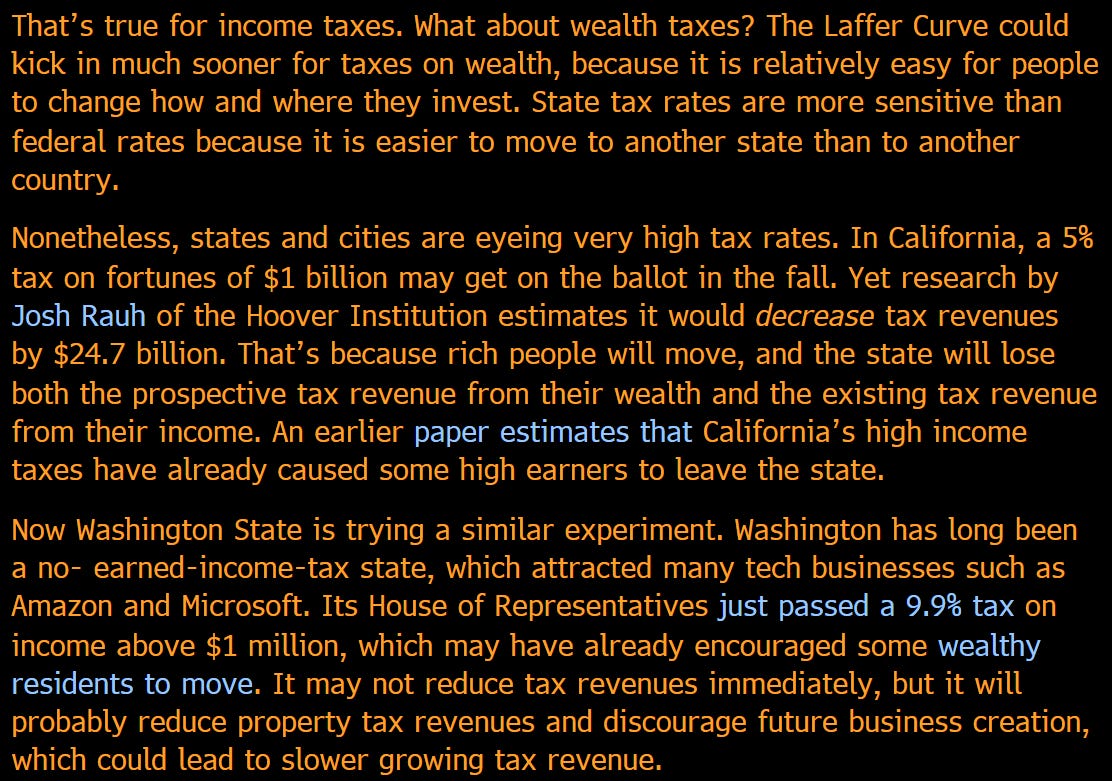
The Laffer Curve recently made headlines when Bloomberg argued that proposed wealth taxes in several US states could ultimately result in lower tax revenues. Wealth, after all, is far easier to relocate than income, which is often tied to employment in a specific state.
Wishful Thinking or just Lies
A recent study by the Hoover Institution estimated that California’s proposed Billionaire Tax Act, including a one-time 5% levy on global wealth above $1 billion, is unlikely to generate the revenues policymakers appear to have just assumed. Supporters of the measure suggest it could raise at least $100 billion in tax income. The Hoover researchers, based on actual modelling, expect the opposite. Instead of a $100 billion gain, they estimate a loss, in present value terms, of nearly $25 billion.
That “present value” adjustment reflects future lost tax revenues discounted back to today, taking inflation into account. That is the same inflation that is steadily eroding the purchasing power of household savings and wealth.
The reason for the lower, rather than higher, revenues aligns perfectly with the Laffer Curve. Even before the proposal has been voted on, around 30% of those affected have already (fiscally) left California. Since these ultra-wealthy individuals typically generate substantial income alongside their wealth, the loss of future income tax revenues alone is enough to turn the expected gains into a net loss.
A Flat Learning Curve
The policymakers behind this somewhat populist proposal appear to be characterized by a lack of understanding, particularly of their own citizens.
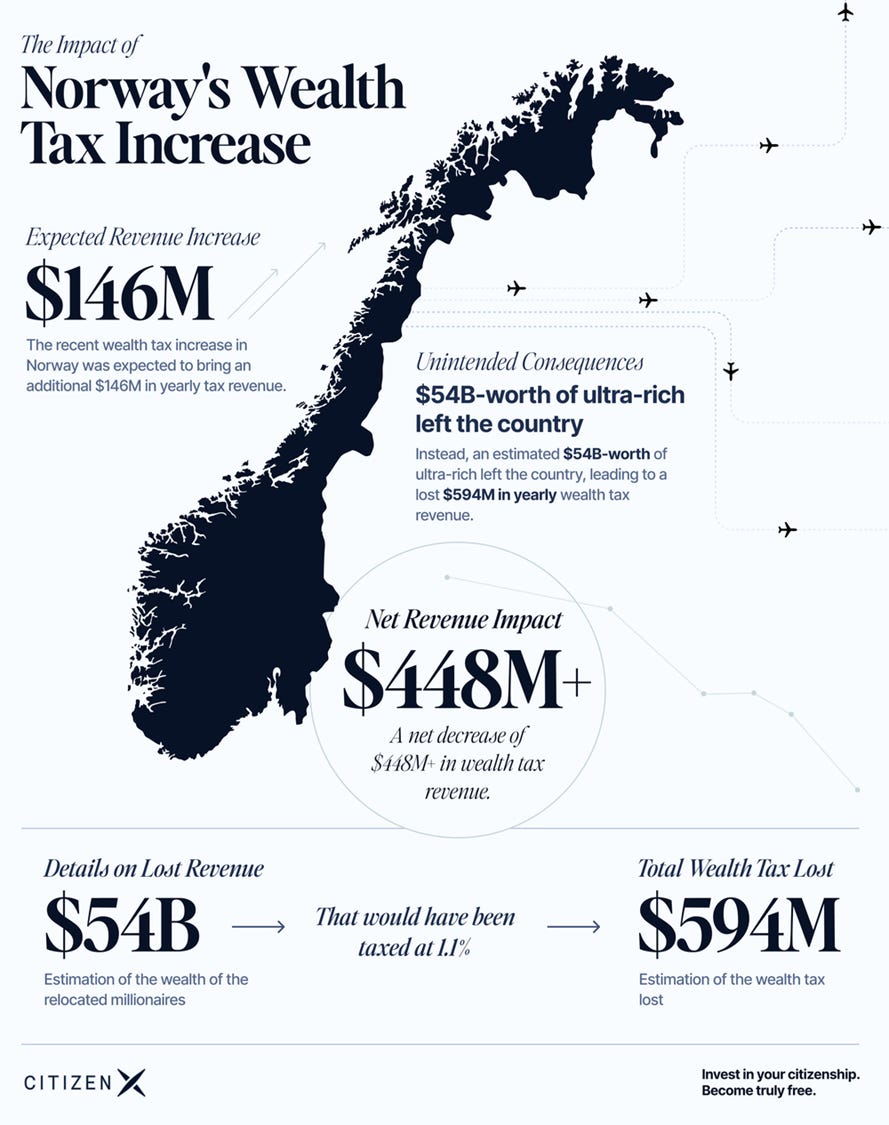
In 2022, Norwegian policymakers decided to increase wealth taxes on affluent residents, expecting to boost government revenues. Wealthy Norwegians responded differently. They relocated approximately $50 billion in assets to Switzerland. The result: Norwegian tax revenues fell by roughly $450 million.
It gets even more remarkable. Just a year earlier, in 2021, taxable wealth in the Norwegian municipality of Bø increased by 60% following a reduction in the wealth tax.
Missing the Point
Some argue that wealthy individuals should simply pay more taxes. That discussion is more nuanced, but it becomes irrelevant if higher taxes result in lower revenues. If a substantial portion of tax revenue is intended to support lower-income households, then policymakers fundamentally miss their objective when higher taxes reduce overall revenue. Increasingly, policymakers appear disconnected from economic reality.
Capital Flight
What policymakers also seem to overlook is that the Laffer effect extends far beyond capital flight. Those who leave also take their human capital with them, along with that of their children and families. Excessive taxation discourages education, entrepreneurship, and work itself. The result is a gradual erosion of human capital.
Finally, do not interpret this column on the Laffer Curve as an argument against investing. The opposite is true. The rules may be flawed and the tax burden high, but investing remains vastly superior to holding cash, especially in a world of structurally higher and more volatile inflation.
Blokland Smart Multi-Asset Fund
Taxes are, in fact, another reason to invest, particularly in a world where inflation remains elevated and unpredictable.
Would you like to learn more about the Blokland Smart Multi-Asset Fund and how we aim to protect and grow capital? And why we invest in a combination of quality equities, physical gold, and bitcoin?
Feel free to contact me at jeroen@bloklandfund.com. You are, of course, also welcome to call. You will find all contact details and further information on our website.
Kind regards,
Jeroen Blokland

Comments
Nothing yet. Say the first thing.
Sign in to join the conversation.