
Almost daily, I find myself amazed by how determined people can be not to see certain things. In everyday life, in politics, and just as much in financial markets. The willingness of investors to systematically ignore the colossal elephant in the room is beyond counting. Even when trusted friends acknowledge its presence, many still stare resolutely in the opposite direction. This text will likely not reach them either. Fortunately, it did reach you.
Enter Toby Nangle, a journalist at the Financial Times and well-known for the FT Alphaville blog. Following the recent surge in yields on the Japanese government bond market, Nangle put pen to paper to illustrate, with remarkable clarity, just how unsustainable high interest rates have become. The most important chart from his analysis is shown below.
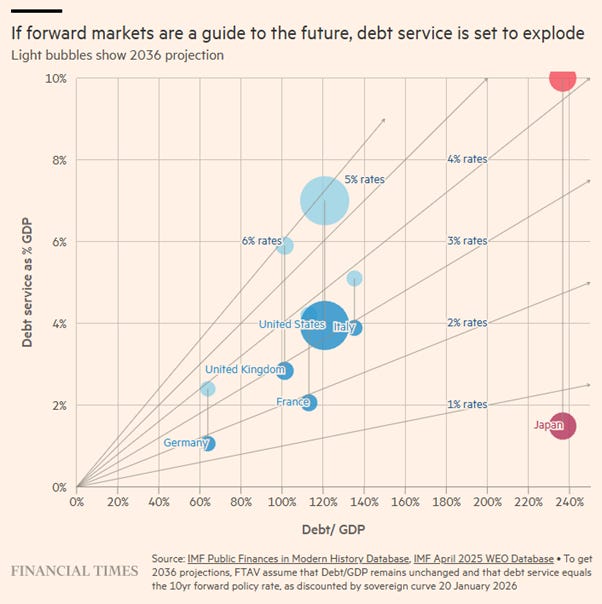
The chart plots government debt as a percentage of GDP for the G7 countries (excluding Canada) on the horizontal axis, against interest expenses on that debt, also expressed as a percentage of GDP, on the vertical axis. The darker dots represent the current situation. Japan is shown in dark red, the other countries in dark blue. The United States, for example, currently pays interest equal to roughly 4 percent of GDP on a debt burden of about 120 percent of GDP.
To make the impact of higher interest rates tangible, Nangle then models a forward-looking scenario. He estimates interest expenses as a percentage of GDP in 2036, under two assumptions. First, that the existing stock of government debt does not increase further. Second, that this entire debt stock is refinanced at the short-term policy rate that markets currently expect to prevail in ten years’ time.
You may already be stuck, quite rightly, on the assumption that government debt levels will somehow stop rising. For now, set that aside. The light blue dots, and in Japan’s case the light red dot, show the outcome. For the United States, annual interest expenses rise from around 4 percent to roughly 7 percent of GDP. In other words, without even a moment's thought about fiscal indiscipline, the US would automatically face an additional budget deficit of 3 percent of GDP per year. Exactly the level that the Maastricht Treaty once defined as the maximum allowable total deficit.
Now turn to the red dots. Japan, burdened by its enormous debt stock, moves from interest expenses of less than 2 percent of GDP, the direct result of eight years of yield curve control, to a staggering 10 percent of GDP per year.
Even without understanding how economic growth models work, without knowing that Japan’s debt burden is almost certain to rise further, and without having read my book explaining why ageing economies require structural fiscal surpluses to preserve living standards, the conclusion is unavoidable. This is simply not sustainable.
In 1981, economists Thomas Sargent and Neil Wallace published a paper that is more relevant today than ever: Some Unpleasant Monetarist Arithmetic. It is a cornerstone of monetary economics and plays a central role in my book The Great Rebalancing.
Their core argument is straightforward. When governments run persistent budget deficits financed through debt, central banks are eventually forced to monetize that debt. Even if a central bank, such as the Bank of Japan today, temporarily prioritizes inflation control, that moment will still arrive. Otherwise, debt sustainability collapses. Precisely the scenario Nangle illustrates with interest expenses approaching 10 percent of GDP.
The unpleasant side effect of monetizing debt through money creation is inevitable inflation. But the alternative is a full-blown confidence crisis in Japanese government bonds and, by extension, in the entire financial system. And once one acknowledges that higher inflation actually reduces the real value of the debt burden, the choice becomes remarkably straightforward.
I do not know when the Bank of Japan will capitulate. I do know that, at some point, it must. That moment may briefly make long-duration Japanese government bonds appear attractive, provided inflation has not already spiraled out of control. What I also know is this. Once rates are pushed back down while inflation remains elevated, Japanese bonds will be deeply unattractive investments for a very long time.
If a raised-eyebrow chart published in the flagship newspaper of the traditional financial world still does not prompt reflection, I am out of arguments.
Which brings me to the next point. Kevin Warsh. The prospective successor to Powell is widely described as someone who wants both lower interest rates, a position that aligns neatly with his patron’s wishes, and a smaller central bank balance sheet.
A noble ambition. But Warsh faces exactly the same dilemma as his Japanese counterparts. The next chart, also included in my book, makes this painfully clear.
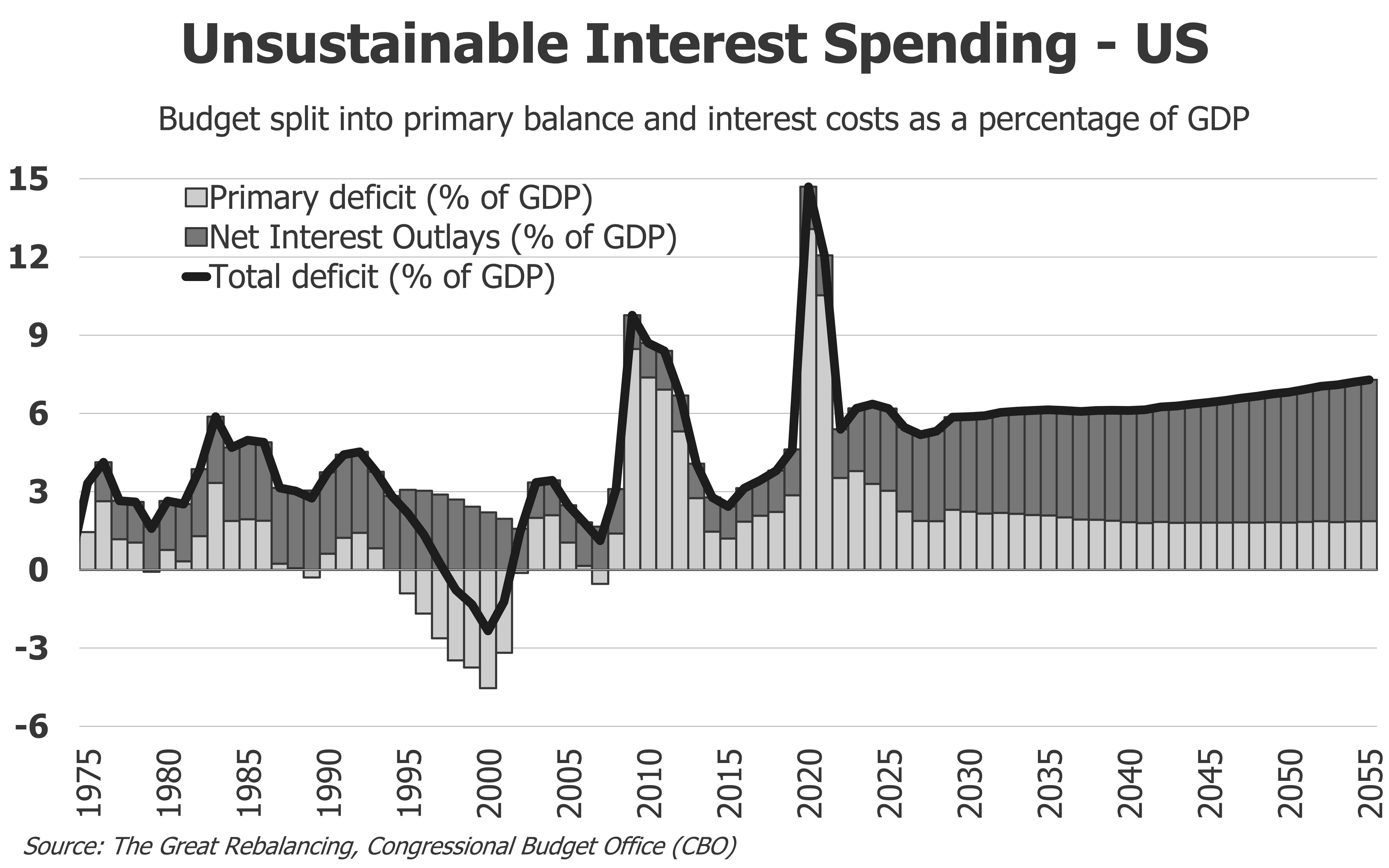
The chart is based on projections from the Congressional Budget Office, an independent agency that provides budget and debt forecasts to US policymakers. The dark grey bars show net interest expenses as a percentage of GDP, and they explode higher over the coming decades.
And these projections do not even assume a further rise in interest rates. Yet if the Federal Reserve reduces its purchases of US Treasuries in order to shrink its balance sheet, that is precisely what will happen. Few investors are willing to hold long-term government debt yielding, say, 4 percent.
The range of options is therefore narrow. Either Warsh must hope that the government forces even more institutions to absorb government bonds, or he will have to abandon his balance-sheet ambitions. My bet is firmly on the latter. If not willingly, then under pressure, imposed by markets and government alike.
How does the Blokland Smart Multi-Asset Fund navigate the debt elephant that now dictates the policies of governments and central banks? And how do we detach portfolios from the traditional equity-bond framework while maintaining a moderate risk profile?
To find out, visit our website to download the presentation. If you prefer direct contact, you are welcome to reach out by email at jeroen@bloklandfund.com or by phone. All contact details and comprehensive information about the fund are available on the website.
Kind regards,
Jeroen Blokland

Comments
Nothing yet. Say the first thing.
Sign in to join the conversation.