
Dear reader,
As expected, a recent post about inflation in the Netherlands sparked a lot of debate. That only confirms what we already know: inflation is something many people struggle with, and certainly not just in the Netherlands. And that makes sense. History and research show that prolonged inflationary periods, like the one we have experienced since 2020, leave deep scars, financially and psychologically.
What stood out to me in many of the reactions is how people, for whatever reason, tend to downplay inflation, dismiss it as “necessary,” compare it to other factors that do not tell the full story, and forget, or refuse, to connect it to the future. And honestly, some of those reactions contain a fair amount of nonsense, sometimes out of ignorance, but often because people want to make a point that, in my view, simply is not there. So in this post, I will lay out the facts and the (un)truths about inflation once again.
“Inflation wasn’t that bad” — part I
According to Eurostat, average inflation in the eurozone was 2.1 percent over the past 25 years, 2.6 percent over the past 10 years, and 4.1 percent over the past five years. I understand why people, especially when looking at that 25-year figure, might say, “It wasn’t that bad.” But the reality is that eurozone inflation has, on average, been above the ECB’s target.
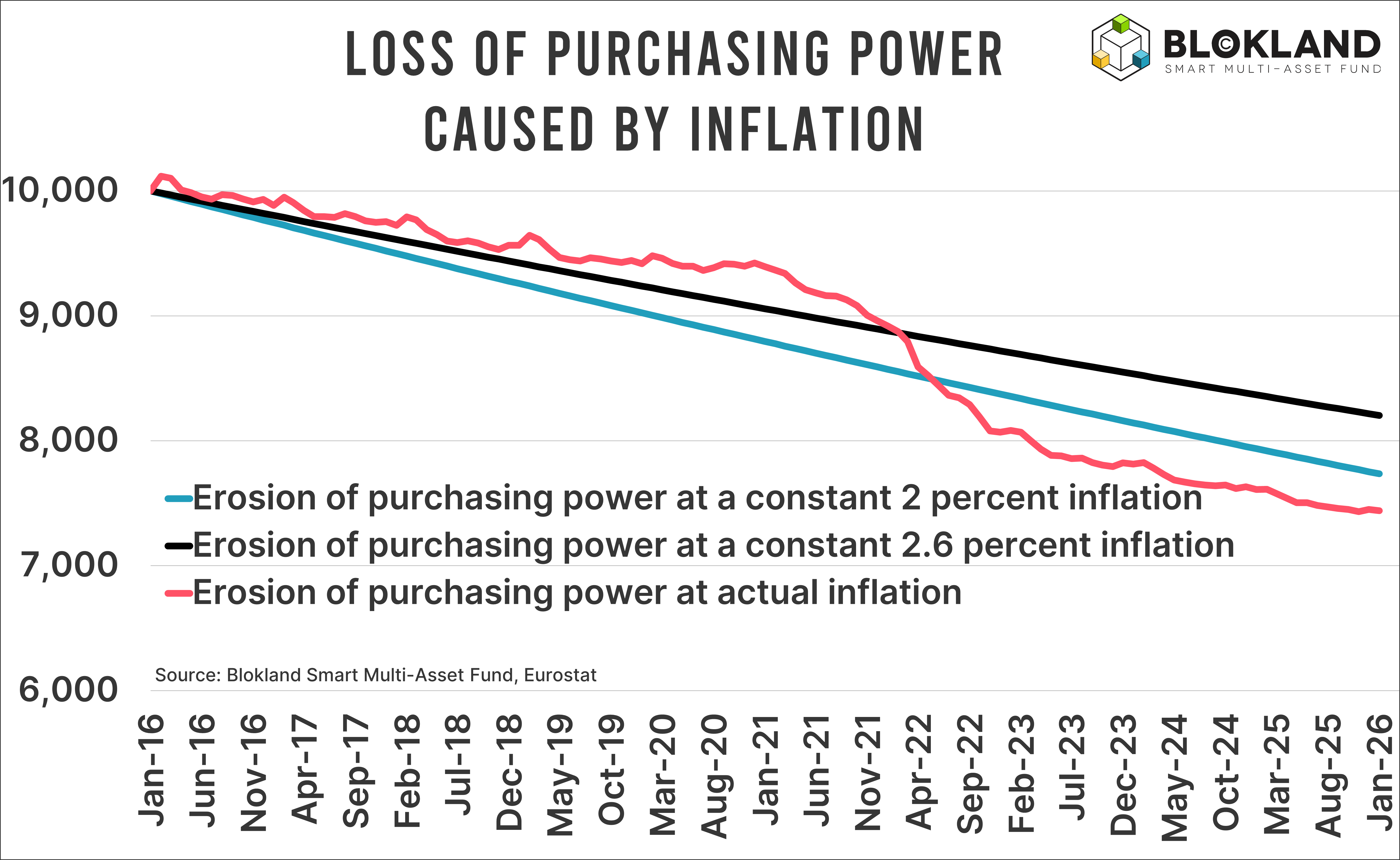
In addition, even a difference that looks small on paper adds up fast. Take the past ten years. Assume inflation was perfectly constant each month, so it ends up exactly at either 2.6 percent, or the ECB’s intended 2.0 percent. Then calculate the real value of €10,000 you kept under your mattress, adjusted for inflation.
At a constant 2 percent inflation rate, after 10 years, the real, inflation-adjusted value of that €10,000 would be just €8,203. In other words, with “only” 2 percent inflation, your money would have lost nearly 20 percent of its purchasing power in just a decade. I question if that is “normal” at all, something many people assume simply because the ECB has a 2 percent target, but let the structural loss of purchasing power sink in for a moment.
With a constant inflation rate of 2.6 percent instead of 2.0 percent, the real value of that €10,000 would have dropped to €7,736. So you lose roughly another €500 in purchasing power.
Those numbers do not exactly match the claim “inflation wasn’t that bad,” but judge for yourself.
“Inflation wasn’t that bad” — part II
I hesitated whether my next argument should have come first, but here it is second. Eurozone inflation was not 2.6 percent; it was 3.0 percent.
How? In many assumptions, interpretations, and reactions, people mix up concepts such as inflation (usually referring to the year-over-year change in a subjective basket of goods and services, the consumer price index, which is adjusted over time), affordability, currency debasement, and the general price level.
That 2.6 percent mentioned above is the average of the monthly inflation rates reported over the past ten years. But if you derive average inflation from the price level itself, measured as the CPI index level, you get 3.0 percent. You take today’s index level divided by the level ten years ago and annualize it.
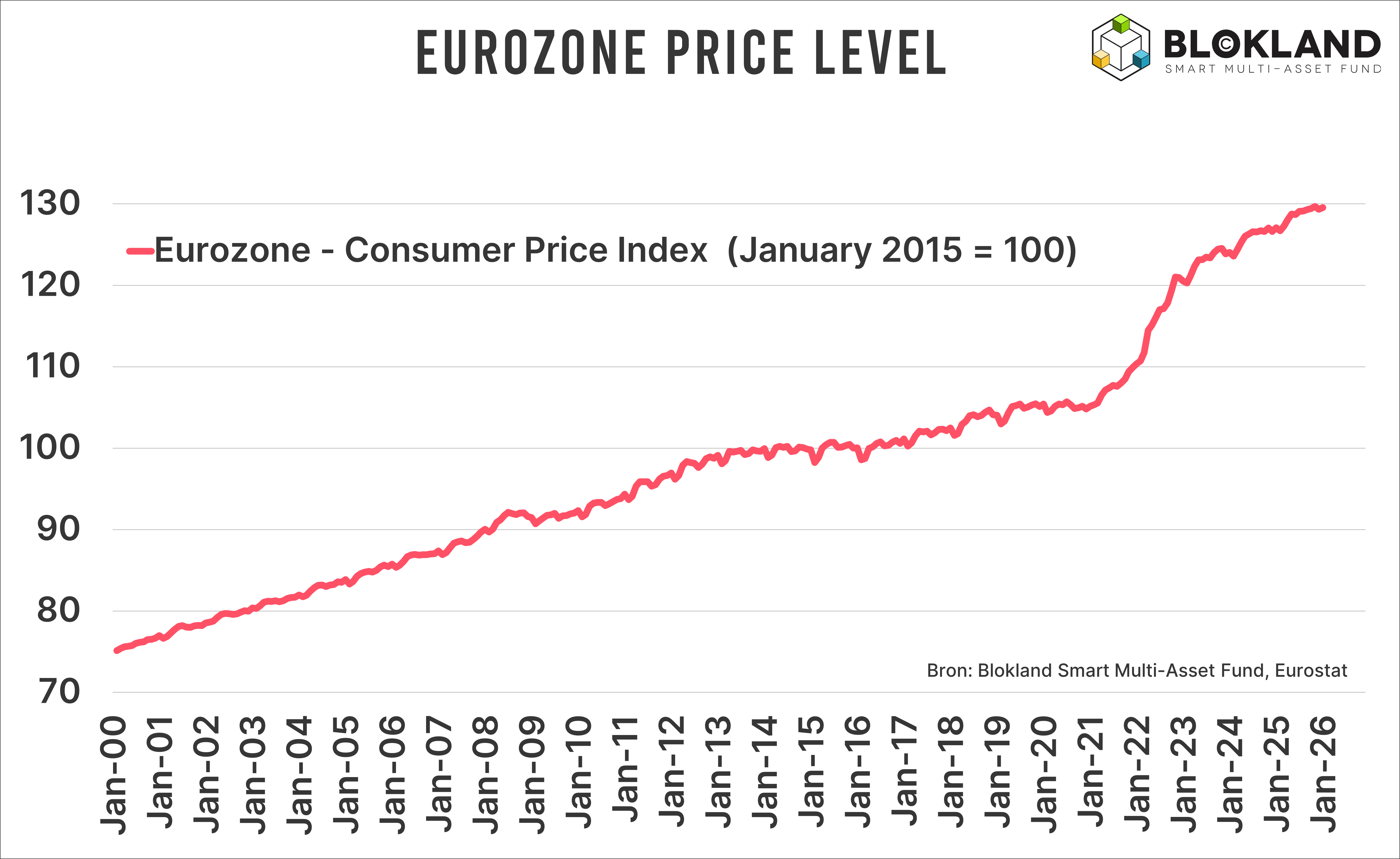
That is exactly how investment returns are calculated. And it captures the cumulative effect, the compounding, of continuous price increases. Averaging monthly inflation rates is not the cleanest way to think about the price level, and it understates what actually happened.
If you take the price level as the inflation anchor, then that €10,000 would be worth just €7,440. So in reality, you would have lost a quarter of your purchasing power if you had kept that money under your mattress. In just ten years!
Of course, other factors matter too, such as interest rates. But this puts inflation in the right perspective.
“It’s not the central bank’s fault”
Inflation is the result of many factors, sure. But that is not the same as saying “inflation is not the ECB’s fault,” which I saw more than once.
A few facts. In my book The Great Rebalancing, I provide an overview of the many programs the ECB launched to fight economic and financial crises. In most cases, these programs involved buying government bonds, and sometimes corporate bonds, at times when inflation was not an immediate problem. The result was a sharp increase in the money supply. There is overwhelmingly high-standard empirical evidence that excessive money supply growth goes hand in hand with inflation. So unless you argue that the ECB did not deliberately expand the money supply, you cannot seriously claim the ECB played no role in the post-COVID inflation surge.
According to the ECB, its policy rate averaged just 0.97 percent over the past 25 years, and only 0.67 percent over the past ten years. Yes, below 1 percent. And therefore, on average, well below inflation. Even over the past five years, the ECB rate averaged 2.3 percent, which still looks depressed compared to the average inflation of 4.1 percent.
Again, there is plenty of research suggesting that excessively low interest rates can be linked to inflation. Not always, but very often.
Did you know the ECB kept rates negative for almost eight years over the past 25 years, something long considered impossible? Add the period of zero rates, and you get ten full years. So for 40 percent of that 25-year period, you lived with zero or negative rates. Over the last 10 years, the ECB held negative rates for the majority of the time. Admittedly, inflation was below target for part of that time. But negative rates are still extraordinary.
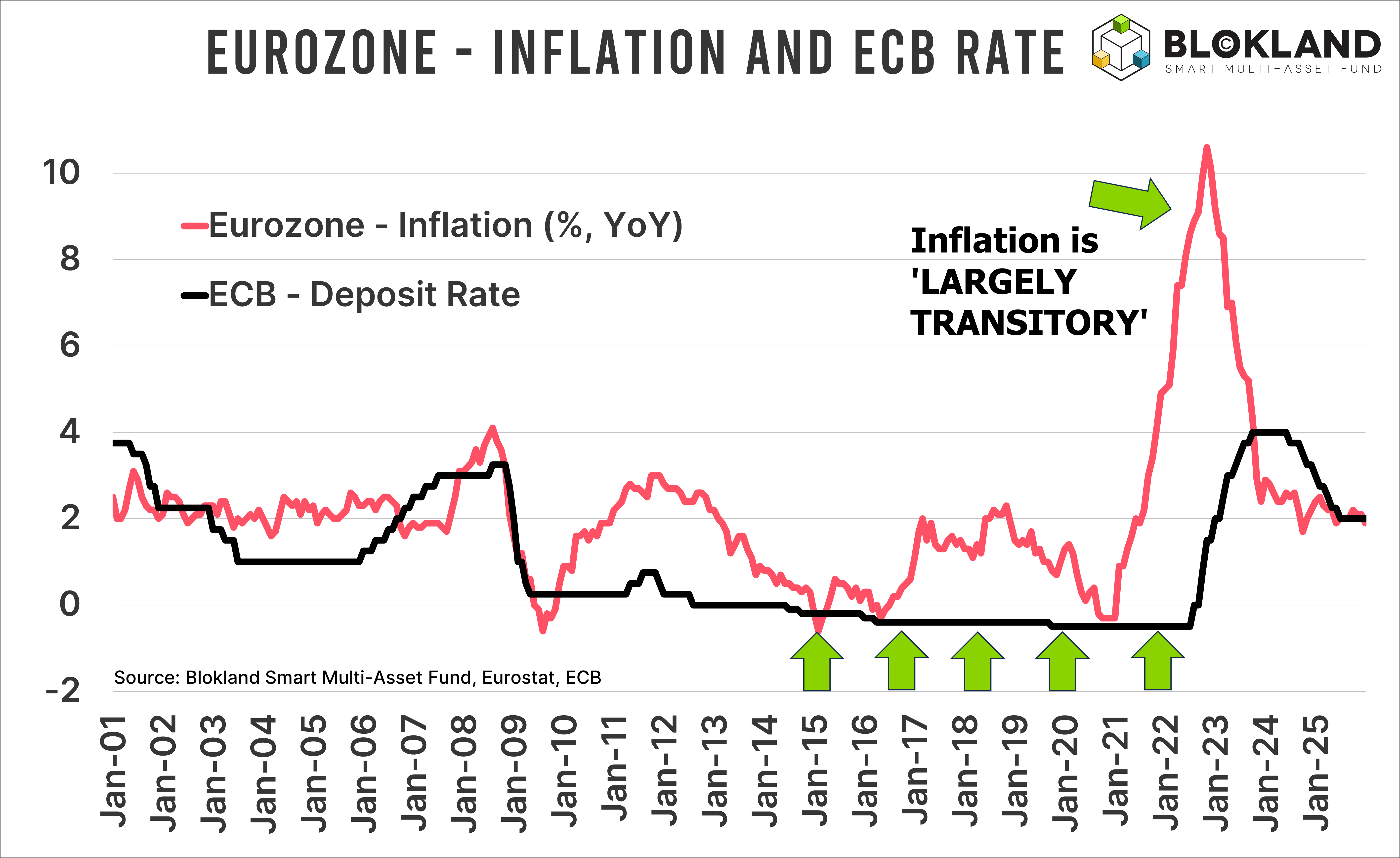
After COVID, when the ECB had already bought massive amounts of bonds, ECB President Lagarde kept insisting inflation was temporary, or “transitory”, as she called it. The result: rates did not move from minus 0.5 percent to zero until July 2022. At that time, eurozone inflation was an astonishing 8.6 percent.
I have written this before, but imagine you are sitting behind a machine with two buttons: one red and one green. Your only task is to steer a (random) number toward 2 percent. Press red, and the number goes down. Press green, and it goes up. When would you start pressing the red button? At 3 percent? 4 percent? Maybe 5 percent? I doubt many people would wait until 8.6 percent.
Finally, that same ECB cut rates again just nine months after its last hike, when inflation was still 2.6 percent. Within a year, rates were halved, from 4 percent to 2 percent, putting them right back below inflation.
The full picture is slightly more nuanced, of course. But it is more than fair to conclude the ECB has not been setting policy based on inflation alone.
“When I say inflation, I mean price increases, not money creation”
In everyday language, inflation refers to annual price increases, as measured by the CPI. That is also how I used inflation above. But that is not the original meaning of inflation.
As I describe in The Great Rebalancing, the word “inflation” comes from the Latin inflatio, meaning “swelling” or “expansion.” Starting in the 18th century, the term was used primarily to describe growth in the money supply. Inflation referred directly to the expansion of money itself. Only later did it become synonymous with rising prices, which are really a symptom of a deeper underlying cause: money creation.
If you want a clearer view of the ECB’s role as a driver of inflation, you should look at money creation too. Central banks sit at the center of that process.
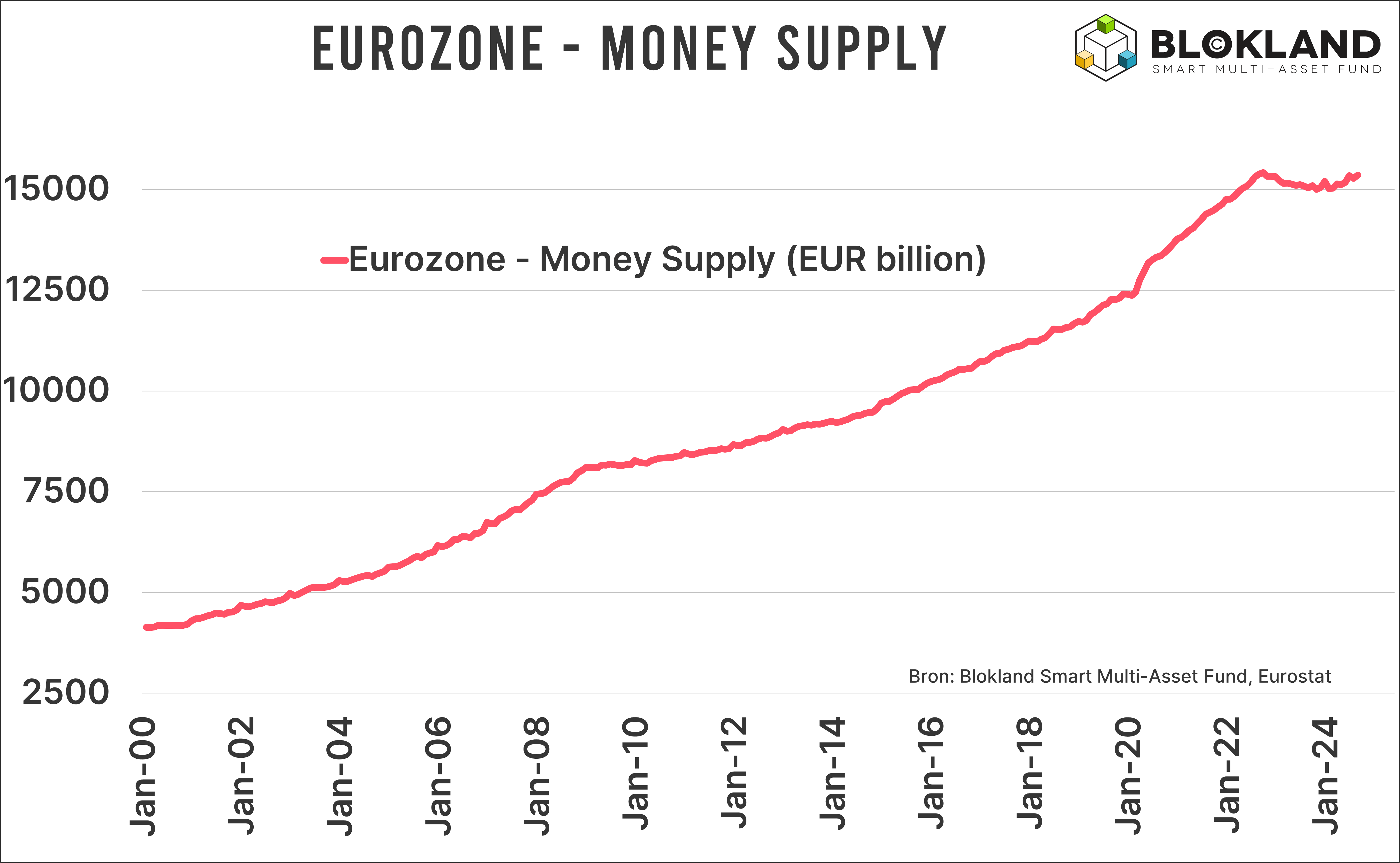
In the eurozone, the money supply (M2) has grown by an average of 6 percent per year over the past 25 years. If you keep it simple, that is the inflation the ECB created. A more advanced approach is to subtract real economic growth, or even more cleanly, productivity growth, since part of the money growth supports real activity. Eurozone GDP growth over the past ten years was about 1.5 percent (productivity growth was lower), which still leaves around 4.5 percent of “inflation,” meaning monetary inflationary pressure.
To be clear, there is an ocean of literature, including Taylor (of the Taylor rule), Reinhart and Rogoff (This Time Is Different), and, of course, Nobel Prize winner Friedman (“inflation is always and everywhere a monetary phenomenon”), showing the relationship between money creation and inflation (change in price level).
“Yes, but wages rose sharply too”
ECB data show wages have risen significantly over the past ten years, averaging 2.4 percent per year, slightly below inflation. For some people, that seems to imply that inflation is not a problem. Unfortunately, that is too simplistic.
First, it is questionable whether there was little loss of purchasing power at all, even with wage growth at 2.4%. Prices often move faster than wages, which tend to lag. Wage demands only rise after inflation has already done the damage. But that is not the main issue.
Rising wages also fuel a classic wage–price spiral. Anyone pointing to wage growth as proof that inflation “isn’t that bad” seems to forget that this is what central banks fear the most. If high inflation keeps getting compensated by higher wage growth, inflation becomes structural. Inflation becomes “entrenched,” and price increases become a given. Inflation expectations rise, increasing the risk of hyperinflation.
Wages are also sticky, especially in heavily regulated eurozone economies. Prices can fall. Wages typically do not. That means companies remain stuck with higher wage costs even when growth slows or turns negative, increasing the risk of bankruptcy.
On top of that, higher wages reduce international competitiveness. Within the eurozone, only Ireland and the Netherlands make the top 10 in competitiveness rankings, out of 69 countries. And both have been sliding in recent years. The Netherlands ranked fourth in 2021.
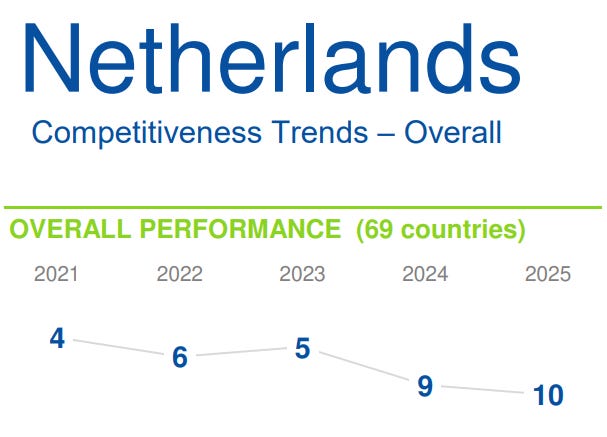
The major eurozone economies do far worse. Germany (19th), France (32nd), Spain (39th), and Italy (43rd) are not exactly leading the world in competitiveness.
And if you dig deeper, it gets worse. IMD breaks competitiveness down by category. Germany, France, Spain, and Italy rank 53rd, 60th, 40th, and 49th, respectively, on prices, out of 69. That is not a comforting statistic.
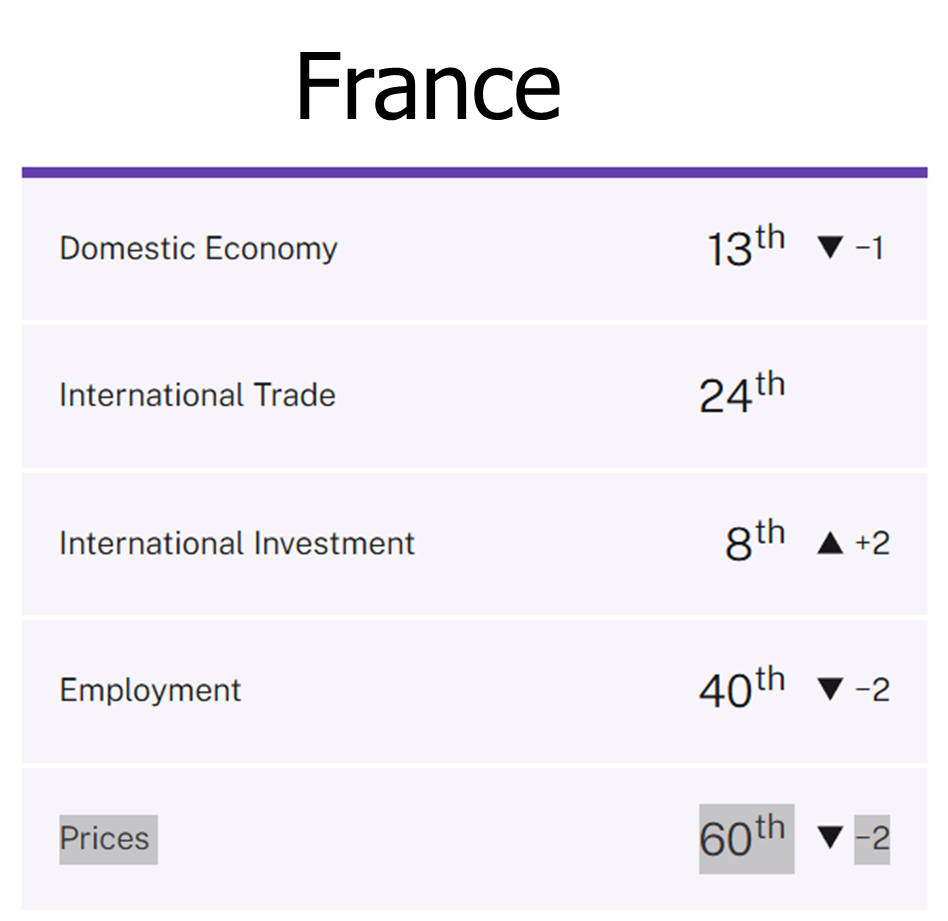
Arguing that inflation is not a problem based on wage growth is, even on this data alone, wildly optimistic.
I’m not done. Wage growth does nothing to offset the loss of purchasing power from savings and bond investing. Judging from the reactions, many people do not seem to realize that over the past 25, 10, and 5 years, they have lost purchasing power by saving, earning too little interest on cash, and by investing in a basket of global government bonds. Below is one of my favorite charts showing exactly that in a fully objective way, based on Bloomberg data series adjusted for inflation.
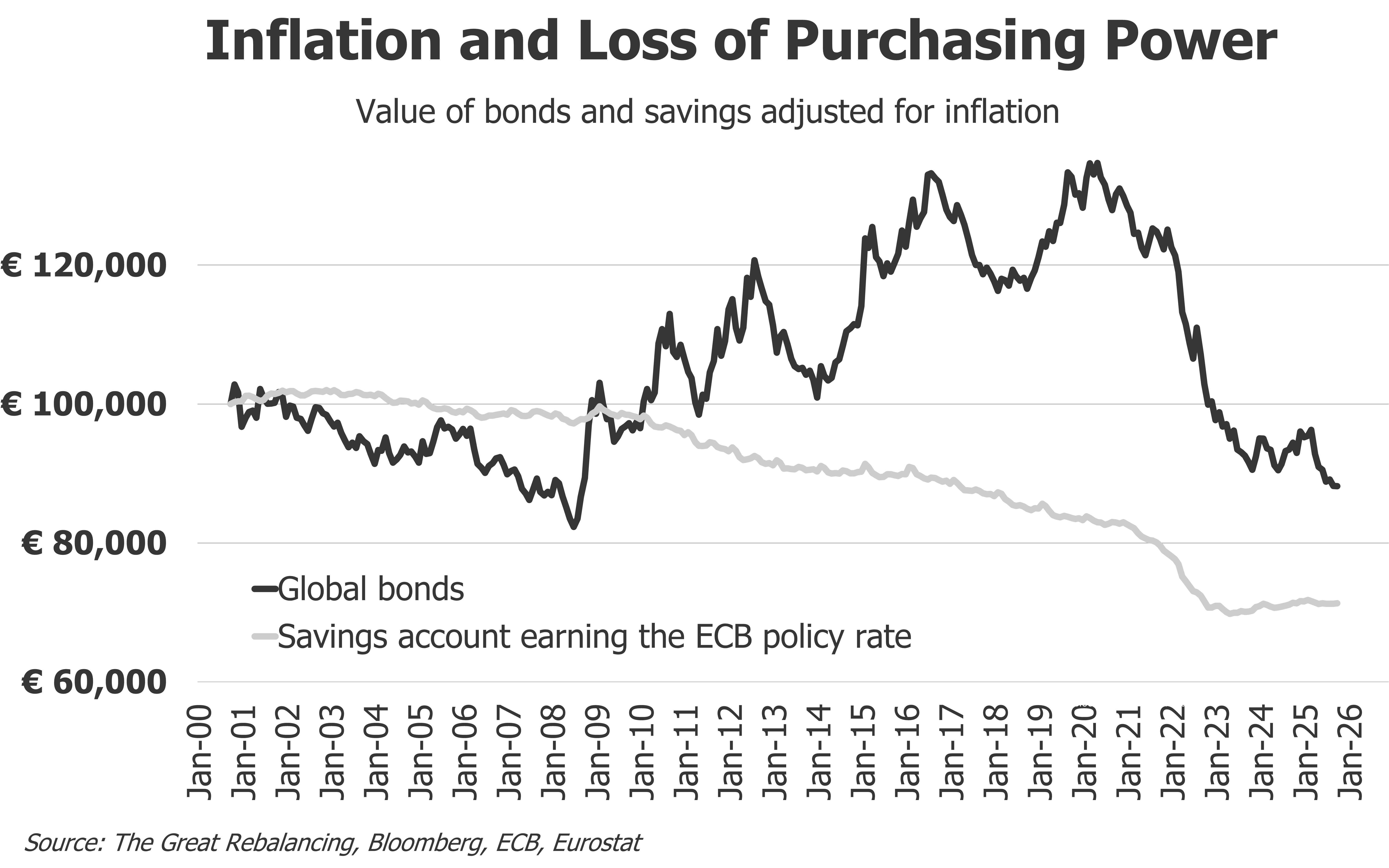
I do fully agree that savers should have invested (more information about the Blokland Smart Multi-Asset Fund here). Saving is not a virtue, especially not in a regime of structurally negative real rates, even though much of Europe still believes it is. But if you say that, you also have to be honest: investing in bonds was not at all beneficial either. And there is far more money in bonds than in savings accounts.
There is also a social dimension at play here. Wage growth applies to people who have jobs. Not necessarily to those living on benefits or pensions. Only if benefits and pensions are fully indexed to keep pace with the rising price level can inflation be offset. But that means higher government spending, which requires cuts elsewhere or higher taxes. Inflation typically increases inequality, something that should not be underestimated in a society growing more polarized.
“That inflation spike was an exception”
Many people believe the post-COVID inflation surge was an incident, a one-off, and will not happen again. I do not think eurozone inflation will simply jump back to 10 percent. But the probability of higher and more volatile inflation is significantly greater than before.
The reason is simple. Government budgets and already massive debt levels require drastic measures to keep debt “manageable.” Note: I am not saying governments will go bankrupt. Quite the opposite. They increasingly rely on central banks to prevent debt from bringing the system down.
In the United States, this is happening in an extreme way. President Trump is trying to force lower rates. First by placing a proxy inside the Fed who calls for large rate cuts at every meeting. Then by suing the Fed and its members. Whether Trump succeeds in pushing rates structurally lower remains to be seen. What we do know is that the Fed always bends to debt when a crisis hits, which helped produce the highest inflation in forty years after COVID, and is now increasingly being pressured to cut rates even under so-called “normal” conditions.
At this point, people would argue: “Yes, but we are not America.” True. But the ECB and the eurozone have their own problems. Remember Draghi’s “whatever it takes.” The multi-year bond-buying that followed had nothing to do with inflation. Neither did the bond purchases during COVID.
What do you think would happen if France became an even bigger focus for investors? Do you really think the ECB will let French yields explode because France has become an unaffordable welfare state? If they did not let Italy fall, they certainly will not let France fall. And anyone who thinks France will suddenly get its finances in order should read my book. Aging, pensions, social spending, polarization: France simply cannot deliver structurally sound budgets. Not with a debt ratio well above 100 percent of GDP.
Fiscal dominance, characterized by low rates, excessive central bank money growth, and elevated inflation, reinforced by financial repression that traps capital in government debt, is the regime that keeps debt sustainability alive. Inflation is not a side effect. It is a requirement.
In short, the assumption that inflation “wasn’t that bad” and that central banks will now, and in the future, successfully contain inflation and steer it neatly back to 2 percent, is… rather optimistic.

Comments
Nothing yet. Say the first thing.
Sign in to join the conversation.