
This year marked the first time that the Blokland Smart Multi-Asset Fund participated in the IEX Investors’ Day, one of the biggest retail investor events in the Netherlands. I can honestly say it was an enormous success. At the same time, it was also highly enlightening. Once again, it became abundantly clear that many investors still do not fully understand the power of scarcity. That is why I want to make another attempt to explain it as clearly as possible.
Scarcity as a characteristic
Before I do, I first want to make one thing clear: scarcity is a characteristic. It is a distinguishing feature that makes an asset class attractive. Just as a low valuation, rapid earnings growth, or stable cash flows can make an investment attractive. In fact, I will argue below that scarcity is a far more reliable characteristic if your goal is to grow your wealth.
Many investors view scarcity as little more than a side effect, an accidental outcome, or even as something irrelevant when evaluating the universe of investments available to them. The challenge, therefore, is to demonstrate how this, in my view, crucial investment characteristic translates into value and investment returns.
Scarcity in practice
Unlike with investing, people intuitively understand the value of scarcity in everyday life. Who wouldn’t want to fly business class or sit in the front row when Taylor Swift is performing (or getting married)? The chances of enjoying a more comfortable flight or getting the very best experience from your favorite artist are simply much greater with the best seats. And people are willing to pay a great deal of money for those scarce seats.
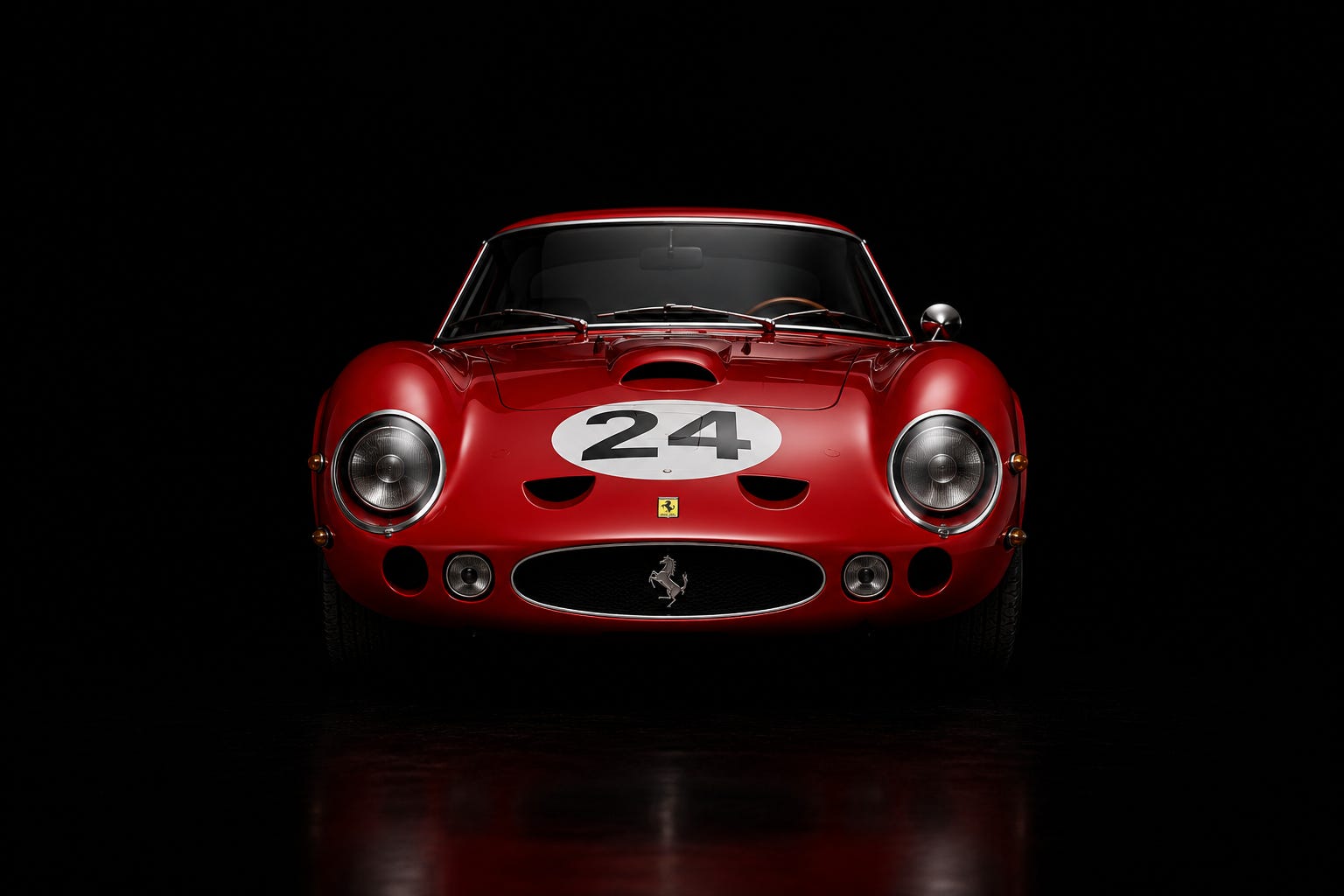
Even people who have little interest in cars probably understand why a Ferrari 250 GTO sells for more than $50 million. The 250 GTO won race after race in its day, captured three consecutive world championships, and is widely regarded as one of the most beautiful cars ever built. More importantly, only 36 were ever produced. And they were not simply sold to anyone willing to pay for them. They were carefully allocated to a very select group of drivers and racing teams.
A Diamond Is Forever
In 1947, De Beers, then the world’s most powerful diamond company, introduced the iconic slogan “A Diamond Is Forever.” The slogan not only emphasized the durability of diamonds but also became the centerpiece of a brilliant marketing strategy that positioned diamonds as something truly exceptional and valuable. De Beers became remarkably successful at creating artificial scarcity. By tightly controlling the supply of rough diamonds and deliberately withholding inventory from the market, together with its hugely effective marketing campaign, it kept prices high.
In reality, diamonds are nowhere near as rare as most people believe. Carbon, the element from which diamonds are made, is the fourth most abundant element in the universe. The true scarcity lies in the very specific geological conditions required to form diamonds deep beneath the Earth’s surface. But that abruptly came to an end.
Since 2020, the production of lab-grown diamonds, led by China and India, has exploded. These diamonds are chemically, physically, and optically identical to natural diamonds. The inevitable result was a collapse in prices. Diamonds turned out to be far less scarce once production could be scaled up on an industrial level.
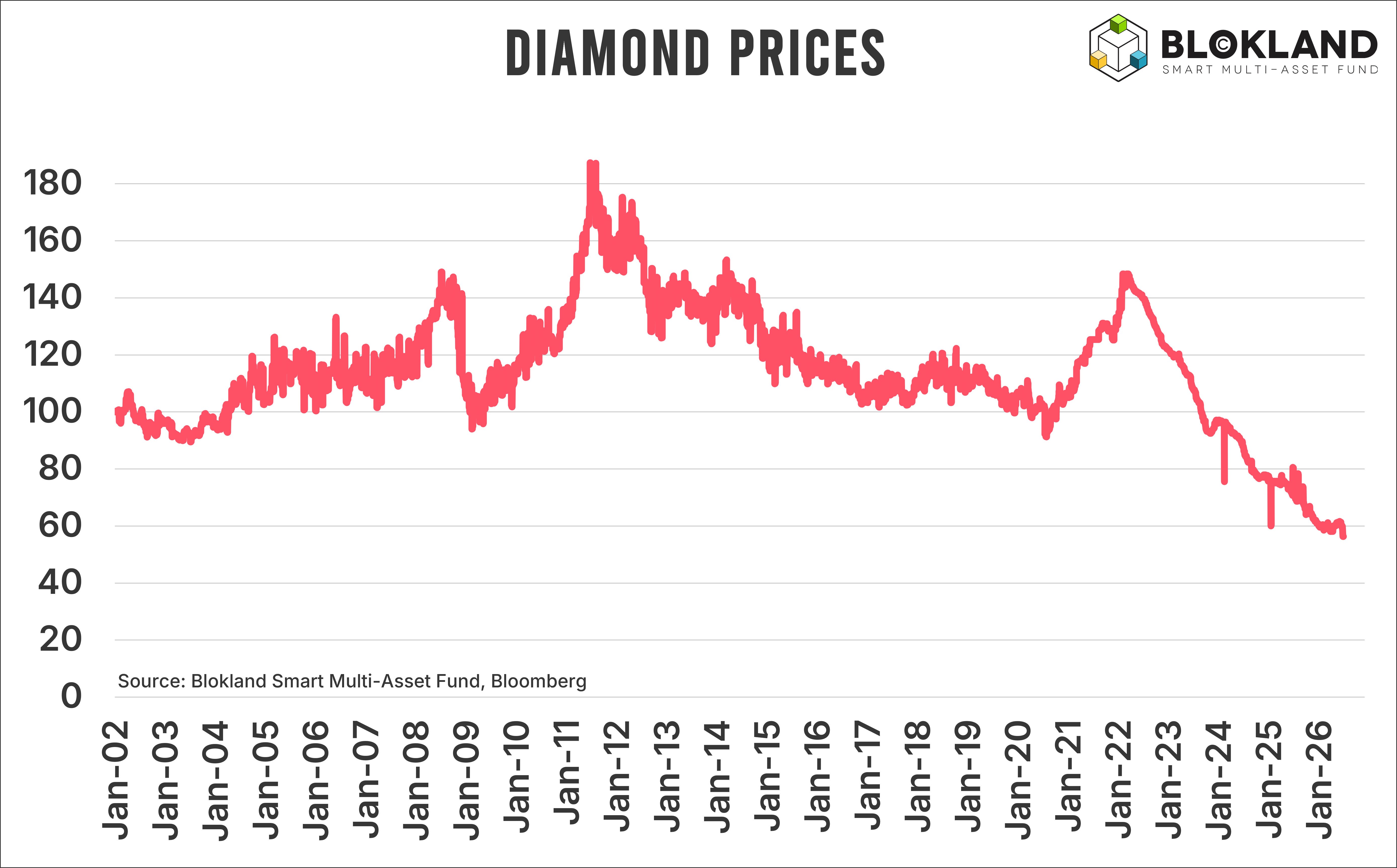
Not all scarcity disappeared, however. Since 2020, the price of lab-grown diamonds has fallen by more than 70%, while natural diamonds have declined by “only” 30% to 40%. People are still willing to pay a substantial premium for a diamond they perceive to be rarer and more special.
Nevertheless, while a diamond is forever, its value certainly is not.
Abundance
The examples above illustrate just how important scarcity is in determining value. Now, let me turn to perhaps the single most important element of our economy and financial system: money.
Our money, fiat money, is anything but scarce. And it has no intrinsic value whatsoever. Money is a social contract. An agreement. We accept it because we can use it to make payments, because everyone else accepts it, and because governments recognize it as legal tender. That is all it is.
Fiat money depends entirely on trust. It is the government’s promise that the rules we accept today will still apply tomorrow and that you will once again be able to buy your groceries with them.
And that is precisely where the problem lies.
Fiat money can be created without limit. Central banks can print new money at the push of a button. Commercial banks create new deposits (IOUs) out of thin air whenever they extend a loan. Governments, confronted with the enormous economic consequences of aging populations, continue to accumulate debt that is increasingly financed with newly created money. Our money has nothing to do with scarcity and therefore represents no real value.
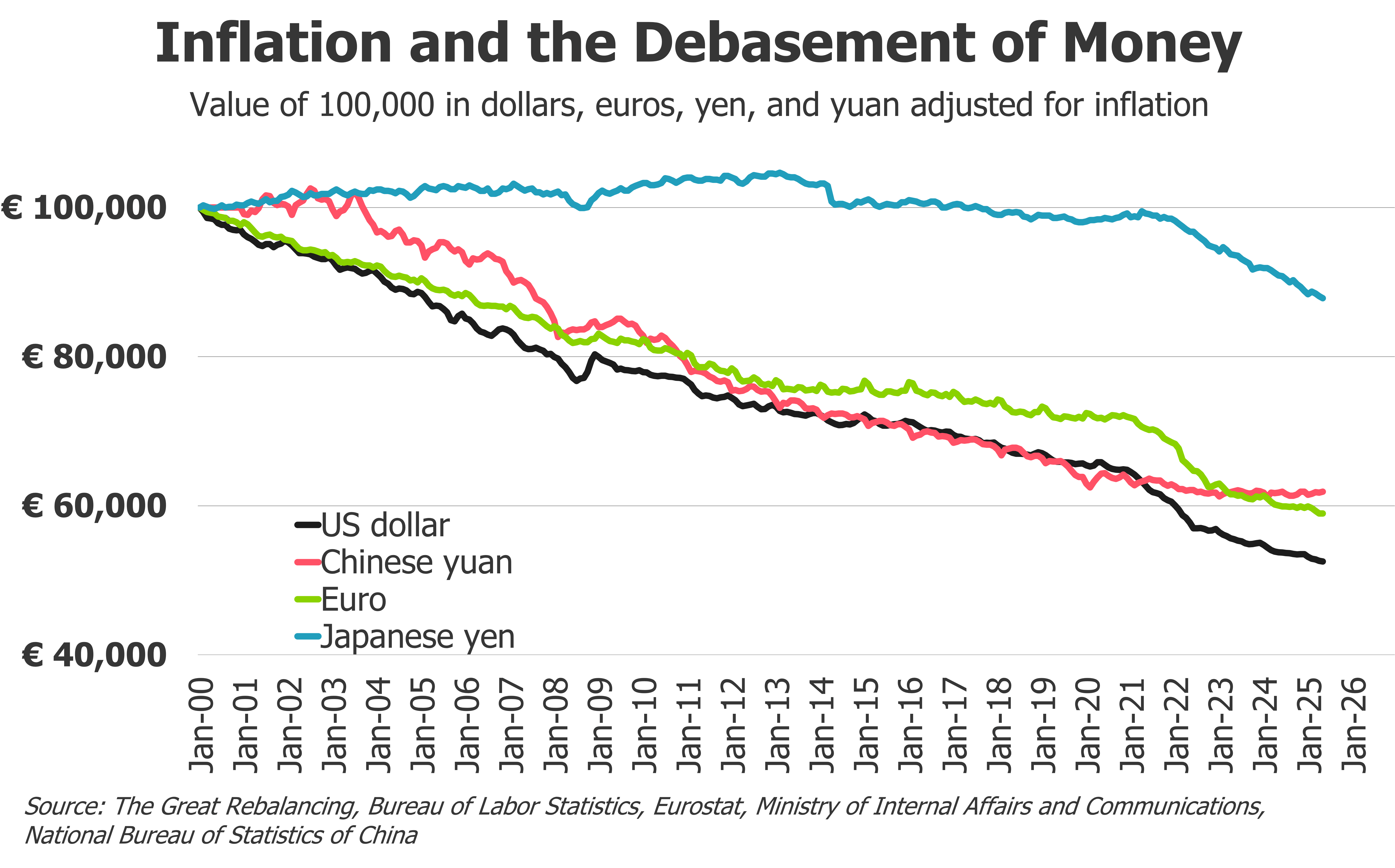
The inevitable result is a persistent loss of purchasing power. Since the beginning of this century, the U.S. dollar has lost roughly 50% of its purchasing power. The euro has lost more than 40%.
Simply because more and more dollars and euros are being created with no true store of value behind them.
The scarcity behind money
Endless printing and the steady destruction of purchasing power continuously erode confidence in our money. And every time the financial system lacked sufficient true value to underpin that confidence, it eventually broke down. From Roman emperors and English kings to today’s unprecedented debt accumulation, history tells the same story. Every time trust in money and its value are debased too much, the system breaks down.
What, then, has consistently provided trust in money throughout history? The answer is straightforward: gold.
For thousands of years, gold, and to a lesser extent silver, has been the anchor that either kept the financial system intact or allowed it to reset. And there is only one reason why: scarcity.
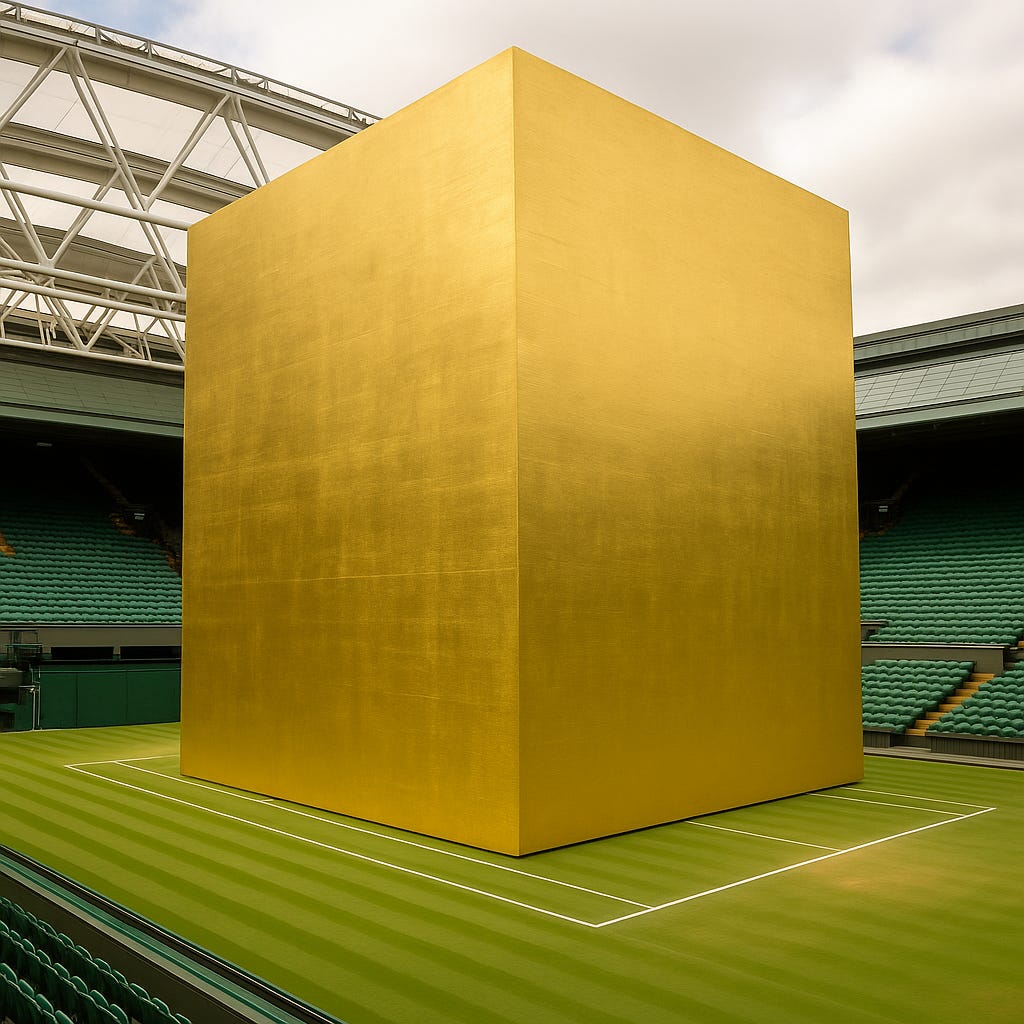
All the gold ever mined fits into a cube measuring just 22 by 22 by 22 meters. Those numbers only become more meaningful when you realize that such a cube would fit comfortably on Wimbledon’s Centre Court without removing a single seat. Just picture that for a moment. All the gold in the world fits into a cube that you could walk around in less than a minute.
That is how scarce gold really is.
It is precisely that scarcity that has always inspired confidence in our money. For centuries, gold and silver literally were money. Later, they directly backed our fiat money, whether in paper or digital form. Until President Nixon abandoned the gold standard in 1971, you could, at least in theory, exchange dollars for gold.
Since then, we have relied solely on trust. Yet that trust is tested time and again as more and more money is created without anything of real value standing behind it. Central banks still hold much of the gold that once served as proof of value behind our money, but the amount of money supported by that gold has exploded.
However, not every country chose to hold on to its gold. The best-known example is the United Kingdom, which, under Gordon Brown, sold 400 tons of gold between 1999 and 2002 at the absolute bottom of the market, a decision that has since become known as Brown’s Bottom.
Scarcity as an investment
Gold is every bit as scarce as that Ferrari 250 GTO. Holding a gold coin or gold bar in your hand should feel like owning that extraordinary car in your garage. At least, that is how it should feel. You own a tiny piece of that cube sitting on Wimbledon’s Centre Court.
But gold is even better.
It is money. You can use it, admittedly with some effort, almost anywhere in the world. It is trust that you can literally hold in your hand. And if you look at the long-term price charts of gold measured in euros or dollars, one thing immediately becomes clear: gold is stored value.
Because it is scarce.
Whether it is the cube, the comparison with a classic Ferrari, or the realization that gold is real money, the important thing is to understand the value of scarcity. Once you start looking at gold as a unique form of scarcity that represents real value, the familiar objections, “Yes, but gold has no cash flows,” or “Gold is a dead investment,” suddenly look very different.
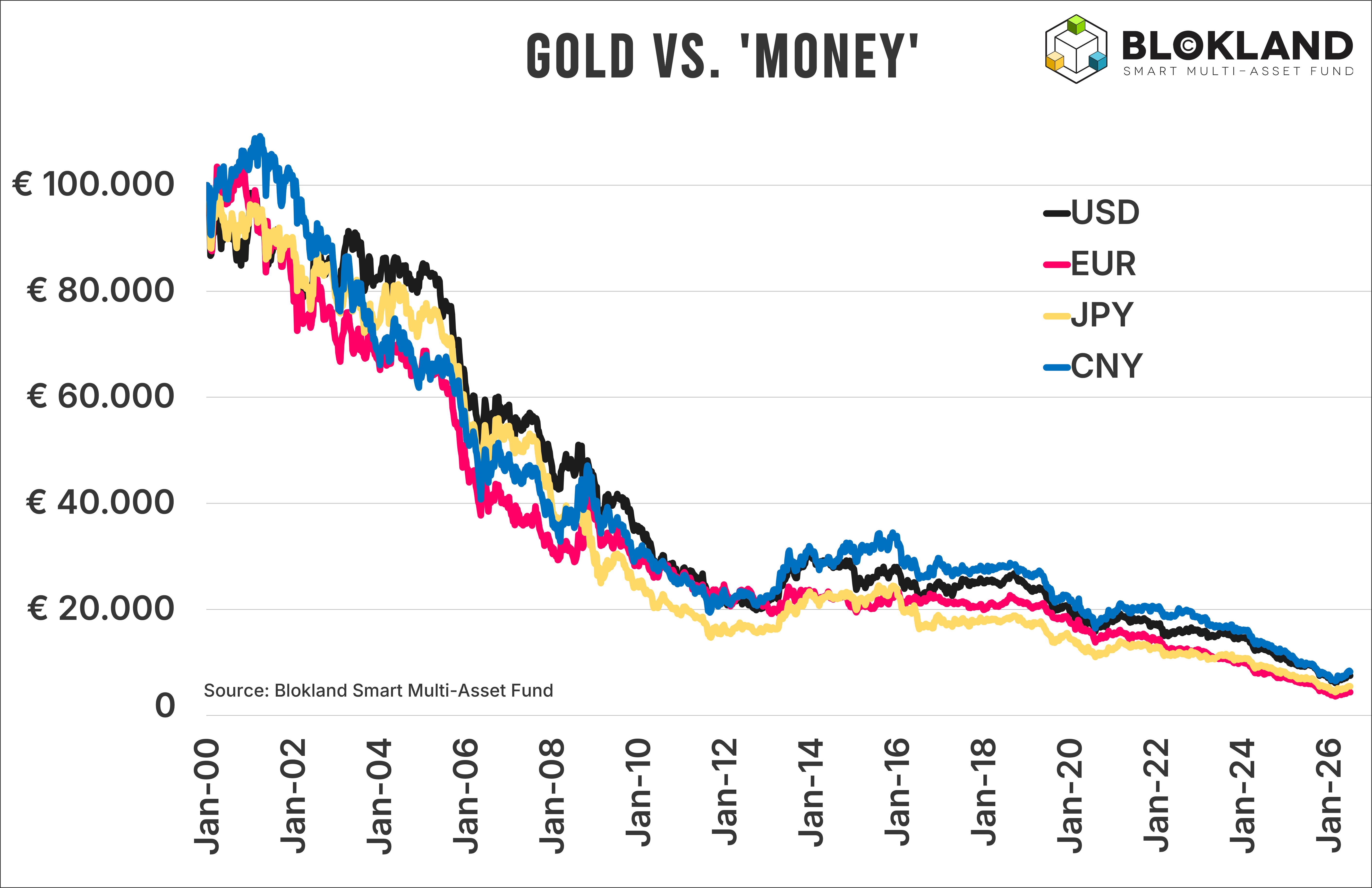
By the way, gold is anything but dead.
That coin or bar in your hand, or in your vault, is a piece of monetary history. It is pure scarcity. It cannot be destroyed, and it will never lose its value. Not least because you simply cannot produce gold in a laboratory or create more of it with a printing press.
Why gold, with its long monetary history, becomes even more important in an economy driven almost entirely by debt, resulting in ever more money printing, lower interest rates, and higher inflation, is a subject I will gladly return to (again) another time.
Blokland Smart Multi-Asset Fund
Scarcity is the foundation of the Blokland Smart Multi-Asset Fund’s investment philosophy. We firmly believe that scarce assets belong in every investment portfolio, with gold as its cornerstone.
That is why the Blokland Smart Multi-Asset Fund maintains a 25% strategic allocation to physical gold. The gold is securely stored in a vault in Switzerland, fully insured, and allocated in the fund's name.
If you would like to learn more, please feel free to contact us. You can email us at info@bloklandfund.com or reach me directly at jeroen@bloklandfund.com.
We would be delighted to discuss how your investment portfolio can be better positioned for the future.

Comments
Nothing yet. Say the first thing.
Sign in to join the conversation.