
Dutch pension provider APG has published its 2025 returns, and they were not impressive, to say the least. Of course, every investor faces headwinds from time to time. What stands out, however, is that the Netherlands’ largest pension asset manager faces remarkably little criticism. And this applies to many pension funds worldwide.
Because the reason for the underperformance looks suspiciously like wishful thinking, or worse, herd behavior, which runs counter to the ambition of pursuing a more active investment policy.
Let me be very clear from the start. Pension fund results cannot be compared directly with the performance of asset classes, benchmarks, or investors focused solely on maximizing returns. Pension funds have interest-rate-sensitive liabilities that need to be hedged.
However, the extent to which the latter should be done deserves far more scrutiny. Especially when the instruments used to hedge those liabilities structurally destroy purchasing power. Yale recently published research showing that the traditional 60/40 portfolio, consisting of 60% equities and 40% bonds, which many pension portfolios still resemble, is far too defensive. But that is a discussion for another time.
My focus here is on APG’s much-emphasized active management. The results have been poor, not only last year but over multiple years. You need to scroll through APG’s 216-page annual report, but in just five pages, you find the key performance figures and a rather limited explanation. For reference, APG devotes 50 pages to sustainability.
Back to performance. The actively managed portfolio underperformed by more than 3 percentage points in 2025. Over the past five years, the underperformance averaged 3.5 percentage points per year. That is, to put it mildly, disappointing. Many investors at commercial asset managers would not survive such a track record.
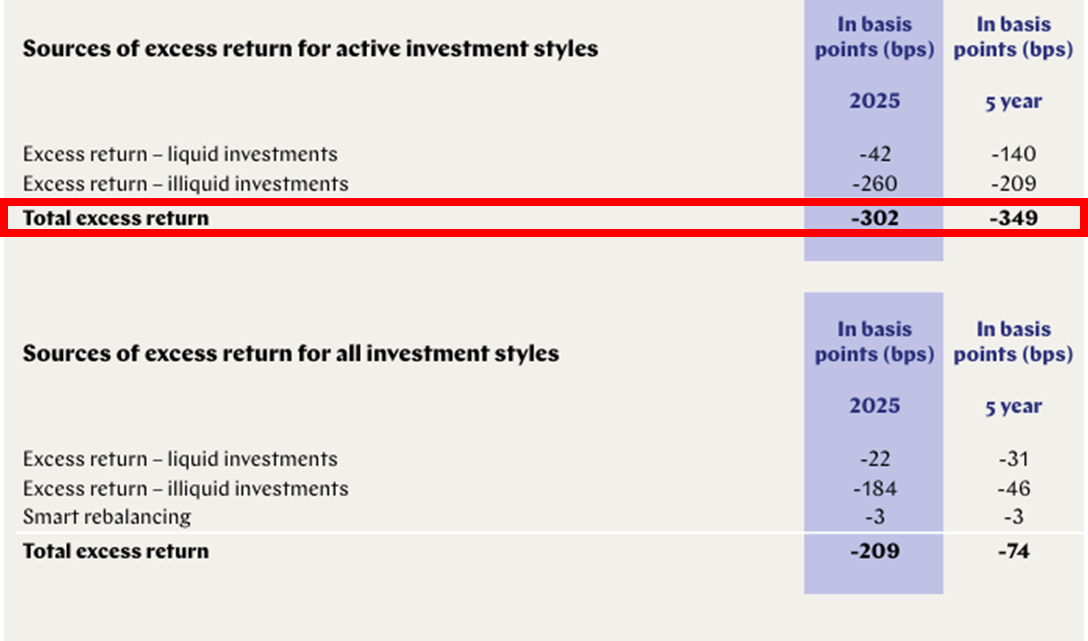
The main reason? Private equity. Not the only one, but certainly the most important. This asset class underperformed its benchmark by nearly 14 percentage points in 2025. APG attributes this to the strong performance of companies directly involved in the AI boom, which are underrepresented in private equity.
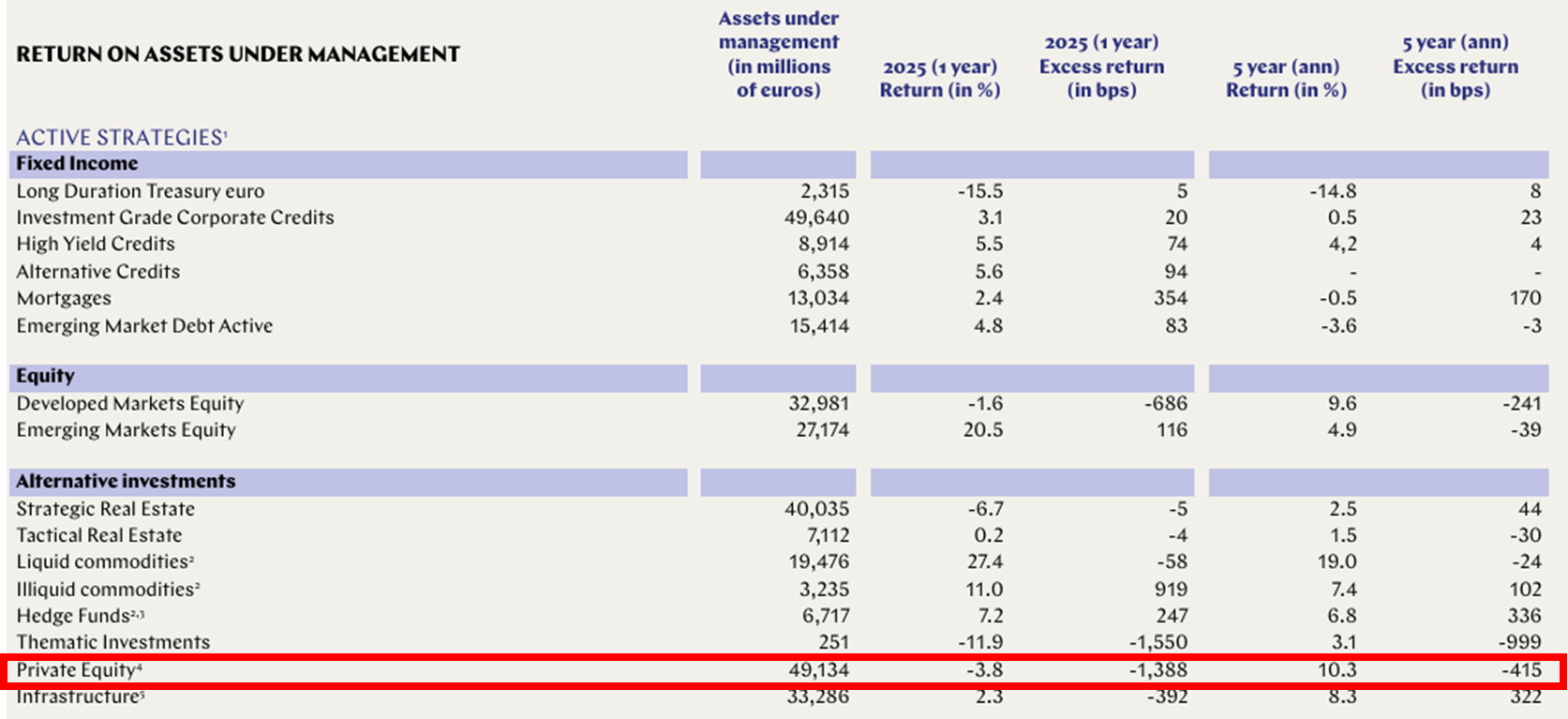
I reviewed the statistics, and there is some truth in that explanation. But it also gives the impression that APG, like many pension funds and institutional investors, has been captivated by compelling marketing narratives, inspired by the success of the Yale endowment.
However, the era of David Swensen, the Yale endowment manager who embraced the illiquidity premium in the 1980s, has long passed.
Today, private equity looks very different. Since the 1980s, a large body of empirical research has emerged, including studies in leading academic journals, showing that the characteristics of private equity are far less attractive than often presented.
The work of Ludovic Phalippou, Professor of Financial Economics at Oxford’s Saïd Business School and author of Private Equity Laid Bare, makes this abundantly clear. When appropriate benchmarks and return metrics are used, there is no consistent outperformance. Phalippou therefore concludes that the excessive fees charged by private equity managers are not justified.
Numerous studies also show that private equity volatility is structurally underestimated due to lagged valuations. Once returns are “desmoothed,” volatility typically rises above that of public equities. Correlations with listed equities also increase, causing the supposed diversification benefits to largely disappear.
In my book The Great Rebalancing, I examine these narratives in detail, highlighting how the appealing stories surrounding private equity often diverge from reality.
It does not take much effort to find evidence that private equity is less superior than often claimed. But beyond empirical studies, basic economic logic also raises concerns.
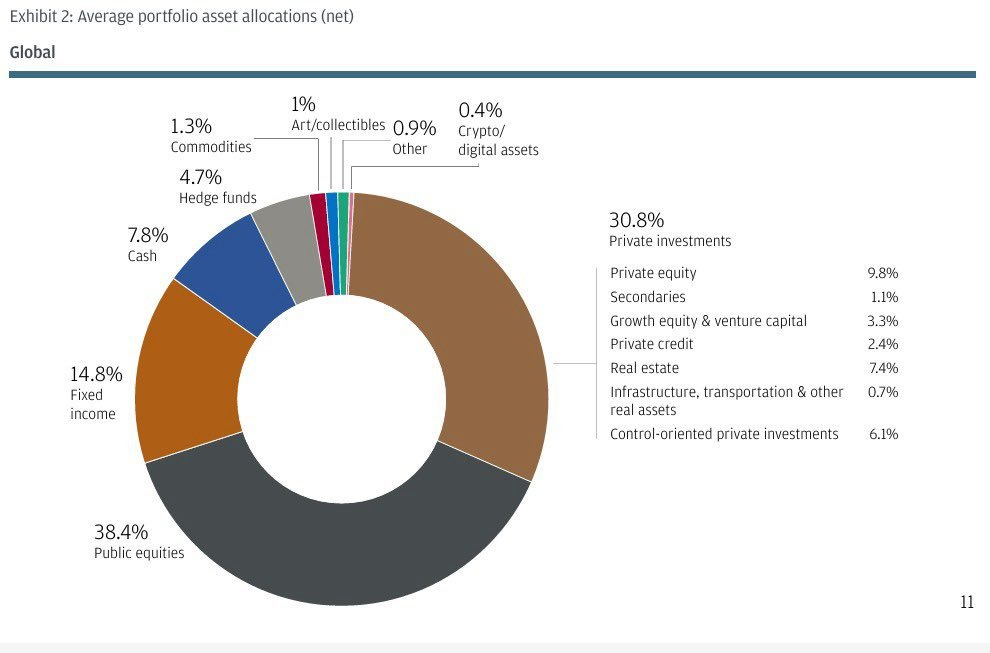
Like many endowments, sovereign wealth funds, and other pension funds, APG’s portfolio is heavily exposed to private equity. Within the actively managed portfolio, private equity is the second-largest category after corporate bonds. Family offices go even further, often allocating more to private equity than to publicly listed equities.
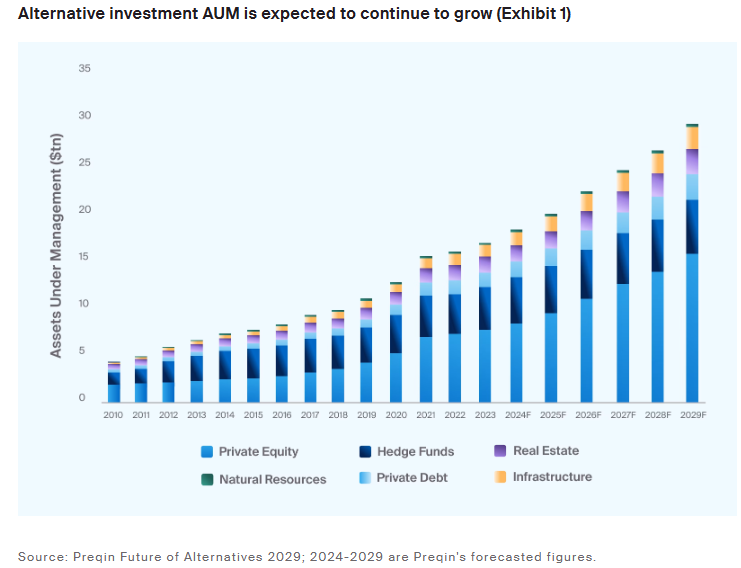
This is precisely where additional risks emerge. The compelling narratives have driven massive inflows into private equity. While this may expand the universe somewhat, more capital does not automatically create more attractive investment opportunities.
Quite the opposite. The pressure to deploy large amounts of capital increases the likelihood that investments flow into less attractive opportunities. It is a classic case of too much money chasing too few (good) assets.
Cracks in the private equity universe are already becoming visible. Unless interest rates decline meaningfully, which would improve financing conditions and valuations, these pressures are unlikely to ease.
ABP’s investment policy is now being revised. Alongside a greater focus on index investing, which does not sound particularly active, the question remains whether a genuine strategic reorientation will follow.
I suspect not. APG remains confident that its active strategy will deliver over time. I have my doubts.
Will they ever consider an asset class that has preserved value and purchasing power for thousands of years, the foundation of any solid pension system?
Do you believe in that asset class, and are you less convinced by private equity? Or would you prefer to build your own investment portfolio and reduce dependence on pension fund performance?
Take a look at the Blokland Smart Multi-Asset Fund. We invest in a thoughtful combination of quality equities, physical gold, and bitcoin, not in private equity or private debt.
Feel free to contact me at jeroen@bloklandfund.com. You are also welcome to call. You will find all contact details and further information on our website.
Kind regards,
Jeroen Blokland

Comments
Nothing yet. Say the first thing.
Sign in to join the conversation.