

In March this year, The Block published an analysis with a blunt conclusion: the large majority of enterprise blockchain pilots in regulated sectors never reach production. Not because the technology broke, but because the architecture assumed the wrong governance model from the start.
That finding fits a pattern that has held steady for years. Deloitte’s 2024 Global Blockchain Survey reported that 83% of executives saw a compelling business case for blockchain. Only 31% had moved beyond the pilot stage. By mid-2025, Deloitte’s CFO Signals survey showed momentum building in a different way: 23% of North American CFOs at billion-dollar companies said their treasury departments plan to use cryptocurrency within two years. Only 1% ruled it out entirely. Boards are talking about it. CIOs are fielding questions. The interest is real and growing.
Meanwhile, the global blockchain market grew from $31 billion in 2025 to a projected $48 billion in 2026, according to Fortune Business Insights. Sixty percent of Fortune 500 companies now have at least one active blockchain project.
The money is moving. The pilots are launching. But the conversion from pilot to production remains stubbornly low.
After two years of tracking enterprise blockchain adoption through our newsletter, consulting conversations, and research, we keep seeing the same five patterns in the projects that stall. Each one is avoidable.
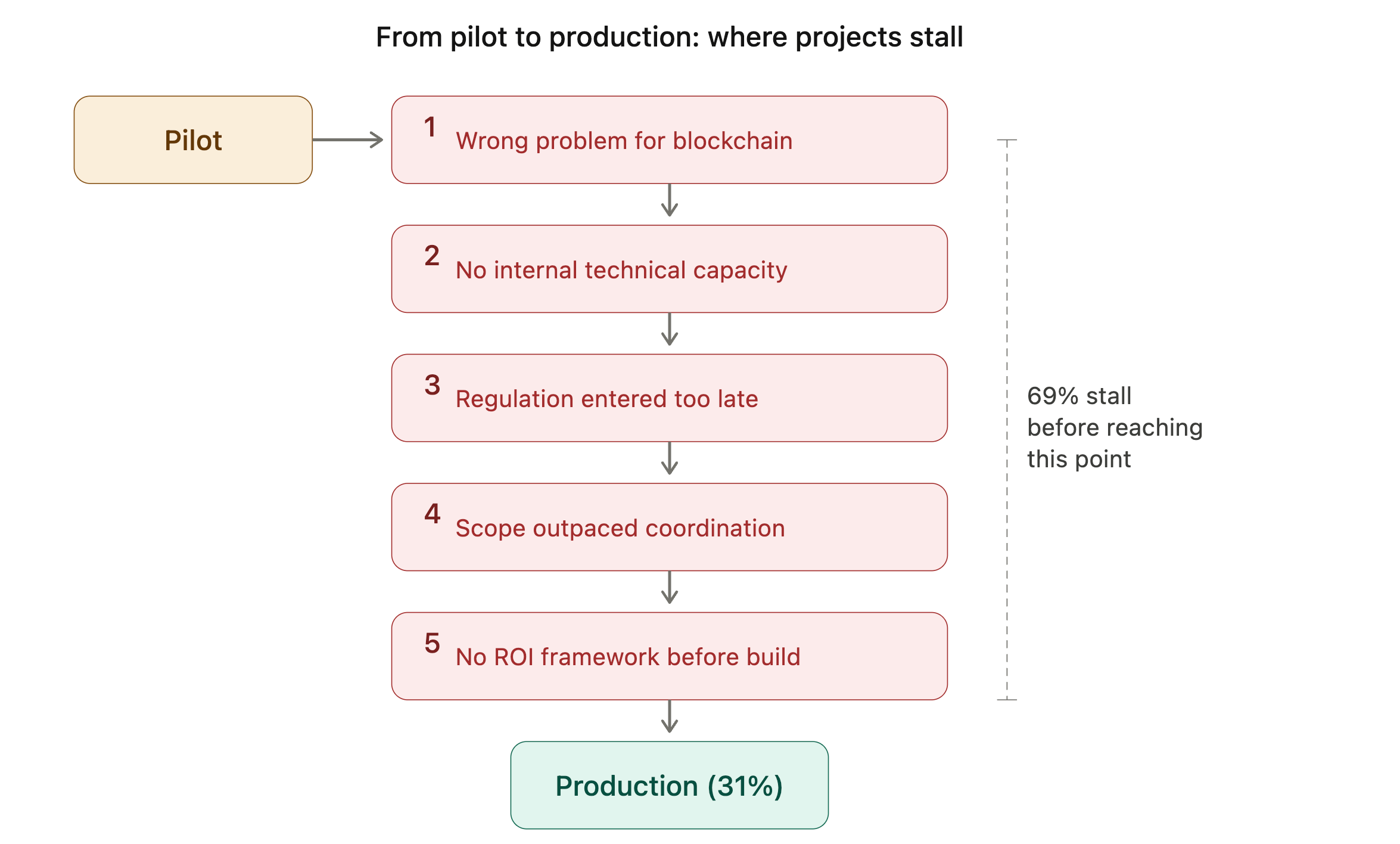
This is where most failures begin, and it happens before anyone writes a line of code. A team picks blockchain because the technology feels like the right answer. But nobody tested whether the problem actually requires it.
Blockchain adds value in a specific situation: when multiple parties need to share a single source of truth and no one party should control it. If one company owns the data and the workflow, a well-built database with proper access controls does the same job faster and cheaper.
Three questions cut through the noise. Does this involve more than one organization sharing data? Does removing a central intermediary create measurable savings? Would the participants benefit from an immutable, time-stamped record?
If all three answers are no, the project does not need a blockchain. It needs better infrastructure. Gartner noted that many organizations still confuse “distributed ledger” with “distributed database.” That confusion produces projects where blockchain is layered on top of a problem it was never designed for. The outcome is a slower, costlier version of what already existed.
Hiring a consulting firm to build a blockchain solution is standard. Counting on that firm to manage it forever is where the trouble starts.
Enterprise blockchain systems require continuous upkeep: node management, smart contract updates, key rotation, consensus tuning, and network monitoring. If no one inside the organization can handle those tasks, the project lives or dies on a vendor contract that may not scale, may not renew, and will cost more every year.
The teams that make it to production invest in internal knowledge from day one. That does not mean retraining the entire engineering department. It means at least one person on staff understands the architecture well enough to troubleshoot, deploy patches, and assess whether the system is doing what it was designed to do.
When blockchain is treated as something you purchase rather than something you learn to operate, the project tends to stall the moment the initial engagement wraps up.
Building a working prototype in a sandbox is fast. Getting that prototype past a compliance team in a regulated industry is where timelines collapse.
The Block’s March 2026 analysis flagged this as a structural issue. Most blockchain platforms are built around a transaction-first model: if the code runs correctly, the result is valid. Regulated institutions work on the opposite principle. A transaction is only valid if it satisfies policy and compliance requirements before it runs.
That mismatch forces teams to rearchitect at the approval stage. In financial services, healthcare, and supply chain operations, regulatory requirements are not a sign-off at the end. They shape decisions about data residency, access controls, identity management, and audit trails from the beginning.
The EU’s MiCA regulation, updated U.S. guidance on digital assets, and sector-specific frameworks from the SEC and CFTC have brought more clarity in 2025 and 2026. But clarity creates obligations. Organizations that treat compliance as a late-stage concern spend more time rebuilding their system than they originally spent building it.
Enterprise blockchain projects often involve multiple organizations: suppliers, banks, regulators, logistics providers, or consortium members. Getting those parties to agree on technology choices, governance rules, data standards, and operational procedures is harder than writing smart contracts.
Gartner identified “overly ambitious scope” as a primary reason enterprise pilots get stuck. A first-phase project that tries to connect 15 supply chain partners on a shared ledger is not a pilot. It is a multi-year governance negotiation with a technology layer on top.
The deployments that actually ship start with one process, one workflow, and two or three participants. They produce a measurable result before anyone is asked to expand the scope. Walmart did not launch food traceability by enrolling every supplier on day one. It started with leafy greens. The mango trace that ran in 2.2 seconds (down from seven days) created the proof point that justified scaling up.
Starting narrow is not thinking small. It is the only approach that has consistently worked at the enterprise level.
“We should be on blockchain” is not a business case. Neither is “our competitors are doing it.” But many projects start without a written framework that answers a basic question: does this investment pay for itself?
Four numbers should exist on paper before any sprint begins. The cost of the current process. The projected cost with blockchain. The implementation timeline. The break-even point. If those numbers do not hold up on a spreadsheet, they will not hold up in production.
The strongest blockchain deployments we have studied all share one characteristic. The business case was defensible before the first line of code. The technology validated an existing hypothesis. It did not invent one.
The projects that reach production have common traits. They started with a bounded problem that blockchain was uniquely suited to solve. They built internal technical capacity alongside the external build. They brought compliance and legal into the architecture phase, not the approval phase. They scoped the first deployment to a handful of participants. And they had an ROI framework their CFO could review before the work began.
None of this requires unusual talent or a massive budget. It requires discipline. The organizations that approach blockchain adoption as an operational decision rather than a technology experiment are the ones that ship.
The market is growing. The frameworks are maturing. The tooling is production-grade. But the difference between a pilot that produces a press release and one that produces a working system still comes down to preparation.
We built a free Blockchain Readiness Quiz that scores your organization across the five areas covered in this analysis: problem fit, technical capacity, regulation, ROI, and scope.
8 questions. 2 minutes. A readiness grade and a specific next step.
If the quiz flags gaps in your blockchain strategy, we offer a 60-minute Blockchain Strategy Call ($150) to work through the specifics.
No posts
Comments
Nothing yet. Say the first thing.
Sign in to join the conversation.