
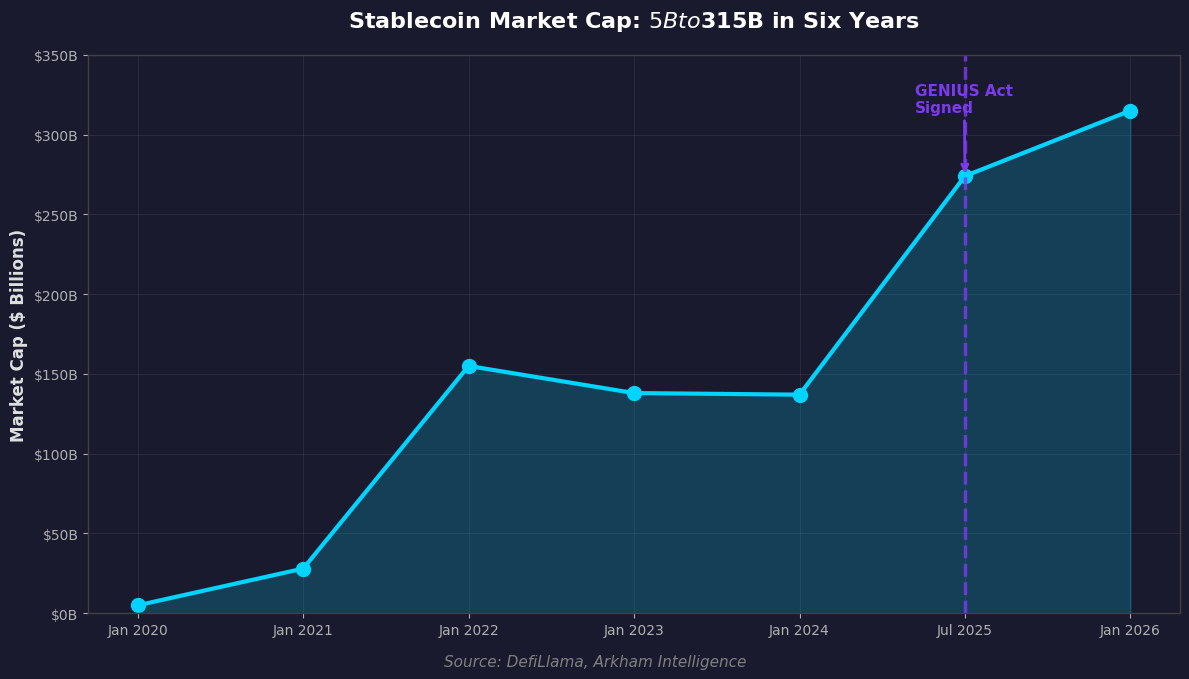
Stablecoins processed over $33 trillion in on-chain transactions in 2025, exceeding Visa’s annual network volume for the first time. Total market capitalization hit $315 billion by early 2026. And in July 2025, the GENIUS Act became the first U.S. federal law written specifically for stablecoins.
The instrument that started as a parking spot between exchange trades now settles card transactions on Solana, draws Federal Reserve balance sheet models, and handles a measurable slice of cross-border remittances. We spent the week pulling apart the infrastructure layer underneath that $315 billion number.
The Guiding and Establishing National Innovation for U.S. Stablecoins Act passed the Senate 68 to 30 and the House 308 to 122 before being signed into law on July 18, 2025.
The structural requirements are specific. Every stablecoin issuer must maintain one-to-one reserve backing using approved assets: U.S. dollars, short-term Treasury securities, or balances held at a Federal Reserve Bank. Monthly public disclosures of reserve composition are mandatory. Any state-regulated issuer that crosses $10 billion in market capitalization must transition to federal oversight within 360 days or stop issuing new tokens.
Then there is the catch. Stablecoin issuers cannot offer interest or yield to holders. That single prohibition draws a hard regulatory line between stablecoins and deposit accounts. It also forces a growing category of yield-bearing stablecoins to restructure or shut down. DeFi composability patterns built around stablecoin yield are directly affected.
The Office of the Comptroller of the Currency followed with a 376-page proposed rule on February 25, 2026. Final regulations are targeted for July 2026, with the law taking full effect no later than January 18, 2027.
Institutional participants now have an unambiguous legal basis for stablecoin integration. The tradeoff: issuers operate under a compliance framework that mirrors banking regulation without requiring a bank charter.
Regulatory clarity arrived first. Capital deployment followed within months.
Visa announced USDC settlement for U.S. issuer and acquirer partners directly over the Solana blockchain. Cross River Bank and Lead Bank were among the first participants. By late 2025, Visa’s monthly stablecoin settlement volume reached a $3.5 billion annualized run rate. Settlement happens seven days a week, including holidays, without changing the consumer card experience. Weekend and holiday cutoff friction, a persistent pain point for card issuers, gets reduced to near zero.
Mastercard took a different route. The company announced it would acquire BVNK, a London-based stablecoin infrastructure firm, for up to $1.8 billion. That deal surpassed Stripe’s $1.1 billion purchase of Bridge as the largest stablecoin-related acquisition to date. The logic: plug 24/7 blockchain-based settlement rails directly into Mastercard’s global network. Mastercard also partnered with SoFi Technologies to enable SoFiUSD as a settlement option.
Two production-grade integrations into the world’s largest card networks, both within the same year. Not announcements of future intent. Live infrastructure.
On March 30, 2026, the Federal Reserve published a FEDS Notes research paper titled “Payment Stablecoins and Cross Border Payments: Benefits and Implications for Monetary Policy Implementation.”
The paper modeled three different asset-backing scenarios and examined how each would interact with the Fed’s balance sheet. The concern: as adoption grows, payment flows between banks and stablecoin issuers could become large and volatile enough to affect reserve management operations. Large, sudden redemption events could create liquidity pressure if reserves are concentrated in Treasuries and Fed deposits.
The Atlanta Fed published a separate analysis in March 2026 sorting through operational, compliance, and systemic risk questions. The IMF released its own working paper on stablecoins and payment markets that same month.
Three central banking institutions, three research papers, one month.
Cross-border payments offer the clearest measurable proof of adoption.
According to a Fireblocks survey, 90% of surveyed institutions reported taking action on stablecoins in 2026, with cross-border payments cited as the top use case. In Latin America, 71% of respondents said they use stablecoins for cross-border transfers. Globally, 48% cited speed as the primary benefit over traditional rails.
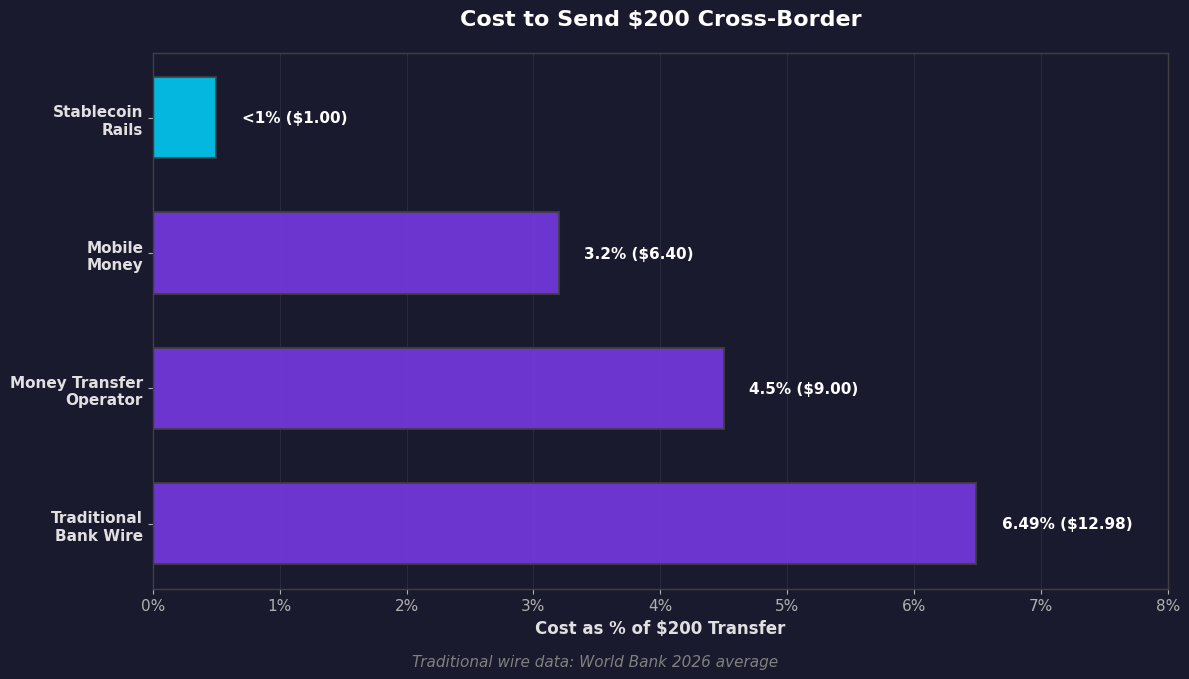
The cost comparison is stark. The World Bank’s 2026 survey found that sending international remittances costs an average of 6.49% of the transaction amount. Stablecoin-based remittances settle in near real time at fees below $1. Industry data puts stablecoins at 5 to 10% of flows in the U.S.-Mexico remittance corridor already.
USDC saw a notable volume shift in March 2026, capturing 64% of total stablecoin transaction volume and surpassing Tether (USDT) for the first time in nearly a decade. USDT still leads in market capitalization at approximately $187 billion (60.7% market share). But the volume flip toward USDC suggests regulated, transparent issuers are capturing a disproportionate share of institutional and payment flows.
The GENIUS Act delivers clarity, but it also concentrates oversight. The OCC will supervise issuers above $10 billion in market cap. State-regulated issuers below that threshold still face monthly reserve disclosure requirements. For a technology that grew out of decentralization principles, federal licensing is a meaningful structural concession.
There is also a global compliance collision building. The EU’s MiCA framework, Singapore’s Payment Services Act, and Hong Kong’s licensing regime are all live. Seven major economies now mandate full reserve backing, licensed issuers, and guaranteed redemption rights. U.S. stablecoin issuers operating across borders will need to satisfy multiple compliance regimes simultaneously, each with different disclosure timelines, reserve asset definitions, and audit standards.
Stablecoins at $315 billion are not a speculative bet on a future payment system. They are the payment system, partially built and partially regulated, with card networks already routing settlement through them.
The yield prohibition in the GENIUS Act will force a redesign of several DeFi protocols. The compliance overlap between U.S. federal law and international frameworks will create friction for issuers operating globally. The Fed’s balance sheet modeling suggests that stablecoin reserves, if concentrated, could introduce new liquidity dynamics the banking system has not tested at scale.
The question is no longer whether stablecoins will be regulated. It is whether the infrastructure built on top of them can absorb the compliance, liquidity, and interoperability demands that come with operating at $315 billion and growing.
RELATED READING: We covered several of the terms and concepts in this analysis in our blockchain glossary. If any of the regulatory or protocol terminology was new to you, it is a good companion read: https://www.blockchainweb3insights.com/post/blockchain-and-web3-terms-people-hear-but-rarely-explain
No posts
Comments
Nothing yet. Say the first thing.
Sign in to join the conversation.