
I was taught many years ago that one should never begin a talk or paper by apologizing for its length…either cut the piece, break it into multiple parts or walk away!
That said, this digest offers an overview of six months of the Antidote to Autocracy Series (AtA) which consists of twenty-five long form posts (and a total of over 40 offerings, including Bonus Posts) published between autumn 2025 and spring 2026.
And so, even in abbreviated form, I’m afraid this has come out longer than I might have liked—so, uh… sorry!!
The complete set of publications reviewed may be found here.
Rather than a formal conclusion, this digest is intended as a reader’s companion: a consolidated reference to many (though not all!!) of the key ideas, frameworks, data points, and calls to action developed across the series, organized so all readers may orient themselves quickly and returning readers may locate the themes/posts most relevant to their work and reflection process.
The series was written from the perspective of someone who has spent more than thirty years working at the intersection of capital and community, meaning and money—an impact investor asking a foundational question:
How are those of us who believe in the power of purpose-driven capital called to show up in this moment of democratic stress and rising American autocracy?
A response to that question is this series and the idea that innovative, community-rooted capital may serve as fuel for freedom; not just metaphorically, but structurally, by expanding economic agency, broadening ownership, and building the democratic belonging authoritarian politics depends on eroding.
This digest is a navigational tool, not a conclusion. A separate concluding post to come in the future, following a bit of distance from the project itself, may offer a personal reflection on the series as a whole.
I also reserve the right ( ! ) to add posts to this series over coming months as I engage with many of you on various topics of mutual interest and collaboration.
This overview seeks to make the terrain of the AtA Series accessible in one place:
The analytical framework from the early posts
The organizational landscape of Post #8
The resistance history of Posts #9 to #16
The capital innovation architecture of Posts #22 to #24, and
The five imperatives that synthesize the series’ core challenge to the impact investing community.
Given many of those following this series came in at various points along the way, my hope is this current post will assist you in finding topics and themes that might be of particular interest to you as well as uncovering topics you might not have had a chance to fully consider given the demands and challenges our community and each of us as individuals must navigate in these times.
Onward!
The opening posts (Post #1 through Post #5) establish the foundation for everything that follows, drawing on Hannah Arendt to Timothy Snyder, Ray Dalio, and Erica Chenoweth to trace the contours of democratic backsliding.
As Post #4 (Autocracy’s Past as Future) makes clear: this is not the dramatic coup of Hollywood imagination. It is the slow erosion of norms, the capitulation of institutions, the degradation of truth, and the concentration of power. The pattern is historically clear and legible—and we have been here before.
Post #6 (On Capitulation to Autocracy) examines the specific phenomenon of accommodation: the ease with which individuals, law firms, corporations, and institutions have bent their knee to executive overreach through a series of small compromises that, taken together, hollow out democracy from within.
Arendt and Snyder converge on the same response from different places:
The antidote to autocracy is not passivity dressed up as prudence.
It is presence.
It is showing up.
A core premise running through the early posts is that democratic drift is inseparable from economic grievance. Since 1989, the wealthiest one percent of Americans have gained some $50 trillion in wealth while the bottom half have seen their share of national wealth cut by more than half. Too many people—in rural communities, in communities of color, in immigrant neighborhoods, in the post-industrial heartland—have experienced not just hardship but a loss of agency: reaching the realization the system was not built for them and does not see them.
With thanks to Paul Shoemaker for bringing it to my attention, the 2026 Edelman Trust Barometer documents the downstream consequence of this rupture.
Across 28 countries and nearly 34,000 respondents, 70% of people are now hesitant or unwilling to trust someone who differs from them in values, information sources, or cultural background.
The income-based trust gap has more than doubled since 2012.
And only 32% of people believe the next generation will be better off. Employers—the data shows—hold the smallest gap between what people expect and what institutions deliver, making the workplace one of the few remaining spaces where people with different worldviews are regularly asked to pursue a common goal.
For the impact community, that is not a footnote.
It is an invitation to action—to invest and put our money where our mouth is!
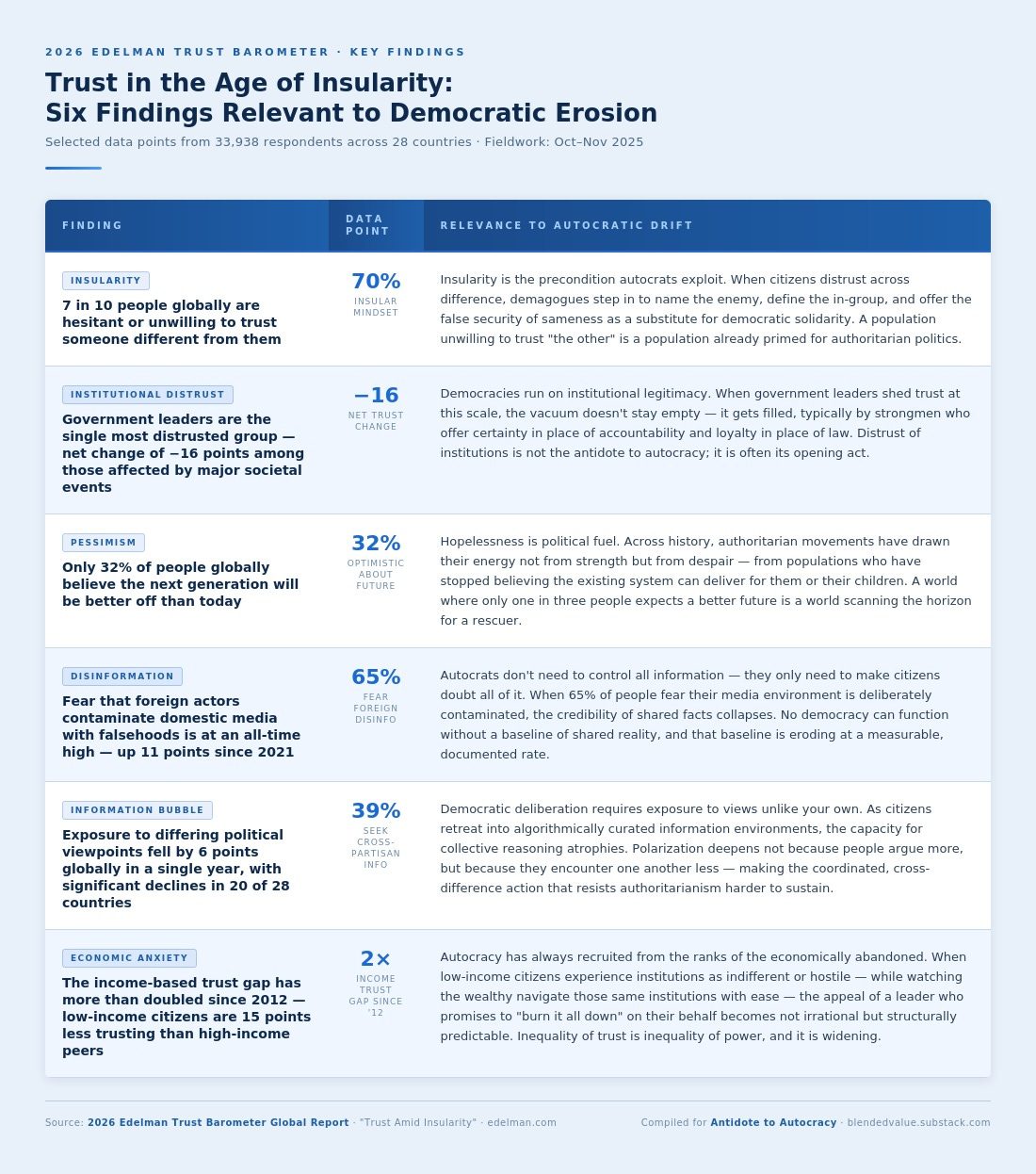
Key Findings: 2026 Edelman Trust Barometer
As the Othering and Belonging Institute at UC Berkeley has documented:
When people feel they don’t economically belong, they become susceptible to movements that promise disruption through authoritarian means.
That gap in belonging is the soil in which authoritarian political weeds grow.
It is not sufficient to oppose our democratic drift without also asking why so many have found authoritarian appeals compelling.
Post #7 (Feeding the Flames: The Communications Ecosystem) establishes that the drift toward autocracy is actively enabled by information environments designed to fragment, inflame, and dis-inform. The media ecosystem has become, in too many quarters, a system that rewards outrage over accuracy and tribalism over truth.
The most intimate form of resistance is also one of the most consequential. The disciplined curation of our information diet is critical here. Choosing to engage with sources that challenge and inform us is itself an act of democratic practice.
For citizens as well as impact investors, the broader implication is that information infrastructure is power infrastructure. Who owns the platforms controls the algorithms and benefits from the attention economy. Exploring this reality belongs in any serious analysis of a democratic portfolio and strategic action.
Post #8 (Organizations of Note: Ours, Theirs and The Radical Center) maps the organizational landscape—Left, Right, and what I and various others call the Radical Center.
I want to revisit that framing briefly here because it is easily misunderstood. The Radical Center is not a call for splitting the difference between democracy and authoritarianism. There is no midpoint worth finding there. Rather, it is a call for the kind of principled, pragmatic, multi-stakeholder coalition that can build and sustain democratic renewal. We need a space to address real material concerns, strengthen institutions, and reject false choices between ideological purity and practical impact.
The Radical Center, as I understand it drawing on thinkers from Marilyn Ferguson’s original formulation to today’s advocates for an abundance agenda, draws on the best ideas from across the political spectrum and anchors them in fairness, pluralism, and innovation. It is about reinventing governance for this era—coupling strong institutions with policies that make people’s lives tangibly better. It is animated by several core commitments:
• Government can and should work effectively for all people
• Prosperity and sustainability are not opposites
• Community ownership and stakeholder power are not departures from American capitalism but its moral completion
• Genuine pluralism—the kind requiring real encounter with the Other—is not a threat to identity but its deepest source
As the Bonus Post on Minneapolis noted, drawing on Báyò Akomolafe:
The stranger is not a threat to the self.
The stranger is the invitation through which the self discovers it was never singular to begin with.
Post #9 through Post #17 survey the rich history of how communities and movements have shown up against authoritarianism—from the White Rose resistance in Nazi Germany to the Montgomery Bus Boycott, from whistleblowers like Daniel Ellsberg to artists and cultural workers who maintain space for truth when those spaces are threatened.
Post #16 (Our Mainstream Response to this Moment) draws on Erica Chenoweth’s landmark research: When nonviolent movements achieve the participation of just 3.5 percent of the population, they become virtually unstoppable.
This is a map of how democratic renewal happens—not through a single heroic act, but through the sustained, distributed, everyday practice of civic engagement. The experience of Minnesota in early 2026—organizing in real time against federal overreach, standing with immigrant communities, refusing intimidation—demonstrated in practice what theory can only approximate: that democratic solidarity is alive, rises when needed, and is more powerful than fear when people choose to act together.
Showing up takes many forms, through:
legal challenge
journalism, art, and education
the unglamorous work of local politics and civic infrastructure
And (the specific calling this series addresses to the impact community) through the deliberate deployment of capital that expands who holds economic power, who owns productive assets, and who has a genuine stake in the economic order.
Post #18: If Not To Act, Why Does Philanthropy Exist?
Seven Critical Questions for Foundations in this Moment
The philanthropic community’s response to rising American authoritarianism has been, for the most part, notable for its absence. Post #18 (If not to act, why does philanthropy exist?) names that absence directly and raises the harder issue:
Before demanding foundations act, we need to honestly examine whether they are even the right institutions to do so, and on what terms.
Executive Order 14173 explicitly targets DEI initiatives and instructs agencies to identify foundations, universities, and nonprofits for investigation. The freeze and claw back of hundreds of billions in federal grant funding has jeopardized programs in public health, education, climate, housing, and justice. International funders are pulling back and reassessing U.S. strategies. The post’s frank assessment: grim reading for those of us who support the nonprofit sector—and as potential actors challenging the rise of American autocracy.
The post discusses a recent piece by Jennifer Thuy Vi Nguyen, who oversees a $100 million grant portfolio, argues U.S. institutional philanthropy functions primarily as a $1.5 trillion tax-sheltering mechanism that hoards wealth rather than solving structural inequities—and advocates dismantling it entirely.
The essays in The Revolution Will Not Be Funded take a related position: philanthropy co-opts and neutralizes social movements by managing dissent rather than supporting systemic change. The post takes these critiques seriously, redirecting them to the productive question:
What are we trying to do, and how do our present structures inhibit or advance our goals?
Philanthropy’s very strengths—speed, scale, independence—may undermine democratic norms if exercised without restraint. The post introduces “humbition”—the pursuit of ambitious goals from a posture of humility and co-creation—as the disposition foundations most need. The central question is not simply whether philanthropy helps democracy, but whether democracy can absorb philanthropic power without being reshaped by it.
Rather than prescribing action, I offer seven areas for honest institutional dialogue before agreeing on a course:
Legitimacy and accountability — Who are we truly accountable to, and what democratic practices govern our own power?
Risk, courage, and ‘obedience in advance’ — Where are we already self-censoring, and what does that teach authoritarians?
Strategy: Guardrails vs. Power vs. Rebuilding — These are different strategies with different implications; which are we actually pursuing?
Money: Payout vs. Seed vs. Moral Seriousness — Are our grant levels commensurate with this moment’s urgency?
Communication as civic infrastructure — Is our public voice democratic practice, or risk management dressed as principle?
Equity and predictability of harm — Which communities bear the greatest cost when foundations stay silent?
Subsidiarity and citizen agency — At what point does philanthropic support strengthen democratic agency, and at what point does it quietly displace it?
Philanthropy sits unavoidably inside democratic life. The disagreement is not about intent. It is about where authority should live when money, urgency, and democracy collide.
If Post #18 asked the hard reflective questions about whether and how philanthropy should engage, Post #19 (Three Areas of Foundation Strategy, Six Types of Foundation Action, and Four Ways to Raise the Bar in the Future) moves from reflection to action. Its organizing challenge, drawn from Rockefeller Brothers Fund President Stephen Heintz, sets the tone:
“Should we lead or should we endure?
To which I say, if we do not lead we may not endure.”
The post documents three strategic areas of foundation response, six anonymized foundation archetypes, and four ways to raise the philanthropic bar—making it the most operationally specific post in the entire series.
Together, Posts #18 and #19 form the series’ most extended engagement with philanthropy as a sector—first interrogating its legitimacy and limits as a democratic actor, then mapping what principled, strategic action actually looks like in practice.
They are essential reading for anyone in the philanthropic community—donor, executive, board member, or stakeholder—who is asking what role their institution should play in defending democratic values, community voice, and the rule of law.
“You can’t ‘grant’ your way out of autocracy—but not utilizing 100% of available philanthropic capital to optimize impact in the face of fascism is no longer defensible.
Free the 95 percent!
Otherwise, what are any of us really doing here?”
America’s heritage as a nation of immigrants is one of the defining values at stake in this political moment. Attacks on immigrant communities—the raids, the rhetoric, the weaponization of fear—are not simply policy disagreements. They are an assault on something fundamental to what this country has been and can be.
Post #21 (Refuge from Autocracy?) explores the topic of refugee lens investing and role of diverse communities as a response to rising autocracy. Immigrant entrepreneurs have been among the most dynamic generators of new businesses, jobs, and communities across American history—from the garment workers of the Lower East Side to the tech founders of Silicon Valley to the agricultural workers who put food on our tables. Impact investors should be asking, with new urgency, how capital can support immigrant-owned enterprises, immigrant entrepreneur networks, and the CDFIs, credit unions, and rotating savings circles that have long served as the financial backbone of immigrant communities outside the formal banking system.
This is not charity.
It is smart investing in under-resourced and undervalued investment categories.
And the hybrid asset-building architecture of Post #22 has particular resonance here: immigrant families are precisely the households for whom universal infrastructure combined with progressive capitalization and modular institutional support holds the most transformative potential. It is, in the fullest sense, an investment in a country that continues to be, at its best, a place where the stranger becomes the neighbor and the neighbor becomes the co-creator of a shared future.
Post #22 (Which of These is Not Like the Other? On an Aspiring King’s Accounts, Baby Bonds and IDAs) examines three competing approaches to individual asset-building, each carrying distinct implications for equity, agency, and democratic health.
As Michael Sherraden’s foundational research established, a household that owns something behaves differently from one that does not—assets, not just income, change life trajectories. Three distinct answers to the question of how to make first asset ownership plausible now sit side by side in the policy landscape:
The IDA tradition (Prosperity Now / CfED) built ‘thick’ interventions: matched savings, restricted asset uses, and financial coaching, aimed at changing life trajectories for low- and moderate-income households whose binding constraint is capacity, not simply access.
The Trump Accounts offer universal participation in capital markets—a federal seed deposit with tax-advantaged growth. This is ownership-society logic at scale: simplicity builds political durability, but universal vehicles can amplify gaps when private contribution capacity varies widely.
Baby Bonds (Senator Booker’s proposal) treat unequal starting wealth as the core problem. Progressive public deposits—larger for children born into lower-wealth households—attempt to narrow the wealth gap before private behavior enters the picture.
Post #22’s bottom line:
IDAs were designed to change inequality;
Trump child accounts are designed to normalize investment.
Same tool category—radically different policy intent.
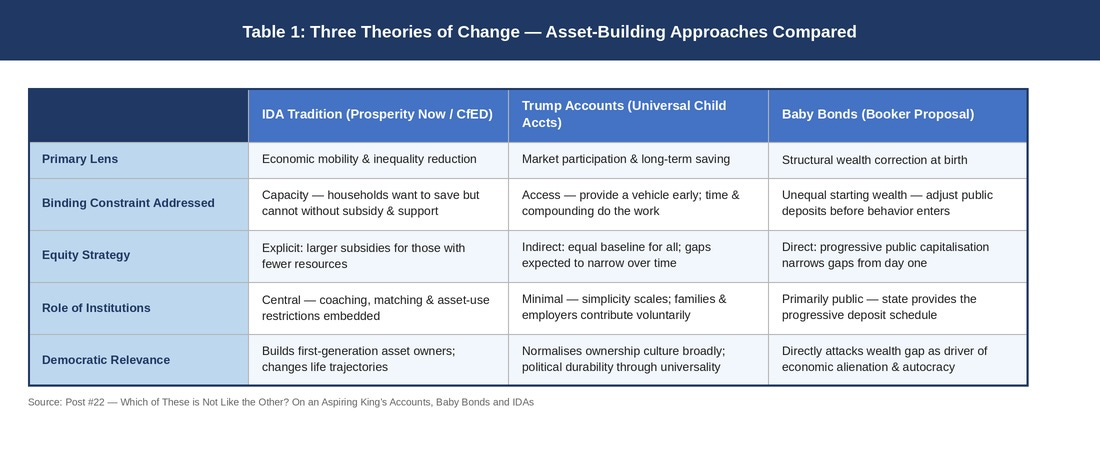
Table 1: Three Theories of Change — Asset-Building Approaches Compared (Post #22)
The most important contribution of Post #22 is its articulation of a fourth, hybrid approach that holds all three insights simultaneously: universal account infrastructure for legitimacy and scale, progressive public deposits calibrated to household wealth, and modular institutional supports that activate at key life transitions rather than as permanent conditions of participation.
Schools, CDFIs, employers, philanthropies, and community organizations become episodic partners in asset conversion. The account becomes a platform—a node in a broader capital stack through which public, private, and catalytic capital coordinate across the course of a life.
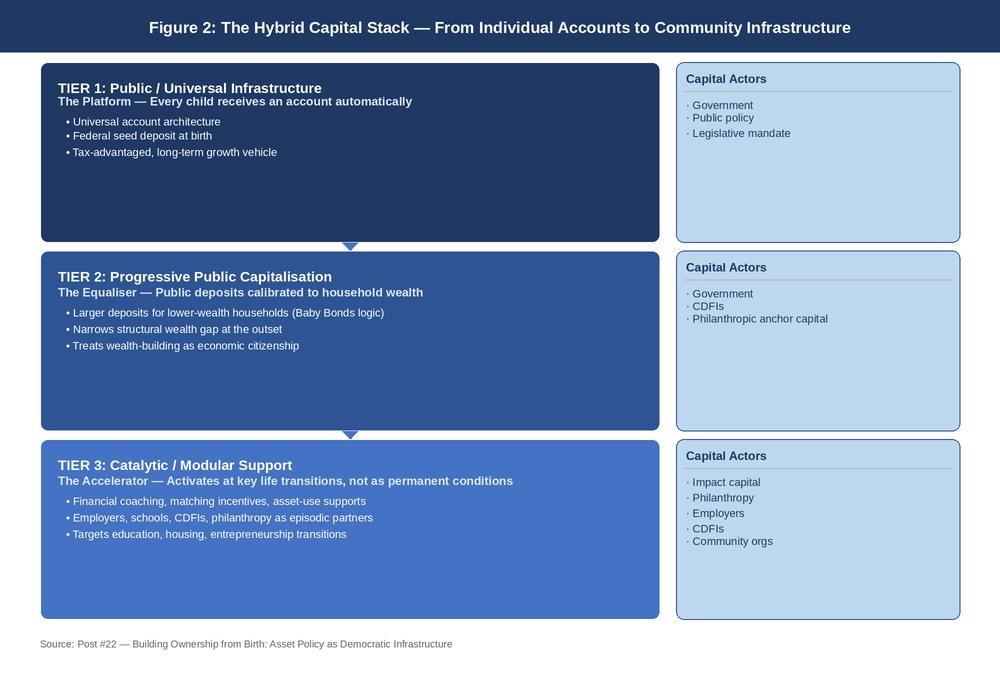
Figure 2: The Hybrid Capital Stack — From Individual Accounts to Community Infrastructure (Post #22)
The challenge to impact investors:
Are we deploying capital in ways that merely expand participation in existing financial structures, or are we intentionally reshaping starting conditions to narrow structural wealth gaps across generations?
Post #23 (Impact in Action: Capital Innovation as Democratic Renewal) moves from the household to the enterprise to deliver the series’ most comprehensive articulation of why capital structure is democratic infrastructure.
The authoritarian impulse reflects a deeper crisis of economic exclusion: when people cannot build wealth regardless of effort; when platforms extract value from communities with no governance voice; when monopolies hollow out local economies—the promise of democracy rings hollow. Authoritarian movements do not manufacture this resentment. They harvest it from conditions that are real, measurable, and changeable.
Post #23 identifies five interconnected pillars of capital innovation that together constitute what we might call a democratic economy built from the ground up:
Employee Ownership and Wealth Building transforms workers from cost centers into stakeholders. The Rutgers Institute documents employee-owners carry 92% higher median household net worth and 33% higher median income. The Ownership Capital Lab is working to unlock the ‘silver tsunami’—2.9 million businesses owned by people over 55—representing a generational transition opportunity.
Steward-Ownership and Mission Protection legally separates voting control from profit participation, ensuring companies cannot be sold for extraction. The Purpose Foundation has supported over 300 companies in this model; Patagonia’s 2022 Perpetual Purpose Trust is the best-known example. Steward-owned firms show six times higher survival probability after forty years.
Platform Cooperativism and Democratic Governance ensures those who create value through digital platforms also control and benefit from them. Nathan Schneider and the Media Economies Design Lab at University of Colorado Boulder are building the intellectual infrastructure for democratic platform governance at scale.
Corporate Accountability and Anti-Monopoly Policy confronts power concentration. Between 2000 and 2015, 75% of U.S. industries became more concentrated—enabling price manipulation, wage suppression, and political capture. The American Economic Liberties Project and the Balanced Economy Project are developing the litigation strategies and model legislation to restore competitive markets as democratic infrastructure.
Transparency, Justice Investment, and System-Level Change makes inequality visible and actionable. The Taskforce on Inequality and Social-related Financial Disclosures (TISFD) is building a global framework to make inequality as central to investment decisions as carbon emissions. Adasina Social Capital has mobilized over $1 trillion in signatory assets toward racial, gender, economic, and climate justice.
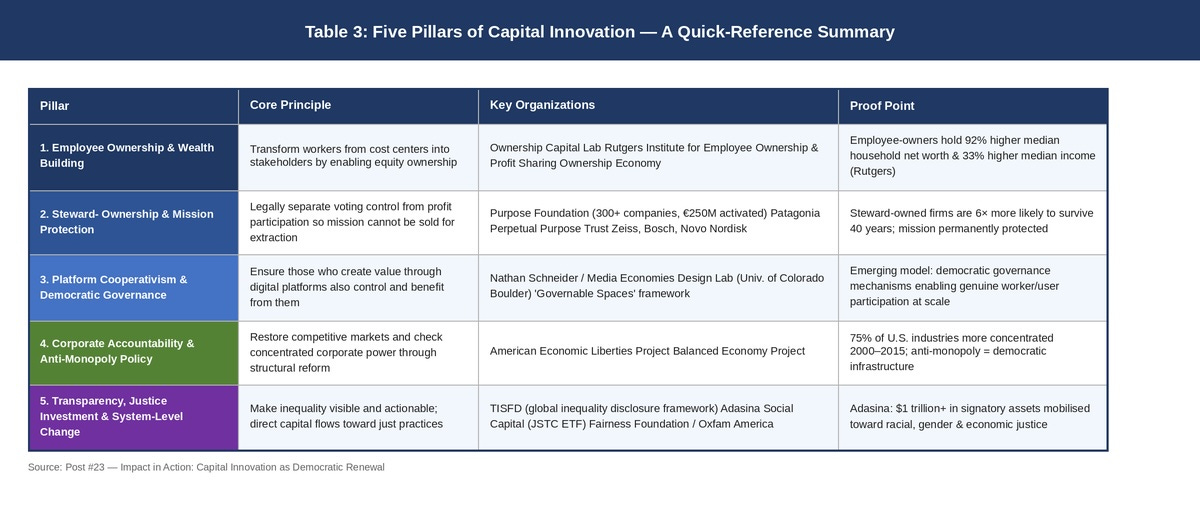
Table 3: Five Pillars of Capital Innovation — A Quick-Reference Summary (Post #23)
What unites all five pillars: economic democracy is the foundation of political democracy. Top-down authoritarianism derives its power from centralization. The antidote is not simply a different set of people at the top, but a genuine dispersal of ownership and decision-making power downward and outward. Steward-ownership, employee equity, platform democracy, and community wealth-building do not merely redistribute income—they redistribute agency. And people with genuine economic agency are far less susceptible to the promises of strongmen.
As Post #23 observed:
This is democracy practiced at the molecular level—in the ownership structure of a small manufacturer transitioning through an ESOP, in the governance bylaws of a platform cooperative, in the municipal bond portfolio of a city choosing to invest in under-resourced communities rather than extract from them.
Post #24 (Onward! Impact Driven Organizations and the Challenge from Autocracy) delivers the series’ organizational call to action. Deploying capital well and stepping back is no longer sufficient. As one colleague framed it:
“The world around us is basically proving our sector’s main point: we need to fix capitalism if we want to solve the world’s problems. If the impact sector really wants to transform capitalism, this is not only a moment of great challenge, it’s also an historic opportunity. What if that ‘someone’ is us?”
Every impact organization—fund, foundation, enterprise, intermediary—is already working to advance equity, justice, and sustainability. But that work, when conducted without recognition of or engagement with rising authoritarianism, will ultimately come to naught.
It doesn’t matter if you hit your next impact KPI if the rights of your workers, community stakeholders, and investors are being swept away. It doesn’t matter if your impact report documents growing positive outcomes within a narrow realm of action if the broader realm—our communities and society—is being deconstructed by public policy.
The dots must be connected between our theories of change and the larger markets, communities, and political contexts within which our work takes place. And we must understand how that work is directly undermined by the rise of authoritarianism in the United States and around the world.
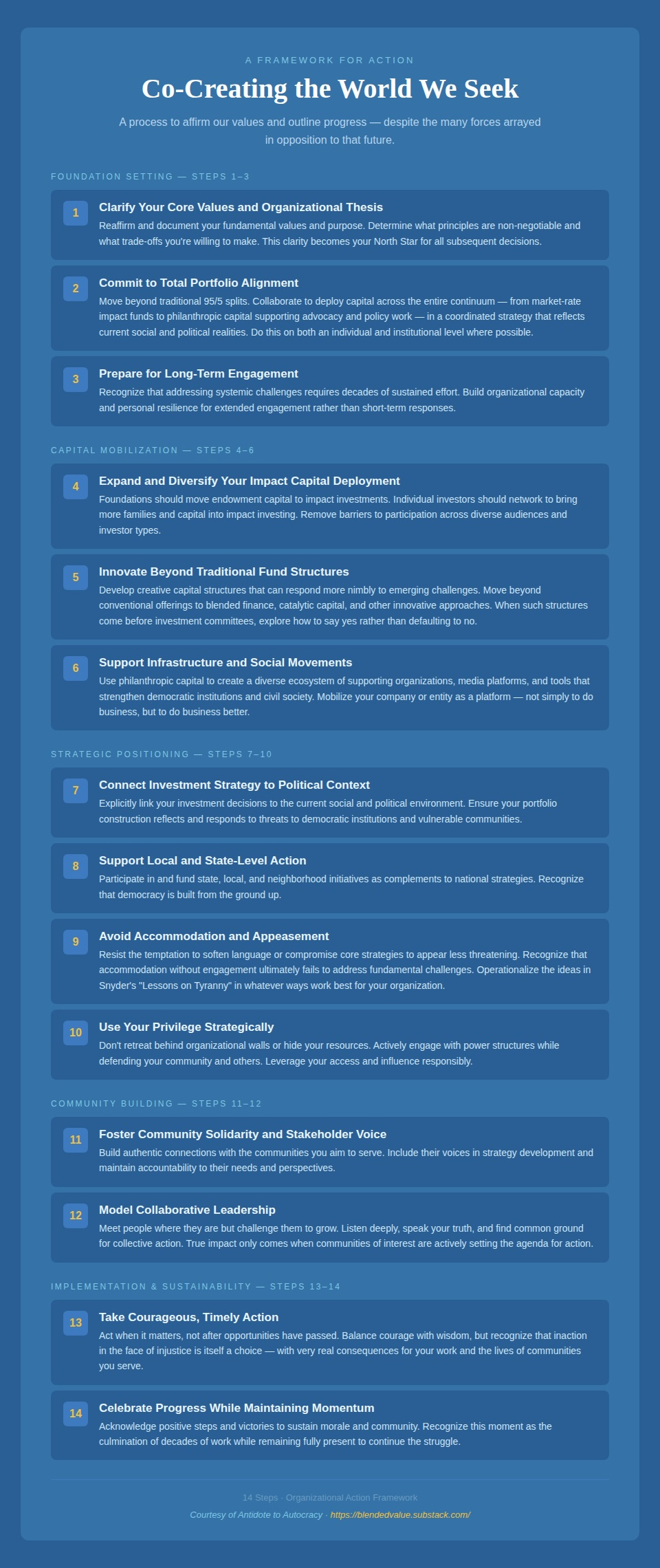
Post #24 offers a 14-step framework across five categories to help impact organizations move from symbolic gestures to concrete action:
• Foundation Setting: clarify core values; commit to total portfolio alignment across the full continuum from market-rate funds to philanthropic advocacy; build capacity for long-term engagement
• Capital Mobilization: expand and diversify impact capital deployment; innovate beyond traditional fund structures; support the infrastructure of democratic resilience
• Strategic Positioning: explicitly link investment decisions to political context; support state and local action as ground-level democracy; refuse accommodation and appeasement
• Community Building: foster authentic community solidarity; include community voices in strategy; model collaborative leadership
• Implementation: take courageous, timely action; celebrate progress while maintaining momentum
No cookie-cutter approach exists.
Each organization must engage its own community to determine the right path.
But the time for waiting has passed.
We are the leaders we have been waiting for!
Alongside the twenty-five numbered posts in the Antidote to Autocracy series, a number of substantive Bonus Posts extended the series’ inquiry into distinct terrain: the obligations of foundations, the financial dimensions of authoritarian risk, and the intellectual betrayal of our economic forebears. They are summarized here as companion material to the main series digest.
Digging Deeper: Moving from 5% Philanthropic Teaspoons to 100% Steam Shovel Justice
This Bonus Post builds on the series’ two posts on philanthropy (Posts #18 and #19) to make a direct argument: foundations that claim to be defending democracy while parking 95% of their endowments in conventional investments are not putting their money where their mission is. The evidence is drawn from a 2024 Bridgespan Group and Capricorn Investment Group study that documents both the gap and what is already proven possible.
Among foundations actively engaged in impact-oriented networks—including GIIN and Mission Investors Exchange—the median allocation to impact investments is just 5% of endowment assets. For foundations with endowments over $1 billion, that median drops to 2.6%. Only 11% of foundations invest beyond their core mission areas at all. This is not a pipeline problem: the landscape of investable impact opportunities today is broader and deeper than anything available twenty-five years ago. What is lacking is not opportunity but will.
A smaller group of pioneering foundations has already shown that allocations above 50% are fully achievable. The Skoll Foundation has aligned 70% of its endowment across four impact areas. Gary Community Ventures in Denver frames its mission as “transferring the assets of Sam Gary from his balance sheet to the balance sheets of low-income and working families in Colorado”—and now declares: “We’re not spending down, we’re raising the bar for how every dollar is invested to catalyze systemic change and family owned wealth.”
I dismiss the tired ‘impact first vs. finance first’ debate as a false dilemma, pointing toward Total Portfolio Management as the resolution for the simple fact that all capital and all companies have impact, so the task is deploying all capital for intentional impact, however you define it. The Bridgespan/Capricorn report—echoing decades of advocacy by myself and others—concludes that increasing impact investment allocation is not an optional initiative for foundations. It is core to fiduciary responsibility.
Whether Dedicated Impact or Traditional Investor, Authoritarian Regimes Undermine Social, Natural and Financial Capital
By Jed Emerson and William Burckart
Co-authored with William Burckart and grounded in the Investment Integration Project’s System-Aware Investing Launchpad (SAIL) framework, this is one of the most analytically rigorous posts in the entire series. Its central argument is that authoritarianism is not a peripheral political concern. It is a core determinant of long-term investment and impact outcomes. For decades, institutional investors have treated authoritarian regimes as a political or ethical issue—managed by governance committees and exclusion lists, not portfolio construction. That approach is no longer defensible.
The post draws a critical distinction between idiosyncratic political risk—which can be diversified, hedged, or tactically managed—and the fundamentally different nature of authoritarian institutional risk, which is systemic, non-diversifiable, and cumulative. The institutional failures with clearest financial relevance are: erosion of judicial independence; politicization of regulatory agencies and central banks; suppression of economically relevant information; concentration of discretionary executive power; and absence of durable accountability mechanisms. When these conditions take hold, contracts become less reliable, regulation becomes discretionary, and data becomes politicized.
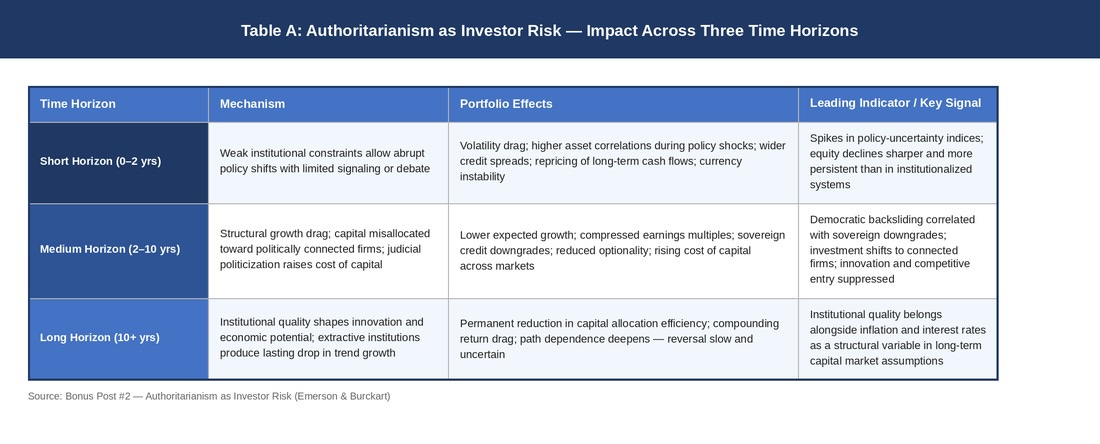
Table A: Authoritarianism as Investor Risk — Impact Across Three Time Horizons
The post also addresses non-diversifiability: institutional erosion rarely occurs in isolation, meaning geographic diversification provides less protection precisely when it is most needed.
For impact investors specifically, the post raises harder questions about complicity versus engagement—whether investments inadvertently legitimize authoritarian control, whether impact metrics can be trusted where data transparency is compromised, and whether capital flows strengthen extractive structures even while addressing specific environmental or social issues.
Its conclusion is unambiguous:
Ignoring the financial implications of institutional deterioration is not neutrality. It is a bet—one increasingly misaligned with the structure of the global investment landscape.
This post is also complemented by an additional post co-authored with Iasabel Huther that explores notions of institutional drift and fiduciary duty, key considerations in investor risk exposure and authoritarianism.
Definitely important themes worth your exploring.
From the Invisible Hands of Smith, Hayek & Friedman to Today’s Road to Serfdom
Intentionally “out of sequence” with the larger series, this Bonus Post asks a deceptively simple question:
What would the intellectual forefathers of modern market economics—Adam Smith, Friedrich Hayek, and Milton Friedman—make of the current moment?
The post reviews the core vision of each thinker before delivering a pointed verdict:
None of them would recognize what is being done in their names today, and all three would be profoundly troubled by it.
Adam Smith‘s ‘invisible hand’ was not blind greed but the emergent order of free exchange under moral restraint, within a system of justice and competition designed to prevent monopolies. Friedrich Hayek‘s warning in The Road to Serfdom was not only against socialist planning but against any concentration of power—governmental or corporate—that destroys the spontaneous order that makes freedom possible. Milton Friedman argued that economic freedom is an indispensable means toward political freedom, but he assumed markets would remain broadly shared systems of opportunity with governments maintaining rule of law, monetary stability, and competition—not ownership.
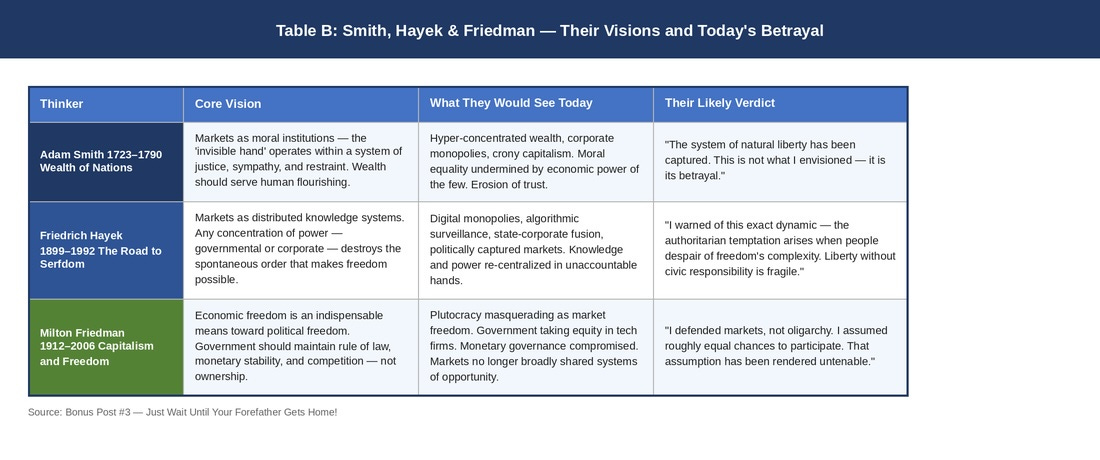
Table B: Smith, Hayek & Friedman — Their Visions and Today’s Betrayal (Bonus Post #3)
Taken together, the post argues, Smith, Hayek, and Friedman would recognize their vision of market-based freedom has been distorted by excess—markets without morality, liberty without fairness, competition without constraint. Smith would call for moral renewal; Hayek for limits on centralized power, whether governmental or corporate; Friedman for rules that restore fair participation and accountability.
The post closes with a direct personal challenge in that as you reflect on these foundational economic ideas, does the current practice of economics by the present administration advance the interests of your household? When you watch the tech titans parade through White House dinners, do you feel your economic interests are being protected—or exploited?
None of the three would defend the current trajectory as the triumph of their ideas.
Co-authored by Isabel Huther and Jed Emerson
This post makes the argument that democratic erosion is not only a political problem but a measurable financial risk that most investment frameworks have not yet been built to see, particularly in developed markets.
Drawing on the Economist Intelligence Unit’s 2024 Democracy Index (which recorded its lowest global score to date, with only 6.6% of the world’s population living in full democracies), the post introduces the concept of institutional drift — the incremental weakening of rule-based governance that underpins predictable capital markets.
The United States, classified as a “flawed democracy” and the anchor of the world’s deepest sovereign bond market, receives particular attention: politicization of its regulatory institutions transmits globally through dollar liquidity, asset pricing, and cross-border capital flows. The post argues that monitoring institutional trajectory — alongside macroeconomic and financial variables — is not an ideological act. It is prudent fiduciary risk oversight, and choosing to ignore it is not neutrality but a bet on conditions that are visibly changing.
We then map four transmission channels through which institutional drift reaches portfolios — policy durability risk, monetary and fiscal credibility, correlation and diversification compression, and impact thesis fragility — before turning to what investors can actually do.
The good news: institutional drift is measurable, through existing governance indicators including V-Dem executive constraint scores, World Bank rule-of-law indices, and policy volatility data.
We close by connecting these dynamics to the series’ broader argument regarding courageous capital:
Capital allocation is not simply exposed to institutional conditions, it helps shape them.
Regenerative finance and solidarity economy approaches — broadening ownership, strengthening social legitimacy, restoring institutional foundations — are presented not as replacements for conventional capital allocation, but as strategies that actively contribute to the resilience that long-term markets require.
The crisis of democratic agency is, in no small part, a crisis of economic agency.
People who feel they have no stake in the economic order—who experience the economy as something that happens to them rather than through them—are people vulnerable to the appeal of strongmen promising to burn it all down. The antidote is not simply a better argument or a better policy. It is a better economic reality.
This is where impact investing, done with genuine intention and structural creativity, enters not as a supplement to democratic activism but as an integral part of it. When we deploy capital into enterprises owned by diverse community members—worker-owned cooperatives, CDFIs, minority-owned funds, Indigenous-led enterprises, immigrant and refugee entrepreneur networks—we are not simply generating financial returns with positive externalities.
Impact Investors have the opportunity to build the economic infrastructure of democratic belonging.
The concept of blended value—understanding the nature of value as simultaneously economic, social, and environmental—has always rested on the insight that value cannot be separated from the communities and relationships within which it is created.
This series extends that insight into the political domain. In a moment of democratic stress, the questions of who owns productive assets, who controls capital flows, and who participates in the upside of economic growth are not merely questions of equity. They are questions of democratic resilience.
The community wealth-building strategies that flow from this insight—employee ownership, local procurement anchored in community institutions, place-based investment funds governed by the communities they serve, and many others—are not new ideas. What is new is the urgency with which they must be understood as part of a democratic renewal agenda, not a niche investment category. In various ways and from different perspectives, the Democracy Collaborative, Impact Capital Managers, and the US Impact Investing Alliance, among various others, have been making this argument for years.
What this series has sought to do is connect those investment frameworks explicitly within the political analysis they deserve.
Posts #22, #23, and #24 sharpen this thesis at three levels:
The architecture of individual asset-building is contested ground on which the future of economic citizenship will be decided (Post #22);
Enterprise-level capital innovation is the structural foundation of democratic belonging, with proven results and growing momentum (Post #23); and
The impact community itself must now step up as an organizational actor in defense of democracy—not as a side project, but as the natural expression of everything we claim to believe about capital’s purpose to function as fuel for freedom in advancing greater sustainability and justice (Post #24).
Two values run through the AtA Series as structural prerequisites for everything the impact community does: the rule of law and the integrity of the electoral process. These are not partisan commitments. They are the institutional infrastructure that makes long-term, community-embedded investing possible.
• Contracts must be enforceable
• Regulations must be predictable
• Democratic processes must be capable of producing legitimate transitions of power
When the rule of law erodes—executive authority exercised without check, courts captured, agencies weaponized—the investment climate for patient, community-aligned capital deteriorates.
The impact community has a direct material interest, in addition to a moral one, in defending the institutions that protect its practice. Impact investors who have spent careers arguing that stakeholder capitalism produces better outcomes than shareholder-only capitalism should understand that democratic accountability is the political analogue of that same principle.
We cannot have stakeholder capitalism without the mechanisms that make stakeholders count.
Across the arc of the AtA Series, five imperatives emerge for the impact investing community. They are not a comprehensive agenda but a distillation—the essential commitments our work demands.
First: Invest in economic agency, in addition to economic outcomes.
Shift the structure of ownership so more—and more diverse—people hold genuine stakes in productive enterprises. The evidence: employee-owners carry 92% higher median household net worth; steward-owned companies are six times more likely to survive forty years. Worker ownership, community land trusts, Indigenous enterprise development, immigrant-entrepreneur funds: these are investments in the social architecture of democratic belonging.
Second: Think in systems, not only programs.
Re-frame asset policy from episodic intervention to generational infrastructure—from accounts as programs to accounts as platforms through which public, private, and catalytic capital coordinate across the course of a life. Ask not just whether each transaction does “good,” but whether it contributes to coordinated capital architecture that creates durable mobility and genuine belonging.
Third: Build the Radical Center through investment, not advocacy alone.
Organizations working to depolarize American politics and build equitable communities need capital as much as ideas. Scotland’s Community Wealth Building legislation, ESOP transitions, anti-monopoly work—the Radical Center agenda requires patient, flexible, non-extractive capital that conventional markets will not provide.
Fourth: Step forward as organizational actors, not only capital allocators.
Every impact organization must reflect on how its capital deployment and strategy can actively defend democratic values. Total portfolio alignment, innovative capital structures, explicit connection of investment decisions to political context: these are the moves Post #24’s 14-step framework maps out.
Fifth: Celebrate the struggle—Sustain yourselves and our community for the long run.
Democratic renewal is the work of generations. The impact community has what many political movements lack: a professional practice, institutions, and a community of peers capable of sustained engagement. Care for each other’s resilience. Resist burnout. Keep alive the sense that this work is, at its root, joyful. Celebrate the struggle. That is not irony. It is strategy!
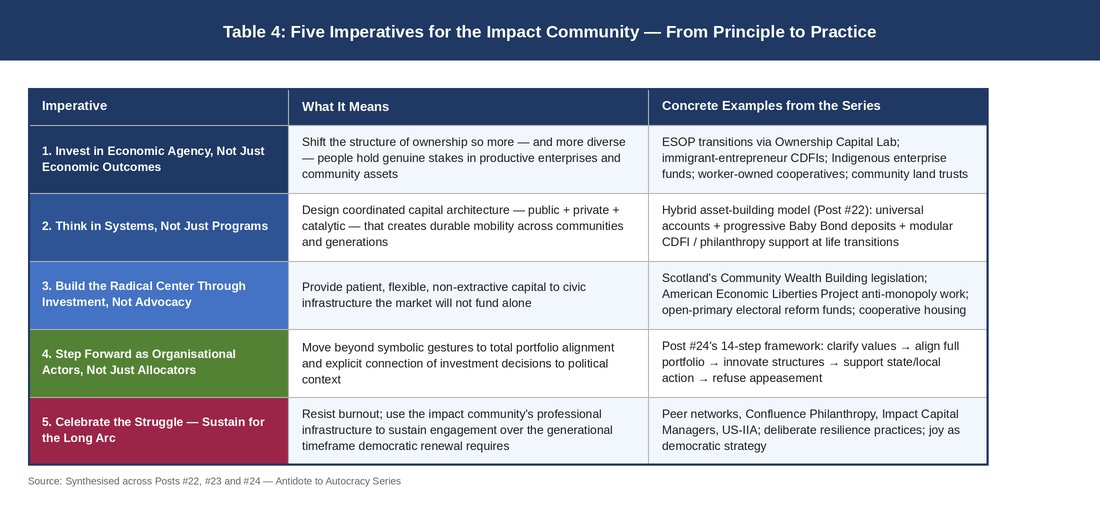
Table 4: Five Imperatives for the Impact Community — From Principle to Practice (Posts #22–24)
What impact investing, at its deepest level, has always been about is the pursuit of a fuller picture of value—one that refuses the false choice between financial return and human flourishing, between economic efficiency and social justice, between individual wealth-building and community resilience.
In this political moment, that fuller picture extends into the domain of democratic health itself. The people most vulnerable to authoritarian politics are those excluded from economic agency—told, in effect, that the economy is not theirs.
The work of impact investing, done right, is the work of rewriting that message:
This economy is yours.
This enterprise belongs to this community.
This capital serves these people and our planet.
And the returns—social, economic, environmental—are ours to steward together.
As explored in my last book, this is capital understood as fuel for freedom—not simply in a metaphorical sense, but in the most practical one:
The material conditions of democratic life—the sense that one has a stake, that one’s participation matters, that the future is not foreclosed—are conditions capital can help create or destroy.
The impact investing community has chosen to be in the business of capital innovation and co-creation.
The work continues.
Let us continue it together.
Onward!
Thanks for reading Antidote to Autocracy! This post is public so feel free to share it.
Author’s Note: While the final writing and analysis are my own, I did make use of various AI tools in research and drafting for this project. For a fuller discussion, please see the closing Note in the first post of the Antidote to Autocracy series.
No posts
Comments
Nothing yet. Say the first thing.
Sign in to join the conversation.