
In this post, I call on impact investing organizations—funds, investors, foundations and intermediaries—to move beyond initial gestures and take concrete action in response to growing authoritarianism in the current U.S. political climate.
Every type of impact entity in the impact investing space has an opportunity (I would say, an obligation!) to reflect on how their capital deployment and organizational strategy may also serve to actively defend democratic values and institutions.
I outline a 14-step framework organized into five categories:
Foundation Setting
Capital Mobilization
Strategic Positioning
Community Building and
Implementation.
The steps within each category range from clarifying core values and aligning entire investment portfolios with democratic principles, to innovating beyond traditional fund structures, supporting local and state-level initiatives, and avoiding accommodation or appeasement of anti-democratic forces.
The bottom-line is there is no one-size-fits-all approach. Each of our organizations must engage its own community in dialogue to determine the right path forward in this time with its many risks and opportunities for us to realize our vision and mission as a community of impact actors.
That said, the time is now!
Real impact requires we act to not simply advance our own individual strategy and pursue our interests—but to do so with reference to and engagement with the present moment within which we find our selves.
We are the leaders we have been waiting for!
To paraphrase the words of impact investor and capital activist Rosemary Addis and to apply them to our specific topic,
Now is the time we recognize the power of substance over signaling.
Now is the time we must act.
There are various and diverse communities mobilizing to challenge emerging authoritarian practices of the current administration and governments around the world, either directly or by connecting the dots.
Read any post from Impact Alpha or Impact Entrepreneur and you will see a large and diverse number of organizations executing upon a wide array of strategies which, each in their own way, hold the promise of being a tool to inhibit and ultimately dismantle our nation’s drift toward greater autocracy.
Within the impact investing field, the previously referenced U.S. Impact Investing Alliance and US-SIF are both working to activate their members in support of “pro-impact” policies which have within them steps that will defend democracy—yet more is needed.
Beyond those efforts, each and every organization engaged in and with impact investing has an opportunity to reflect more deeply upon how their firm, fund or foundation may work to more explicitly and directly promote values and practices, as well as deploy capital, along lines that stand against the forces working to undermine our American democracy.
There is no cookie cutter approach to how each of our work needs to evolve over coming years.
In the same way individual action will differ based on how one responds to the Questions of Reflection and Challenge presented in Post #14: On Individual Action to Face the Future, every organization needs to convene its own community to engage in dialogue and discussion regarding how best to position and leverage its work to act in opposition to the policies and practices of those presently in power while simultaneously executing their own particular strategy and tactics to advance their particular vision.
That said, there is a process in which we may engage to affirm our values and outline needed progress to co-create the world we seek despite the many and great forces arrayed in opposition to that future.
I’d ask you to consider the following:
Foundation Setting (Steps 1-3)
Clarify Your Core Values and Investment/Organizational Thesis
Reaffirm and document your fundamental values and purpose. Determine what principles are non-negotiable and what trade-offs you’re willing to make. This clarity becomes your North Star for all subsequent decisions.
Commit to Total Portfolio Alignment
If you’re a foundation, move beyond traditional 95/5 splits. If you are an individual, family office or involved in any investment process, collaborate to deploy capital across the entire continuum—from market-rate impact funds to philanthropic capital supporting advocacy and policy work—in a coordinated strategy that reflects current social and political realities. Do this on both an individual and institutional level if and as possible.
Prepare for Long-Term Engagement
Recognize addressing systemic challenges requires decades of sustained effort. Build organizational capacity and personal resilience for extended engagement rather than short-term responses.
Capital Mobilization (Steps 4-6)
Expand and Diversify Your Impact Capital Deployment
Foundations should move endowment capital to impact investments. Individual investors should network to bring more families and capital into impact investing. Remove barriers to participation across diverse audiences and investor types.
Innovate Beyond Traditional Fund Structures
Develop creative capital structures that can respond more nimbly to emerging challenges. Move beyond conventional fund offerings to blended finance, catalytic capital, and other innovative approaches. When such structures come before your investment committees, explore how to say yes as opposed to saying no because the structure doesn’t look like every other vehicle in your portfolio and may sit a bit outside your comfort zone.
Support Infrastructure and Social Movements Promoting Democratic Resilience
Use philanthropic capital to create a diverse ecosystem of supporting organizations, media platforms, and tools that strengthen democratic institutions and civil society. Use organizational capacity to do the same, mobilizing your company or entity to act as a platform to not simply to business but do business better.
Strategic Positioning (Steps 7-10)
Connect Investment and Organizational Strategy to Political Context
Explicitly link your investment decisions to the current social and political environment. Ensure your portfolio construction reflects and responds to threats to democratic institutions and vulnerable communities. Explore ways your company/organization can support and create these same links and tactics.
Support Local and State-Level Action
Participate in and fund state, local, and neighborhood initiatives as complements to national strategies. Recognize that democracy is built from the ground up.
Avoid Accommodation and Appeasement
Resist the temptation to soften language or compromise core strategies to appear less threatening. Recognize that accommodation without engagement ultimately fails to address fundamental challenges. Review this series’ post on capitulation and seek to operationalize the ideas in Timothy Snyder’s previously posted “Lessons on Tyranny” however each of these works best for your organization.
Use Your Privilege Strategically
Don’t retreat behind organizational walls or hide your resources. Actively engage with power structures while defending your community and others. Leverage your access and influence responsibly.
Community Building (Steps 11-12)
Foster Community Solidarity and Stakeholder Voice
Build authentic connections with the communities you aim to serve. Include their voices in strategy development and maintain accountability to their needs and perspectives.
Model Collaborative Leadership
Meet people where they are but challenge them to grow. Listen deeply, speak your truth, and find common ground for collective action. Avoid free-riding on others’ efforts. Recognize whatever vision and ideas you may have are great—but true impact will only come when communities of interest are actively setting the agenda for action.
Implementation and Sustainability (Steps 13-14)
Take Courageous, Timely Action
Act when it matters, not after opportunities have passed. Balance courage with wisdom, but recognize that inaction in the face of injustice is itself a choice with very real consequences for not only your work, but the lives and communities of others.
Celebrate Progress While Maintaining Momentum
Acknowledge positive steps and victories to sustain morale and community. Recognize this moment as the culmination of decades of work while remaining fully present to continue the struggle.
And for those of you who prefer a spiffy chart format you may print out separately to share with your friends, stakeholders, family and collaborators… here you go!
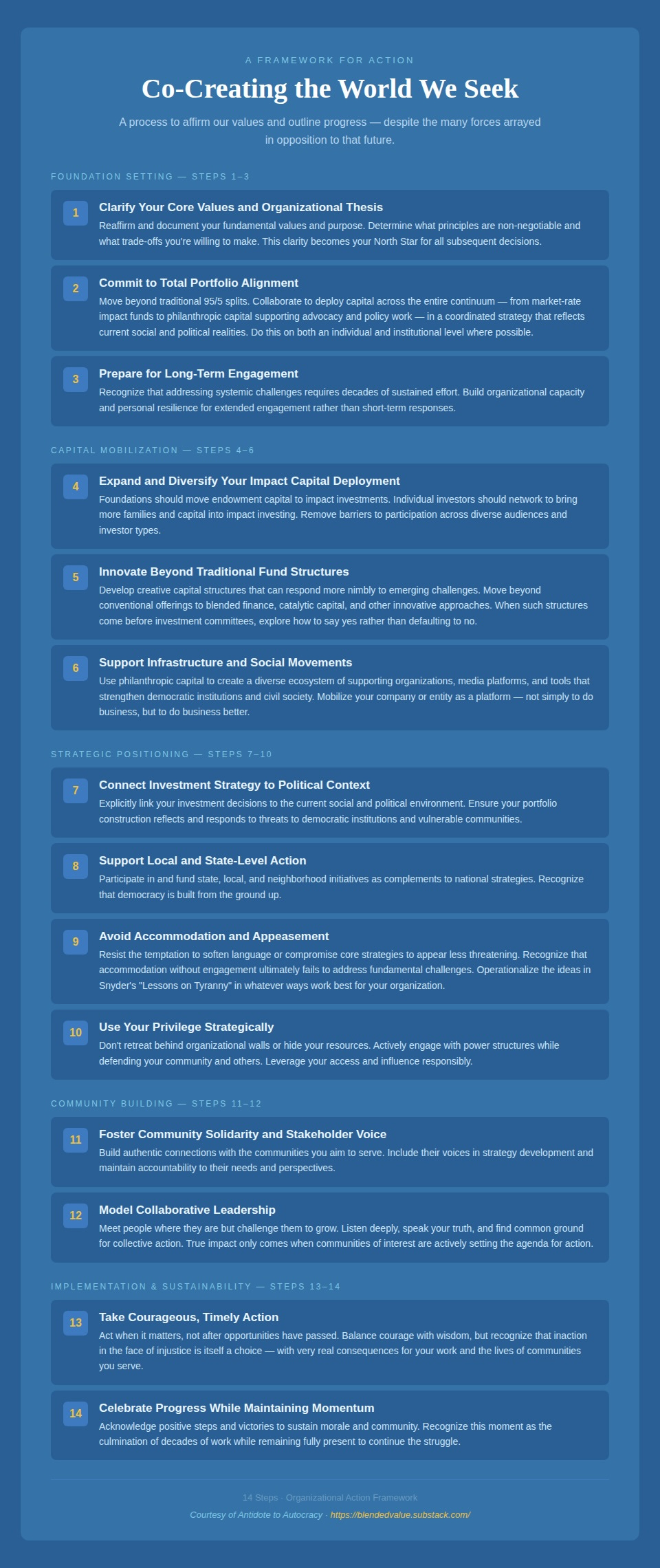
Table #1: Co-Creating the World We Seek!
Within the impact investing arena, we have a particularly unique opportunity to stand in the face of fascism and I explore organizational implications below—but let’s start by re-framing how we even think about our place, purpose and connection to the changes now ongoing around us, in our communities and across our nation.
At its core, impact investing seeks to optimize for various levels of financial return with the generation of measurable and generally positive social and environmental impacts. One would think the impact investing community would be at the forefront of today’s debates regarding the rise in authoritarianism and threats of growing tyranny.
Yet that is not the case.
As one of our colleagues wrote to me,
“It feels like a moment when the world around us is basically proving our sector’s main point: We need to fix capitalism if we want to solve the world’s problems…If the impact sector really wants to transform capitalism, this is not only a moment of great challenge, it’s also an historic opportunity.
Imagine the mainstream attention and support the sector could attract if it publicly mobilized to join the fight against authoritarianism, and tried to move the broader business sector in that direction. There’s a great public appetite for “someone to do something,” yet practically every key power center — academia, media, the “opposition party,” the business community — are actively folding, hiding or collaborating.
What if that “someone” is us?
What would the sector’s future look like if we stepped forward to lead at this moment?
And conversely, what will it look like if we sit on our hands, concealing or diluting our beliefs in the hope that the government won’t target us next?
I believe this is truly a do or die moment for the impact movement — one that will reveal if we were actually serious about transformative change, or if that was just a buzzword for our impact reports this whole time.”
A variation on these ideas was also present in Aunnie Patton Power’s post last spring and reflected in different ways within more recent posts by Gillian Marcelle and Anna Maria Camelo Vega, wherein they discuss the role and place of private capital in catalyzing community change—which is great, but to my mind,
These capital tools may and must also be connected to a larger strategy of engagement and activism to mobilize capital in opposition to the present administration’s authoritarian policies and practices.
We need to evolve our understanding of and thinking about what “impact” means, raising it from a focus on funds and operating entities to more directly embrace social, political and policy systems that determine the perpetuation of extractive economics and various levels/forms of injustice.
Open virtually any issue of Impact Alpha and you’ll find innovations in shared prosperity and any number of other compelling, critical areas of our field’s activities and progress.
Log on to any podcast from Impact Entrepreneur and you’ll hear stories of leading social entrepreneurs and impact investors—most of whom you’ve never heard of—executing strategies of deep and meaningful impact in the face of incredible challenge and odds.
Finally, just take a few minutes to scroll through the dozens of funds that made the last roster of the ImpactAssets-50 to see credible, well performing agents of change deploying capital in diverse and powerful ways to advance an alternative vision of capitalism, economics and enterprise development.
While each and virtually every impact organization—whether fund, enterprise or other—in our space works in various ways to advance core values of equity, justice and sustainability that work when done without recognition of or engagement with the larger context of rising authoritarianism will ultimately come to naught.
It doesn’t matter if you raise your next round or hit your next KPI if the rights of your workers, community stakeholders, natural eco-system and investors are being swept away.
It doesn’t matter if your next impact report can speak to the growing number of positive impacts you claim think within your limited realm of action if the overall realm, if our communities and society, is being negatively affected and in many cases deconstructed and by present and future public policies and governmental practices.
We must and need to consistently connect the dots between our efforts to execute our business plans and theories of change with the larger markets, communities and context within which our work takes place.
And we must in turn understand and clearly state how that work is directly undermined by the rise of Authoritarianism in the United States and around the World.
And with all that in mind and place, we must act.
We are the leaders we’ve been waiting for!!
In what acts are you engaging?
Are your actions in alignment with the processes and initiatives proposed in this section?
What additional steps might be considered and what would it take to advance them?
Author’s Note: While the final writing and analysis are my own, please know I did make use of various AI tools in research and drafts conducted for this project. For a fuller discussion, please see the closing Note in the first post of the Antidote to Autocracy series. Thanks!
No posts
Comments
Nothing yet. Say the first thing.
Sign in to join the conversation.