
America’s democratic crisis has many drivers—but a core one is certainly economic.
When wealth concentrates in fewer and fewer hands and workers feel like cost centers not stakeholders, when platforms extract value from communities that have no say in their governance and monopolies suppress wages and warp political power, when all that is in play, people lose their sense of belonging to the economy and, by extension, to the society the economy shapes. This loss of belonging and sense of economic agency is the fertile soil in which authoritarian movements grow.
This essay argues at least a partial antidote to our drift to autocracy is not only rhetorical or electoral, but structural: a new generation of capital innovation that rebuilds ownership, accountability, and democratic participation from the ground up.
Across the five interconnected pillars of employee ownership, steward-ownership, platform cooperativism, anti-monopoly advocacy, and transparency and justice-investment, frameworks that make inequality visible and actionable—these innovations share a common conviction: that economic democracy is the foundation of political democracy.
The evidence these approaches work is no longer in doubt. The Rutgers Institute documents employee-owners hold 92% higher median household net worth than comparable non-owner workers. Purpose Foundation has helped over 300 companies legally insulate their missions from speculative extraction. Adasina Social Capital has mobilized over $1 trillion in signatory assets toward racial, gender, and economic justice. And Scotland is on the verge of making Community Wealth Building a legal mandate.
Taken together, these developments represent not a utopian wish list but a practical, proven, and urgently needed architecture for democratic renewal. This post further explores these ideas and their future potential.
I would like to thank Delilah Rothenberg of the Predistribution Initiative for her great and thoughtful perspective as well as assistance in identifying organizations I might cite as examples of capital innovation in action against authoritarianism.
The Predistribution Initiative is one of the leading groups studying and promoting work to expand ownership options for employees and other stakeholders. As they state, “The Predistribution Initiative (PDI) is a multi-stakeholder nonprofit, non-partisan, organization working across sectors and geographies to build broad-based prosperity and reduce economic inequality.”
National, collaborative initiatives such as PDI will continue to be critical to our advancing new alternatives to traditional ownership models and are key to our field’s overall monitoring and advancing of an evolved vision of capital.
An additional group worth acknowledging is the Workforce Directors Coalition. WDC works with investors and firms to expand options and strategies to ensure worker voice is present at the board level when key decisions are made regarding the future of companies with which they are engaged.
The authoritarian impulse in American politics reflects a deeper crisis of economic exclusion and the failure of belonging. When people feel the economy is rigged, their effort bears no relationship to reward and decisions affecting their lives are made by distant elites accountable to no one, they become receptive to strongmen promising to break the system.
Capital innovation offers structural reforms that broaden participation in ownership, decision-making, and value creation and build genuine economic belonging. By enabling workers to build wealth through ownership and engagement via the five approaches outlined below, we directly address the material conditions producing democratic erosion.
Policy tools exist and the organizational infrastructure is being built. Examples include:
Scotland is demonstrating how well-being economics can become law.
Adasina Social Capital is proving capital markets can align with justice movements.
The Purpose Foundation is showing companies can be permanently protected from extraction.
The Othering and Belonging Institute is documenting why economic democracy is essential to political democracy.
These organizations and others discussed below demonstrate another economy is possible—one that channels American dynamism toward broadly shared prosperity rather than narrow enrichment. In doing so, they take the wind out of authoritarian sails by addressing the economic anxieties authoritarian movements exploit.
This is the promise of capital innovation: not simply fairer distribution but the democratic renewal that comes from supporting people in taking full economic agency of their lives; to shape their economic destinies, to genuinely belong in the economy, and to participate meaningfully in the decisions that affect their lives.
America stands at an inflection point:
Despite unprecedented aggregate wealth, vast swaths of the population are economically disenfranchised, politically powerless, and existentially anxious about their economic futures. This erosion of economic security has created fertile ground for authoritarian appeals promising simple solutions to complex systemic problems.
The statistics tell a stark story. Since 1989, the wealthiest 1% of Americans have gained $50 trillion in wealth, while the bottom 50% have seen their share of national wealth decline from 3.6% to just 1.5%. The Othering and Belonging Institute at UC Berkeley has documented how this economic marginalization drives a deeper crisis: when people feel they don’t economically belong, they become susceptible to movements that promise disruption through authoritarian means.
Yet within this crisis lies an opportunity for democratic renewal through what we might call ‘capital political innovation’—new models and mechanisms for broadening ownership, redistributing economic power, and building belonging through economic inclusion. A growing ecosystem of organizations is pioneering approaches that address root causes of economic alienation and the rise of American authoritarianism.
These innovations offer more than technical fixes; they represent a fundamental re-imagining of who gets to own, who gets to decide, and who benefits from American economic dynamism.
The organizations pioneering capital innovation cluster around five interconnected strategies. Each addresses a different dimension of economic power concentration, yet all share a common conviction: broadening ownership and building economic belonging are essential to preserving democracy.
Core Principle: Transform workers from cost centers into stakeholders by enabling them to own the enterprises they help build.
Perhaps the most direct path to addressing wealth inequality is enabling workers to build equity through ownership of their workplaces. When workers own meaningful stakes in the businesses they build, they participate in value creation rather than merely receiving compensation for labor.
Leading Organizations:
Ownership Capital Lab addresses the critical capital gap preventing business transitions to employee ownership. The Lab works to unlock the ‘silver tsunami’ opportunity—2.9 million businesses owned by people over 55. If just 10% transitioned to employee ownership, 8.2 million workers would gain wealth-building stakes.
Rutgers Institute for the Study of Employee Ownership and Profit Sharing provides the intellectual infrastructure for the movement. Their research shows employee-owners have 92% higher median household net worth and 33% higher median income than comparable non-owner workers.
Ownership Economy operates as the field’s infrastructure platform, providing verification, assessment tools, and collective advocacy for diverse ownership models.
Core Principle: Ensure companies remain independent and mission-driven by legally enshrining that profits serve purpose and governance belongs to those connected to the mission—not to speculative capital.
Steward-ownership represents a fundamental re-imagining of corporate structure. By legally separating voting control from profit participation, it ensures companies cannot be sold for extraction and decision-making remains with those committed to the enterprise’s purpose.
The Purpose Foundation has emerged as the global center for steward-ownership, having supported over 300 companies and activated €250 million for steward-owned enterprises. The model rests on two legally binding principles:
1. Self-Governance: voting control held by mission-connected stewards, not investors
2. Profits Serve Purpose: wealth cannot be extracted; it’s reinvested or donated
Notable examples include Patagonia’s 2022 transition to a Perpetual Purpose Trust, century-old Zeiss and Bosch in Germany, and Novo Nordisk in Denmark. Research shows steward-owned companies have 6 times higher survival probability after 40 years.
Core Principle: Democratize the digital economy by ensuring those who create value through platforms also control and benefit from them.
Nathan Schneider and the Media Economies Design Lab at University of Colorado Boulder serve as the intellectual center of platform cooperativism. Through books like ‘Governable Spaces’ and experimental governance mechanisms, Schneider explores how platform architecture can enable genuinely democratic participation at scale.
Core Principle: Restore competitive markets and check concentrated corporate power through vigorous antitrust enforcement and structural reforms.
Between 2000 and 2015, 75% of U.S. industries became more concentrated. This consolidation enables price manipulation, wage suppression, and political power concentration that undermines democratic governance.
American Economic Liberties Project has become the hub of the modern anti-monopoly movement, developing litigation strategies, drafting model legislation, and coordinating advocacy to demonstrate that anti-monopoly policy is essential democratic infrastructure.
Balanced Economy Project focuses on connecting anti-monopoly work to broader questions of economic inclusion and democratic participation.
Core Principle: Make inequality and social impacts visible, direct capital flows toward just practices, and create accountability through measurement frameworks.
TISFD (Taskforce on Inequality and Social-related Financial Disclosures) is an ambitious effort to create a global disclosure framework for inequality impacts, aiming to make inequality as central to investment decisions as carbon emissions have become.
Adasina Social Capital bridges financial markets and social justice movements through investment products screened for racial, gender, economic, and climate justice. Unlike conventional ESG and Sustainability firms, Adasina partners directly with communities most impacted by systemic inequities to create investment criteria—40+ screens and 80+ metrics sourced from those communities. Their JSTC ETF and Fiscal Justice Strategy (investing municipal bonds in Black communities) demonstrate capital can be a powerful force for systemic change. Adasina has mobilized over $1 trillion in signatory assets through investor campaigns.
Fairness Foundation (UK) and Oxfam America provide research and advocacy connecting inequality to democratic erosion, with Oxfam pioneering the concept of ‘dynamic materiality’—recognizing that inequality creates system-wide risks affecting all portfolios.
Othering and Belonging Institute
The Othering and Belonging Institute at UC Berkeley operates at the intersection of research, narrative strategy, and democratic practice. Director john a. powell and the Democracy & Belonging Forum have documented the connections between economic marginalization and the rise of exclusionary politics.
OBI’s frameworks—including ‘targeted universalism’ (interventions tailored to move marginalized groups from exclusion to belonging) and the ‘economics of belonging’—provide the theoretical foundation for understanding why capital innovation matters for democracy. OBI recognizes belonging is not mere inclusion in existing extractive structures but requires fundamental transformation: economic democracy where workers and communities participate in governance, redefinition of what counts as work and value, and ownership structures that strengthen connection to place and community.
Scotland’s Community Wealth Building Legislation
Scotland is poised to become the first country to make Community Wealth Building a legal requirement, with legislation expected to pass in June 2026 (read more). The bill would mandate that public bodies create action plans around five pillars: progressive procurement, fair employment, plural ownership, democratic land use, and local finance.
This represents the most comprehensive attempt to mainstream well-being economics through law—moving from movement to mandate. With Scotland’s top 10% owning 200 times more than the bottom 10%, the policy aims to systematically rewire wealth circulation. Scotland is proving that democratic economics can become legal infrastructure rather than optional innovation.
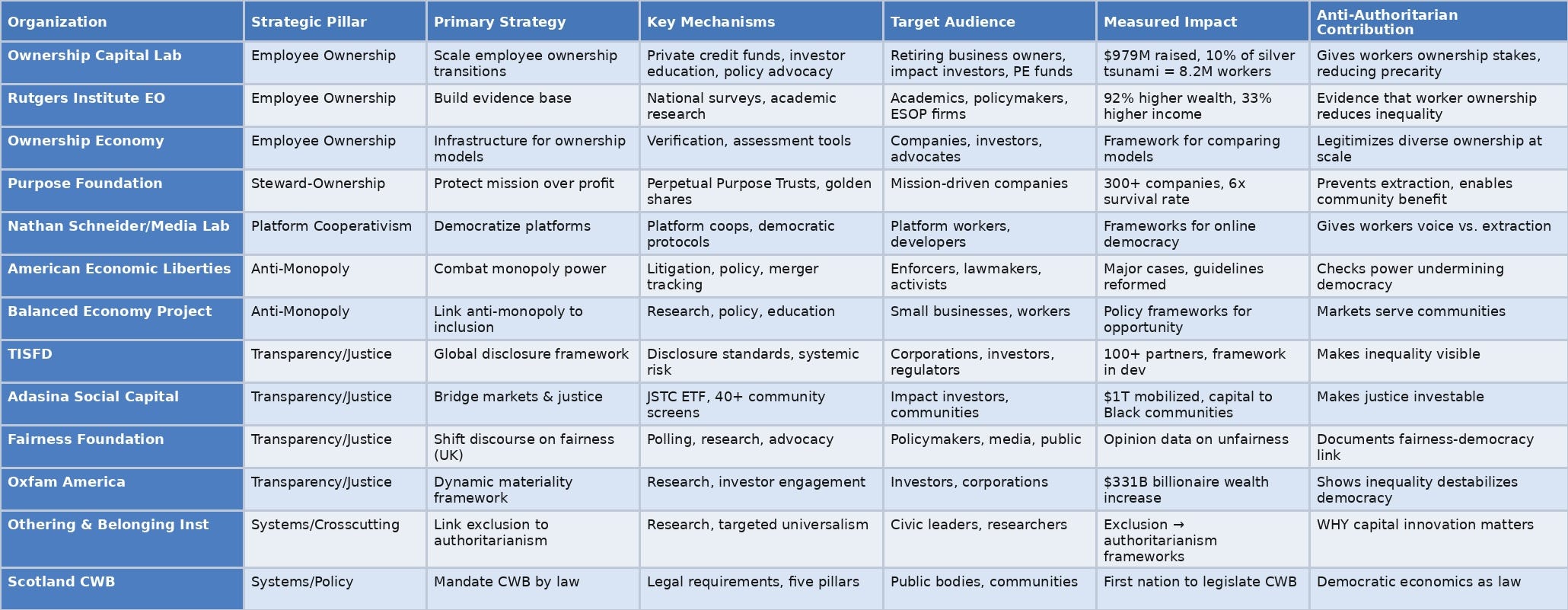
The following table presents each of the above organizations in a comparative framework so the reader can see for herself how they sit, one with the other.
When it comes to providing a coherent response to the forces giving rise to our American authoritarianism, there is no silver bullet, but rather a blast of silver buckshot—with multiple and varied strategies, both existing and in evolution—some of which may be relevant in one context and not another—but all of which are needed tools in the toolkit for anti-authoritarian organizing and action.
The authoritarian temptation is ultimately a symptom of a system that has failed to broadly distribute either its rewards or decision-making power.
When people cannot build wealth no matter how hard they work they often find or feel the platforms they populate are governed by distant shareholders. Furthermore, as consolidating monopolies hollow out local economies and suppress wages, the promise of democracy rings hollow. Authoritarian movements do not manufacture this resentment from nothing—they harvest it from conditions that are real, measurable, and, crucially, changeable. The capital innovations documented in this essay are the tools of that change.
What makes these approaches so powerful—and so politically significant—is where they take root. They do not wait for a savior in Washington or a breakthrough at Davos. They are built in workplaces where employees become co-owners, in neighborhoods where community wealth-building legislation redirects procurement dollars, in families where a worker-owner’s balance sheet looks fundamentally different at retirement than their parents’ did.
This is democracy practiced at the molecular level:
In the ownership structure of a small manufacturer transitioning through an ESOP or in the governance bylaws of a platform cooperative or in the municipal bond portfolio of a city choosing to invest in Black communities rather than extract from them.
This ground-level character is precisely what makes capital innovation a durable defense against authoritarianism rather than a temporary political fix.
Top-down authoritarianism derives its power from centralization—from the concentration of economic control in the hands of a few who then exercise political power to protect it. A possible antidote is not simply a different set of people at the top, but a genuine dispersal of ownership and decision-making power downward and outward.
Steward-ownership, employee equity, platform democracy, and community wealth-building legislation do not merely redistribute income—they redistribute agency.
And people with genuine economic agency are far less susceptible to the promises of strongmen.
The family and community dimensions of this work deserve particular emphasis. Wealth is not only an individual asset—it is the substrate of family stability. It grounds educational opportunity, neighborhood investment, and inter-generational security. The Rutgers research showing employee-owners carry 92% higher median household net worth is not just a financial statistic; it is a description of families who can absorb shocks, invest in their children, and participate in civic life from a position of security rather than precarity.
Communities anchored by worker-owned businesses, democratically governed platforms, and locally circulating capital are communities with the density of relationship and mutual interest that authoritarianism struggles to penetrate.
They have, in the fullest sense, something to protect.
The work ahead is neither small nor simple. Monopoly power is entrenched. Capital markets remain oriented toward extraction. The legal infrastructure for steward-ownership and community wealth-building is still being built jurisdiction by jurisdiction. But the pathways are clear, the organizations are operating, and the models demonstrated.
What the organizations described above collectively represent is a democratic response to democratic crisis—not from the top down, but from the ownership stake up, from the cooperative bylaw out, from the family balance sheet forward.
And this is how democracy ultimately defends itself:
Not by decree, but by being built into the bones of our nation’s economic and social life.
Thanks for reading Antidote to Autocracy! This post is public so feel free to share it.
Author’s Note: While the final writing and analysis are my own, please know I did make use of various AI tools in research and drafts conducted for this project. For a fuller discussion, please see the closing Note in the first post of the Antidote to Autocracy series. Thanks!
No posts
Comments
Nothing yet. Say the first thing.
Sign in to join the conversation.